All posts by David Lublin

Democratic Party Chair Kathleen Matthews Defends New Gender Balance Rules

I am pleased to publish this response to earlier post by Maryland Democratic Party Chair Kathleen Matthews:

I wanted to respond thoughtfully to Ed Kimmel’s Seventh State blog about the Maryland State Democratic Central Committee’s recent decision to adopt new rules to achieve gender balance by popular election on our county and state central committees.

These rules were debated over the past year, to be ready by last week’s filing deadline for the 2018 primary election. The policy was vetted for sex discrimination and other concerns by members of each county’s Democratic Central Committee.  While it was initiated by women in the state party — including Montgomery County’s gender balance member, Jennifer Hosey—it was supported by men and women in a unanimous voice vote at the November 4, 2017 Maryland Democratic Party statewide meeting.

Women have had the vote for nearly 100 years, but we have a long way to go to achieve gender parity in our American politics. Women represent more than half our population, an even greater percentage of voters, and yet they are 20 percent of our Congress, about one-third of our Maryland Legislature, and we have yet to elect a woman President or woman governor of Maryland. At the current rate, we are centuries away from true parity.

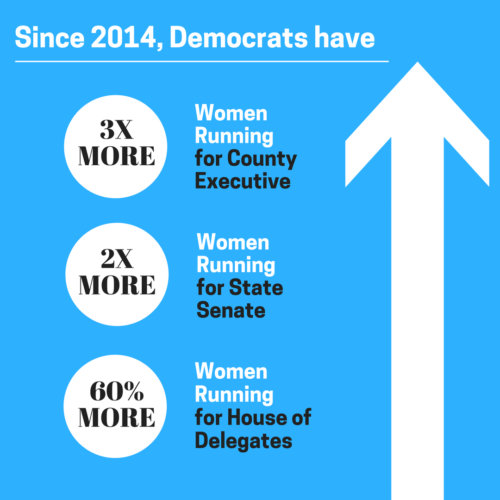
But I’m excited about the progress this year as more women are stepping into the political arena. We just reviewed the candidate filing data on the Democratic side, and compared to 2014, we have three times as many Democratic women running for county executive, double the number of women running for state senate, and a 60 percent increase in the number of women running for House of Delegates. This is the result of women who are saying “Me Too,” especially after the 2016 Presidential election, but also the hard work of our state party and organizations like RepresentWomen and Emerge Maryland, on whose board I am honored to serve.

At a moment in our political life when the old norms are changing, it is appropriate to ensure that women have an equal ELECTORAL chance to be represented in the party’s governing bodies, and this gender balance rule helps move us in that direction.

The changes we adopted have created a uniform process for gender balance across all 24 county and city jurisdictions of the state; they align with the national Democratic Party rules; provide women and men an equal opportunity to gain experience in a grassroots elected position; most importantly, they put power back in the hands of the voters who get to decide who will represent them. This is inherently more democratic and preferable to appointment, and adds greater legitimacy to the party governing bodies who claim to truly represent its members.
For those who care to read on, it’s interesting to note that the history on this issue goes back to women’s suffrage when the 19th Amendment, ratified in 1920, granted women full voting rights.  Soon after, political parties began wooing women in earnest, seeking to double their constituencies. “Fifty-fifty” rules were soon adopted to attract female voters at both the national and state levels.

In the 1930s, the Democratic Party took a more active role in the fight for gender equity. Molly Dewson, the head of the Democratic National Committee’s Women’s Division, argued that gender-balance requirements were the most effective way to increase women’s participation and leadership in political parties. She wisely framed the issue as providing women with opportunities, rather than limiting those of men. (In fact today, when county parties appoint members to achieve gender balance, often it is to add men to their membership.)

Fast forward to today, when the Charter and Bylaws of the Democratic Party of the United States (Article Nine, Section 16) requires all party governing bodies, including state central committees, to be “as equally divided as practicable according to gender” for the purpose of conducting their affairs and selecting delegates for the Party’s quadrennial National Convention. Subsequent court review has found the Democratic Party’s “Equal Division Rule: to be constitutionally sound and an effective way of enhancing the diversity of members and perspectives among Party leadership.

In Maryland, we have had a system to achieve this 50-50 gender equity but it varied widely by jurisdiction. Cecil County adopted gender balance at the ballot for its central committee back in 1920, with Allegany, Carroll, Fredrick, Harford, and Washington Counties following suit. 7 counties, including Montgomery County, passed laws requiring gender balance by appointment after voters made their selection. The remaining counties had provisions in their central committee bylaws requiring gender balance by appointment. As a result, the size of central committees would expand and contract depending on the balancing requirements.

Most concerning, in some counties, members who had been appointed for gender balance did not have full voting rights. This was particularly problematic, we felt, when central committees had the responsibility to fill vacancies in the state legislature.

Many of these concerns have been addressed in our state party’s new gender balance rules, and for Maryland Democrats they are are another step forward in a long journey. Other countries — Norway, Rwanda, for example — have achieved diversity more quickly through gender quotas, but thus far, the American electoral system has resisted this approach, looking for other ways to achieve gender equity. I am proud to be involved with other Marylanders, like Cynthia Terrell at RepresentWomen and Martha McKenna and Diane Fink at Emerge Maryland, who are working hard on structural reforms and practical solutions to bring more women’s voices into our political process. Women’s voices are vital to strengthen the democratic process, represent women’s perspectives on policy, and build collaborative solutions to our nation’s most pressing problems. In the end, I firmly believe this progress towards a more diverse and inclusive Democratic Party is in everyone’s best interest.

Share

Are Republicans Playing Dirty Pool to Unseat Klausmeier?

Max Davidson

Sure looks like it.

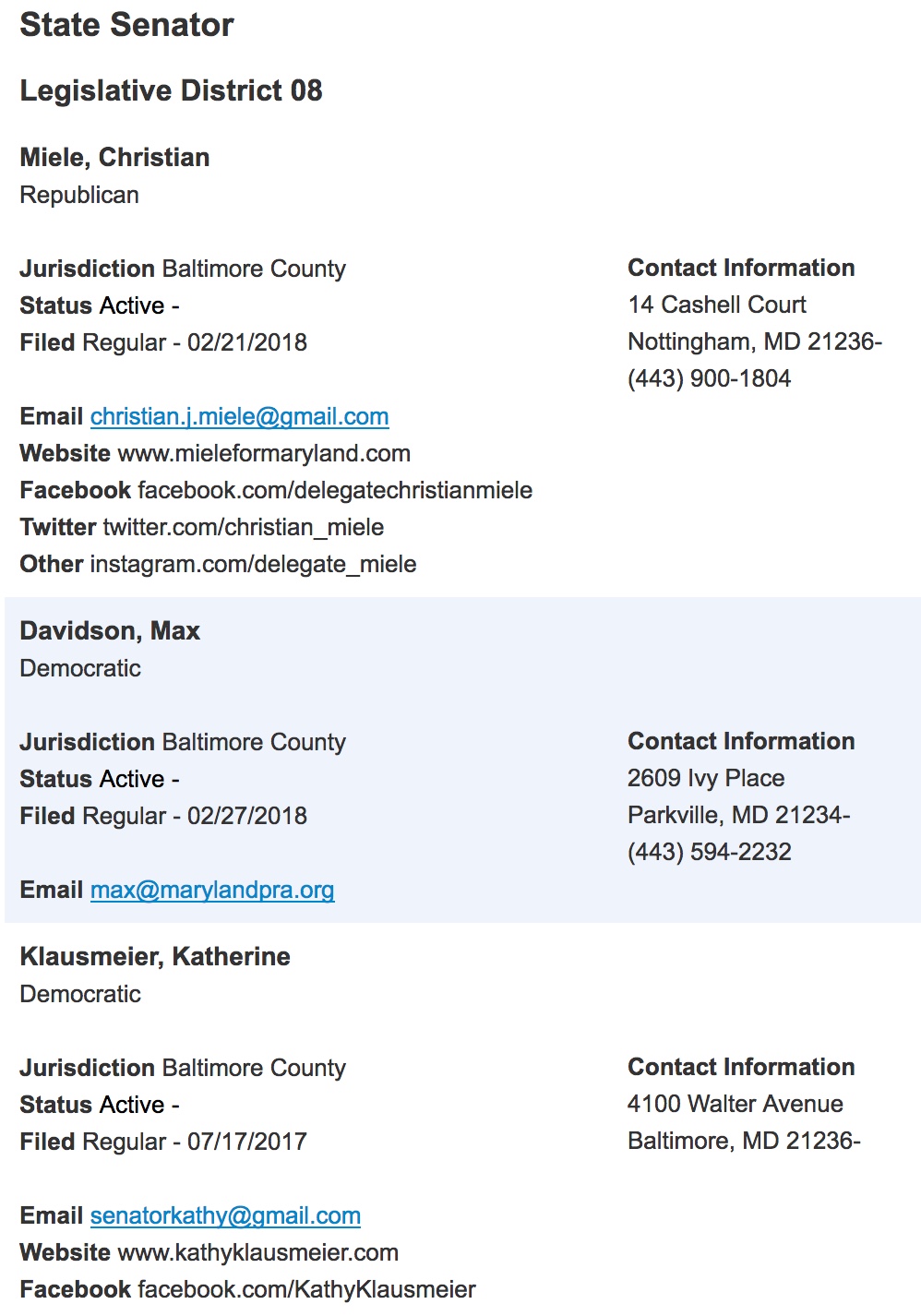
On the day of the filing deadline, Max Davidson launched a primary challenge against four-term Baltimore County Sen. Kathy Klausmeier (D-8). Davidson is head of a pro-medical marijuana lobbying group, the Marijuana Patient Rights Association.

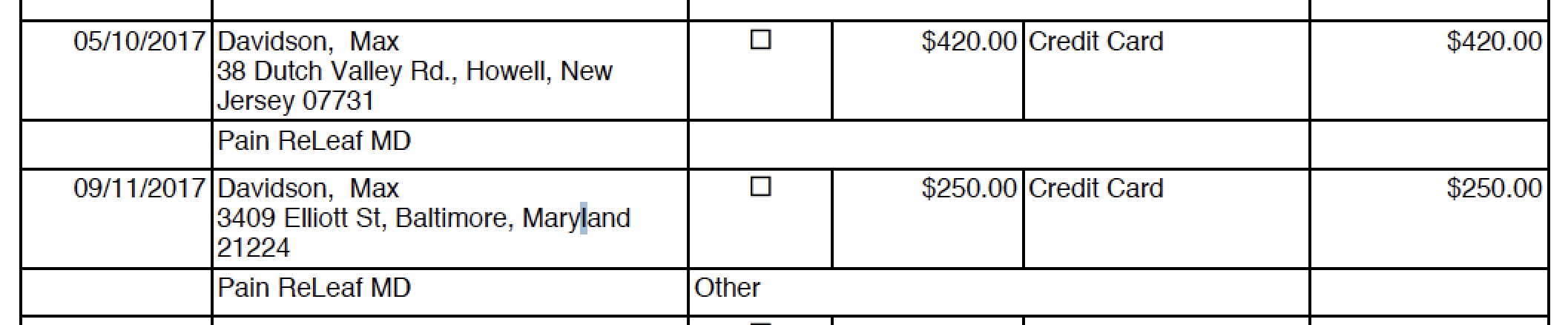
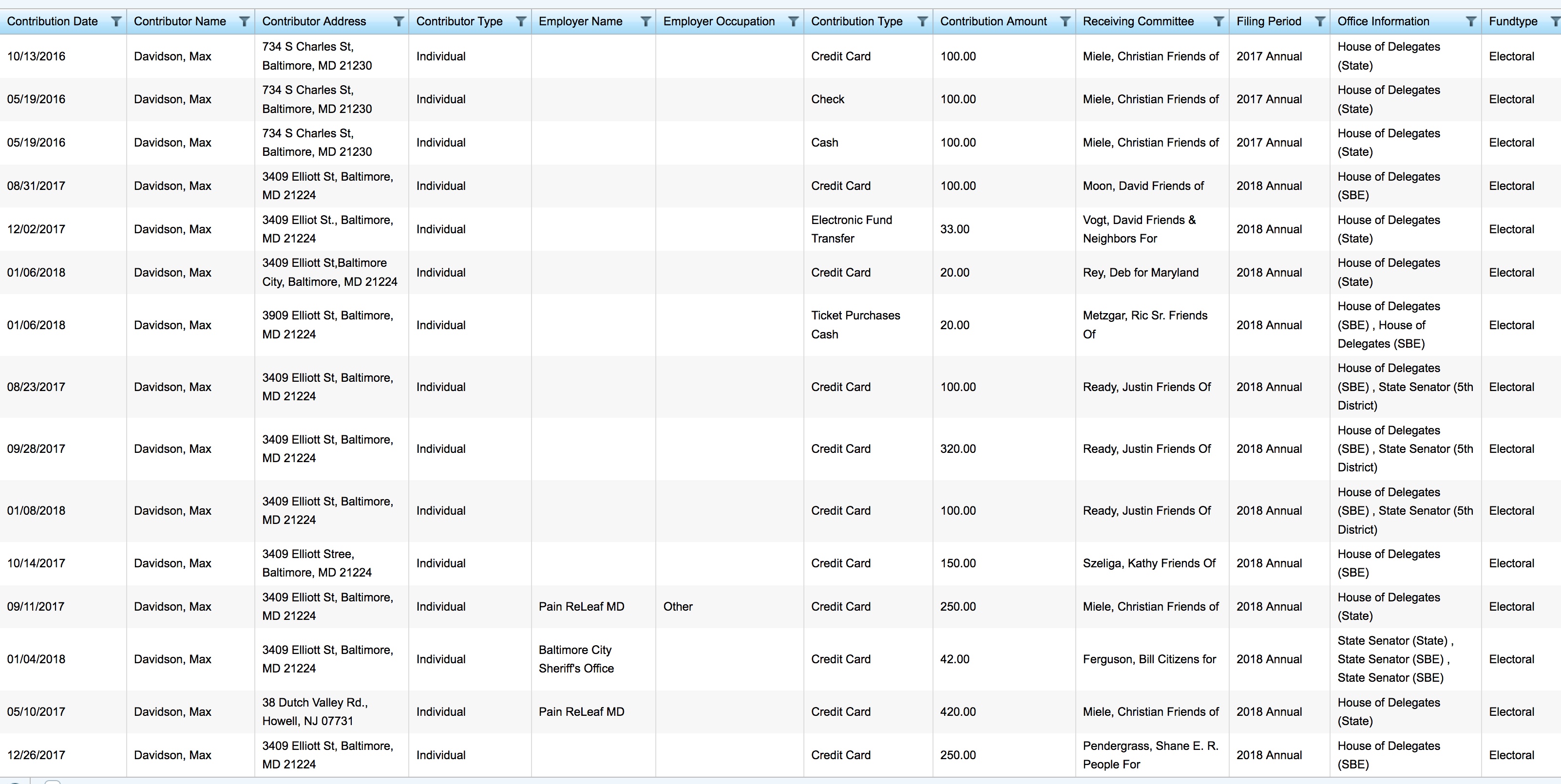
Davidson has donated $970 to Del. Christian Miele, Klausmeier’s struggling opponent, as a look at Miele’s campaign finance reports reveals:

Not exactly the profile of a Democrat who is raring to take on Miele.

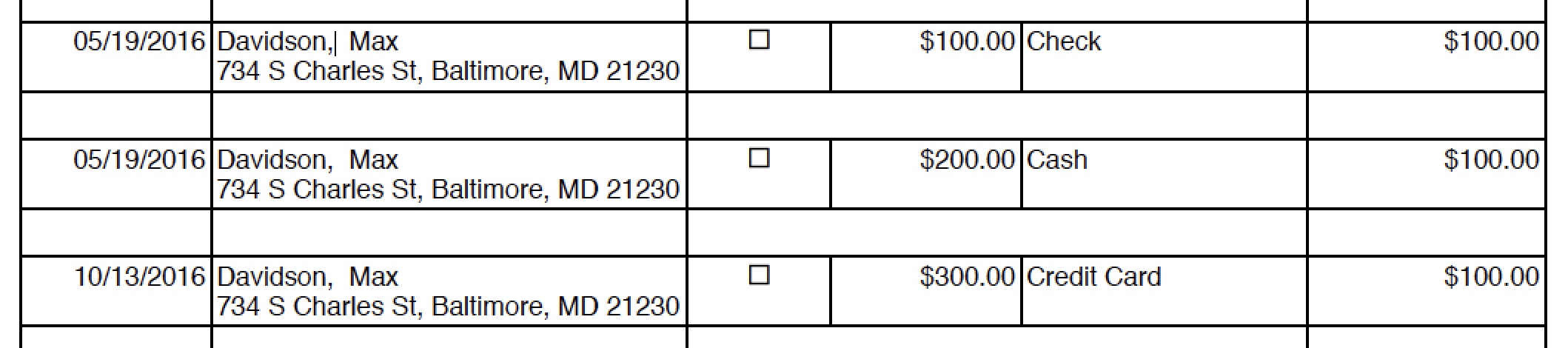
Indeed, Davidson’s donation profile leans heavily Republican. Besides Miele, he also gave $520 to Sen. Justin Ready (R-5), $150 to Del. Kathy Szeliga (R-7), $33 to Del. David Vogt (R-4), $20 to Del. Deb Rey (R-29B), and $20 to Del. Ric Metzger (R-6) for a total of $1713 in donations to Republicans.

In contrast, he gave just $392 to Democrats — $250 to Shane Pendergrass (D-13), $100 to Del. David Moon (D-20), and $42 to Sen. Bill Ferguson (D-46).

Rather than being eager to take on his favorite state legislator, Davidson’s candidacy smacks heavily of a Republican effort to weaken Klausmeier. Davidson presents no real threat to Klausmeier but Miele would sure love if he softened her up a bit and forced her to expend resources in the primary.

The notion that Davidson wants to take on his favorite Republican makes no sense. Did Davidson really not coordinate or discuss with Miele, his favorite Republican, before filing for his seat?

Any voter who was on the fence, or who just doesn’t like these tactics, now has an excellent reason to vote for Klausmeier. You should also remember this one the next time Hogan and the Republicans trot out the usual bromides and claim that they are political reformers.

Share

Krasnow Makes Baseless Sexism Charge Against Frick — And Then Acts Identically

In a radio interview, Del. Bill Frick made hard-charging remarks regarding former Rockville Mayor Rose Krasnow’s competing campaign for county executive.

“I had never heard her name before she announced as a candidate,” Frick, 43, said. “She hadn’t been in public life since the turn of the century. I really had not interacted with her. I’ve been a member of the legislature for 10 years and never encountered her.”

On the same radio show, Bill Frick also said:

“I’ve knocked on a lot of doors in Montgomery County and I’ve never heard someone say whoever’s in charge of the Planning Department should be in charge of the county,” Frick said. “That is not a sentiment I’ve ever heard.”

Krasnow replied by accusing Frick of being dismissive of her campaign and consequently sexist:

In a statement Krasnow sent to Sherwood that was shared with Bethesda Beat, she suggested, “Perhaps Mr. Frick’s dismissive remarks about me are a reflection of his attitude toward women.”

She elaborated during an interview Monday with Bethesda Beat. “I assume his comment about the turn of the century was trying to make me look old,” added Krasnow, 66. “I was in office until the end of ’01. It means I wasn’t an elected official yesterday, that’s definitely true … .”

Even if one believes that it’s okay for Krasnow to refer frequently to her service as Rockville’s mayor and not for Frick to point out it was some years ago, making her look old would be ageism, not sexism. Ironically, after accusing Frick of sexism, Krasnow then engaged in the exact same dismissive behavior and topped it off with a false claim:

“I, like many other people, had not heard of Bill Frick until I got into this race,” Krasnow said of Frick, who has served as the delegate from Bethesda-based District 16 since first being selected by the county’s Democratic Central Committee to replace Marilyn Goldwater in 2007. Last year, he was appointed House majority leader.

She noted she learned more about him from a 2007 blog post titled Who The Frick is Bill. “So I wouldn’t start talking about name recognition. I believe mine is much higher than his,” she said. “He has represented a fairly small district in Bethesda while I represented the entire city of Rockville.”

Frick is one of three delegates who represent District 16, which encompasses an area with a population of about 120,000 residents, while Rockville’s population is about 62,000.

While I am sure Adam Pagnucco Kevin Gillogly is flattered by the reference to his blog post, behaving as if there is one rule for male candidates and another for female candidates is the very definition of sexism. On Monday, Frick responded by describing Krasnow’s allegation as “ridiculous and baseless.”

“I think that’s out of line,” Frick said. “I’ve been a feminist since I was old enough to pronounce the word. I have a 100 percent voting record and have been a strong leader on women’s issues.”

Krasnow could have taken other more effective approaches in her response to Frick. For example, she could have instead pointed out that she is the only candidate with senior executive experience in the public sector – not just as mayor but at the Planning Board – and thus turned the biased idea that men are better executives on its head without even mentioning gender.

She also could have just stuck with the calm, thoughtful claim that voters don’t really know any of the candidates well and she hoped that voters had the opportunities to learn about her through the campaign. She started off with that approach – one that would have made her look experienced and judicious – but then shifted to the weak-beer sexism allegation.

As has been rightly discussed much of late, sexism is alive and well with the spotlight revealing male employers using their positions to behave inappropriately, unprofessionally, and worse towards their female employees. Unfortunately, Krasnow’s accusation attracts attention for the wrong reasons.

Share

Elrich, Krasnow & Leventhal Mix It Up on Racial Equity & Purple Line

The recent county executive debate was fascinating if only for the incoherence brought to it regarding the Purple Line:

Rose Krasnow, deputy director of the county’s planning department and former Democratic Rockville mayor, said the Purple Line “will have wonderful benefits for people along its length. It will raise property values, but it will spur development,” she said. . . .

After Elrich expressed his concern about gentrification that could follow the path of the Purple Line, Leventhal spoke about the benefits the line would bring immigrant workers.

“We should stop frightening people about it, as Mr. Elrich has repeatedly done,” Leventhal said.

“I never said the word ‘destroy’ about the Purple Line,” Elrich responded, noting that his opposition to some of the plans resulted in changes that will preserve hundreds of affordable housing units.

Purple Line advocates have long argued that it will spur new development around Purple Line stations. Indeed, although Metro stops have not resulted in urban nodes similar to Bethesda or Silver Spring near any station in Prince George’s, proponents have faith that the slower moving light-rail Purple Line will nevertheless make it happen.

If they’re correct, the Purple Line will, as Rose Krasnow points out, result in more development and higher property taxes. More generally, if land near Purple Line stations becomes more desirable, its value will increase and so will taxes on it. Generating more tax revenue was a major rationale for the Purple Line.

If a place becomes more desirable and tax rates increase, the cost of renting or buying housing near Purple Line stops will rise and some current residents will find it harder to afford housing. Developers and landlords obviously prefer higher rents — and the Purple Line’s goal is to stimulate investments that will allow them to charge more.

As a result, current residents will gradually be forced out. It can occur when a property is wholly redeveloped so that higher prices can be charged. Alternatively, greater demand will allow landlords to raise rents and sellers to charge more. People who worked hard to buy homes there will gain.

This is not a side effect of the Purple Line. It is the intent of the Purple Line. Indeed, the more successful the Purple Line is achieving economic development, the more it will occur. Notwithstanding all of the social justice blandishments, there is only so much counties can do to stop it.

Nor do they want to do so because they want the tax revenue and it’s the nature of the market. When areas become more desirable, prices rise. This is not meant as an attack on people who leave as abandoning the neighborhood or on people who move in as insensitive gentrification agents. It is simply how the market works.

George Leventhal says “We should stop frightening people about it.” But, as the debate highlighted, change will occur. To the extent that the Purple Line is a transportation boon, and billions are going to be  invested towards that end, it will raise prices and drive current residents out, as it has in Bethesda and increasingly in Silver Spring.

There are a variety of policies one can do to increase the availability of affordable housing more generally. But the Purple Line is not one of them. Marc Elrich, an advocate of the Purple Line and more aggressive efforts to preserve affordable housing near Purple Line stops, explained his view in more detail in a blast email yesterday:

To zero in on an important case that came up at the forum, county officials have too often proposed zoning changes that would displace low-income communities of color. In 2012 and 2013, a Long Branch sector plan that included the upzoning of a very large swath of existing affordable multi-family housing – housing occupied largely by Long Branch’s low-income immigrant community – was brought before the County Council. The plan’s architects intended to tie construction of the Purple Line to new, much more expensive housing developments that would replace the existing affordable housing in that area. Even if 15% of the new units were “MPDUs” (moderately priced dwelling units), which was the best-case scenario, there would have been fewer total affordable housing units available in Long Branch if this plan had been implemented – in other words, less available lower-priced housing for people who need it.

Many of the families living in the existing affordable multi-family homes would not have qualified to live in MPDUs. Some had more family members than most MPDUs would have been able to hold (the proposed plan did not require developers to provide family-sized units). Some families had incomes too low or credit histories too short to qualify. For others, legal status would have been their chief barrier. In addition, the county did not have the resources to provide long-term rental assistance on the scale that would have been required in Long Branch.

In other words, under the Planning Board’s proposal, the current low-income immigrants in Long Branch would have been forced to relocate elsewhere. Since the existing buildings weren’t even an impediment to building the Purple Line, the Planning Board’s recommendations were particularly ill-advised.

When I met with planning staff and their director at the Long Branch shopping center, I told them – forcefully – that their plan was unacceptable.

I am happy to note that, within a week of my meeting, the proposal to rezone the particular properties I had questioned was withdrawn. I was also able to get results when the same process unfolded in two more sector plans and a proposal from the Planning Board to do a mini master plan. But these plans should never have been proposed in the first place. I am convinced they never would have been if we had a racial equity lens in place and were required to show the impacts such plans would have had on the surrounding communities of color.

I’ve been the consistent voice on the County Council speaking out on these issues because I know what the consequences will be if we fail to preserve our existing affordable housing. And as your next County Executive, I would like to make the consideration of racial equity the expectation in all of our policymaking, rather than the exception to the rule.

Put another way, the question is essentially how much power is  county government willing to exercise over developers both in terms of what they can do and what they have to pay. However, it’s also a question of how much tax revenue the county is willing to sacrifice. Happy talk is not the same as action or making the best of not-so-easy choices.

Share

Is Vignarajah Eligible? She Finally Filed and Has a Running Mate, So We’re About to Find Out

Krish Vignarajah at Sunday’s Debate (Photo: Ed Kimmel)

Krish Vignarajah filed the papers to run for governor with only hours to spare. The Baltimore Sun reported earlier today that she is running with Sharon Blake, the former president of the Baltimore Teachers Union, in “the first ever all-women of color ticket.” Though now public knowledge, I cannot seem to find any mention – or nice photo of the ticket to put above this post – on Vignarajah’s website, Twitter, or Facebook.

Vignarajah has made a positive impression at gubernatorial debates and forums based on before and after straw polls, as her Twitter feed understandably reports. My own impression is that she is clearly very sharp and got off the best line at Sunday’s debate, but I would like to see evidence of more in-depth knowledge of state public policy.

Nevertheless, Vignarajah may have had trouble attracting a running mate due to serious questions about whether she is qualified for the ballot. The Maryland Constitution requires that gubernatorial candidates have resided and been registered to vote in Maryland for five years.

Vignarajah has a real problem here, as Bethesda Beat first reported:

Vignarajah, 37, an attorney, first registered to vote in Maryland in 2006 at an address in Catonsville. However, she didn’t vote in the state until the 2016 general election. . .

While her Maryland registration remained active, she registered to vote in D.C. on Sept. 14, 2010, then voted in the city’s primary the same day, according to her D.C. voting history, also obtained by Bethesda Beat.

She listed her address at the time at an apartment building at 1701 16th St. NW in the District.

Her D.C. voting record shows that she also voted in the April 26, 2011, special election, as well as the 2012 and 2014 general elections in the city.

Though she was never purged from being registered in Maryland, Viganarajah was registered and voted in the District in 2014. Two years later, she voted in Maryland for the general but skipped the primary.

This issue has plagued Vignarajah’s campaign from the start, punctuated by her disastrous exchange with Tom Sherwood on “The Maryland Politics Hour” (starts at 4:25) in which her only explanation for why she registered and voted in DC if she was a Maryland resident was convenience, and she also refused to say if she paid income taxes in Maryland.

Vignarajah referred to her D.C. apartment as a “crash pad” and said she “did not live there” after Kojo Nnamdi described the building as “the coolest” in the city, raising the obvious question of how she registered to vote in D.C. if she didn’t have a D.C. residence.

Despite asserting that “I am absolutely eligible to run” and that she made legally certain of it before entering the race, Vignarajah filed a lawsuit demanding that the State Board of Elections confirm her eligibility. Attorney General Brian Frosh opposed the suit. Since she had not yet filed, the issue was not really ripe for consideration – courts don’t do hypotheticals – and she then withdrew the suit.

I imagine some potential running mates would be put off by the excellent prospect of being thrown off the ballot with Viganrajah, thus turning a long shot at the number two slot into the latest joke and a very short campaign.

I imagine we will find out shortly.

Note: As we have pointed out previously, Adam Pagnucco and I are both supporters of Rich Madaleno’s campaign. Nevertheless, as is always the case, our posts remain our own.

Share

Bananacakes or Not? Cooper Says No, 7S Says Oh Yeah.

Jordan Cooper response to Adam Pagnucco on “Bananacakes or Not?”:

In a recent Seventh State post on February 26th the following is written: “And so we have something extremely rare in MoCo politics: a candidate who drafts a questionnaire for other candidates with an endorsement on the line.” I’d like to correct the record with examples to the contrary:

Serving as a member of the Maryland General Assembly is considered to be a part-time job. State delegates and senators frequently have other means of employment concurrent with their service in elected office. Indeed even members of the Montgomery County Council, which is considered by many to be a full-time legislative body, have additional part-time positions. Just as many members of the legislature and many candidates for elected office have other jobs, so too do I as the host Public Interest Podcast. It is entirely within the realm of accepted practice for candidates and elected officials to be involved with political organizations and for those organizations to issue endorsement questionnaires.

I’d like to add that Public Interest Podcast is a non-partisan entity and, much like The Washington Post, The Baltimore Sun, and other periodicals, issuing endorsements in no way diminishes the non-partisan nature of the endorsing organization. Endorsements will be issued by Public Interest Podcast based solely upon candidate responses to the questionnaire regardless of party affiliation and regardless of whether those candidates’ views are aligned with my own political views.

Seventh State Disagrees.

Adam: I am not defending those other organizations. But there is a difference here: they involve more than one person and can establish recusal procedures. You ARE Public Interest Podcast. There is nothing else there other than you recording interviews with people.

David: I called out Progressive Neighbors four years ago for having a ridiculous number of candidates on their board. Dana Beyer even sent a questionnaire to her opponent. I believe that they’ve fixed the problem and have no candidates on their current Steering Committee. Adam is also correct that PIP is you of course.

Jordan’s Response:

I hadn’t thought of a recusal process before. I could very well have someone else go through the endorsement responses and give them metrics for endorsement, say 7 of 9 questions have a Yes. That would be very fair wouldn’t it? In any case I can assure you that Republicans with whom I disagree personally on many issues will receive a Public Interest Podcast endorsement. I just don’t see a conflict of interest here. Perhaps we’ll have to agree to disagree on this. I did ask quite a few people before I sent out the questionnaire if they thought it was ethical or would present any problems and they told me that as long as I keep the campaign separate from the podcast there’s no reason why I shouldn’t use this opportunity to get candidates speaking about some of the issues I raised that no one else is talking about.

Final Thoughts

David: People frequently misunderstand that someone who recuses themselves from a process does not participate in it. Someone who designs a process for rating other candidates has not recused himself. I don’t see how one can keep the campaign separate from the podcast.


Share

Hucker Gets a Challenger

It looked for a bit that Tom Hucker (D-5), who only narrowly prevailed over Evan Glass in the open primary four years ago, was going to have an easy ride in his reelection bid. Not so. Kevin Harris has jumped into the race.

Harris and Hucker look likely to clash over development and the Route 29 BRT proposal. My impression is that normal primary divisions are a bit scrambled, as Harris is against the Route 29 BRT and wants to rein in developer influence.

Hucker’s decision to stay out of the public financing system while taking sizable contributions from development interests has already attracted attention in Bethesda Beat. Harris has chosen to stay in the public financing system.

If campaign finance resonates as an issue anywhere, you’d think it might be in this very progressive district. As the incumbent who has been in politics for years, Hucker starts out as a natural favorite but no longer has a cakewalk to a second Council term.

Kevin Harris Announcement by David Lublin on Scribd

Share

Gubernatorial Debate Moments

I live tweeted last night’s debate in Takoma Park. This post highlights moments that stood out in my mind. During the fast-paced debate, I did my best to capture what candidates actually said, either as quote or a paraphrase, along with provide analysis along with many typos. Rushern Baker skipped the debate.

Alec Ross Goes Extreme on Immigration

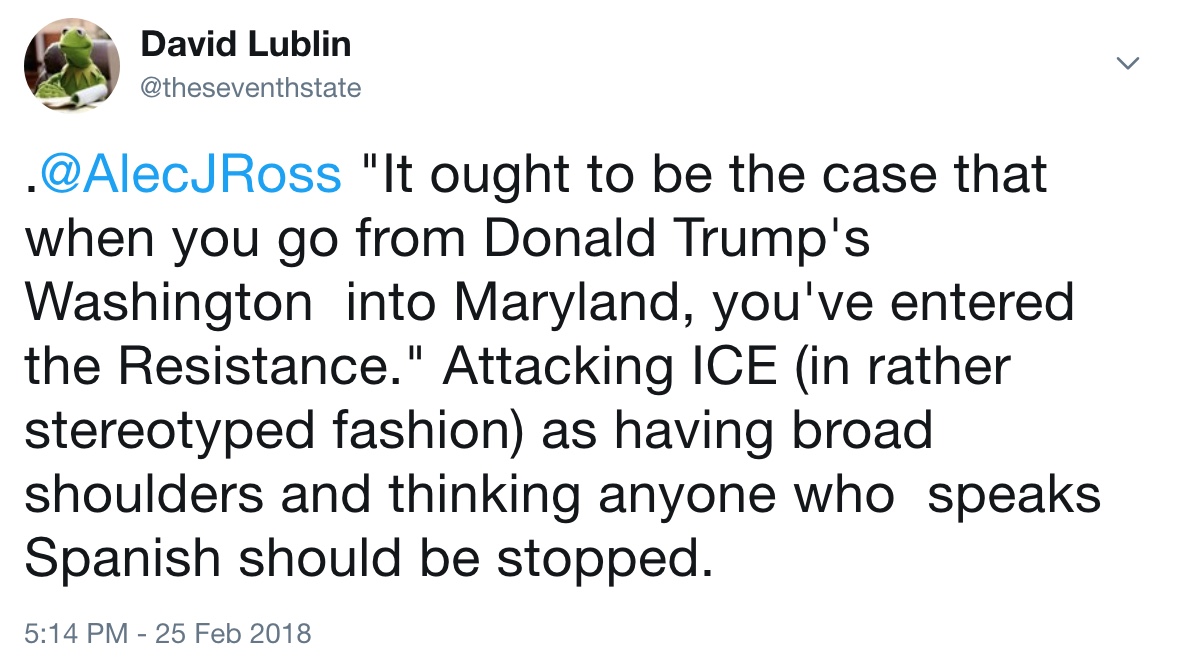
A theme for Alec Ross was his effort to stand out as a different kind of candidate, unafraid to criticize Democrats for being insufficiently progressive. He pejoratively stereotyped ICE workers and called for sending out state troopers to fight them if needed to that end:

Ben Jealous Over Credit Claims?

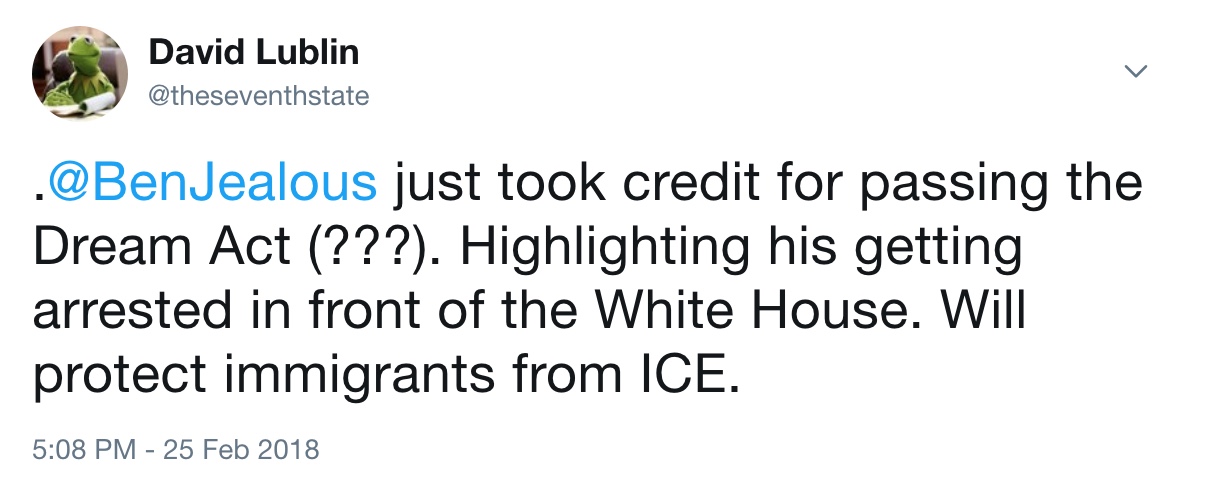
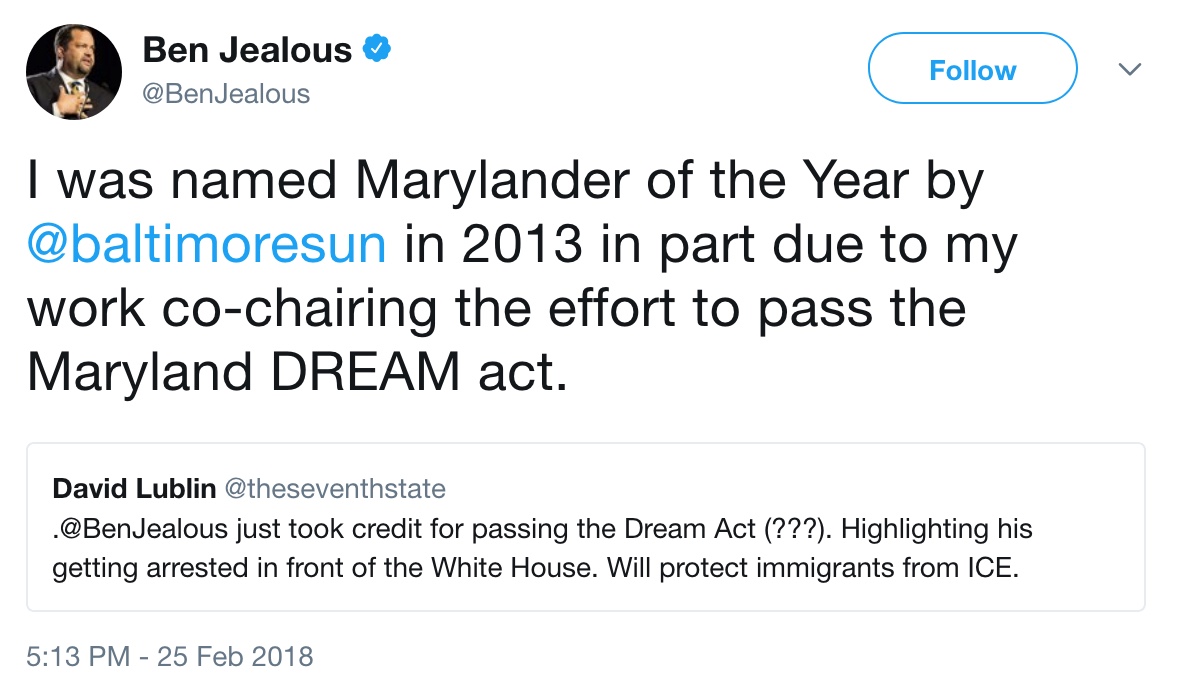
Ben Jealous and I had an exchange on Twitter during the debate regarding his taking credit for the MD DREAM Act’s passage that paralleled Adam Pagnucco’s past critique:

Jealous’s followers certainly agreed with him on Twitter.

Jealous on Corruption and the NRA

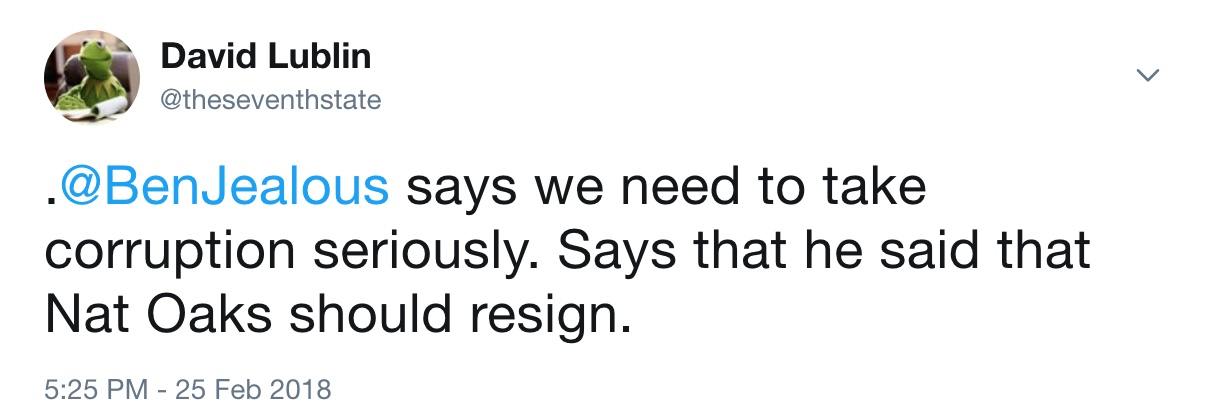
Jealous also stood out for his attack on corruption and call for Baltimore Democrat Sen. Nat Oaks to resign:

He also attacked taking NRA money–very popular based on the retweets:

The problem with Jealous’s severe attacks on any Democrat who takes money from the NRA is that he co-chaired Bernie Sanders presidential campaign. The current anti-gun moment is not ideal for Sanders, who originally won election to Congress with heavy NRA support. While Sanders is no longer the pal of the NRA, he has a past of opposing the Brady Bill and many other pro-gun votes. Awkward.

Said and Unsaid by Krish Vignarajah

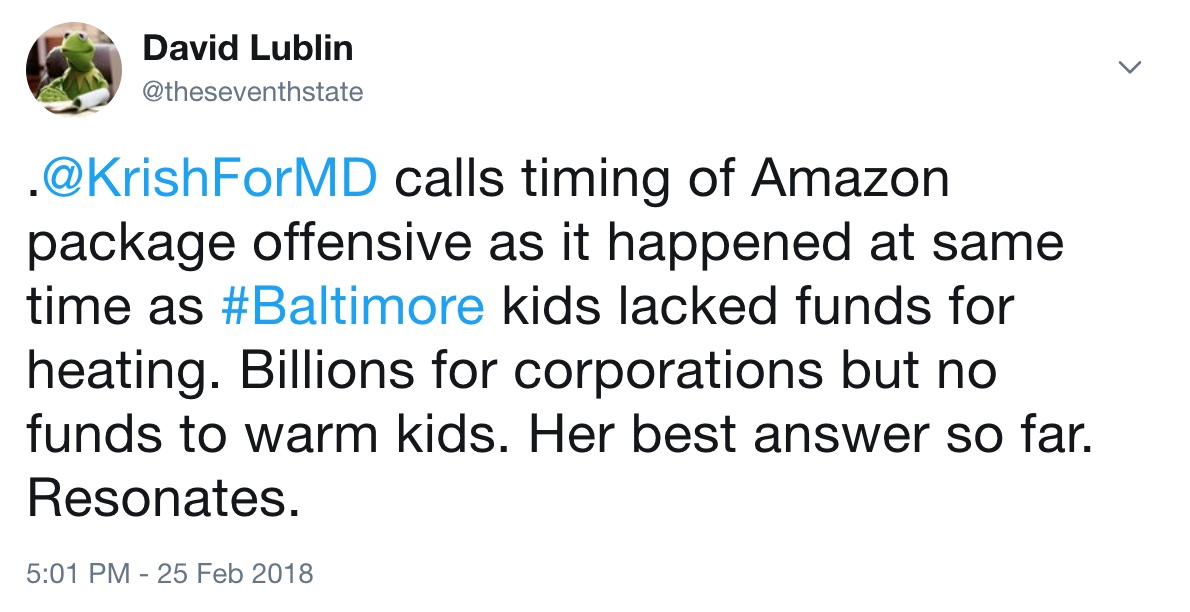
Krish Vignarajah is razor sharp and may have been the smartest person on the stage. She had one of the best moments of the debate with her linkage of Hogan’s Amazon package and the lack of funds to heat Baltimore schools.


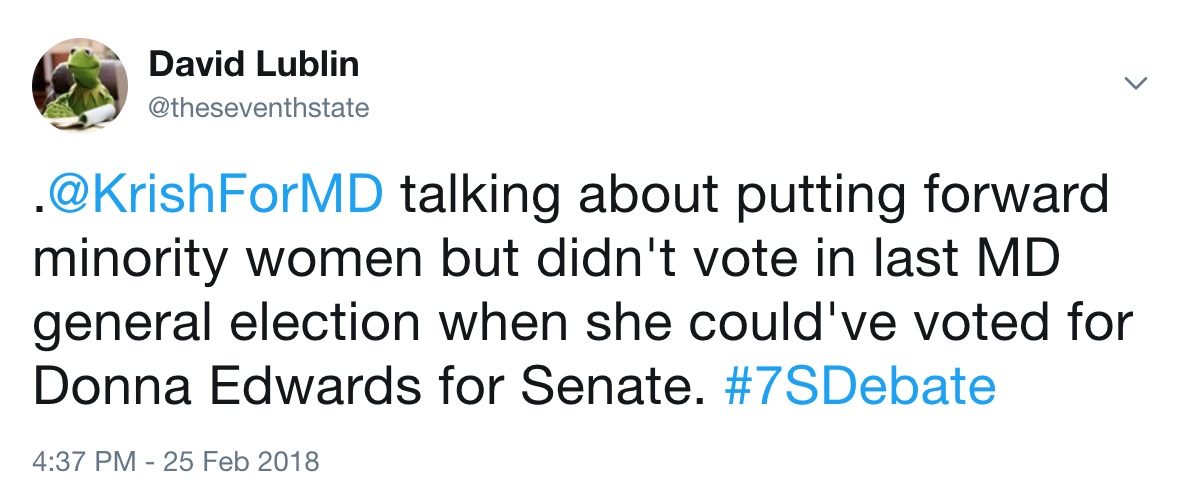
Sometimes, however, what she left unsaid seemed as loud as the points she was making:
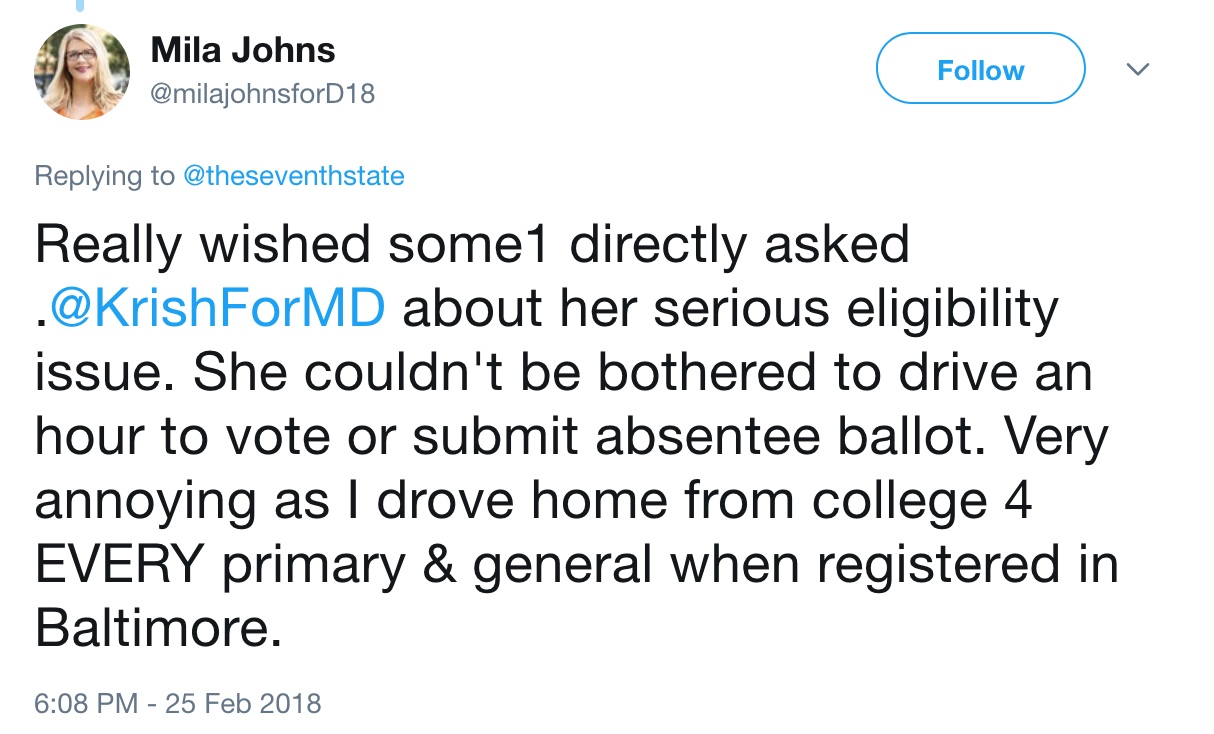
Of course, the doofus who wrote the tweet should have said primary instead of general election. However, District 18 Delegate Candidate Mila Johns was even sharper:

Vignaranjah still has not filed.

Rich Madaleno Relentless on Republicans

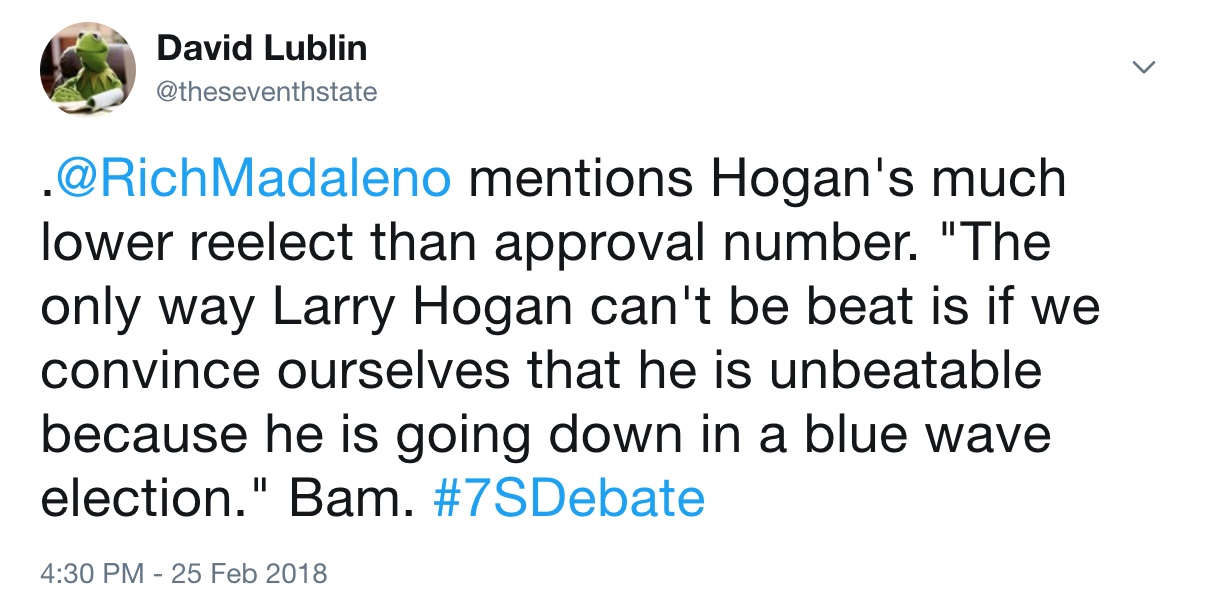
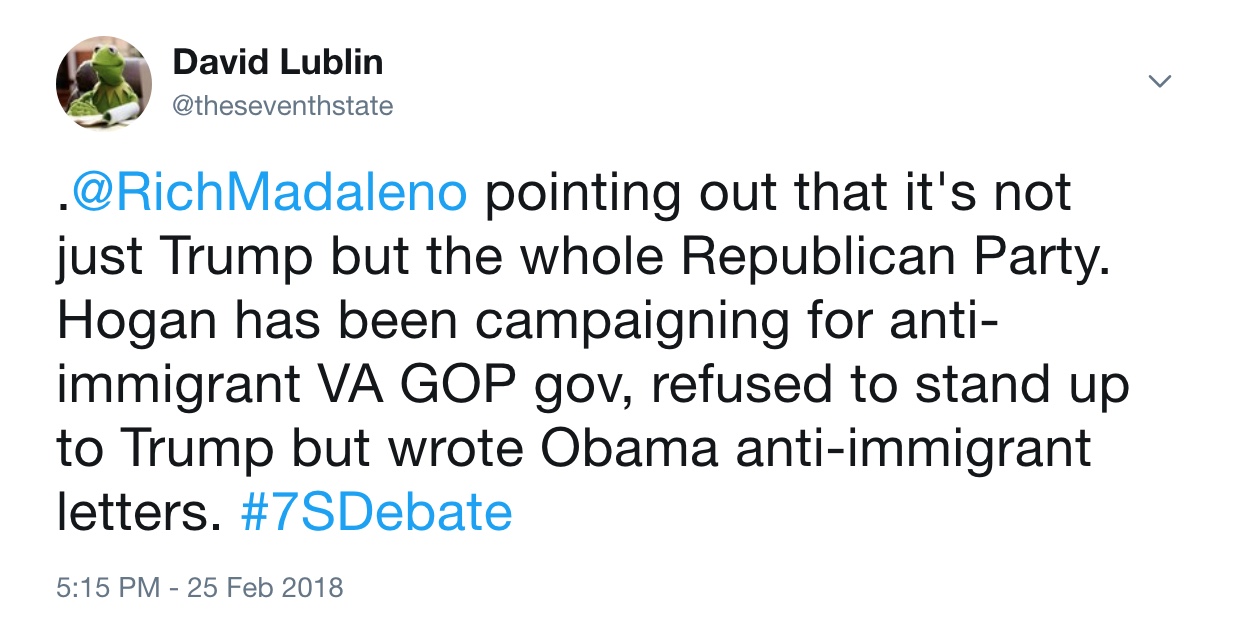
Unsurprisingly, all of the candidates weren’t keen on Hogan or Trump. Rich Madaleno’s remarks still stood out.

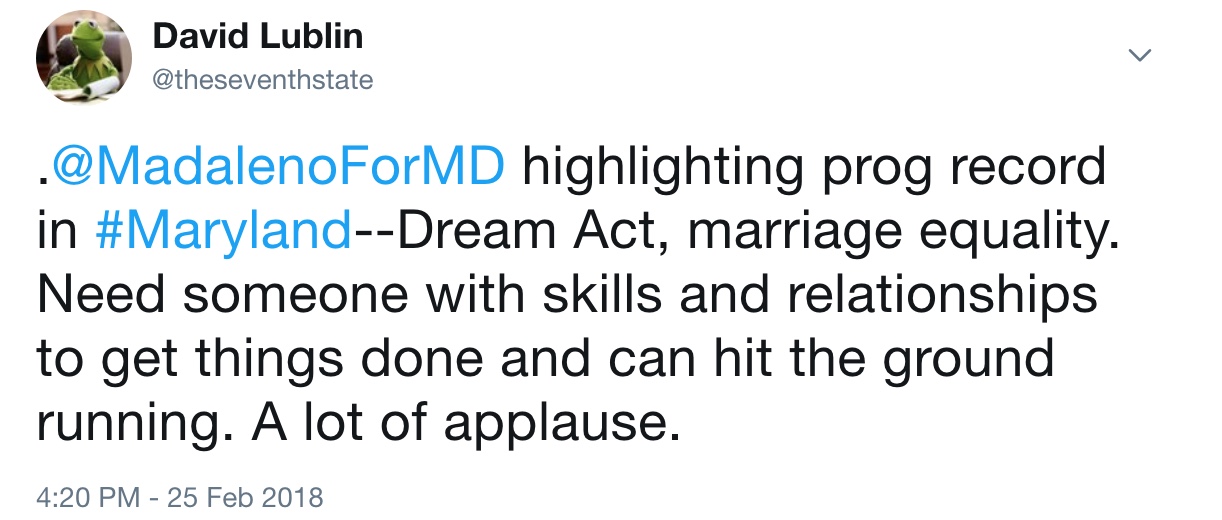
Along with Kevin Kamenetz, Madaleno made the tough sell in anti-establishment times that we need someone with experience. He contended that he and his running mate, Luwanda Jenkins, had made change and had the experience to do so as governor:

Kevin Kamenetz and Jim Shea

These two guys didn’t have moments. By all rights, Baltimore County Executive Kevin Kamenetz should be a top contender. He is county executive of a swing county, clearly more knowledgeable than many of his rivals on a lot of issues due to having grappled with them in office, and does his best to link them to personal stories from his own life or time as county exec.

Yet, Kamenetz is simply not a natural debater and seems a bit awkward on the stage despite clearly having worked on honing his pitch. He was at his best when challenged due to his sureness and utter willingness to fight back. But it just didn’t feel like his moment as he didn’t connect with his audience.

Jim Shea seems earnest, well-meaning, smart and steeped in the community. He has been involved in a litany of efforts to improve Baltimore and Maryland for years. He was seated next to Vignarajah and the contrast could not have been greater. He’s an an unexciting and unmemorable speaker who had all of the specific, deep knowledge of Maryland she lacked. They should consider teaming up.

Share