All posts by David Lublin

Correction on Earlier Ben Jealous Post

4/26 UPDATE TO THE UPDATE: Ben Jealous blasted me in a blog post today. Some are for the mistakes outlined below that I apologized for and corrected two days ago. Jealous now also explains that he lived in California when he wasn’t voting (but apparently wasn’t purged) in D.C. in 2006 and 2008. You can read my response here. I’ve left this post unchanged at this point so that you can better assess his claims and mine.

UPDATE: Some of the information in the original version of the previous post wasn’t right. I’ve corrected the table as well as the text, so you can see the difference.

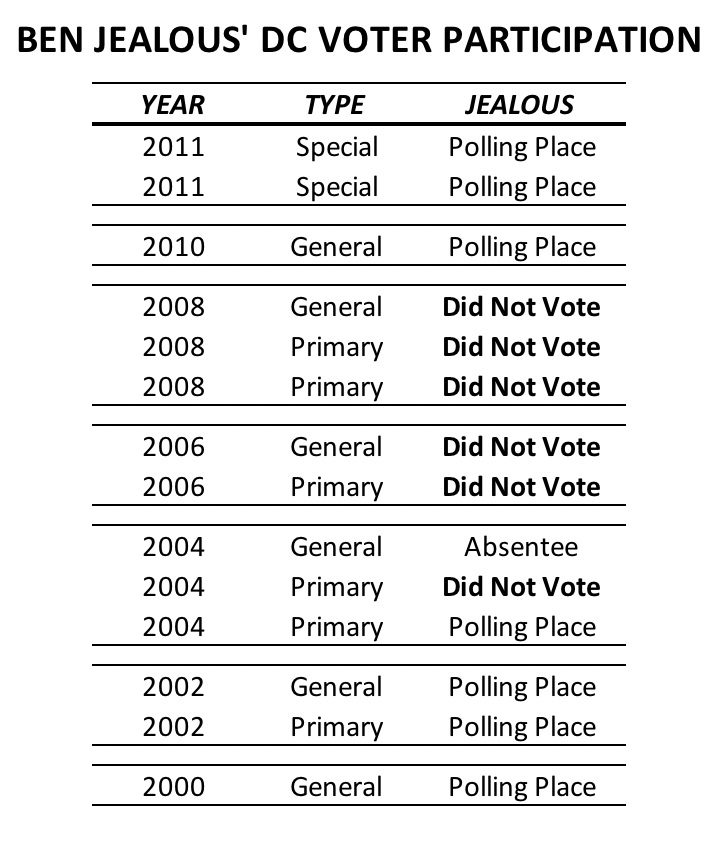
The source of the error is that Ben Jealous did not miss the 2012 and 2014 elections in DC, as he was registered in Maryland, though the DC database records him as not having voted because he had not yet been purged because of the change of address. I discovered the error myself after rereading the post.

My apologies not just to Ben Jealous but to readers for the errors.

Several key facts, however, remain unchanged. Ben Jealous did not register as a Democrat prior to his move to Maryland. He did not vote in a high share of elections, including the previous gubernatorial primary and the historic 2008 presidential election.

Share

Ben Jealous’ Surprising Voter History

UPDATE TO THE UPDATE (4/26): Ben Jealous blasted me in a blog post today. Some are for the mistakes outlined below that I apologized for and corrected two days ago. Jealous now also explains that he lived in California when he wasn’t voting (but apparently wasn’t purged) in D.C. in 2006 and 2008. You can read my response here. I’ve left this post unchanged at this point so that you can better assess his claims and mine.

UPDATE (4/24): Some of the information in the original version of this post wasn’t right. I’ve corrected the table above as well as the text below, so you can see the difference. (The source of the error is that I counted the elections before he was purged in DC as having been missed, when Jealous had registered in Maryland.) My apologies not just to Ben Jealous but to readers for the errors.

Yesterday, I looked at the voting records of all Democratic gubernatorial candidates. Ben Jealous has been registered to vote in Maryland only since 2012 and I speculated that either he had been voting elsewhere or not at all.

Turns out that Jealous was registered in DC from 2000 through 2010 (he wasn’t purged from the DC rolls until after the 2014 elections) – far longer than he has been registered in Maryland.

Recent Democrat

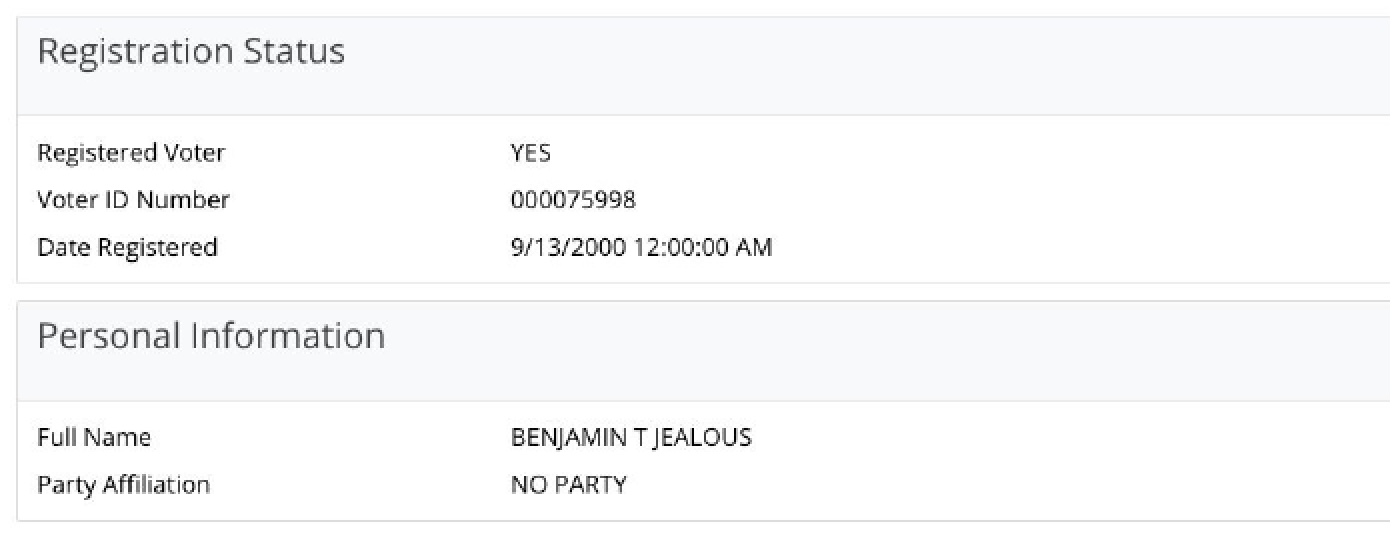
Jealous became a Democrat only recently. He was registered in DC as an unaffiliated voter:

This choice stands out because, as in Montgomery and Prince George’s Counties, the closed Democratic primary is the key election in most cases. His decision to register as an independent means that, for example, he could not vote in the 2008 presidential primary between Hillary Clinton and Barack Obama. Jealous also did not have the opportunity to weigh in on heated contests for mayor and other local offices.

Lackadaisical Voter

For someone who is asking people to vote for him, Jealous missed a lot of elections. When he was registered in DC, Jealous skipped 6 of 14 elections in which he was eligible to vote. (Primaries in which the DC Board of Elections and Ethics says he was ineligible are excluded. There must have been nonpartisan offices or questions on the primary elections listed here.)

As reported yesterday, he also missed two of the six elections while registered in Maryland, so he has voted in 12 of 20 elections since 2000.

Missed Historic Votes

Among the 43% 56% of DC elections that Jealous skipped were some important contests. He didn’t vote in the historic election of Barack Obama as our first African-American president, probably unusual in a former NAACP President! He also did not vote in 2012, when he was reelected even more handily. (Folks, this is incorrect, he voted in that election in Maryland).

Jealous also missed out on the vote on to legalize marijuana in 2014.

At the local level, the 2013 special election to fill a Council vacancy, the DC equivalent of our state legislature, was an exciting contest and far from a foregone conclusion. (Also wrong, he voted in Maryland that year, as my chart from yesterday shows.)

Finally, as mentioned yesterday, he has never voted in a Maryland gubernatorial primary. The first Democratic primary vote he casts for governor will be for himself.

Share

Who Voted – and who Didn’t – in Maryland?

The participation of the seven Democratic gubernatorial candidates in Maryland elections varies widely. The table at the top of the post reveals not just whether but also how each voted since 1994, a period that includes 12 primary and general elections apiece with the number also evenly split between presidential and gubernatorial election years.

Rushern Baker, Kevin Kamenetz and Rich Madaleno

The three officials who currently hold elective office – Rushern Baker, Kevin Kamenetz and Rich Madaleno – have voted in every one of the 24 elections.

Krish Vignarajah

Despite registering to vote in Maryland in 2006, Krish Vignarajah has voted just once in Maryland. In 2016, she voted in the general after skipping the primary. She registered to vote in D.C. in 2010 and participated in four elections there from 2010 through 2014.

In order to remain eligible to run for governor, Vignarajah claims incredibly that she remained a legally registered voter in Maryland. Even as she cast ballots elsewhere and claimed a D.C. address on her voter registration application, she was never purged from the rolls in Maryland.

This presents a series of real problems for Vignarajah. To put it bluntly, if she really lived in Maryland all the time and her D.C. apartment was just a “crash pad” as she now says, why did she fraudulently claim that she lived in D.C. on her 2010 voter application? Alternatively, if she was honest on her application, how can she claim that she has always maintained her Maryland residency?

Additionally, if she was always a Maryland resident, why didn’t she just vote here? She says voting in D.C. was just a matter of convenience because she was so busy at her job working for Michelle Obama. But many other busy people manage to apply for absentee ballots and they’re not all Marshall Scholars who made law review at Yale. Why couldn’t she do the same? It doesn’t exactly exude commitment to the State.

Moreover, how can one be legally registered to vote in two places at the same time? Just because she wasn’t purged from the rolls, as she should have been after she registered in D.C., doesn’t mean that she remained someone who could legally cast a ballot here.

I’ve had personal experience with this issue. When I moved back to Maryland twenty years ago after four years teaching in South Carolina, I discovered I was still on the rolls. I had registered and voted in South Carolina but, until I moved back to Maryland, I didn’t have illusions that I could vote here or was still a resident despite frequent visits.

Vignarajah could advance her residency claim if she would release her tax returns. She already refused to answer where she filed when Tom Sherwood asked on WAMU. As he pointed out, that really answers it anyway. One imagines that Vignarajah would have said that she had filed in Maryland if she had done so.

We’ll get a chance to know for sure when Vignarajah releases her tax returns. Her campaign told the Baltimore Sun that she’d release her returns “if others do.” Jealous, Ross, Shea have said they will, and Madaleno has already done so,. Hopefully, we will know soon if she filed in the District or Maryland or both, assuming that this is not a Trump promise, which is an oxymoron.

Ben Jealous

Unlike Vignarah, Ben Jealous is unquestionably eligible to run. However, he has only voted four times in Maryland since 1994, which surprised me as his online bio certainly gives the appearance that he spent most of his life in Maryland.

His voter participation record suggests otherwise. Jealous first registered to vote in Maryland in 2012. Though he has participated in all general elections, he skipped both the 2012 and 2014 Democratic primaries. When Jealous casts his ballot in 2018, presumably for himself, it will be the first time that he has ever voted in a Maryland gubernatorial primary – something he has in common with Vignarajah!

Either Jealous has been voting elsewhere or not at all.

Jim Shea and Alec Ross

Jim Shea voted in all general elections but missed 5 of the 12 primaries, with four of the five that he missed occurring in presidential election years. None of these four primaries had a hotly contested presidential or senatorial primary.

Alec Ross did not vote in 7 of the 24 elections. Ross took a pass on his first opportunity to vote in 1994, but he would have just moved to Baltimore in the summer before the primary. However, he also missed both the primary and general in his second statewide elections. More recently, Ross skipped the 2010 and 2012 primaries.

Share

Clash on the Issues, Part III: Blame It on the Alcohol

This is the third in a series about the issue positions of candidates in District 1 based on the debate hosted by Friends of White Flint. Today’s topic: what do the candidates think about the Montgomery County Department of Liquor Control’s alcohol monopoly?

Time to Get Off the Sauce: Candidates for Privatization

Bringing levity to the debate on several occasions, Pete Fosselman started by bluntly stating “I like my liquor” to laughter from the crowd. He proposes letting the county retain control of hard liquor but privatizing the sale of beer and wine, arguing that the change would boost in Montgomery restaurants. As an industry that makes most of their money on alcohol sales, they watch this aspect of the business carefully.

Andrew Friedson spoke passionately in favor of privatization. Fighting back against those concerned about the loss of revenue generated by the monopoly, Friedson stated “I believe government should be judged on how well it serves people, not how well it makes money.” Moreover, he argued that the monopoly costs Montgomery revenue, as it is hard to explain why alcohol sales are 41% lower here than elsewhere in the region unless you think Montgomery has “a secret temperance movement.”

Meredith Wellington agreed with Friedson, saying thoughtfully that the monopoly is a symptom of the county’s problematic approach. Arguing that government can’t do everything, Wellington said that we want entrepreneurial people in the county and need to work with them to help us market the county to businesses.

Though concerned about losing the union jobs, Reggie Oldak also thinks the county should not be in the liquor business, pointing out that $30 million is not much in a $5.5 billion budget. She shouldn’t worry so much. Private liquor distributors are also unionized. Why should the county should favor jobs with one union over another?

They Tried to Make Me Go to Rehab, I Said No, No, No: Candidates against Privatization

Bill Cook believes that privatizing the liquor industry would be a huge loss for the county because we’d lose $30 million and those “great paying union jobs.” Taking perhaps an unusual tack, he then proceeded to attack of his own potential constituents, Total Wine Co-Owner David Trone, who lives and has located the headquarters of his business in District 1.

Stating that there is “nothing wrong” with the county selling liquor and endorsed by UFCW 1994 MCGEO, Ana Sol Gutiérrez favors modernization, not privatization. She says that “significant steps have been taken” in terms of improvements. I wonder if she also thinks Metro escalators rarely break down. Gutiérrez likes that we can take on new debt by bonding the revenue stream. In other words, the county is fiscally hooked on alcohol.

Jim McGee opposes privatization but favors modernization. Unfortunately, that has been promised for years but is much like waiting for Godot. They say that it’s coming. But when is it coming? At the same time, McGee thinks it is too hard for microbreweries to distribute their product.

Share

Clash on the Issues, Part II: is Ballooning Debt a Problem?

This is the second in a series about the issue positions of candidates in District 1 based on the debate hosted by Friends of White Flint. Today’s post looks at whether the candidates are concerned about the share of the county budget going to service debt, which is approaching 20% according to the question.

Ana Sol Gutiérrez doesn’t see County debt as a problem and views it is analogous to a home mortgage, leaving me hoping that we don’t end up under water like so many home owners. She has confidence in analyses showing the county is financially stable but also expressed interest in finding “other funding streams,” which sounds like taxes. Throughout the debate, however, she referred to mysterious state-level funds that the county had left untapped, a perplexing claim from a this long-time delegate on the appropriations committee who should be well placed to direct funds to the County.

In a similar vein, Bill Cook commended the Council for its balanced budget and well-funded rainy day fund, and blamed “reckless” development without appropriate impact taxes for placing additional burdens on county residents.

Reggie Oldak took a more centrist position, arguing that too much debt is a burden and Montgomery needs to preserve its AAA bond rating. At the same time, she agreed it is shortsighted not to spend on the safety net, leaving me a bit concerned as debt should go to capital, not operating, expenses.

Noting a lot of agreement among the candidates, Jim McGee took a similar position. He views debt as an “investment in the future” but also says we need to see the return on the investment. He also noted aptly that interest rates are rising, so debt will cost more in the future. Economic growth is the real solution to this problem.

Meredith Wellington was the first to express directly that she is very concerned about the debt gobbling up more of our budget even as revenues have not bounced back and we’ve raised taxes. She supports the affordability guidelines, even though they constrain the county’s ability to borrow, and said we need to set priorities. In short, Wellington was the first to identify rightly that growing debt and flat revenues is not a sustainable fiscal path, and that the county will have to make real choices as a result.

Andrew Friedson concurred with Wellington. He countered Gutiérrez’s home mortgage analogy directly, arguing cogently that we cannot do the equivalent of taking out a bigger mortgage or taxing our way out of it. There is certainly little appetite for increased property or income taxes in Montgomery, especially in the wake of the County’s big tax hike.

Showing his expertise on the topic, Pete Fosselman noted the $375 million paid in interest last year and the $120 million hole in the current budget. He’s concerned about the County’s AAA bond rating, arguing that we need fiscal discipline and to work better to provide services through nonprofits even as we stop funding politically connected “sock puppet nonprofits.”

Once again, voters appear to have a real choice, as candidates expressed broad differences on both debt as a problem and the solutions. All should be concerned with the county bond rating because lower bond ratings mean we pay more in interest and can afford less. As Wellington identified, and Friedson and Fosselman agreed, we are not on a sustainable fiscal path, so debt should be a real concern. The era of difficult choices is far from over.

Share

Clash on the Issues, Part I: Recruiting Amazon

This is the first in a series about the issue positions of candidates in District 1 based on the debate hosted by Friends of White Flint. Candidates clashed greatly on whether and how to pitch White Flint as Amazon’s future location. While all touted Montgomery County’s assets, there was enormous disagreement on providing tax incentives.

Jim McGee argued against doing anything to recruit Amazon to Montgomery. He’s outraged that Jeff Bezos makes “$35 billion per year” and opposes the siting of the equivalent of “two Pentagons” here. While correct that Bezos is wealthy, though missing that it’s for creating a world-beating company, this analysis ignores both Amazon’s duty to its shareholders or the reality of its economic power to command incentives. McGee admitted candidly that he was “probably not the right guy” to make the pitch to Amazon.

Bill Cook wants the jobs but is “not willing to prostrate” before Amazon. He’d tell Jeff Bezos that he doesn’t need the money and you already have a mansion in Kalorama. Cook says he knows that Amazon is coming to Washington but won’t be going to DC or Fairfax because “the schools suck are terrible.” Neither true nor the way I’d put it. The Washington area provides three excellent candidates but Cook’s attitude would assure that Amazon doesn’t come to Maryland.

In contrast to these wildly unrealistic, populist views of the world, Reggie Oldak countered that it would be great if Amazon came, pointing out astutely that we are giving tax breaks, not subsidies, and that collecting 90% of something is better than 100% of nothing. Additionally, we’d receive transit funding from the State. Indeed, the tax breaks are spaced over many decades based on Amazon spending many times more in salaries.

Several candidates, such as Andrew Friedson, pointed out the attractiveness of our location near DC and three airports along with our transit system, educated workforce and excellent school system. Citing Montgomery as a diverse and welcoming community, Pete Fosselman argued emphatically that the tax breaks don’t outweigh the “phenomenal” long-term benefits. Fosselman also pointed out the State’s new funding for Metro along our planned BRT system as real positives in our recruitment pitch.

Demonstrating her planning skills, Wellington also emphasized our great location and said agreed with Pete Fosselman’s support for the Council’s recent zoning changes shortening the comment period for the site, perceptively pointing out the most important discussions occur before the submission of the plan. She’d work to make sure that Amazon’s new building integrate well into the community.

Ana Sol Gutiérrez said “Let’s make a deal. We can both win” but did not outline the sort of deal she’d expect or support. Gutiérrez said that the Governor is enticing Amazon with tax credits but wanted to know what we would gain from Amazon, saying that it’s not about the jobs but the diversity. I suspect most would disagree with Gutiérrez and say that it is, in fact, about the jobs, pointing out that Amazon’s arrival here would provide opportunities for our diverse workforce and assure that all people hired by Amazon, or the many businesses its arrival would spawn, would be covered by Montgomery’s protections for employees.

Unfortunately, Dalbin Osorio was ill and unable to attend the debate, which was too bad as he was a lively and interesting candidate at the first debate.

Share

SEIU Political Director Calls Miller “Piece of Excrement”

SEIU Local 500 Political Director Mark McLaurin has termed Senate President Mike Miller a “piece of excrement that calls himself the Senate President.” Not in my copy of How to Win Friends and Influence People but it’s one option. McLaurin loves a good feud like few others, so it’s not exactly shocking.

Complaining about the failure of “my bill” is a double-edged sword because it highlights McLaurin’s ineffectiveness as well as Miller’s opposition. After all, he hasn’t been able to find a way to get the bill through the Democratic Senate even as lots of other liberal legislation passed.

Adding the #buckletupbuttercup may prove more controversial as it’s slang for “a sensitive female” and the sort of insult normally associated with the hard right. Mike Miller probably cares less but it doesn’t provide the image I’d want for SEIU as a group that lashes out at people as sensitive or female.

See Adam Pagnucco’s piece from this morning for more information on SEIU’s no holds barred effort to go after Miller.

Share

On Prancing, Broad Shoulders and Alec Ross

Prancing

Alec Ross has received a lot of press attention over his accusing openly gay Sen. Rich Madaleno of “prancing around around Annapolis.” Ross’ initial reaction was to ignore. Then, he said he would not apologize in a meeting with the Howard County Young Democrats.

His running mate, openly lesbian Julie Verrati, a co-owner of Denizens, got outraged in a tweetstorm. Beyond arguing that Ross is not homophobic, Verrati pointed out that she has been regularly subjected to demeaning remarks, which is an odd defense of her running mate doing the same on television.

Verrati also argued that she shouldn’t have to address this issue. I agree. Ross should have just addressed it quickly and directly instead. Finally, I have heard that Ross made a form of the political non-apology apology over his poor choice of words that he should have done immediately to dispense with the issue.

Broad Shoulders

Ignored amid the kerfuffle is that Ross’ remarks are not the first time that he has trafficked in strange stereotypes.

Ross has repeatedly and weirdly referred to Immigration and Customs Enforcement (ICE) employees as “broad shouldered” as part of his effort to gain attention for his staunch support of immigrant rights and desire to protect them against deportation. He did it at the debate in Chevy Chase Takoma Park that I attended and here is he doing it on the radio in Baltimore:

Though I laud the pro-immigrant sentiment, why is it necessary to stereotype federal employees? While ICE undoubtedly has its bad apples, as do groups that Democrats tend to like such as teachers and union leaders, the people who work for it are federal employees, like many people in the vote rich Washington region.

Of course, even more concerning, is his repeated statement that he would send in Maryland State Troopers to confront ICE. While a nice piece of braggadocio, this would not end well.

Alec Ross

All of this raises the questions about Alec Ross’ candidacy. These sorts of inappropriate and untempered comments are hardly an advertisement for good judgement or an understanding that language and word choice matters when you’re running for office.

As I have mentioned previously on this blog, I am a supporter of Rich Madaleno.

Share

S’Long Max Davidson, We Hardly Knew Ye

Faux-Democrat Max Davidson, who jumped in to primary incumbent Sen. Kathy Klausmeier (D-8) at the last moment, has now issued a lengthy “Don’t Cry for Me, Argentina” statement withdrawing from the race:

I have been slandered, insulted and had my name dragged through the mud because I challenged the Annapolis establishments preferred candidate. I was called a plant, a fake Democrat among many other things. What’s more, the Democratic Senate Caucus spent untold dollars on advertisements calling me a Republican plant. This is completely absurd and wrong. These allegations have made it impossible for me to have a fair shot at running for office currently.

Davidson’s claims that he has been “slandered” and that he is a progressive Democrat even as he scurries back into his hole remain untrue. He gave far more money to right-wing Republicans than Democrats and doth protested too much in his response after I pointed them out. He still has yet to deny any connection with Republican Christian Miele.

If anyone has been slandered, it is the Seventh State. If “untold dollars” were directed by the Annapolis establishment to attack Max, I sure didn’t see any of them. I have never held any Annapolis job nor received a dime in payment from the Democratic Senate Caucus or any member of the General Assembly.

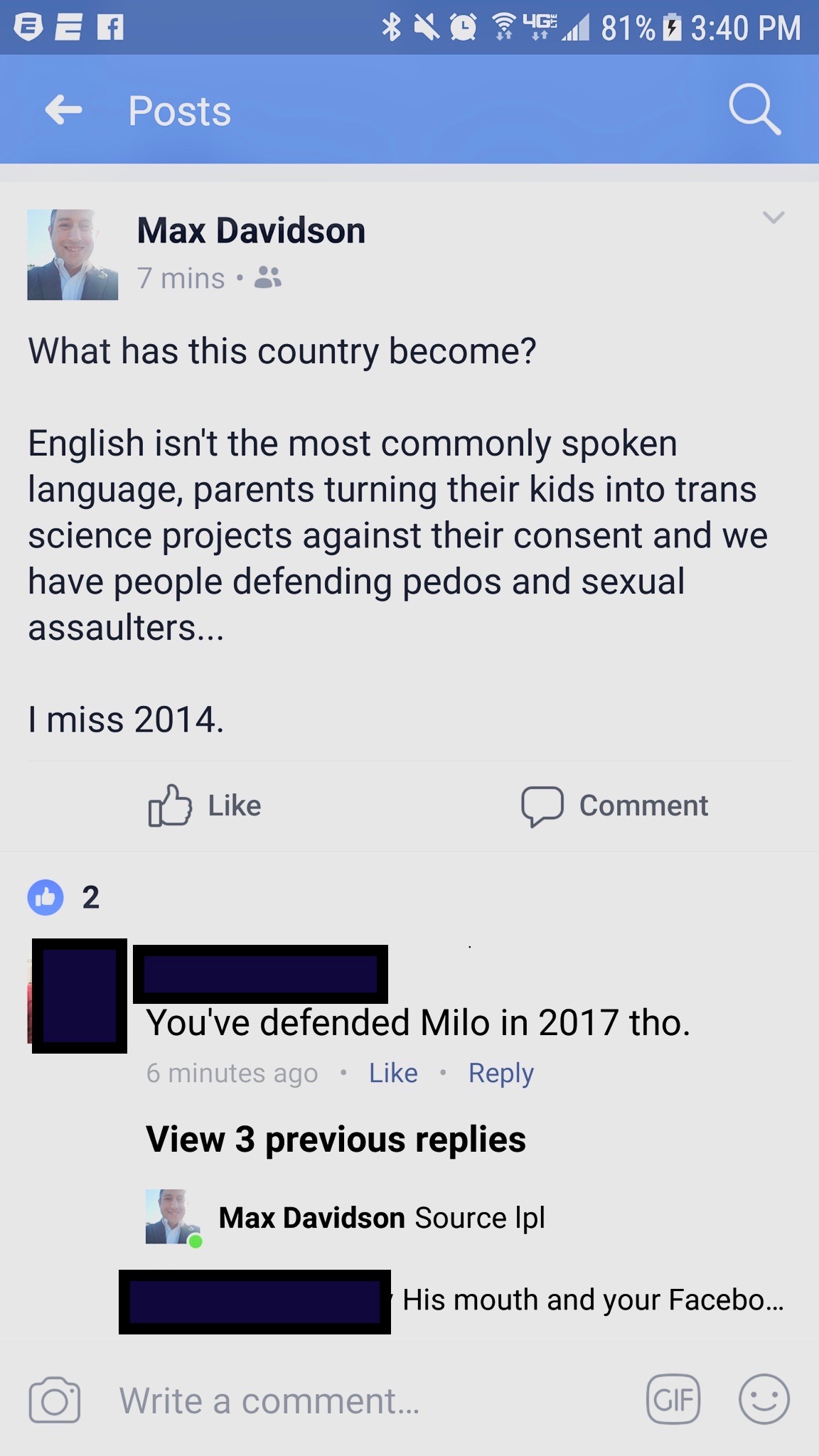
Meanwhile, more evidence has emerged that Max is a right-wing kook. After learning from a fellow journalist that Davidson was running for office, Charles Daye shared with me concrete evidence from Facebook of Max’s true political sympathies:

Attacking the decline of English dominance, transgender Americans and defending Milo sure doesn’t sound like standard progressive talking points. Trying to trash someone for not earning enough is also not the acme of class.

This approach is more commonly found among people who appear on FOX and Friends. In short, there is more evidence to support rumors that Max is a Black Lives Matter-hating, Trump-supporting sort of guy than a “Berniecrat.”

So long, Max. We hardly knew you. But what we did was more than enough.

Share