All posts by David Lublin

The Power of Traditional Gender Roles in Maryland Elections

The share of women among officeholders varies dramatically based on the office type. While my previous posts focused on Congress, I’m going to focus today on countywide offices because they vary nicely in terms of job responsibilities.

Below is a table showing the party (D = Democratic, R = Republican) and gender (M = Man, W = Woman) for four offices elected in 2014 in all 24 Maryland jurisdictions. County executive is also included for counties with that office.

Source: Maryland Manual.

Closer examination of the data reveals that women hold some of these offices far more often than others. Women are more far more likely to occupy positions as Circuit Court Clerk and Register of Wills than County Executive, Sheriff and State’s Attorney.

Traditional gender roles cast women as fairer and more process-oriented than men who are seen as having stronger leadership skills along with greater physical strength and a propensity for violence that lends itself to fighting off threats. The types of offices more often held by women reflect these roles. Women are much more likely to hold clerkship or process-oriented offices than executive leadership or crime-focused positions.

Circuit Court Clerks and Registers of Wills oversee the careful organization, administration, and collection of detailed important records as well as related taxes and fees. Fair process and administrative ability are central to each position. In Maryland, 67% of Registers of Wills and 42% of Circuit Court Clerks are women.

In contrast, while these same abilities are no doubt useful for County Executives, Sheriffs, and State’s Attorneys, people see them more as positions requiring leadership and crime fighting skills. Not a single Maryland Sheriff is a woman. Though women now form nearly one-half of attorneys and a majority of law students, only 17% of prosecutors, or State’s Attorneys, are women. Among Maryland’s nine county executives, 22% are women.

(Note: my reporting on the continued power of gender roles is neither meant as an endorsement of them nor a suggestion that many men and women do bot perform all of these offices well.)

Women form a higher share of Democratic than Republican officeholders. These differences may result from a variety of factors about which I can only speculate. Republicans are more likely to hold traditional values regarding gender norms while women form a higher share of Democratic primary voters. Democrats may also simply perform more strongly in areas more amenable to female officeholders but this may relate to the same factors.

These differences are similar to what I found in an article coauthored with Sarah Brewer, a former AU graduate student and now Ph.D., published in Social Science Quarterly that studied the election of women to county offices in the South in the 1990s.

Source: David Lublin and Sarah E. Brewer, “The Continuing Dominance of Traditional Gender Roles in Southern Elections,” Social Science Quarterly 84: 2(June 2003), pp. 386-7.

Untangling the causes of these differences is difficult. This sort of work cannot really speak to the extent that these differences result from electoral barriers or career choices stemming both from the environment or other gender differences.

Candidate Supply

Candidate supply is an easily overlooked factor that needs to be considered. Just as there may be more female Democratic officeholders because more women are Democrats, demographics relating to the gender composition of high-quality candidate pool also influence the probability that a woman holds an office. Sarah Brewer and I found that women are more likely to win in areas with large numbers of African Americans or senior citizens.

Why? At the time of our study, men tended to be better educated than women among whites, while the gender gap in education was reversed for African Americans. As a result, women formed a higher share of the high-quality candidate pool in counties with high African-American populations.

According to the 2016 American Community Survey (ACS), similar racial and gender differences in educational attainment exist in our state. Among whites, 42.6% of men and 41.9% of women hold a bachelor’s degree or higher. In the African-American community, 29.9% of women but only 25.2% of men have a B.A. degree or higher.

Though older voters are usually seen as more traditional than younger voters, women may perform better in counties with high concentrations of seniors for another depressing reason (at least from my end): women live longer than men. The 2016 ACS reports that 57.0% of Marylanders 65 and older are women compared to just 50.7% of under 65s.

Share

Vignarajah’s Farcical Claims

Can we please stop pretending that Krish Viganarajah comes close to meeting the legal requirements to run for governor?

Candidates for governor of Maryland have to be registered in the State for five years. Yesterday, the Washington Post published three legal documents in which Krish Vignarajah claimed D.C. residency as recently as 2014 and 2016.

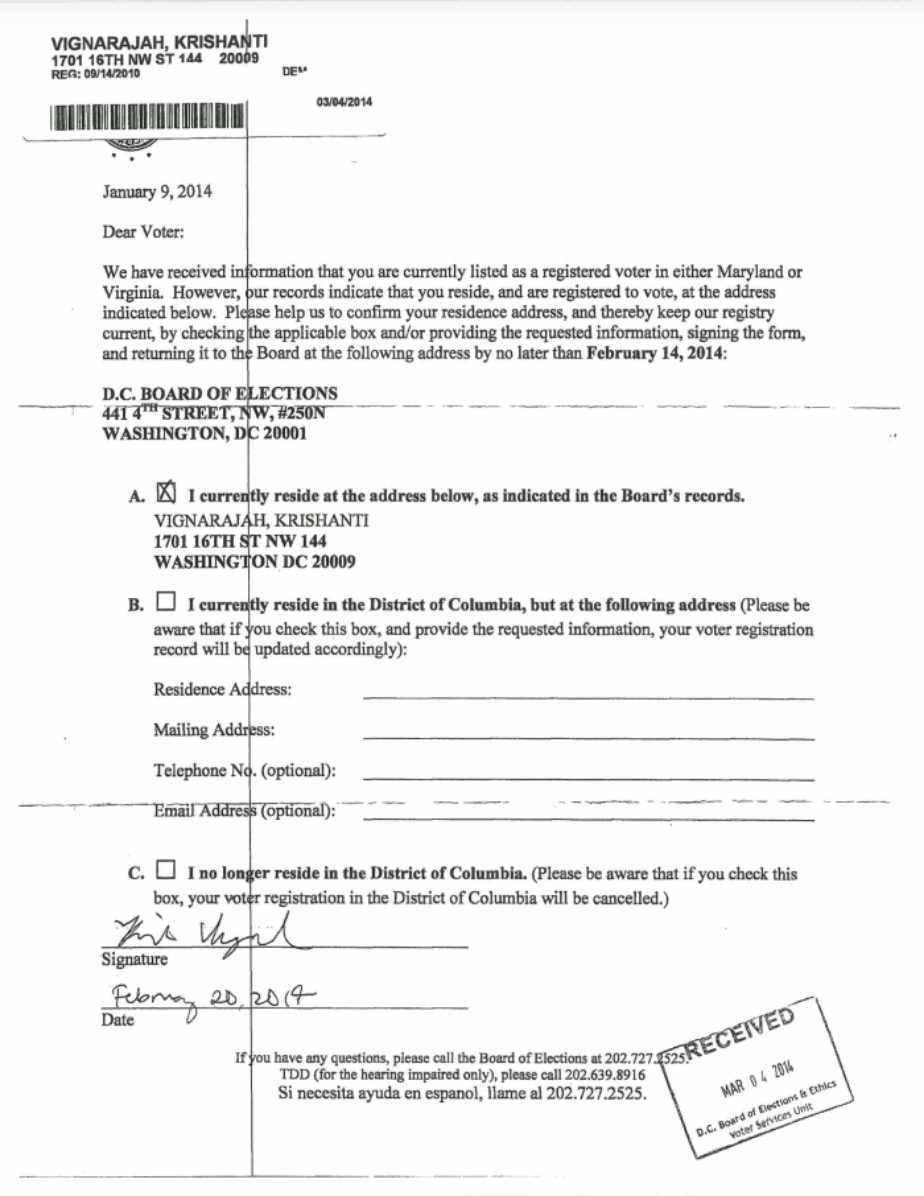
In response to a query from the D.C. Board of Elections, Vignarajah signed her name to confirm that she is a D.C. resident and should be able to vote there rather than Maryland:

The real kicker is in the first paragraph, which makes clear that they are asking her to confirm that she resides and should be registered in D.C. even though she is listed on the registry in Maryland. This form makes explicit that she intentionally abandoned her Maryland residency and registration.

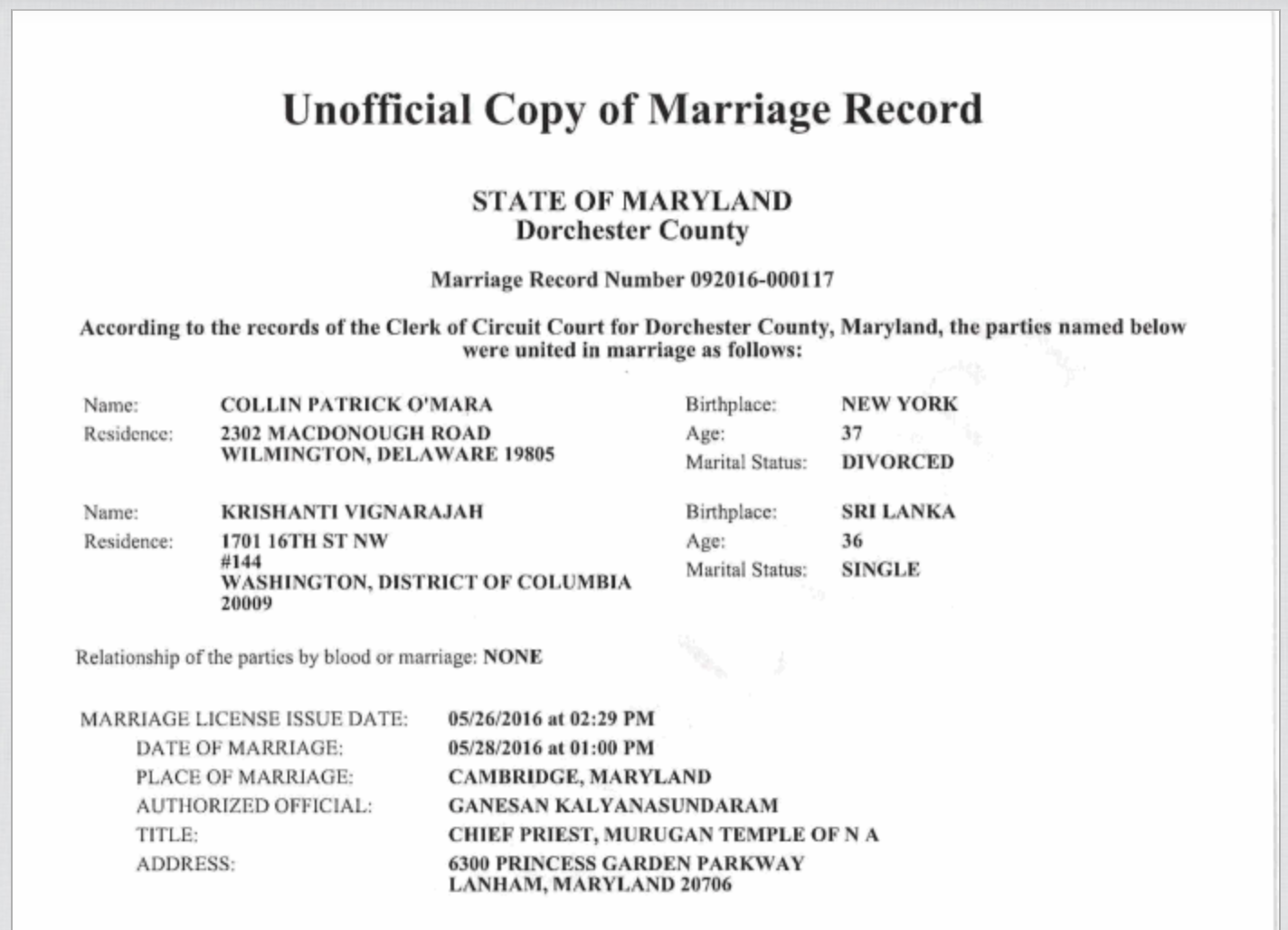
Vignarajah got married in 2016 in Dorchester County. Even though she now says that she was a Maryland resident and legally registered voter, she listed D.C. as her residence on her Maryland license application:

In other words, even though she got married in Maryland and had a marriage license in our state, she claimed residency elsewhere.

Of course, Vignarajah’s original voter registration application from 2010 also attests to her D.C. residency:

Remember that Vignarajah has only voted in Maryland once in her entire life.

Her response to this evidence is ridiculous:

Maryland is and always has been home. Temporarily residing outside of Maryland, whether it’s for school or work, does not change my permanent residence, as a matter of law or common sense.

I know Vignarajah is a trained attorney but it’s still impressive that she can say this with a straight face. Residing for years in another state or the District changes your permanent residence except under specific legal circumstances (e.g. being a student or in the military). Indeed, common sense wisdom is the exact opposite of her claim.

All the legal experience it takes to file taxes makes this even clearer. Incidentally, Vignarajah petulantly promised to release her taxes if other candidates do so. Rich Madaleno and Jim Shea have released theirs but we’re still waiting for hers, probably because they are yet further evidence of her D.C. residence.

It would be a disaster if Vignarajah won the nomination, as Republicans would challenge her eligibility and likely win:

A Hogan spokesman declined to comment. But other Republicans, including Del. Joe Cluster (Baltimore County), the former state GOP executive director, said someone in the party would surely attempt to challenge Vignarajah if she were the nominee.

“She shouldn’t be able to be on the ballot,” Cluster said. “If I was executive director of the Maryland Republican Party and she was the nominee for the Democrats, I would challenge her running for governor.”

Were such a challenge permitted, the government documents and Vignarajah’s voting history would be “a killer,” said Timothy Maloney, a lawyer and former Democratic state lawmaker who is not supporting anyone in the primary. “It would be almost impossible to overcome.”

Even if she somehow beat the challenge because it was too late to make it, Hogan’s team will make endless hay out of her five minute legal residence.

Krish Vignarajah should resign from the race.

Share

Why Women Hold Fewer Elective Offices

Yesterday, I reviewed political science research revealing that women who run for Congress do just as well as men and, contrary to public perception, do not face hostile press coverage that harps on their gender and appearance.

So why are there substantially fewer women than men in public office?

Today and in the next post, I focus on two key factors: First, women are less likely to run for public office than men. Second, the type of office greatly shapes who runs and wins.

My discussion today relies heavily on research by Jennifer Lawless and Richard Fox, particularly their articles in the American Journal of Political Science and American Political Science Review. The APSR is widely viewed as the top journal in political science and the AJPS is one of the top three venues to publish work in American politics.

Fewer Women Run

Lawless and Fox’s Citizen Political Ambition Study surveyed 3,765 people (1,969 men and 1,796 women) they considered highly eligible to run for office, largely people in the professions of law, business and education.

Among this group of potential candidates, 59% of men but just 43% of women said that they considered running for office. The probability that those who considered running actually sought office also revealed gender differences with 20% of men but only 15% of women taking the plunge to enter the political arena.

Interestingly, among those who did run, 63% of the women held public office as opposed to 59% of men. Unlike the gender differences mentioned in the previous paragraph, this one is not statistically significant. If we want more women in public office, we need to focus on the barriers that deter women from running.

Barriers to Women Running for Office

Fox and Lawless find that women are less likely than men to discuss the possibility of running for office with family and friends (22% of women v. 33% of men), community leaders (9% v. 15%), and party leaders (6% v. 12%) than their male counterparts. Improved outreach seems a straightforward way to overcome this barrier.

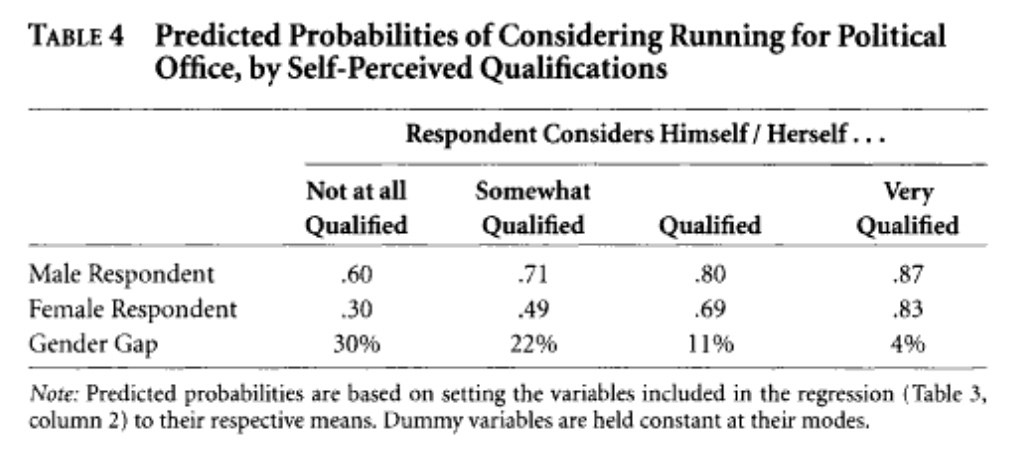
Next, Fox and Lawless showed that men are more likely than women to consider running for office even when they have similar perceptions of their qualifications:

Source: Richard L. Fox and Jennifer L. Lawless, “Entering the Arena? Gender and the Decision to Run for Office,” American Journal of Political Science 48: 2(April 2004), p. 273.

As the table shows, women who see themselves as “not at all” or “somewhat” qualified are far less likely than men who see themselves the same way to consider running for office. The yawning gap shrinks dramatically, but does not disappear, at higher qualification levels.

It’s really a double whammy.  Women are not only less likely to perceive themselves as qualified but also are less likely to run even when they have the same perception of their qualifications to run for office as men.

Interestingly, Fox and Lawless argue that two suspected culprits, family responsibilities and having a more traditional political cultural outlook (i.e. being more moralistic) do not shape the likelihood of running for office after controlling for other factors such as income, age, encouragement, and self-perceived qualifications.

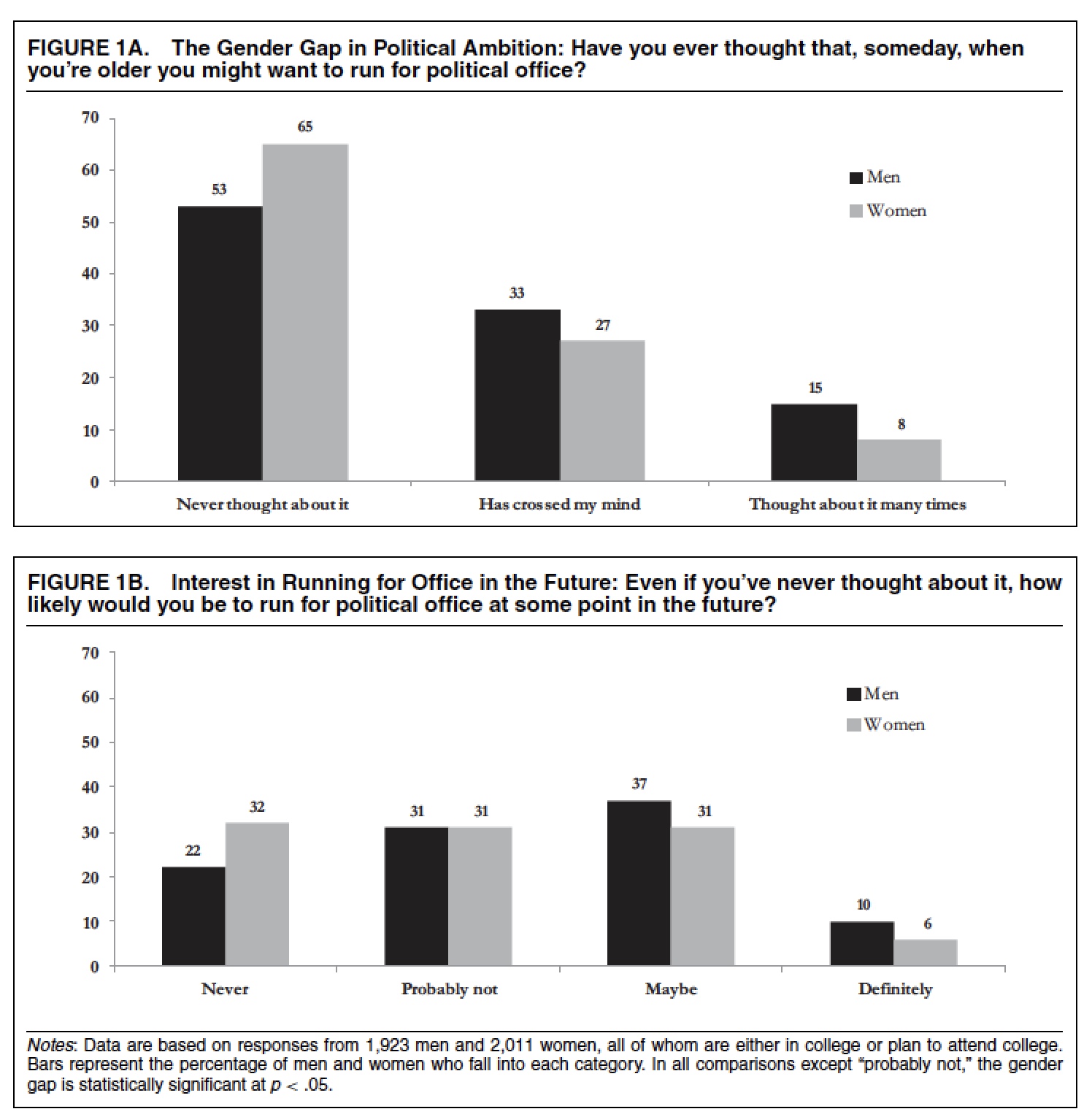
Going deeper into the subject matter, Fox and Lawless find that gender differences in political ambition surface in both high school and college students. Their survey revealed that young women are less likely than young men to think about running for office:

Source: Richard L. Fox and Jennifer L. Lawless, “Uncovering the Origins of the Gender Gap in Political Ambition,” American Political Science Review 108: 3(August 2014), p. 502.

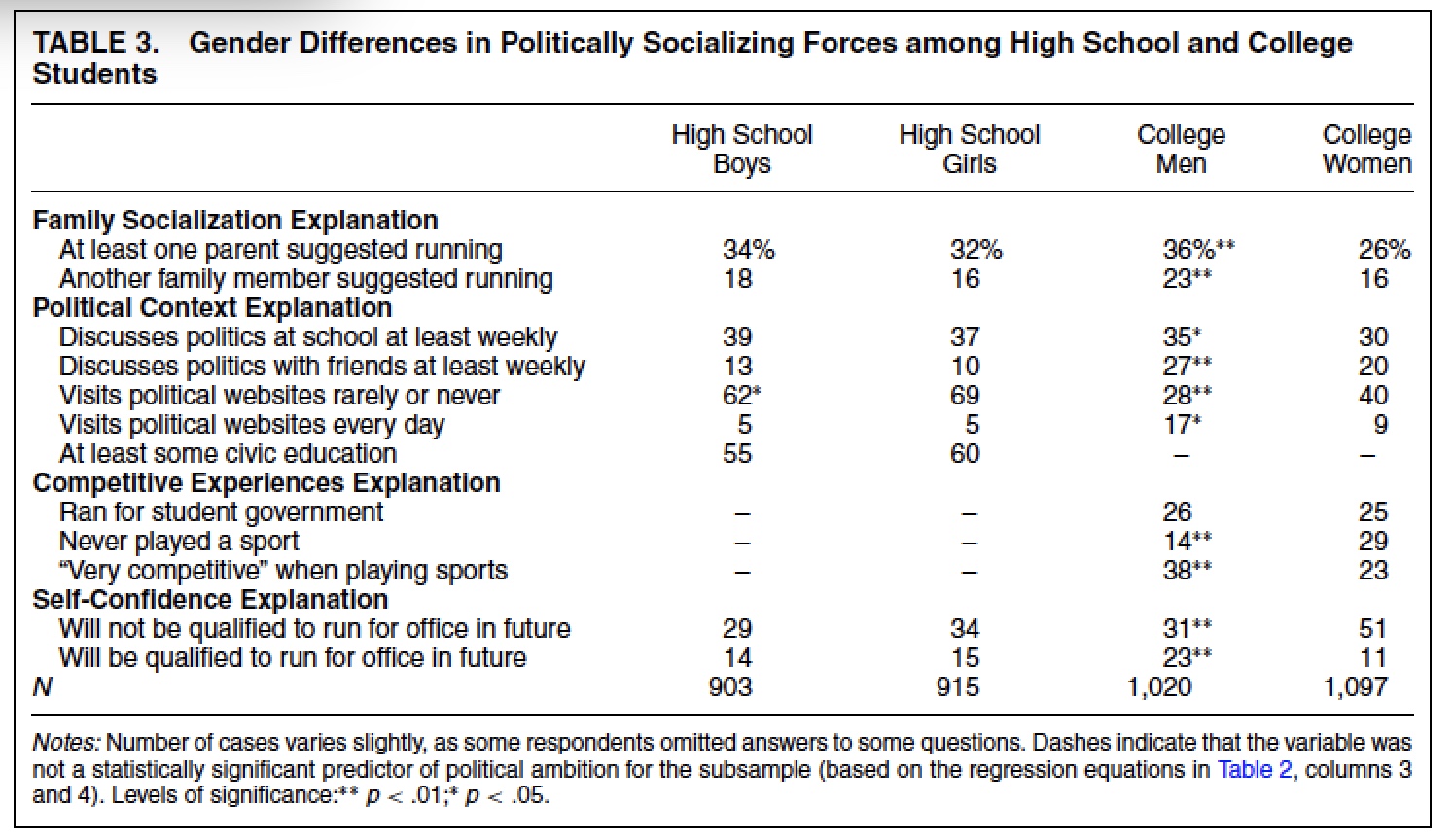
They find that gender differences that help drive these differences in political ambition are especially pronounced among college students:

Source: Richard L. Fox and Jennifer L. Lawless, “Uncovering the Origins of the Gender Gap in Political Ambition,” American Political Science Review 108: 3(August 2014), p. 510.

Family members are more likely to suggest to college men that they run for office. College women are less likely to discuss politics or visit political websites. Perhaps most jarringly, college women are less likely than college men to think they will be qualified to run for office in the future.

In the final part of this three-part series, I examine how the type of office also shapes whether women run or win.

Share

Voters Oust Longest Serving Garrett Park Mayor

In a close election, the voters of Garrett Park turned out incumbent Mayor Peter Benjamin and elected former Town Councilmember Kacky Chantry to the position. The two incumbent candidates for the Town Council were unopposed.

Mayor
Kacky Chantry, 243
Peter Benjamin (i), 232

Council
Jane McClintock (i), 341
Hans Wagner (i), 338

Turnout
Registered Voters, 903
Ballots Cast, 478
Rejected Ballots, 0

Benjamin has served as Mayor of Garrett Park repeatedly, first being elected to the position in 1996 and 1998. Nancy Floreen, now an at-large County Councilmember, then served a single term. After winning election to the Council in 2002, Benjamin was then appointed to fill a mayoral vacancy (caused, I imagine, by Mayor Floreen’s election to the County Council).

Benjamin served another term on the Council from 2005 through 2007. He began his most recent stretch as mayor in 2012 and was reelected to two more terms in 2014 and 2016 before being defeated by 11 votes in this election.  Adding his six terms together, Benjamin has served twice as long as any other mayor of the Town.

Incoming Mayor Kacky Chantry previously served two terms on the Town Council starting in 2013. You can learn more about the views of the incoming mayor and all of the candidates from the most recent edition of the Garrett Park Bugle.

Share

Valerie Ervin Issues Statement

Valerie Ervin Issues Statement Following the Passing of Kevin Kamenetz
PIKESVILLE, MD (May 10, 2018) — Valerie Ervin today issued the following statement:

“Like so many, I am shocked and heartbroken by this sudden and unexpected loss. I want to thank those across Maryland for their outpouring of support, sympathy, and gratitude during this difficult time.

“Kevin was first and foremost a loving husband to his wife Jill and a proud father to Karson and Dylan. And he was a dedicated, bold leader who served the people of Baltimore County for over 20 years. I have been honored to call him a friend and partner.

“Today all of Maryland mourns with his family, friends, and loved ones.”

Share

Kevin Kamenetz Died This Morning

Kevin Kamenetz Announces for Governor

In shocking and horrible news, Baltimore County Executive Kevin Kamenetz died early this morning at University of Maryland St. Joseph Medical Center after cardiac arrest.

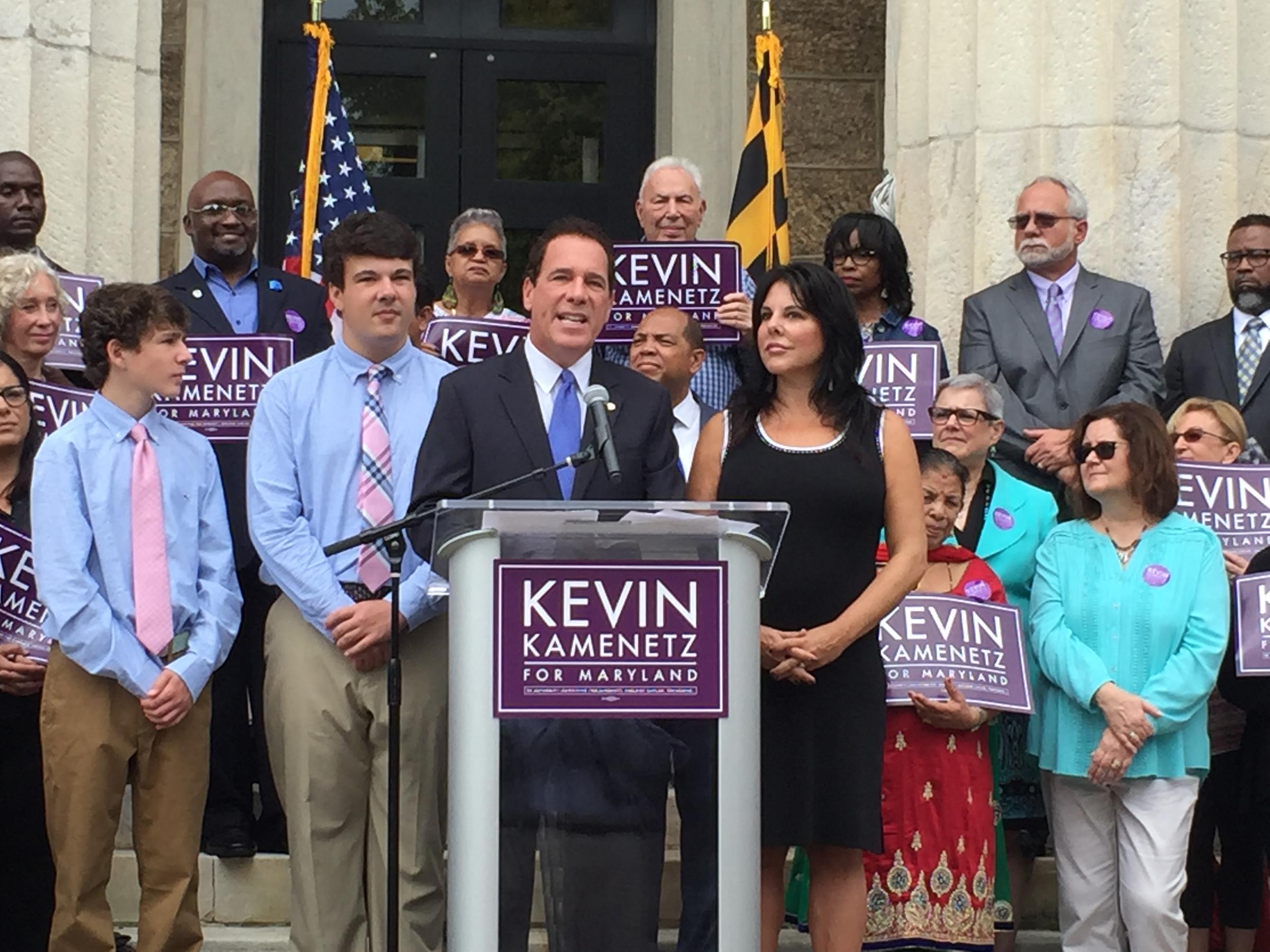
Kamenetz was completing his second term as county executive as he launched his gubernatorial bid. Previously, the former prosecutor served four terms on the Baltimore County Council. As the county executive of a large, swing county with deep Baltimore roots, he was a top-tier candidate. Former Montgomery County Councilmember Valerie Ervin was his running mate.

Kamenetz is survived by his wife and two sons. My heart goes out to them and all members of the Kamenetz family.

You can read reports from the Washington Post and Baltimore Sun.

Share

What You Believe about Why Fewer Women Hold Legislative Office is Probably Wrong

The U.S. House up for grabs and many women are running as challengers today incumbents and for open seats. Del. Aruna Miller’s bid for the open Sixth Congressional District is a great example. Many Americans believe that it is harder for women than men to run and to win these elections. In particular, women are subjected to sexist media coverage with too much focus on how they appear. Female candidates also find it harder to raise money and face bias from voters, so they have to be more qualified than men to win election to Congress.

None of this is true.

More specifically, political science research on congressional elections doesn’t support these conclusions. Gender matters in elections but it doesn’t shape House elections in these ways.

Today’s post borrows heavily from research by Jennifer Lawless. Jen is Professor of Government at AU, though we are unfortunately losing her to UVA in the Fall, and Director of the Women and Politics Institute. She has written much of the best and most cutting edge scholarship on women running for office. In particular, I rely on a book she coauthored with GWU Prof. Danny Hayes, Women on the Run: Gender, Media and Political Campaigns in a Polarized Era.

Media Coverage

Let’s start with the media. In their study, Hayes and Lawless looked at articles in the top local newspaper from the last month of every 2010 and 2014 congressional campaign. Despite their decline, newspapers remain the most influential source of U.S. House campaign coverage. Among the 4,524 articles coded, they found exactly 32 references to candidate appearance:Source: Danny Hayes and Jennifer L. Lawless, Women on the Run, p. 66.

In other words, 0.7% of newspaper campaign coverage mentioned appearance. Rather than harping constantly on candidate appearance, such discussion is almost nonexistent in newspaper coverage of congressional candidates. One reason for the decline is that the novelty of women running for Congress has vanished for the most part.

Another is that men and women run very similar campaigns in terms of the issues that they discuss. Hayes and Lawless find that party plays a far greater role than gender. Analysis of congressional candidate television ads and tweets reveals that candidates tend to emphasize similar issues with gender differences being small and only rarely statistically significant.

Similar campaigns result in similar press coverage. Gender differences in the issues emphasized in newspaper coverage are small and usually not statistically significant. As the focus on issues specific to one gender is small, so is coverage of those issues. Additionally, while party plays an enormous role in how voters view candidates, gender differences are once again small (often to the benefit of women) and not statistically significant.

Winning Elections

When women run for Congress, they do just as well as men.

This is not a new conclusion. In her 1996 book, A Women’s Place is in the House: Campaigning for Congress in the Feminist Era, Barbara Burrell did not find that women are penalized for their gender by voters at the polls. Hayes and Lawless arrived at the same conclusion in their more recent study of the 2010 and 2014 elections.

Source: Danny Hayes and Jennifer L. Lawless, Women on the Run, p. 107.

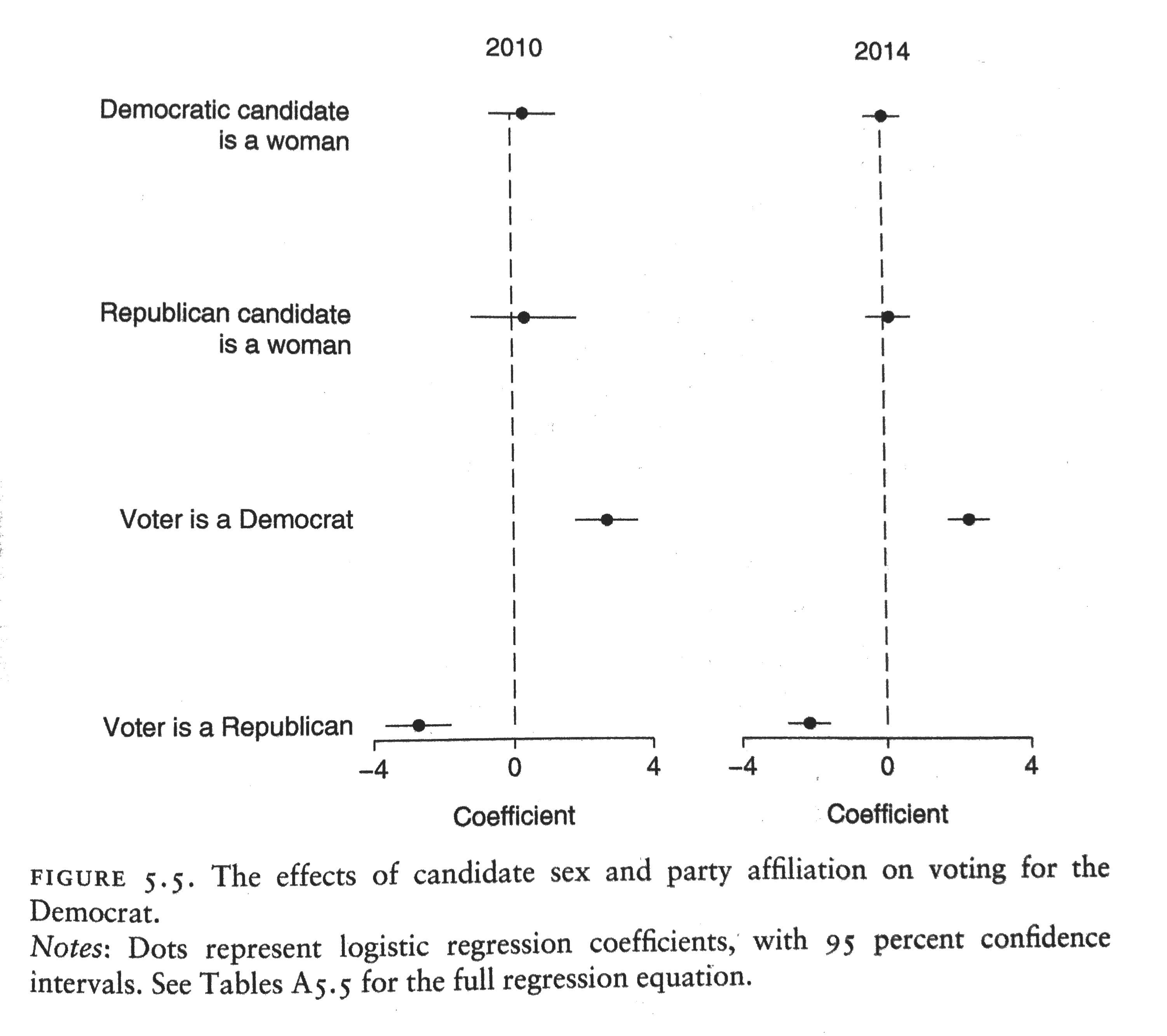
The graph above presents the relative impact of gender and party on the probability of a the success of the Democratic U.S. House candidate after controlling for a variety of factors. Gender has almost no impact, as indicated by the small coefficients. The overlap of the confidence intervals, shown by the lines around the dots, with zero indicates that candidate gender has no statistically significant impact on the outcome.

Other research not reviewed here also indicates that women do just as well in raising campaign funds – no real surprise as women dominated the world of fundraising at the national Democratic Party even 30 years ago in the late 1980s. They also don’t need to be more qualified – women do just as well as men with equivalent qualifications.

So why do women hold substantially fewer elected offices than men in the U.S.? That’s the subject of tomorrow’s post.

Share

Skewed Metro Ridership Forecasts Too High

We can’t rely on WMATA ridership forecasts.

Today, I look at forecasts for MetroRail and MetroBus for the two most recent comparable periods with available data. In the period from July 2017 through March 2018, MetroRail forecasts were above projections in four months and below in five months.

This doesn’t sound too bad until one examines the overall numbers. Metro overestimated ridership for these nine months by nearly 2.8 million. Actual ridership was 2.1% lower than expected by WMATA in its budget forecasts.

On the good news front, the rail ridership forecasts were not as off as the previous year.

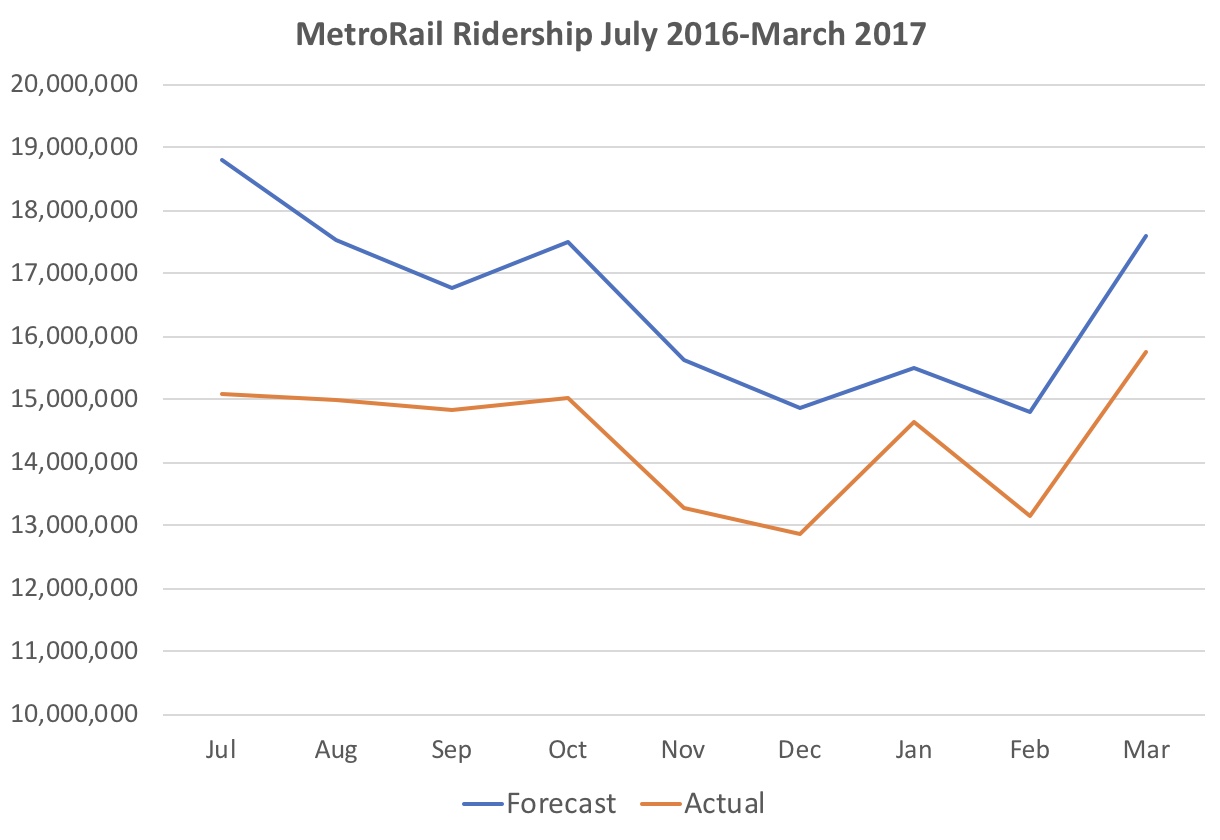
In July 2016 through March 2017, WMATA overestimated rail ridership every single month, resulting in a net overestimate of 19.4 million or 13.0%. However, though WMATA projections are less wildly optimistic, notice that the skew direction remains the same.

The improvement was less strong in MetroBus ridership forecasts and the skew direction remained overly rosy. Here are the projected and actual MetroBus ridership for the most recent period.

WMATA projected more MetroBus riders every month than expected with the projections worse in the most recent months. Overall, there were nearly 4.5 million, or 5.1%, fewer riders than anticipated by the budget forecasts.

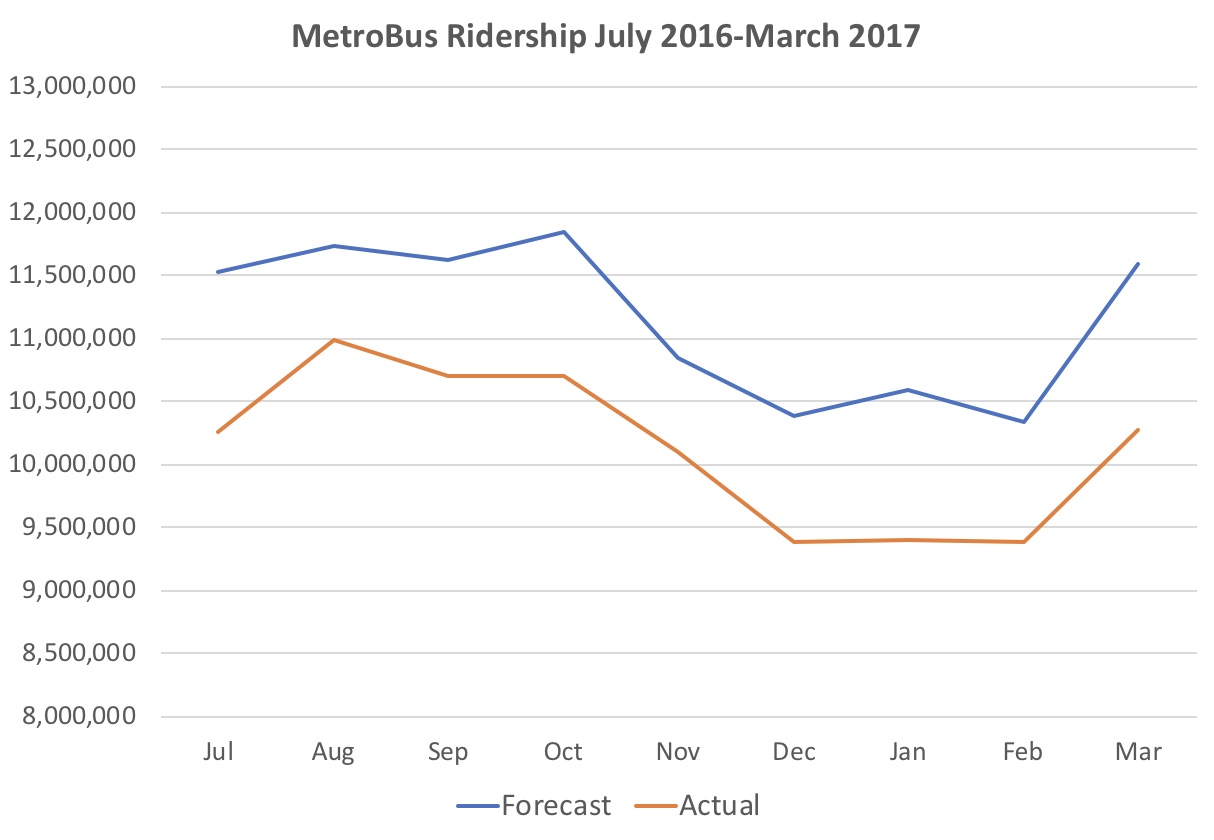
Like for MetroRail, the previous year’s MetroBus projections were abysmal.

The previous year’s projections were off by even more in every single month. WMATA overestimated MetroBus ridership by 9.3 million. Actual ridership was 9.2% lower than the forecast.

WMATA needs to reform its projections so they do not skew in favor of overestimating ridership. Indeed, if anything, it would be better to err on the conservative side since Metro’s budget relies in part on the expected collection of fares related to these projections.

Share

Metro Ridership Still Falling

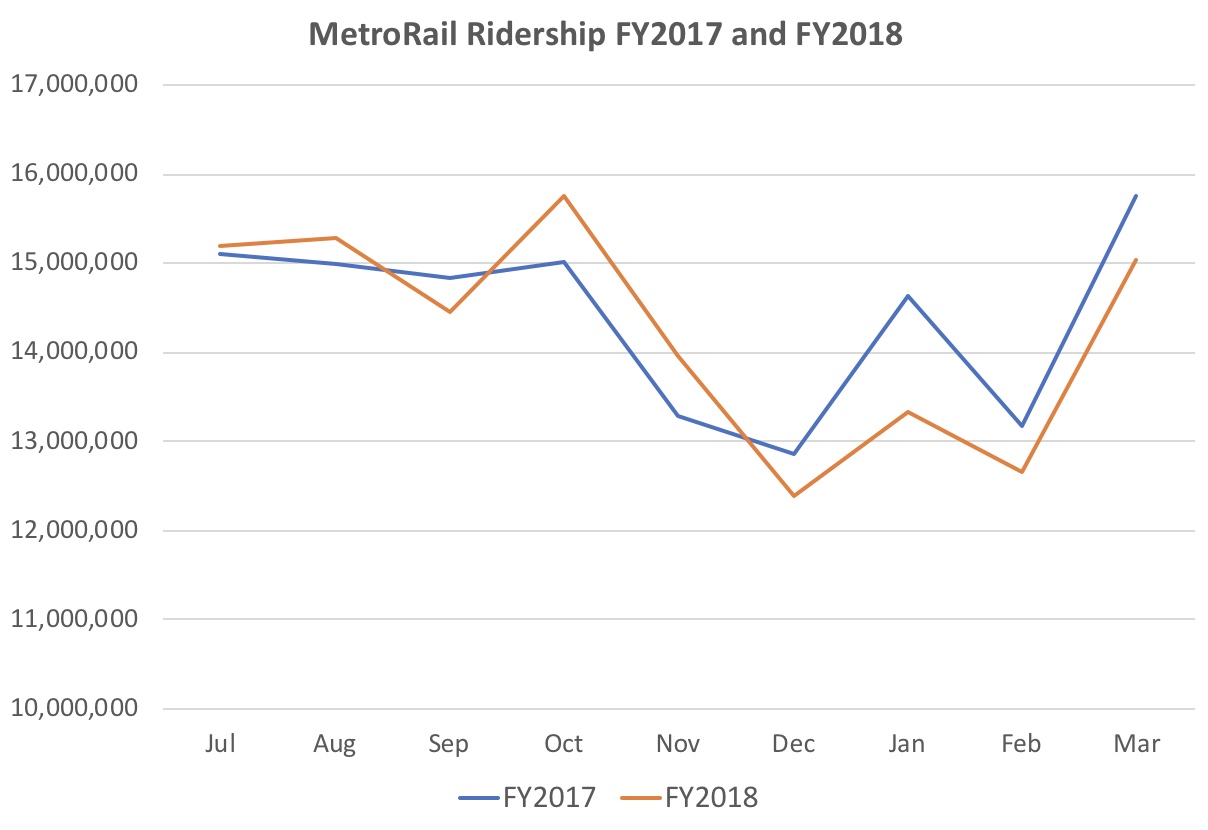
Today, I’ve put together MetroRail and MetroBus ridership over the same period from July though March for FY2017 and FY2018.

Among the nine months with comparable data, MetroRail ridership was up over the previous year in four months and down in five months. The months with decline, especially January, saw overall greater slump than the months with gain.

As a result, MetroRail ridership for more recent period is a net 1.57 million lower, or 1.2%, over the previous year. Metro should find this very discouraging. SafeTrack ended, at least temporarily, in June 2017, so the current year is completely post-SafeTrack. Its completion along with the “Back to Good” campaign has simply not halted the long-term hemorrhage.

Moreover, one can hardly blame the decline from December through March on a brutal winter this year. This planned closing of  stations in summer from 2018 through 2021 for weeks on end doesn’t seem likely to help matters either.

If you think the rail numbers are somewhat discouraging, take a look at the bus numbers.

MetroBus ridership is off by 8.6 million (!) over the previous year, an incredible decline 9.4%. No month saw a year-to-year increase. Declines in ridership impact Metro’s budget, as it depends on fares to provide a significant portion of its budget.

Data Sources: Vital Signs Report (Q1-2017), p. 21; Metro Performance Report (Q3-2018), p. 40.

Share

MD NARAL Endorses Rich Madaleno for Governor

Along with Rep. Jamie Raskin’s (D-8) support, this is the biggest endorsement to date received by the Madaleno campaign.

Choice, access to contraception and women’s health care are big issues, especially in this #metoo election. Additionally, U.S. House Republicans made reducing access to women’s health care services integral to their failed plan to gut the Affordable Care Act. So these issues are more salient than four years ago and MD NARAL’s imprimatur, always nice to have, is more valuable than usual.

Why did NARAL Pro-Choice Maryland endorse Rich Madaleno over his Democratic competitors?

For a start, though women form close to 60% of Democratic primary voters and are a critical constituency for any candidate, County Executives Kevin Kamenetz (D-Baltimore County) and Rushern Baker (D-Prince George’s) surprisingly did not submit questionnaires to MD NARAL.

Four other candidates – Ben Jealous, Alec Ross, Jim Shea, and Krish Vignarajah – were rated 100% by MD NARAL on their questionnaire responses. They will understandably tout this rating as good evidence of their staunch pro-choice and pro-women credentials.

Apparently, MD NARAL chose Madaleno over these four candidates based on his established record of not just supporting MD NARAL’s viewpoint on these questions but having delivered concrete legislative gains on a wide range of issues. As the Madaleno campaign explains in its press release:

Madaleno was the Democrat who protected funding for Planned Parenthood when it was attacked by Republicans in Congress in 2017. He has also co-sponsored a number of laws: to make feminine products available to homeless girls and women; to expand services to victims of sexual assault; and to ensure insurance coverage in Maryland for prescription contraceptive drugs and devices.

The full press release is below.

Share