All posts by David Lublin

Waldstreicher Fibs His Way Out of Facing His Constituents

Bethesda Beat reported that Del. Jeff Waldstreicher, who hopes to win the Democratic nomination for the District 18 Senate seat, had to miss the District 18 Democratic forum on May 30th “due to what sponsors said was a commitment in Annapolis related to his legislative duties.”

Except that there was nothing official going on at that the General Assembly that day, as these screenshots of its calendar reveal:

Jeff isn’t the only one in the General Assembly campaigning for reelection, so it’s mighty odd that he had to miss a forum. I sent an inquiry to Jeff as to what was so important related to his legislative duties but have not received a response.

Jeff worked hard to avoid commenting on any controversial issue, or even speaking much at all, at an earlier forum, and skipping out on this forum would fit this pattern. Moreover, Jeff’s attendance at delegation meetings during the legislative session has been lousy, so his need to miss the forum for reasons of state seems odd.

Liquor control was one of the hot issues at the debate. Jeff didn’t comment on it at the first debate, and obviously didn’t at the one he missed. he might be keeping a low profile because he is against decontrol, as evidenced by his support from MCGEO, but not from public statements.

Share

Jealous Snags Poll Position in Gov Race

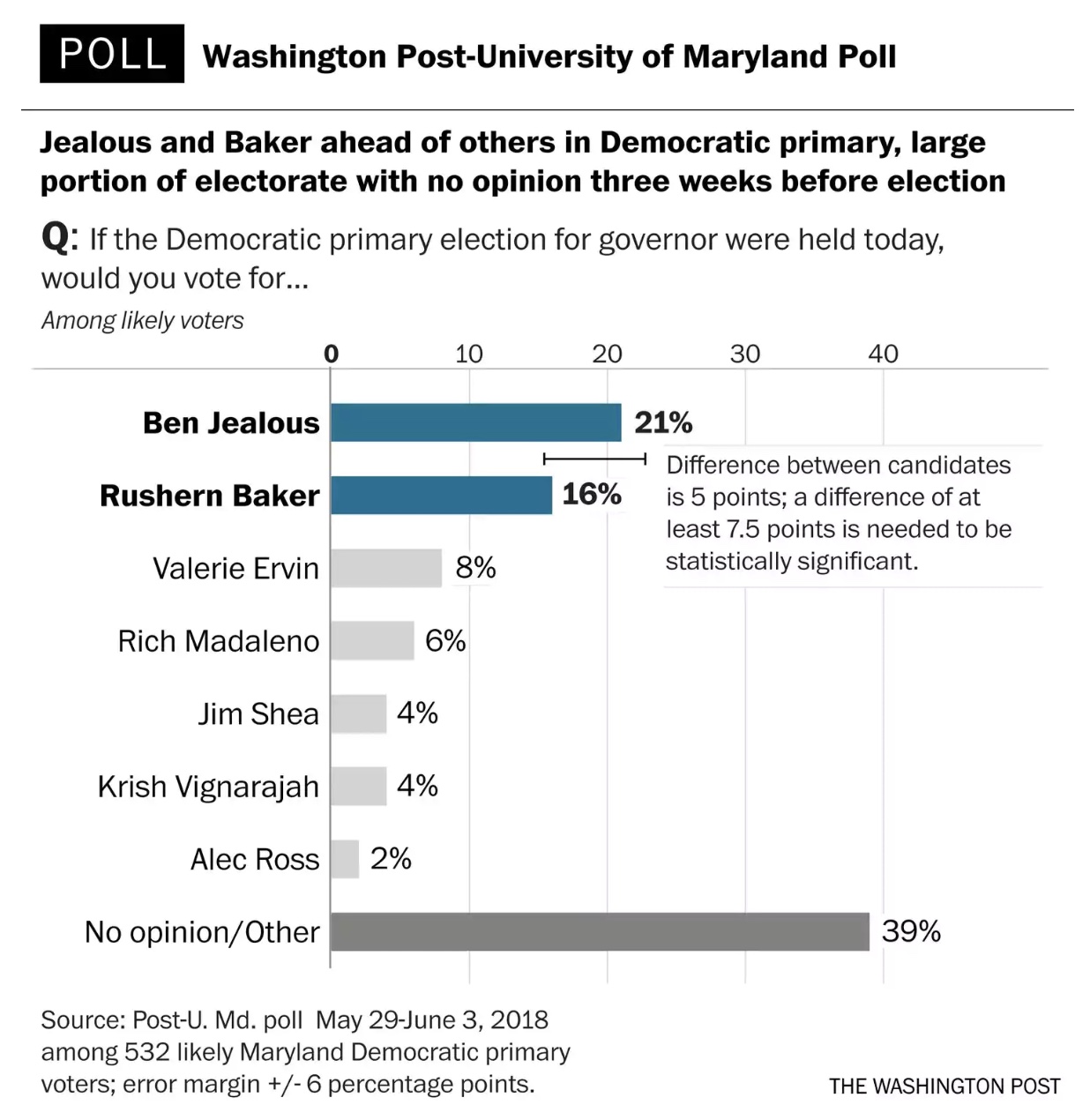
The Washington Post reports the results of a Washington Post-University of Maryland poll:

Gov. Hogan performs well against all Democrats:

[Hogan’s] 71 percent job-approval rating among all Marylanders matches his previous record high, and residents are more optimistic about the state’s direction than in any Washington Post poll over the past quarter-century, the poll finds. The governor leads each Democrat by at least 10 percentage points in possible general-election matchups.

State Sen. Richard S. Madaleno Jr. (Montgomery) has 6 percent support in the Post-U-Md. poll, although he is among the most competitive of the Democrats in a head-to-head matchup with Hogan.

Share

The Utter Absurdity of Vignarajah’s Claim of Deep Support for LGBT Marylanders

Can Krish Vignarajah’s campaign get any more ridiculous?

The Washington Blade published a puff piece on Vignarajah in which she touts her deep support for LGBT Marylanders. She has a nice laundry list of policy concerns:

Vignarajah said as governor she would support Maryland Attorney General Brian Frosh’s decision to challenge the Trump administration’s efforts to ban trans people from the military.

Vignarajah supports the repeal of Maryland’s sodomy law and would seek to eliminate the provision of the state’s trans rights law that exempts religious institutions and private institutions. Vignarajah’s campaign platform also calls for an end to discrimination against LGBT Marylanders in housing, healthcare, employment, education and public services.

Vignarajah has called for the use of additional funding from Maryland’s general fund to combat homelessness among LGBT youth. She would also support legislation “explicitly protecting” adoption rights for same-sex couples.

Vignarajah’s platform also calls upon the Maryland Motor Vehicle Administration to make it easier for Marylanders to change the gender marker on their driver’s licenses.

Except she chose not to vote in the 2012 referendum on marriage equality. Despite claiming a strong commitment to LGBT Marylanders and that she would be the most pro-LGBT governor ever, she just couldn’t be bothered to drive home to Maryland to vote or request an absentee ballot.

Instead, she voted in DC for “convenience.” By the way, this also means she missed the vote on the Maryland DREAM Act, so perhaps we might also ignore her commitment to “Making Maryland the Most Immigrant-Friendly State in America.”

How stupid does she think we are?

Share

On “Those Good Union Jobs” at the Department of Liquor Control

MCGEO has done quite a number on county residents. When discussing the hot issue of privatization of Montgomery County’s liquor monopoly, politicians automatically express concern about the potential loss of those “good union jobs.”

People would be a lot less sympathetic to the idea of protecting liquor store or distributor employees. Why on earth should we maintain an antiquated, inefficient monopoly to protect their jobs but not spend money to protect the grocery store cashier or bank teller threatened by automation?

What makes all the angst about losing “good union jobs” even more galling is that private liquor distributors are unionized by the Teamsters – a little fact that never seems to get mentioned in all the handwringing.

Privatization doesn’t threaten union jobs. It threatens union jobs that pay dues to MCGEO. So MCGEO President Gino Renne, who was paid $196,700 by his local union and an additional $20,000 by his international union last year, is naturally quite concerned. As Gino likes to say, “Just keeping it real.”

Sadly, no one seems concerned about all these Teamsters Union jobs lost due to the monopoly depriving them of a livelihood. Not to mention the restaurant jobs lost because of extra costs that make it harder to turn a profit and frustration with the Department of Liquor Control that stops businesses from opening or expanding in Montgomery.

The other unasked question is why does the DLC perform so poorly if these jobs are so great? Service at DLC stores is variable at best and most employees are unfamiliar with their product. Beyond the stories about the DLC failing to deliver product at key moments, such as right before New Year’s, I’ve also heard about the DLC dumping shipments in the middle of the bar during happy hour.

It’s almost as if Ernestine left the phone company once Ma Bell was broken up and sought refuge at the DLC. “We’re the DLC, we don’t have to care.”

It’s not as if the DLC is understaffed. Somehow, Montgomery County-based Total Wine manages to keep in stock and much better organized a far greater range of product. They do it with fewer employees who yet also seem to know about the product that they’re selling and are more likely in my experience to provide good customer service. Other stores do the same.

Similarly, I’d like to know the share of DLC workers who live in Montgomery County. While some might argue that this is irrelevant, why must Montgomery County citizens keep in place a costly system to subsidize workers who don’t even live here? Even this question has totally lost the plot as government should not be a make-work program but should provide services to residents.

Councilmembers defend the DLC because it brings in money to the county. It would be a miracle if a monopoly on booze in the DC area did not. The sad truth is that it brings in far less than it might. The amount of beer and spirits sold per capita in Montgomery is lower than almost all other jurisdictions in Maryland as well as the Virginia suburbs. Does anyone seriously believe that we drink phenomenally less than people in Fairfax? Greater efficiency would also increase profit. Couldn’t we just tax alcohol and try to grow the economic pie instead of clinging desperately on to a stagnant unloved system?

None of this means that we shouldn’t pay county employees decent wages or we should just chuck the DLC workers out of a job. But nor should taxpayers be obligated to maintain a system that doesn’t work and myopically hurts the economy in perpetuity.

It’s time to call the question and end this outdated monopoly.

Share

Ben Jealous’s Need to Claim Credit for Marriage Equality is Just so Wrong

It’s a strange day when a straight man takes credit for marriage equality in Maryland but Ben Jealous is that guy.

I’m certainly happy that the NAACP moved to endorse marriage equality on his watch. It was a good decision and showed leadership. But it is a far cry from claiming to be the critical guy who made marriage equality happen.

In debates and on twitter, Jealous and his campaign have repeatedly cited the Baltimore Sun editorial honoring him as Marylander of Year as evidence to back up his claim. Indeed, it’s a generous editorial:

“Maryland is a better state — and ours is a more perfect union — because of Ben Jealous and his commitment to justice, equality, and the dignity of every child’s home,” Governor O’Malley said. “Here in Maryland, he was an indispensable part of repealing the death penalty, passing the Maryland Dream Act, ensuring civil marriage equality and expanding access to voting.”

When it comes to his being “indispensable” on marriage equality, however, Jealous and his campaign have been categorically unable and unwilling to provide any evidence to back up the claims of the editorial.

When the Jealous campaign tweeted a link to the editorial at me, I read it and then asked which legislators’ minds he had changed. The reply is revealing:
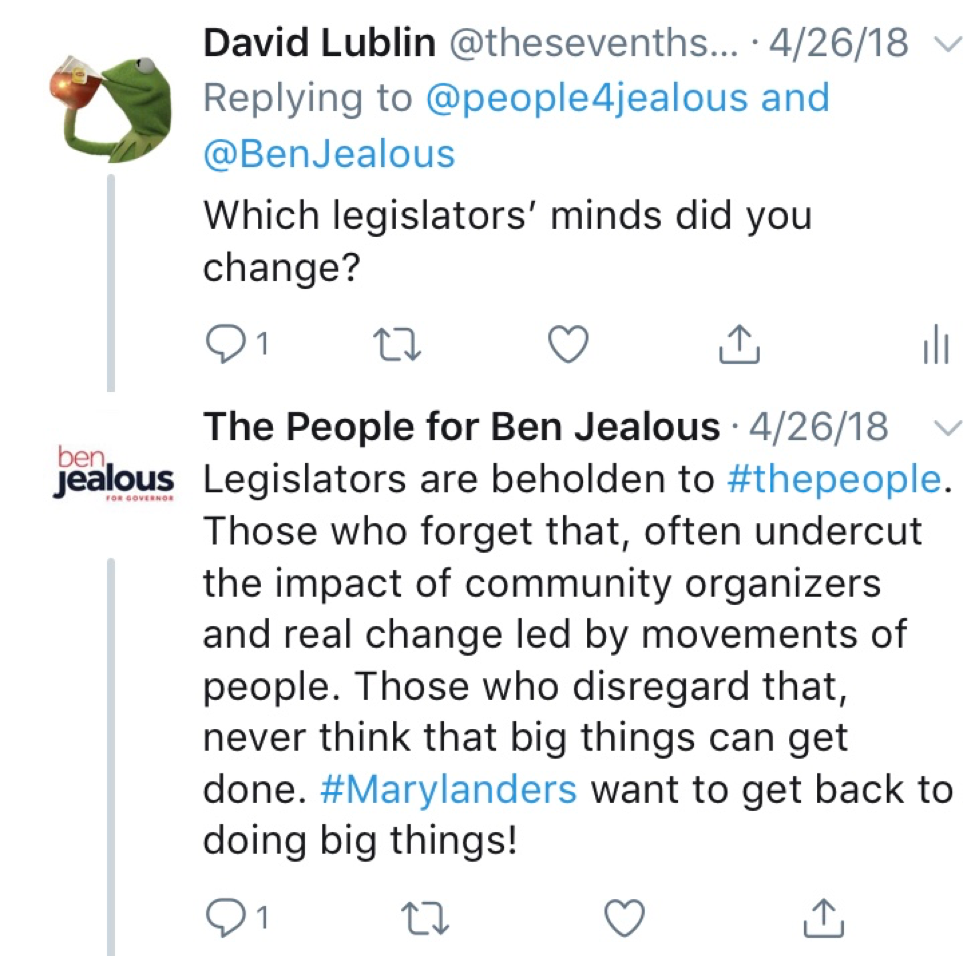
In other words, Jealous cannot identify a single legislator who changed their mind thanks to his efforts. I followed up by asking how many community organizers he had placed on the ground, as he claimed that had made the difference:
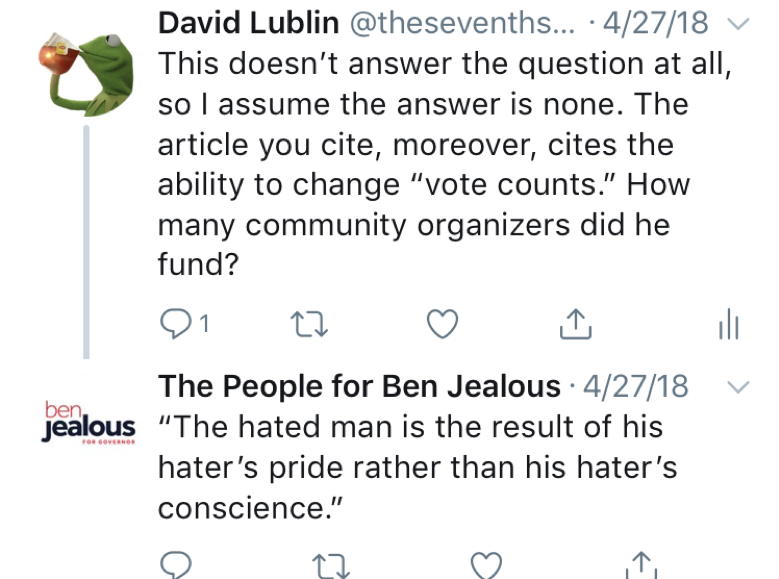
Personally, I preferred the Taylor Swift version of his reply. But again, it’s revealing. Rather than answer the hard-hitting question, he attacks the questioner. It takes a certain amount of chutzpah to accuse me of “pride” when he’s the guy claiming to have gotten marriage equality and numerous other legislative initiatives done.

So ultimately, beyond the editorial and the nice quote from Martin O’Malley of the sort that politicians tend to give when asked about someone receiving an award, we’re left with a whole lot of bupkis for evidence.

As someone who was actively part of Equality Maryland’s legislative lobbying team and Co-President of Equality Maryland during the referendum fight, I have some knowledge on the question. Jealous never showed up at any of the strategy sessions held with key legislators that I attended.

Jealous  was certainly never mentioned when it came to recruiting key votes on the issues. Carrie Evans, the Executive Director of Equality Maryland, played a key role in recruiting at least one Republican to a yes vote. Rep. Jamie Raskin, then a state senator, played a similar role in wooing the vote of a colleague on the fence.

Most importantly, I know that Sen. Rich Madaleno, who I support, spent years indefatigably working on this issue long before it was fashionable. As part of a long-term strategy, he built legislative capital and support to get the bill on the floor and passed. So many outsider candidates like to denigrate Annapolis politics, yet how do they think bills become laws and why then are they running for office?

Moreover, Rich Madaleno focused his energies so heavily on raising money for the marriage campaign that his own campaign account was sufficiently low to attract a challenge from deep pocketed Dana Beyer. (I should also mention that Ben Jealous’s running mate, Susie Turnbull, was very active in assisting the effort to win the 2012 referendum.)

None of the leaders of Equality Maryland, or any other incredibly kind and giving people who worked hard on the bill, have ever claimed to have been the key person in getting marriage equality accomplished. While I feel I did my bit, I also know that many were on the scene long before I arrived and also personally saw the self-effacing involvement of many good people.

One example I remember often is that of Del. Ben Barnes. He carried the bill for years in the House before it had a real chance of becoming law. Nevertheless, when asked to step aside for other sponsors in order to help advance the bill, he did so without any hesitation whatsoever. That’s someone who will never get much public credit but deserves it. The late Sen. Gwendolyn Britt similarly sponsored the bill in the Senate until she passed.

I do want to thank two straight African-American men for their incredibly helpful support: President Barack Obama and the late former NAACP President Julian Bond. President Obama’s timely evolution on the issue in advance of his own 2012 reelection bid created a critical and noticeable bump in the polls among African-American voters. When I asked Julian Bond if he’d be willing to appear in pro-marriage ads (he had the office next door to me at AU), he said yes immediately. I’ve also never seen anyone look so embarrassed when I thanked him in his office just before I got legally married.

Back to pride for a moment. If Ben Jealous wants to spout quotes on pride at me, he might think on another one before claiming credit for being the critical person in a long-term effort of someone else’s civil rights movement: “Pride goeth before a fall.”

Share

Montgomery’s Undervalued Gem

In votes on the Montgomery County budget, Councilmember Craig Rice expressed deep unhappiness about the process and cuts to the Montgomery College (MC) budget:

Montgomery College’s budget was severely cut which could mean even greater increases in tuition than originally proposed, reductions to strategic programs designed to reduce the achievement gap and eliminate disparities, or reductions in staff pay. And none of these things will help us to address workforce disparities that our community college has been partners with us on fixing for many years…

I can’t speak to the process, though the last time I saw Craig speak out publicly in this way was to defend constituents against George Leventhal’s atrocious behavior on the dais. I also am not knowledgeable to assess MC staff pay.

What I can tell you is that Montgomery College is the least discussed major asset in the county and does far more good than will ever get mentioned. In particular, it does more to promote upward mobility than any other institution.

For starters, it provides an affordable, accessible path to a college education. The idea of taking out ginormous loans to pay for an away-from-home school like UMD understandably scares the bejeezus out of many people who loathe debt and have never seen remotely that much money. It’s also not the most cost effective way to pay for a college education. The cost effectiveness of MC also means that government gets far more bang for its buck in terms of outcomes.

MC makes it possible for students to live at home and pursue degrees at their own pace, commonly while holding down a job to support themselves or help defray the far more affordable cost. Students who earn their associates degree are also then well prepared, if they choose, to pursue a four-year degree at a college like UMD.

Another virtue of many of MC’s educational programs is that they are geared toward obtaining practical skills in various areas that lend themselves to employment immediately upon graduation in fields as diverse as teaching, hotel management, nursing, and cybersecurity. As a result, it provides students with skills that result in higher wage employment and employers with more highly skilled employees, which makes Montgomery a more attractive place to do business.

Additionally, MC provides needed vocational training. Too often, education is talked about in terms of college or nothing. But not everyone wants to or is going to college and a lot of jobs require skills. As anyone who has hired a plumber or had their or A/C unit fixed knows, many non-professional jobs pay a lot better than unskilled labor.

In short, what MC provides is a range of real opportunities for students looking to move up the ladder at an affordable cost to both the students and the government. Ramping up institutions like the University of Maryland has aided the state and DC suburbs enormously. But we should not underrate the role played by Montgomery College in not just training students but also providing many different employers with skilled workers.

Share

Madaleno Gains Baltimore County Endorsements

Baltimore County Executive Kevin Kamenetz naturally gathered up a lot of endorsements in his home base. His sudden passing has left open a lot of support that would’ve otherwise understandably gone to Kamenetz up for grabs.

Looks like Rich Madaleno, who I support, is gaining at least a share of that support with endorsements from the West Baltimore County Democratic Club and the Baltimore Progressive Democrats  Club. The endorsements reported in the press release include support from Sen. Delores Kelley (D-10):

State Senator Delores Kelley, a key member of the West Baltimore County Democratic Club, stated, “If you want a Governor who is already up to speed on greater opportunities inherent in the State budget for all Maryland jurisdictions, a team committed to smart growth for every economic sector, to better resourcing of public education at all levels, and a Lieutenant-Governor with actual executive experience in Maryland  State  government, then join me in voting for Rich Madaleno and Luwanda Jenkins.”

Robert Benjamin, President of the Baltimore County Progressive Democrats Club, called Madaleno “the most progressive voice” among the primary candidates:

As a group, our club decided that Rich Madaleno is the most progressive voice in the pack of Democratic candidates vying to challenge Larry Hogan in November – and who is well-positioned to successfully do so. Baltimore County progressives need a candidate like him who can bring people together and speak to a wide segment of the population, because unity is what it will take to vote Hogan out.

Madaleno fell just short of also gaining the Central Baltimore County Democratic Club, beating Ben Jealous 57% to 19% but below the group’s 60% endorsement threshold.

Share

On Marc Elrich and Socialism

After all this time, it still often ends up amazing me how much fracas a single turn of phrase can cause. Adam’s recent comment referring to Marc Elrich as “a decades-long socialist” has been one of those moments.

In many ways, I saw Adam’s description as  a stereotype of how many voters will see Marc. Adam has also argued with justification that it’s simply true. Moreover, while it’s tempting to say “labels are for cans,” they are also highly useful shortcuts in identifying political views and general outlook.

The problem here is the way the word “socialism” has been used in American politics. Back in the day of the Soviet Union, well within the lifespan of the bulk of Democratic primary voters, socialism was often used as a synonym for communism. The full name of the USSR, after all, was the Union of Soviet Socialist Republics. Americans rightly reviled this soul-destroying system that murdered millions of people and was imposed on the peoples of Eastern and East-Central Europe after World War II.

However, as Nik Sushka explained on the Seventh State Facebook page:

There is a chasm of difference between the DSA and the way “socialism” is used against people on the left. If you like public schools, public safety, public libraries, public defense, and public transit—including public roads—then you like Democratic socialism so far. If you want public health care and public utilities—including net neutrality—you might desire greater “socialism.”

Can we at least try to have a fair conversation about why these distinctions exist and why a candidate trying to defend his record on supporting business and robust economies might say—hey, stop saying I have a “socialist” business agenda?

I disagree with Marc Elrich on various issues. The liquor monopoly needs to go and Adam isn’t wrong that it’s among the more “socialist” of county policies. But it was created before Marc arrived on the scene and is a legitimate topic for debate. Rent stabilization is also a bad idea, but Marc would be the first to tell you it’s not on Montgomery’s agenda.

Marc also holds many positions that I admire. While the Washington Post wants to cast him as Dr. No, he’s the guy who brought the creation of a BRT system for Montgomery to the agenda. Far more affordable than light rail or heavy rail – we would have saved literally billions of dollars if the Purple Line had been planned this way – it provides a real means to provide a transportation system for Montgomery. In other words, it addresses traffic concerns of existing residents yet also paves the way for additional development and economic growth.

Marc also is known as the guy on the Council who goes around to every neighborhood in the County and listens and talks to people. His argument that infrastructure for schools, police, fire, and so forth should match the pace of new development is seemingly radical to many on the current Council. It’s not to residents.

Ditto on the idea that one needs to be sensitive to the impact of new development on existing neighborhoods. Change will occur but it doesn’t have to mean placing a 20-story building right next to a single-family home in the name of “you can’t stop progress!”

In many ways, I saw Marc and Adam as talking past one another. Marc’s reply struck me as not a denial of being a democratic socialist but as being in the thoughtful vein of “OK, what does this term mean in this day and age, and for how I would govern as county executive” and that he’s practical rather than an ideologue.

Whatever you think of Marc’s views, I see remarkable consistency is the way he presents himself in various forums, questionnaires, and the like. What you see is what you get.

Share

Marc Elrich Responds to Adam Pagnucco

Today, I am pleased to present a guest blog by Councilmember Marc Elrich (D-At Large), a candidate for county executive, that responds to a piece posted by Adam yesterday:

First of all, I’ve made my views pretty clear on “socialism.”  You would be hard-put to classify me, but I’ve been pretty clear that I think in terms of blending aspects of both major isms – which is pretty much what most European societies, which are largely democratic socialist, believe and what modern American society reflects, at least up to the present, with minimum wages, 40 hour weeks, social security, Medicare, child worker laws and health insurance.  My interest is in finding solutions that make sense – I’m not an idealogue. I have spent 12 years on the Montgomery County Council and I have yet to introduce a SINGLE piece of socialist legislation (whatever that is). I don’t think about my job that way.

 Most of what I’ve proposed over the years has been passed with 8-1 or 9-0 votes, so this fear of “socialism” is frankly nuts – I don’t have a socialist agenda that I’m trying bring here.  Now if socialism means expecting developers to adequately contribute to schools and transportation, I’ll point out that that’s not socialism, it’s simply not wanting to allow developers who substantially benefit from public decisions on zoning, to externalize the costs of providing infrastructure on to the public.  I do not believe in zero growth – I believe in responsible growth – and when I work with communities I’m pretty straight-forward about stating that change will come and my goal is to make sure that the people who live here participate in shaping that change. When there’s no viable plan for schools, or transportation, or other promised amenities in a Master or Sector Plan then, yes, I will and do vote against it.  Again, hardly socialism.

Second I never equated transit-oriented development with “ethnic cleansing”, I voted for the Purple Line which I wouldn’t have done if I thought that. I never said that TOD equates with “ethnic cleansing” and my BRT approach supports TOD.  I made a specific accusation about a specific planning board recommendation about a specific part of the plan that would have displaced thousands of people who would have had little to no chance of remaining in the area, let alone in the County.  The only nexus to the PL was that the plan was being done in response to it and, in this case, the Planning Board way over-reached. In a public session review of the plan, I said, “Couldn’t we for once just let the people who live here stay here after we fix a place up?” and no one responded or changed anything.  It was only when I dramatized it by calling it “ethnic cleansing”, in an onsite meeting with staff of the Council and PB, did anything get fixed: less than a week later the proposal was withdrawn; it was withdrawn on July 22, 2013 because of the possible implications of the zoning that had been proposed and its impacts on our affordable housing goals. The recommendation to remove was a 3-0 vote on committee, and it happened in a blink of the eye. Never seen so much land rezoned so fast. So in that particular instance, existing affordable housing was preserved because of my comments and involvement.   More broadly though, the PL will cause gentrification and almost everyone involved, except for a few who are uncomfortable with confronting anything that might taint their rosy scenario, knows it. The whole point of the Purple Line Compact was to create a multi-party agreement between the State and the Counties to have in place programs that would prevent, or at least minimize, the displacement of small businesses and existing residents. Everyone knew this was coming, and my saying it isn’t some stark new revelation.  But we all know that there is no compact because none of the parties would commit do anything to ameliorate what they know is coming down the road. So they changed the word “compact” to “agreement” which is toothless, devoid of funding or requirements to act; it is basically an agreement to worry about what might happen and to hope that someone comes up with a bright idea or two that, preferably, don’t have any costs attached.

Lastly, while I do favor a limited rent stabilization – one that would allow for larger rent increases for repairs or operating costs when they exceed the CPI, and it would not apply to new construction or buildings with existing MPDU’s or otherwise rent limited units – I never had the votes on the council to even discuss it and would expect the same from the next council. I would welcome an honest conversation about it, without any labels attached. I’ve always proposed that the County evaluate different strategies with an eye to what would result in the largest stock of affordable housing 20 or 30 years down the road.  And I’d be interested to hear how others would solve the problem of disappearing affordable housing: the recently approved Bethesda master plan would result in fewer affordable units than we have today. And we simply can’t build enough moderately priced dwelling units (MPDUs) to keep up. And we’re not building housing for the thousands who are too poor for MPDUs and spend 50-60% of their income on housing. By contrast, Takoma Park has had decades of rent stabilization, which has provided numerous families with stable housing. It’s not a perfect system but it has been an important tool to preserve affordable units as the area has grown in popularity and housing prices there have skyrocketed.  And Takoma Park has increased in desirability and popularity and is proud of its diversity of population.

So while the urban legends are amusing, they’re not who am and they don’t reflect what I do.

Share

Remembering Kevin Kamenetz and Valerie Ervin’s Decision

I spend a lot of time (too much time) watching candidates and talking with them. Being from Montgomery County, I didn’t really know much about Baltimore County Executive Kevin Kamenetz before he entered the race.

Remembering Kevin Kamenetz

I had a chance to sit down and talk with him and watched him in debates and forums and he kinda grew on me. He wasn’t the best public speaker in the race but he had a long record of political involvement and experience that meant he could talk easily and in detail about many of the key issues facing Maryland.

Even more critically, he had grappled with many of them. As a result of this experience and representing a swing county, Kamenetz understood that people have a wide range of views and issues are often complicated but also how to make progress on them.

But until I read an article recapping his career in the Baltimore Sun, I didn’t know about Kevin Kamenetz’s work on affordable housing:

Housing was also a battleground in the changing county. Many fought against a program in the 1990s to allow poor city residents to move to the county. The NAACP and other groups filed a federal housing complaint against the county in 2011 alleging discriminatory policies.

It was resolved in 2016 with an agreement signed by Kamenetz that calls for the county to spend millions of dollars to support the construction of affordable housing in neighborhoods lacking it.

“I think it was his leadership that brought the administration to the plate,” [NAACP County Branch President] Fugett said. The settlement “may not be a popular decision,” Fugett said, but Kamenetz “always tried to do the right thing.”

Affordable housing is one of the most unbelievably difficult issues. Localities will go to the mat and beyond to fight the placement of low-income housing in their area. It’s a difficult issue and powerful efforts to force acceptance of affordable housing have usually failed in the face of strong opposition.

In short, there was no political hay to be made on this issue. Nevertheless, Kamenetz got it done, and he got it done in a very low key manner. One of the secrets of politics is that the best accomplishments are often the ones that go unnoticed precisely because they were done carefully in a way that minimized opposition and thus allowed progress to be made.

In an era that celebrates newness, often derides political experience and increasingly celebrates radical change, this sort of politics is underappreciated. Unlike sweeping promises that die on the rocks of reality, getting this done will make a meaningful difference in real people’s lives.

Valerie Ervin’s Decision

In the wake of Kevin Kamenetz’s untimely and sad passing, many of us learned for the first time that Maryland law allows the surviving running mate of a gubernatorial candidate to choose a new running mate and even to switch positions on the ballot. Consequently, Valerie Ervin can now run for governor or lieutenant governor and select a new running mate.

She has to make a decision quickly. Speculation has naturally ensued about what she will decide. While Donna Edwards, Ervin’s longtime friend, has encouraged her, I’ve heard other voices that are more critical of an Ervin bid.

I say it’s up to Valerie Ervin and we should respect her decision whatever it is. Kamanetz and Ervin made a good team and seemed to work well together from what I could see. Beyond that the law clearly gives Ervin the right to run, I see nothing wrong with her choosing to do so.

I imagine she would consult with the Kamenetz-Ervin team, especially with the Kamenetz family. Ervin has already indicated she plans to speak with Jill Kamenetz but I think everyone also understands that this suddenly widowed mother of two kids is coping with an enormous and shocking personal loss.

I don’t know what the law will say about access to the funds that Kamenetz raised for his campaign – they are not in a joint account. I also don’t know how it will impact the race if Ervin runs. The Washington Post quoted speculation that it might hurt Ben Jealous and Rich Madaleno, my preferred candidate. But honestly, who knows at this point in a very fluid election.

Regardless, I think it’s Ervin’s decision. We should respect it and move on with the campaign. Of course, she would rightly face the same scrutiny as any other candidate. And that’s how it should be in any healthy democratic competition. But, her decision to run shouldn’t be the issue.

Share