All posts by David Lublin

Early Voting Day 5 Stats

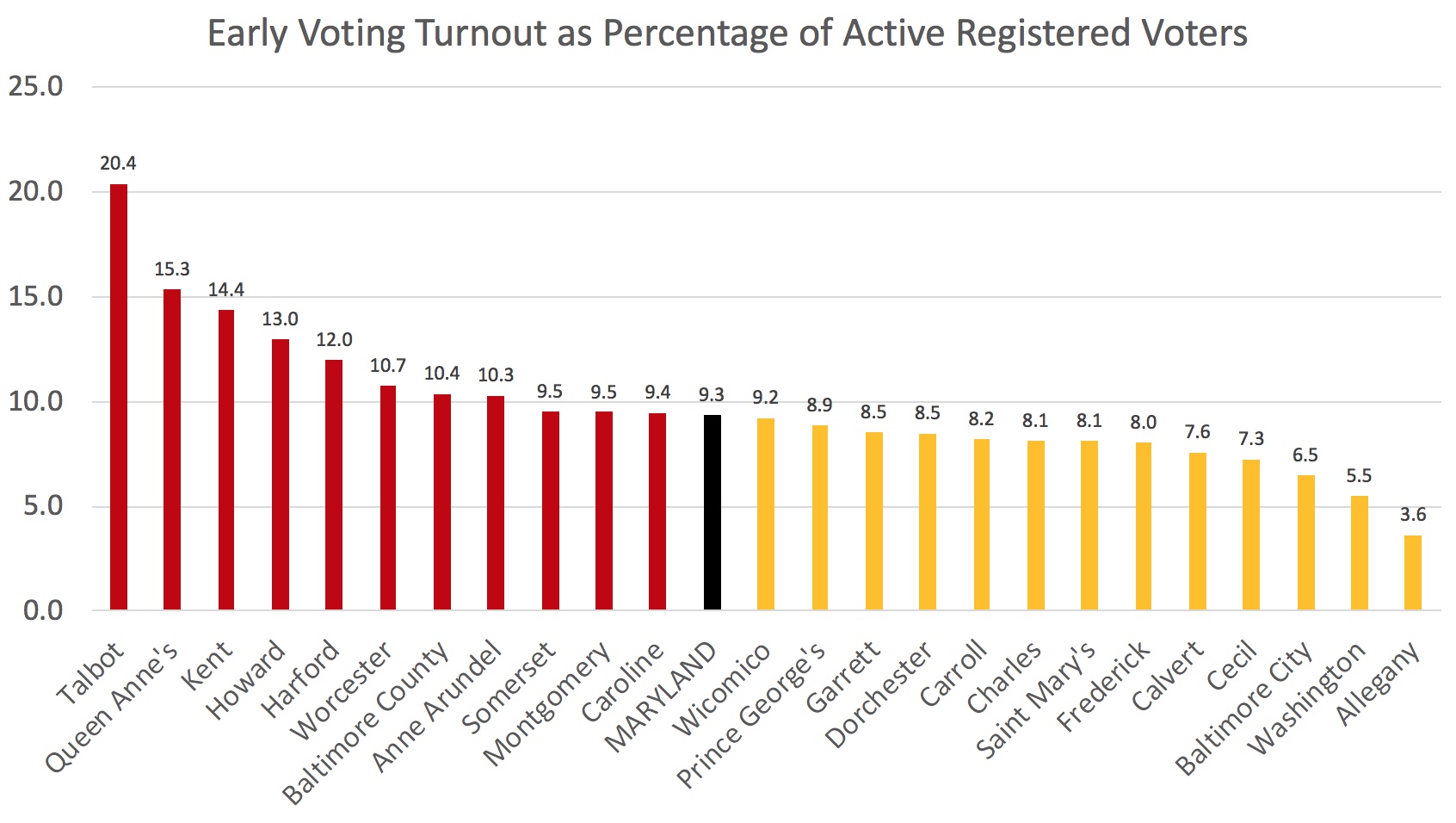
At the end of yesterday, 9.3% of registered Maryland voters had taken part in early voting. Talbot continues to lead the early voting pack as over one-fifth of its registered voters have now cast ballots. Allegany trails at the end with just 3.6% having participated in early voting. Indeed, all Western Maryland counties lag in early voting.

Most counties with hot executive races – Howard, Baltimore County and Anne Arundel – continue to have above average turnout but Frederick continues to be an exception. Montgomery has very average turnout despite its comparatively unusual three-way contest.

Most counties in CD 1 are also voting at high rates. Dorchester and Cecil continue to lag with Wicomico just below average but closing the gap with the state average compared to yesterday. It’s interesting to see Somerset in the above average category as this relatively poor county often has low turnout.

Share

MoCo Early Vote Day 5

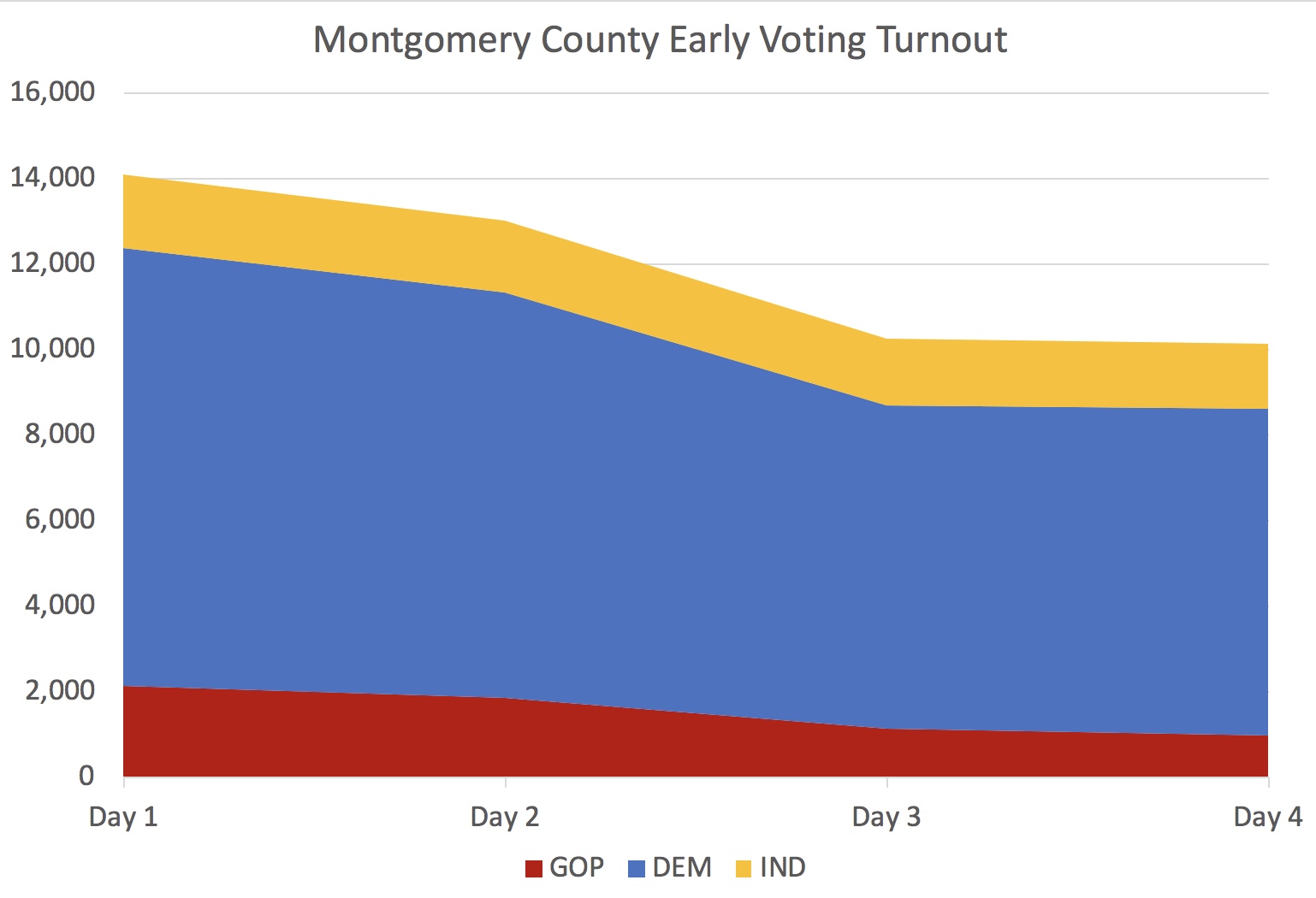
Early voting participation bounced back after the slow weekend to the highest so far this year in Montgomery, as 14,247 hit the polls – just 27 more voters than turned out on the first day.

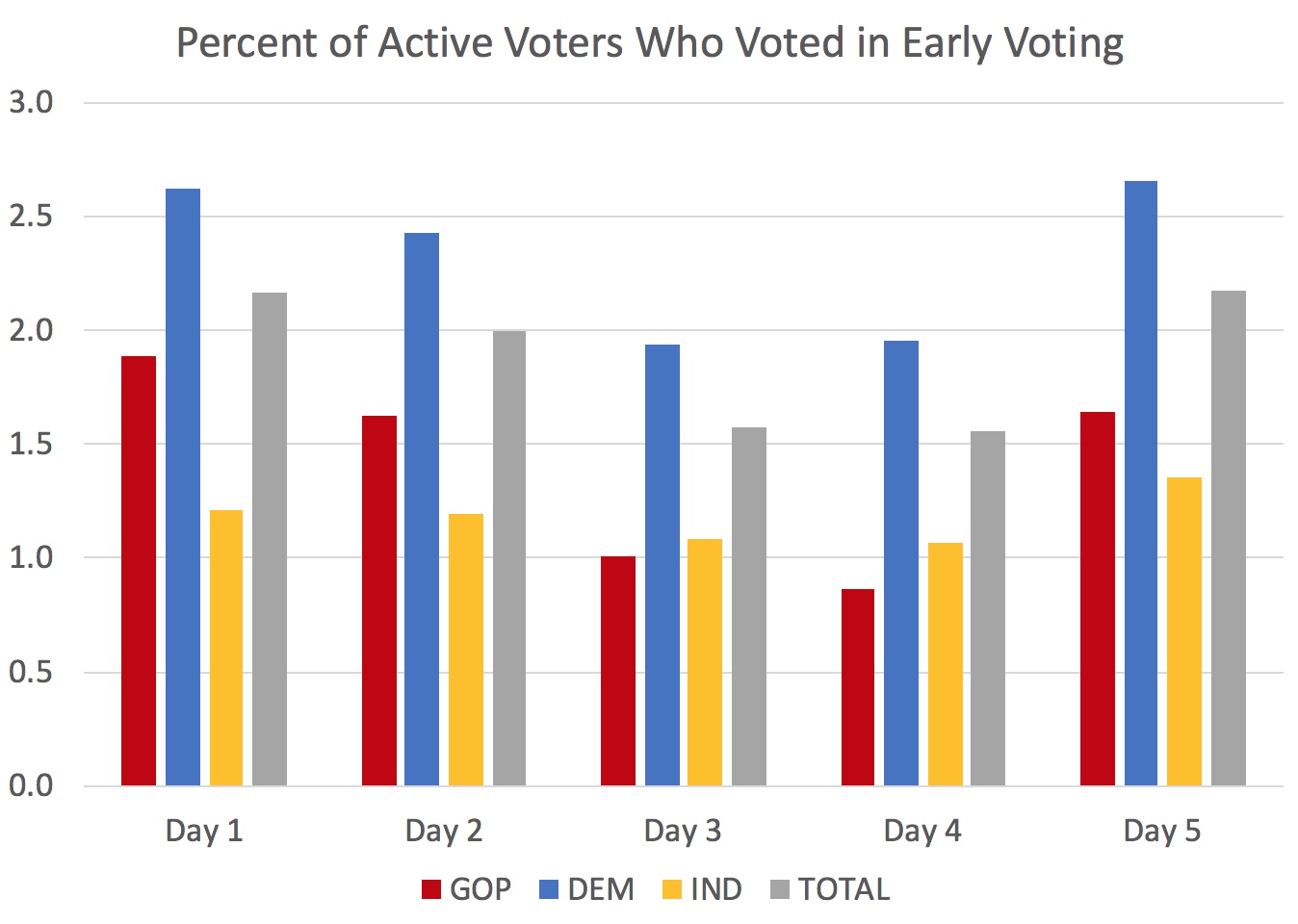
These numbers, however, don’t reflect changes in the composition of who voted early in Maryland’s largest county, The 72.8% share of Democrats among early voters was up 0.7% over the first day. In contrast, the 13.0% share of Republicans was down 2.0% as the share of independents rose.

At the end of day 5, 11.6% of registered Democrats in Montgomery had voted early, compared to 7.0% of Republicans and 5.9% of Democrats. To the extent that Montgomery has been turning out at slightly above state averages, it’s due to Democrats.

While Republicans may make up the difference on Election Day, the banked votes allows Democrats to focus on a smaller number of people who haven’t voted yet. You begin to see why Republicans don’t like early voting.

Share

No Evidence of Blue Wave Youth Turnout in Maryland Early Voting

At the end of the fourth day of early voting, age appears heavily correlated with participation in early voting. According to the raw data released by the State Board of Elections, here are the number of people who early voted by age cohort:

18-24: 9,588.
25-44: 41,586.
45-64: 117,992.
65 and older: 101,787
unknown: 7,818.

Looking simply at the raw numbers, the old are casting early voting ballots in massively higher numbers than the young. For example, the 45-64 cohort had 284% more voters than the 25-44 cohort. Both cover 20 year periods (i.e. one generation).

What does it look like if you consider the rate of turnout rather than absolute numbers? I used the 2015 Maryland Department of Planning population estimates to gauge the size of each cohort’s population. (It’s not perfect as it includes non-citizens but gives a rough indicator. Age is reported in five-year groups, so I estimated the 18 and 19 year olds as 40% of all people ages 15-19.)

Here are the resulting estimates of early voting turnout rates:

18-24: 1.7%
25-44: 2.7%
45-64: 7.4%
65 and older: 14.4%

If anything, I suspect that this understates age differences. Remember that among Latinos and Asian Americans, two groups with large immigrant populations, kids are far more likely to be citizens than their parents because many were born in the U.S. and are citizens and eligible voters by right. As a result, the older cohorts likely includes higher shares of non-citizens.

Some might ascribe especially low rates among 18-24 year olds due to many people this age being away at college. This may indeed depress turnout figures somewhat but turnout rates among 25-44 year olds are also very low.

The Ben Jealous campaign has argued that the polls showing Hogan leading him handily are wrong because, among other reasons, they “undercount young people” who are “energized” about voting this year. So far, the early voting data suggest that no blue wave of young voters has arrived yet.

Share

What Explains Which Counties Have High Rates of Early Voting?

Earlier today, I presented data on the share of people who have voted early for each Maryland county. At the end of the fourth day of early voting, 7.1% of registered Marylanders had voted. The share across counties varies much more widely from 2.8% in Allegany to 15.5% in Talbot.

What explains the variation?

St. Mary’s Political Science Professor Todd Eberly suggested on Twitter that he thought there were signs of higher turnout in counties that (1) have competitive executive races, and (2) are in the First Congressional District. Is he right?

Two other hypotheses occurred to me: (3) turnout might be higher in counties with more older residents as age is associated with participation, and (4) race might also be associated with voting. In particular, Latinos and Asian Americans tend to vote at lower rates than whites or African Americans.

I created multivariate models of turnout at the end of the fourth day of early voting in order to test these hypotheses. The models allow one to assess the probable impact of one factor while controlling for others. However, the relatively small number of units in Maryland (24) precludes including too many variables.

So where are more people voting? Increasing the share of the population over age 50 by 2% raises the predicted share of early voters in a county by an estimated 0.59% (p = .02 for the statistically minded who are familiar with OLS models).

Counties in the First CD also seem to be participating at higher rates, though the effect is small. In counties in which 100% of registered voters live in CD 1, turnout is an estimated 0.02% higher than elsewhere in the state (p = .04). Though perceived as a safe Republican seat, voters there seem energized this year.

Counties with hot executive races (defined here as Anne Arundel, Baltimore County, Frederick and Howard) are seeing much higher early voting turnout. The estimated impact of close exec contest on the share of early voters at the end of day 4 is 2.75% (p = .04). Including Montgomery as a hot race causes the effect to vanish, suggesting that our unusual three-way race is not motivating EV turnout in the same way in MoCo.

Contrary to my expectation due to historically lower rates of Latino and Asian turnout, counties with more non-Hispanic whites seem to have fewer early voters. Increasing their share of the population by 2% is estimated to reduce EV turnout at the end of day 4 by 0.10%. However, the effect is marginal as statistical significance is normally assessed (p = .09) and I would interpret with especial caution.

Closer examination of the data reveals that any impact is driven by the presence of Latinos and that changes in the share of blacks have no real impact on EV turnout. Only Montgomery and Prince George’s have relatively high shares of Latinos (and MoCo also has the highest share of Asians), so I suspect that what is being captured by the model is that these two counties have relatively high turnout once you consider that they are not in CD 1, don’t have tight exec races, and the age of their populations.

In case you were counting, Todd Eberly wins the hypothesis prediction race. Both of his panned out while one of my two turned out to be a turkey-and Thanksgiving isn’t quite here yet.


Share

Early Voting Turnout around the State

The share of all active registered voters who have participated in early voting varies widely around the state from a low of 2.8% in Allegany to 15.5% in Talbot. In Maryland as a whole, 7.1% have cast ballots via early voting.

The state’s largest jurisdictions show quite a spread too. Baltimore City has had low early voting turnout at 4.8%, as has Charles at 5.9%. Prince George’s and Frederick are slightly below average at 6.2%. In contrast, Montgomery is just a bit above average at 7.3%.

The Baltimore suburbs are generally showing above average turnout. Baltimore County and Anne Arundel are a slightly above average at 7.8% and 7.9%, respectively. EV turnout is 9.2% in Harford, and 10.1% in Howard.

While Democrats are turning out at much higher rates than other voters in Montgomery, the share of Democrats does not appear related to overall voter turnout across counties. Indeed, two jurisdictions with lower early voting turnout have the highest rates of Democratic registration-Baltimore City and Prince George’s.

These are also the only two black-majority jurisdictions. Charles is on the edge and also turning out at below state average rates in early voting. (Montgomery is a majority-minority county but with a mixture of non-white groups composing the majority.)

Ben Jealous has repeatedly touted his ability to get minority voters out and his campaign claims that polls are not capturing high rates of minority voting. So far, however, early voting turnout in the state’s most heavily African-American jurisdictions is under performing the state as a whole.

Note that turnout might still be up relative to the past but this graph doesn’t provide evidence in support of world-beating early voting in heavily black jurisdictions (unless we also think that white turnout in these same areas is extremely low for some reason).

Share

Democrats Dominate MoCo Early Voting

As has been true in the past, early voting turnout in Montgomery was lower over the weekend. The basic trends, however, remain the same. Democrats comprise the great bulk of early voters in the county, forming 73.0% of all early voters to date.

In contrast, the share of Republicans who voted early, 12.7%, is currently lower than the 13.5% of independent (i.e. unaffiliated) voters who have voted. This is a change from the first day, when the absolute number of Republicans who voted outnumbered independents.

Democrats outnumber Republicans at the polls not only because there are far more of them – 390,400 as opposed to 112,995 Republicans and 142,173 independents – but because they are voting at higher rates.

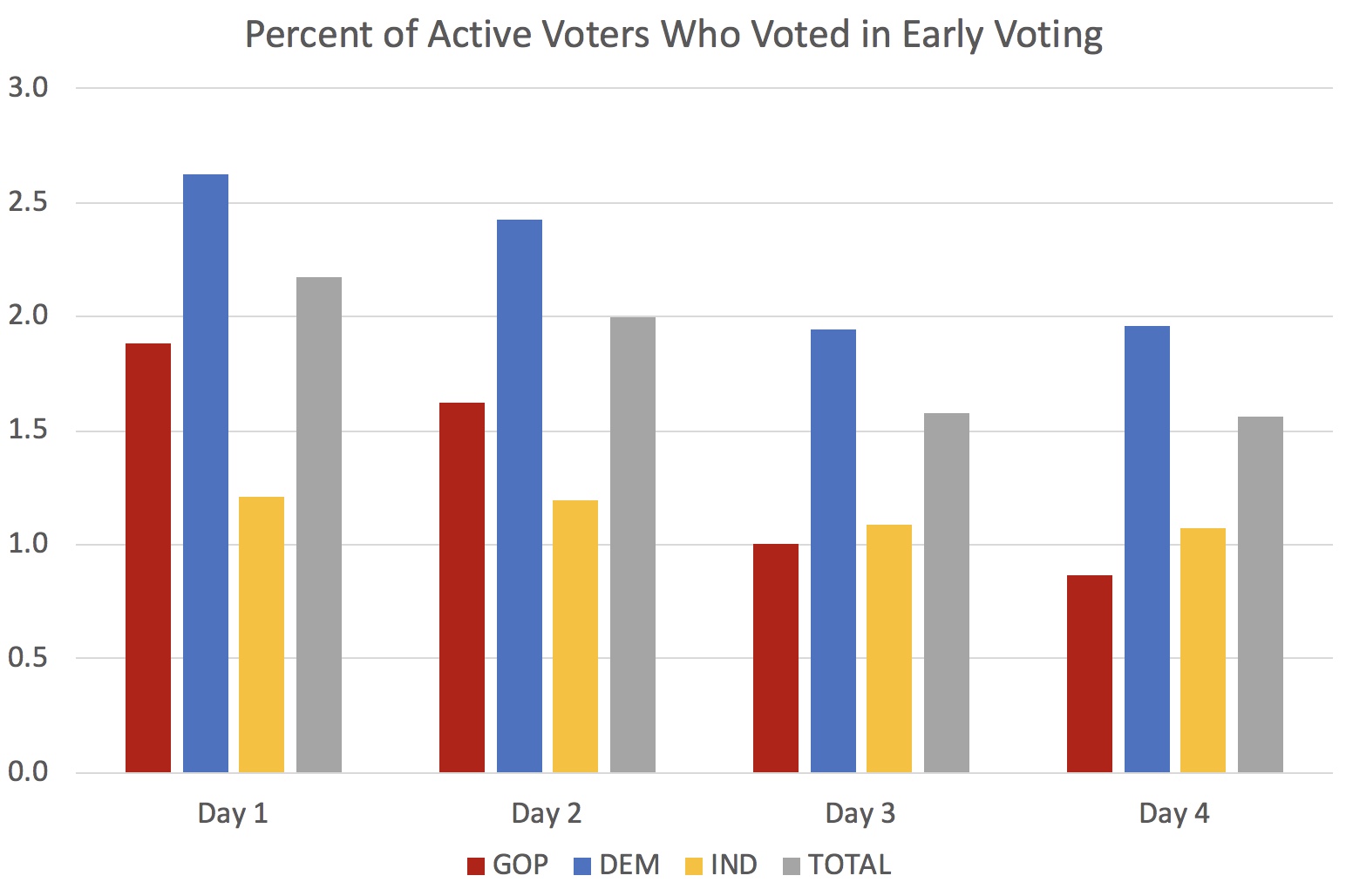
The share of Democrats participating in early voting has outpaced that of Republicans and independents on each of the first four days of early voting. After leading independents on the first two days, Republicans fell behind these voters who choose not to affiliate with a party over the weekend.

This is bad news for the Montgomery Republicans, as partisans normally participate at higher rates than independents. They will need to make up this difference through absentee voting and turnout at the polls.

The differences really add up over time. Right now, 9.0% of all registered Democrats (i.e. active voters) have voted in early voting. Only 5.4% of Republicans and 4.6% of independents have done the same. Put another way, Democrats are early voting 85% more often than Republicans and 96% more often than independents.

Remember, you can see wait times at early voting centers on the excellent Montgomery County Board of Elections website.

Share

The Pittsburgh Attack, George Washington, and This President

The tragic murder of at least 11 Jews at a Pittsburgh synagogue in the latest act of white supremacist terrorism should be an easy lift for any leader. You express sympathy for the victims, condemn anti-Semitism and despicable attacks of this sort at any place of worship, and vow to bring the perpetrator to justice.

Apparently, this was too much for President Trump in his initial response, who instead called for armed guards and lamented the slow pace of death penalty executions. Trump simply cannot bring himself to be a unifying force even briefly no matter the occasion. Even his later response avoided using the word “terrorism,” which is a totem for the right and Trump when such acts involve Muslims.

David Frum’s critique of President Trump’s response to today’s murders makes a devastating comparison:

There’s no politician to blame for the ideas in the synagogue murderer’s head. There are plenty to blame for the weapons in his hands. And at the top of that list is Trump, whose response to the killing was to blame the synagogue for not having armed guards of its own. In his famous letter to the Jewish congregations of Newport, Rhode Island, the nation’s first president pledged to them a country that would fulfill the biblical prophecy: “Every one shall sit in safety under his own vine and fig tree and there shall be none to make him afraid.”

Trump is an unworthy successor to George Washington who feeds off fear, normalizes it, and exploits it. He’s done it again today. This crime is not his fault at all. And yet he nevertheless found a way to use this crime to add to his own accumulating shame.

I’d go further than Frum and say that, even if Trump largely avoids direct anti-Semitism in favor of attacks on Blacks and Latinos, the regular stirring of white supremacy and the bile that goes with it along with his steady praise for violence has played a role in stimulating people like the shooter and the bomber.

Frum himself points out, “There is plenty of coded anti-Semitism in the United States: Every Jew knows who you mean when you castigate ‘globalists.'” There are lots of legitimate reasons to debate trade. But we’re kidding ourselves if we don’t think that fear of the foreigner animates much of the opposition to it.

Share

So Who Voted on Day 1 of Early Voting?

Early voting has started in Maryland. The Montgomery County Board of Elections helpfully provided me with statistics on turnout on the first day as well as information on where you can vote early and the lines are shortest.

Is Early Voting Turnout up?

Depends upon how you look at it. In Montgomery County, 14,519 eager voters hit early voting centers yesterday. That’s way up from the 4,321 who did the same in the 2014 midterm election but still decidedly lower than the 21,888 who cast ballots on the first day in the 2016 presidential.

Among the participants, 10,468 were Democrats, 2,168 were Republicans, and 1,883 were unaffiliated, Libertarian or Green party registrants. Based on the number of voters registered at the time of the primary (I can’t seem to locate quickly statistics on current on more recent registration levels), that’s 2.3% of all registered voters.

Good News for Democrats

At the time of the primary, 59.1% of registrants were Democrats, while 17.6% were Republicans and 23.3% were unaffiliated or registered Libertarian or Green.

Early voting statistics look quite different. At the end of the first day, 72.1% of early voters were Democrats – 13.0% higher than their share of the electorate. In contrast, only 14.9% were Republicans, 2.7% less than their share of the electorate.

Unaffiliated voters were the least likely to show up at early voting. Only 13.0% of first-day early voters were unaffiliated (or minor party) registrants. That’s fully 10.3% less than their share of all registered voters.

This last statistic isn’t terribly surprising. While many self-identified independents lean towards one party or the other, core independents who don’t lean towards either party form roughly 10% of the electorate. As a group, these voters know less about politics and participate at lower rates than partisans.

I know someone out there is thinking that this can’t be right because they’re an independent who always votes and some independents are just disenchanted with the two major parties. Remember that this information speaks to the the group of pure independents as a whole and may not apply to individuals.

The data is certainly encouraging for Democrats. However, Republicans tend to be more likely to vote at the polls than take advantage of early voting, so it’d be a mistake to assure that the electorate will necessarily be vastly changed this year.

Early Voting Information

Montgomery County has eleven early voting centers scattered around the county. The county has put together a cool website that now only shows their addresses but has links to maps and wait times.

The center nearest you may not be the quickest if it has a long wait. Traveling just a bit further to another center or going to one near your place of work may take less time if it has no wait. The Damascas Recreation Center, the Mid-County Recreation Center, Sandy Spring Fire Department, and Saint Catherine Laboure tend to have shorter waiting times.

Same Day Registration

On the first day of early voting, 59 people took advantage of the ability to register to vote at early voting. An additional 71 had their address changed or updated. Voters approved same day voter registration during early voting in a 2014 referendum.

Currently, same day voter registration is only allowed at early voting. But voters have a chance to expand this opportunity to election day at the polls by voting FOR Question 2, which would amend the Maryland Constitution to that end. I strongly encourage a vote in favor of this constitutional amendment.

Share

Sorry Larry, Not Nearly Good Enough on Trump

Gov. Larry Hogan has received plaudits for his willingness to utter any criticisms of Donald Trump’s grotesque behavior, in contrast to the lapdog approach that prevails among Republicans. Nevertheless, Hogan has been quite reluctant to criticize Trump and extremely strategic in both when and how he does it.

Larry Hogan relies regularly on one excuse to explain his usual unwillingness to comment on Trump:

But during the Obama administration, during the Trump administration, I always said: “I didn’t run for Congress. I didn’t run for the Senate. I’m not in Washington. My focus — what they hired me to do — was run the state of Maryland.”

Funnily enough, Hogan’s self-proclaimed laser-like focus on Maryland and reticence to attack the president or engage in national policy debates fell away when he opposed allowing Syrian refugees to be settled in Maryland when Barack Obama was president. Who knew that states set refugee policy?

In contrast, Hogan had nothing to say on Trump’s Muslim ban because “it didn’t rise to the point where it was something I thought I should weigh in on” notwithstanding massive protests at BWI. Earlier this year, Hogan opposed the separation of kids from parents at the border when Trump’s reactionary immigration policy threatened to imperil his own political future.

It’s not unusual that Hogan’s pique at having to comment on issues outside of Maryland melts away quickly when it suits his purposes. Taking time to campaign for Chris Christie in New Jersey and Ed Gillespie in Virginia sure wasn’t part of running Maryland. Hogan went out and stumped for Gillespie even as the campaign emulated Corey Stewart and went full Trump in its demagoguery.

In contrast, Hogan had nothing to say about the Republican tax bill in Washington that ended the state and local tax deduction – a major hit on many of his Maryland constituents. Sure seems news of the weird when a Republican won’t attack Washington for raising taxes on his constituents.

Even a cursory analysis reveals that Hogan’s gentle criticisms of Trump’s policies are often made without mentioning the president. Sstatements on Trump himself are usually calibrated carefully to appeal to Trump supporters even as he maintains his political viability in this heavily Democratic state.

Hogan’s statements on the Mueller investigation are typical. Right after Hogan said that ending the Mueller investigation “would be a step too far,” the Governor reflexively echoed the president’s talking point that “the investigation is going too far afield of its original intent.”

It’s classic Hogan, sound centrist but then immediately pivot to shore up the Trump base. Incredibly, Hogan also stated that “I can’t sit in judgment. Whether I like what’s going on, the people overwhelmingly elected him as president.” Overwhelmingly.

Yes, Hogan has clearly spoken out more than most Republican politicians. But it has been only occasionally and grudgingly. He benefits enormously from grade inflation stemming from the supine posture of virtually all Republicans towards Donald Trump.

When you think about the endless Republican efforts to somehow turn the tragedy in Benghazi into a crime by Hillary Clinton, their total lack of interest in any of Trump’s public violation of our laws and democratic norms is even more amazing.

Gov. Larry Hogan has greater responsibility to speak up precisely because he is a Republican. It ought to be more reprehensible to him when a member of his own party acts abominably than a Democrat because it reflects on his party.

Moreover, as a member of the same party, statements by Hogan against Trump’s routine breakage of presidential and democratic norms would carry more weight in our overly polarized era. Hogan has handled Trump very deftly from a political perspective. But political acumen is not the same as moral leadership.

Share