And just when I was getting ready to pull an Al Haig and take control.
Hogan leading with 57.4% to 41.5% for Jealous. Looks like all those Democrats who said it would be in single digits just might be wrong.
Frosh at 62% Franchot at 71%.

No, the crabs are not carrying the ballots one by one to Annapolis. Apparently, several precincts ran out of ballots and are now being kept open late. In other places, people were still waiting in line. The state doesn’t report returns while the polls are still open.
AP has nonetheless calling it for Hogan. Are they just guessing?
The State Board of Elections is posting nothing. The early returns that I cited from Montgomery County have now been pulled with a notice saying that early results will not be released until the SBOE says it’s alright. Nothing reporting in Frederick or Howard either. Baltimore County still has results up.
Sen. Kathy Klausmeier (D-8) is barely leading Del. Christian Miele in the early vote. This looks bad for her as Democrats normally lead int he early vote, which skews their way.
In District 42, Robbie Leonard (D) leads Del. Chris West (R) by 7% in the early vote. We’ll have to see how this develops in a seat that the Republicans are expecting to take tonight.
Montgomery is reporting the early vote now. For Governor, Jealous-Turnbull has 60% to 40% for Hogan-Rutherford. The early vote skewed very Democratic in Montgomery. If Hogan is getting 40% of the EV in Montgomery, he’s going to win easily.
Contrast that with the 84-85% that Frosh and Franchot-the D nominees for AG and Comprtroller, respectively-are receiving in Montgomery. While one poll made Frosh look shaky, he’s doing very well in his home county.
Meanwhile Marc Elrich has 68% (!) of the early vote in Montgomery to just 20% for Floreen and 12% for Ficker (R). Looks like Elrich is headed back to Rockville but as County Executive this time. Democrats are doing their usual sweep in other MoCo offices.
I hope to do some live blogging tonight. I have also created a results tracker in Google Docs that will provide results for (1) key state Senate races, (2) key House of Delegates races, (3) county executive races, and (4) county council composition.
You can find the results tracker at: https://tinyurl.com/ybtwqv4m
Eight Maryland counties elect county executives. These powerful offices are the equivalent of being mayor of a city. Incumbents are seeking reelection in five counties.
State’s Attorney Angela Alsobrooks is sure to win in Prince George’s where the Democratic nomination is tantamount to election.
Baltimore County has quite the race between John Olszewski, Jr. and Al Redmer. Republicans think they have this one, partly due to the enormous margins Hogan is expected to rack up. But Olszewski has unified Democrats and is pulling out all the stops. Democrats think he’ll win this one.
In Anne Arundel and Howard, Democrats are running unexpectedly lively challenges to two favored Republican incumbents. In Anne Arundel, development is a major issue, as are incumbent Steve Schuh’s occasional wanderings into more right-wing rhetoric on non-county issues.
Allen Kittleman in Howard has a more moderate profile but faces a more Democratic electorate. Additionally, Howard has exactly the highly educated profile of places that are swinging hard to the Democrats this year.
Despite challenges, both Anne Arundel and Howard lean Republican and it will an upset if Democrats win either. Based on past election statistics and the political leanings of each county, Schuh ought to be harder to defeat. But Kittleman has carefully tailored his profile to his county.
Montgomery has more of a race than usual. Councilmember Floreen has abandoned the Democrats to run as an independent. Though she often voted with Elrich on the Council, Floreen argues that Marc Elrich is too hostile to business. Republicans are left with perennial candidate Robin Ficker.
Elrich should win easily notwithstanding ongoing hostility from the Washington Post and their support for Floreen. Despite an influx of cash into Floreen’s campaign coffers, her campaign has just not been visible enough to make the case against Elrich needed in order to persuade the overwhelmingly Democratic electorate to defect to her in sufficient numbers.
In contrast, Elrich has attacked Floreen as a tool of developer interests and maintained good pre-election contact with Democrats. As a former council president, Floreen represents the status quo in a year when voters seem ready for change.
Even if Floreen does well in the less Democratic upcounty, she will still have to contend with the heavily Democratic crescent that contains far more voters. There are just too many loyal Democrats and not enough has been done to peel them off.
Finally, portions of Floreen’s campaign seem designed to alienate Republicans and she needs their support. Floreen has repeatedly identified herself as lifelong Democrat and publicized photos with Hillary Clinton. Neither seem likely to woo Republicans. Since Republicans have shown themselves willing to reject Ficker, I’m not sure it was the best approach.
I can’t say I know enough about the remaining races to make any strong predictions. In Frederick, Del. Kathy Afzali is challenging incumbent County Exec. Jan Gardner in what I imagine is a hard fought race in this purple county. Harford and Wicomico are the sorts of places that tend to elect Republicans countywide.
Now, I’m heading out to go vote. If you haven’t done the same, I encourage you to join me at the polls!
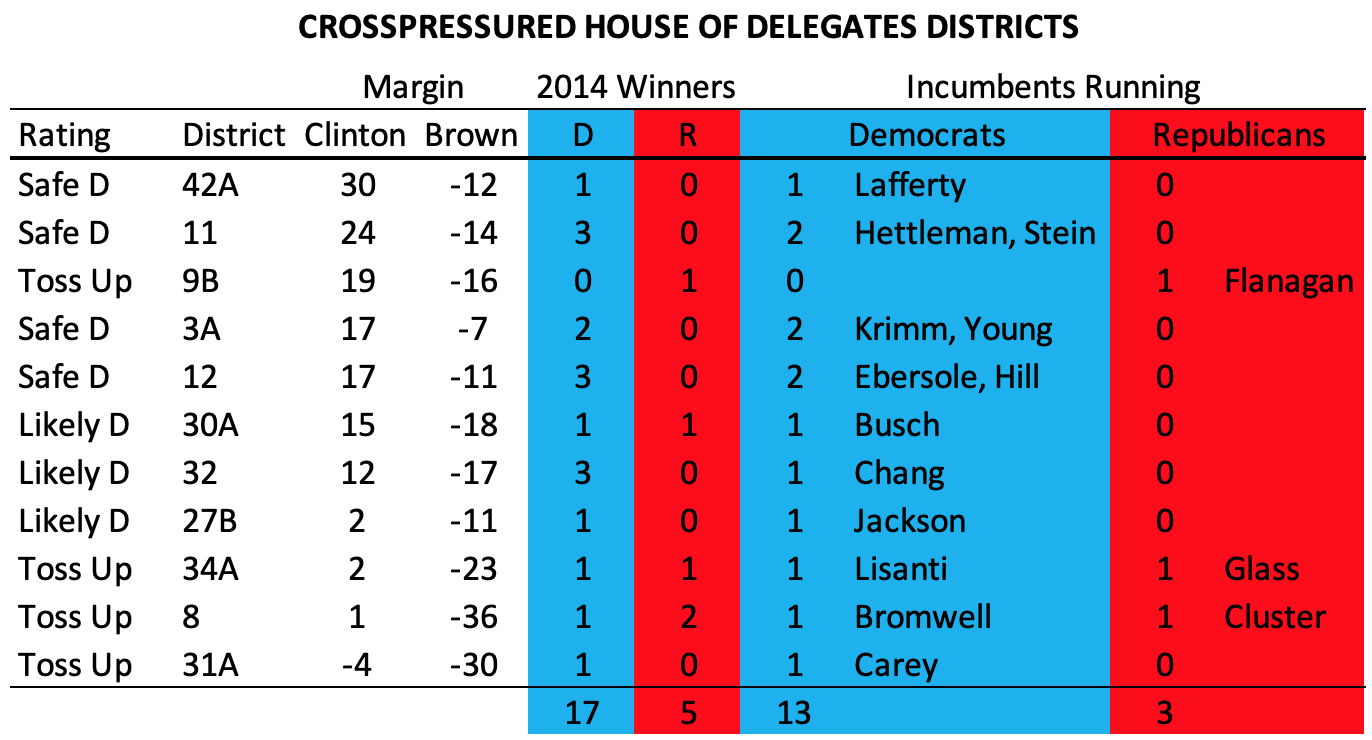 Any House of Delegates district that is crosspressured in the sense of having voted for Clinton in the 2016 presidential and for Hogan in the 2014 gubernatorial made this list. It additionally includes one district that elected a Democratic delegate in 2014 despite leaning Republican in these two contests.
Nevertheless, in many ways, the House of Delegates races are less interesting than the Senate. Republicans correctly perceive their chances of obtaining a veto-sustaining minority as greater in the Senate than the House.
Del. Robert Flanagan in District 9B is the most vulnerable Republican incumbent in either house of the General Assembly. While Hogan won his district by 16 in 2014, Clinton won it by 19 in 2016. This Howard district is exactly the type that is trending hard towards the Democrats due to its highly educated electorate.
Even worse for Flanagan, his opponent is Courtney Watson. While Watson lost the county executive race to Allen Kittleman in 2014, she is a well-known and experienced candidate. Flanagan will need all the luck he can get to hang on to his seat.
While Republican Glen Glass is likely safe in District 34A, any Democrat in Harford County always has to watch their back. Del. Mary Ann Lisanti who also represents 34A is no exception. The district, centered on Havre de Grace, went slightly for Clinton in 2016. The likelihood that Hogan will roll up an even greater margin than the 23 points he won in 2014 is no help to Lisanti. Still, she’s established and voters here clearly are used to splitting tickets.
In east Baltimore County District 8, the Republicans are likely safe and looking to take sole Democrat Del. Eric Bromwell’s seat. But Bromwells have long been a strong candidate in this district and he may be a tad better positioned than Sen. Kathy Klausmeier.
But Johnny Oleszewski’s family also had its own brand in neighboring District 6 before he lost in 2014. Bromwell came in third in 2014. While the best candidate that the Democrats could run, the question remains whether Bromwell can overcome a Hogan margin even more massive than the 36 points from 2014 in a district moving away from the Democrats.
Seeking a second term, Del. Ned Carey already represents Republican territory in District 31A in Anne Arundel. It went for Trump over Clinton by 4 points and for Hogan over Brown by 30 points. I suppose the good news for him is that the Hogan margin was smaller than in Bromwell’s district.
If he won this turf in tough 2014, Carey may be hard to dislodge in a more favorable 2018. Still, Carey won by just 52.6% in 2014, so has only a small cushion. Located just south of Baltimore City, the question is whether a less hellacious political climate can overcome an even larger margin for Hogan.
In District 30, Speaker Busch is looking to pick up the seat being vacated for his long-time bête noire Herb McMillan. While the Republicans always look to take out Busch, the recent Democratic sweep in Annapolis bodes far better for a Democratic pickup than a surprise defeat of Maryland’s longest serving Speaker.
I doubt Republicans will take out either Del. Michael Jackson in District 27B or pickup any of the three delegate seats in District 32, though Del. Michael Chang is the only incumbent running. Clinton won both districts by at least 12 points. Hogan’s margins will not be high enough to allow Republicans to capitalize on the gov’s success when split-ticket voting is rampant.
It seems virtually impossible that the Democrats will lose seats in Districts 3A, 11, ,12 or 42A. Hillary Clinton won all of these districts by more than 17 points. Voters in these districts are happy to split their tickets in the gubernatorial but it won’t be enough to take out the Democratic delegate candidates.
In District 3, Sen. Ron Young is endangered but District 3A excludes the most Republican turf. Dels. Carol Krimm and Karen Young should return to the House.
In District 11, the Republicans are running only one candidate. Incumbents Shelly Hettleman and Dana Stein will be rejoined by Jon Cardin, who ran unsuccessfully for attorney general in 2014.
District 12 contains much territory in Howard with many highly educated voters of the sort that are moving Democratic this year. There is little reason to think that the Republicans will close the substantial gap of several thousand votes from 2014. In any case, their top vote getter from that year is running for Senate. I expect Democratic Dels. Eric Ebersole and Terri Hill to be joined by Jessica Feldmark.
Incumbent Stephen Lafferty did not run for Senate and instead chose to seek reelection in District 42A. While Hogan will carry this district, it is hard to imagine Republicans defeating Lafferty in a district that went for Clinton by 30 points.
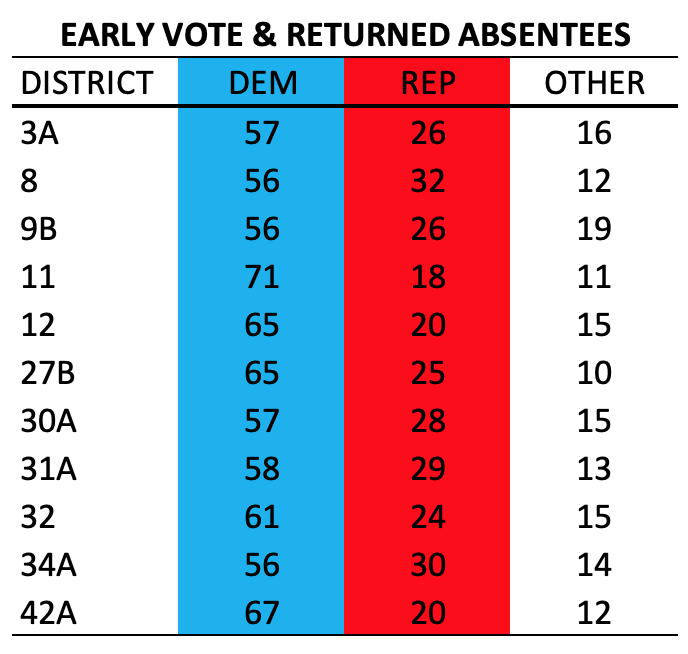
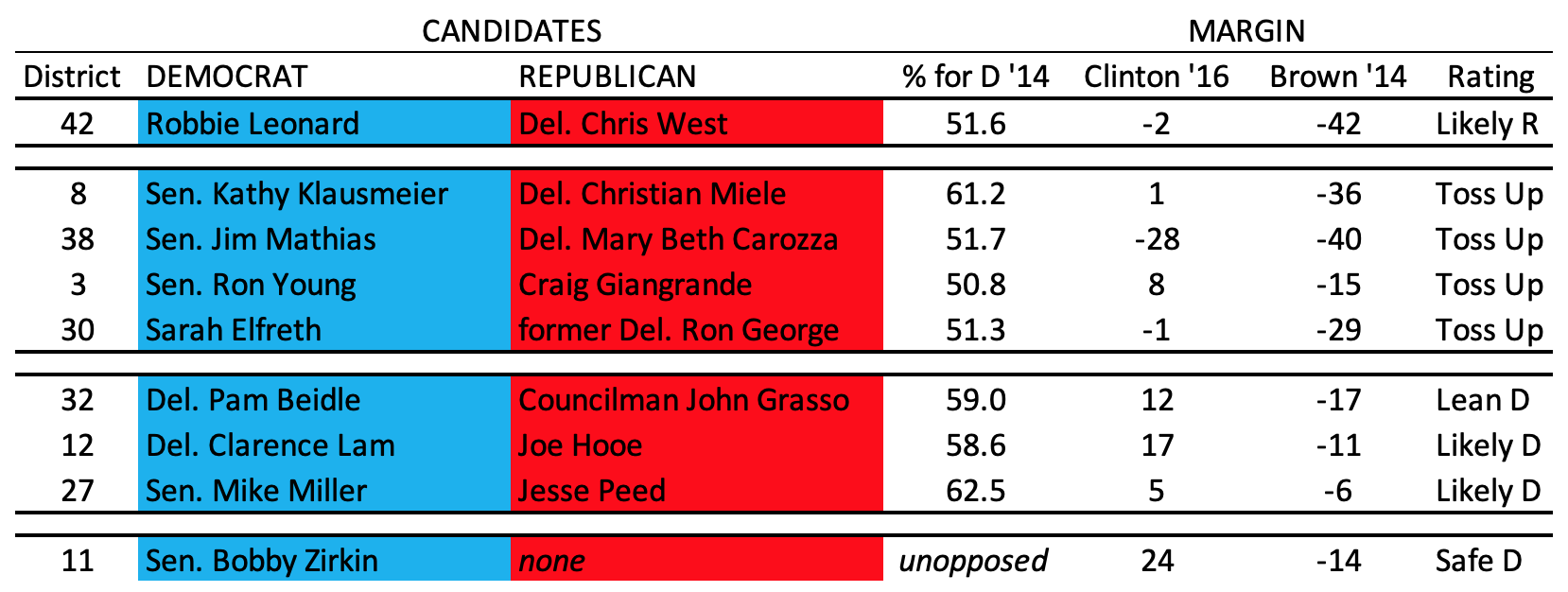
Earlier tonight, I detailed the list of 24 safe Democratic and 14 safe Republican seats in the General Assembly. Included on that list was any seat that the appropriate party swept in (1) the 2014 gubernatorial election, (2) the 2016 presidential election, and (3) the 2014 state legislative elections.
Sen. Bobby Zirkin (D-11) should really have been included on the safe list, as he enviably has no opponent. Though Hogan won the seat by 14 in 2014, Republicans evidently decided not to take on Zirkin in this seat won by Clinton by 24 in 2016.
That leaves eight vulnerable Democratic seats. Republicans need to net five to gain enough seats to uphold a veto should Larry Hogan win election to a second term tomorrow. Today’s scorecard ranks them from most to least vulnerable:
1. District 42 (OPEN) Likely Republican
This Baltimore County district meanders from the City to the Pennsylvania border. Sen. Jim Brochin (D), the most moderate member of the General Assembly, gave up his seat to run for Baltimore County executive. He lost the Democratic nomination by just a hair to Democrat Johnny Oleszewski.
An astute campaigner, Brochin nevertheless held the seat with just 51.6% in 2014. That Brochin held it at all is a credit to his skills. Hogan won it by 42 points-more than any other seat on this list of vulnerable Democratic seats.
Republican Del. Chris West (R-42B) already represents two-thirds of the district and hopes to move to the Senate. Robbie Leonard, his opponent, is a former chair of the Baltimore County Democratic Central Committee. It’s hard to see how Leonard wins in a district that Clinton lost narrowly in 2016 and that Hogan will likely take by even more in 2018 than four years ago. But anything is possible if Democrats perform strongly enough tomorrow.
Early Vote + Returned Absentees: 54% D, 32% R, 13% other.
2. District 8 (Kathy Klausmeier) Toss Up
Though not the most Republican seat on this list, Sen. Kathy Klausmeier is nonetheless the most vulnerable incumbent Democrat running for reelection. She is facing her toughest contest yet as she hopes to fend off Republican Del. Christian Miele.
This east Baltimore County district barely went for Clinton in 2016 just two years after Hogan won it by 36. In many ways, it resembles neighboring District 6, which had long been held by Democrats until it fell to a Republican sweep in 2014 and took down Johnny O’s Senate ambitions with them.
While D6 is 6% more African American than D8, it too has many white voters who find Trump appealing and among whom Hogan is the consensus choice. Miele is a strong candidate with fewer vulnerabilities than other Republican challengers, notwithstanding his odd links to marijuana lobbyist Max Davidson.
Republicans already hold two of the delegate seats. One wonders if any less well attuned Democrats than Sen. Klausmeier and Del. Bromwell would have a shot in a district that seems to be moving away from them. It doesn’t help Democrats that the Jealous campaign doesn’t speak to the concerns of this district’s voters even as Hogan remains quite appealing.
Early Vote + Returned Absentees: 56% D, 32% R, 12% other.
3. District 38 (Jim Mathias) Toss Up
No Democrat other than Sen. Jim Mathias would even have a prayer in this seat. Trump beat Clinton by 28 points and Hogan defeated Brown by 40 points in this southeastern Eastern Shore district. Republicans took all three of the delegate districts in 2014. So why isn’t Del. Mary Beth Carozza just waltzing into this seat?
Like Larry Hogan, Jim Mathias has his own brand. Neither would have a hope of winning if they were heavily identified with their political party. It also doesn’t hurt that former Ocean City Mayor Mathias has represented all of D38, while Carozza now serves just one-third of it in the House of Delegates.
There are two hugely contrasting trends here. The electorate can only be more favorable to Mathias than in 2014 when Democratic turnout sagged terribly. On the other hand, my bet is Hogan wins by even more than four years ago.
Mathias will always have a target on his back. But he has his own brand and the financial backing needed for his campaign. By all rights, Republicans should win this one but Mathias may well keep them at bay for another four years.
Early Vote + Returned Absentees: 43% D, 45% R, 12% other.
4. District 3 (Ron Young) Toss Up
In contrast to Klausmeier’s Baltimore County district, Young’s Frederick County district seems to be moving towards the Democrats. Clinton won it by 8 in 2016 and Hogan’s 15 point 2014 win was less impressive than other similar areas.
More Democratic voters keep moving into the area, resulting in the shift that has already turned Frederick from a red Republican bastion into a decidedly purple county. In the most recent Frederick City elections, Democrats convincingly ousted Republicans.
The problem for Democrats here is Young fatigue. A solid member of the Senate, Young has nevertheless been around Frederick politics a long time in a year when experience is seen as code for outdated and untrustworthy by many. His opponent, Craig Giangrande, has no political experience but a lot of cash.
Young won by a bare majority four years ago when he earned a second Senate term. The more congenial composition of the electorate combined with long-term trends ought to help him out even if Hogan is well positioned to pad his margins here. Democrats will nonetheless want to get out every last vote to hold this seat.
Early Vote + Returned Absentees: 56% D, 28% R, 16% other.
5. District 30 (OPEN) Toss Up
Sen. John Astle (D) is stepping down after an unsuccessful run for mayor of Annapolis. Democrat Sarah Elfreth represents a young but politically experienced and savvy fresh face. In a year when voters seem interested in new candidates, she combines it with an utterly capable and trustworthy pair of hands.
The district is not easy territory for Democrats. Clinton lost it by 1 in 2016 and Brown fell 29 points short in 2014. Note, however, that this is still 7 points better than in Klausmeier’s district. The likelihood that the electorate will be more congenial in 2018 than 2014 for Democrats will also aid Elfreth.
Elfreth also benefits from her opponent, former Del. Ron George, who is 65 and been around the political block. He won his seat by coming in third place in District 30 in 2006 but came in second when he won reelection in 2010.
Someone edited his Wikipedia page to state that George came in fourth in the Republican gubernatorial primary in 2014. This seems a bit kind since fourth was also last with just 12% of the vote. Even in District 30, he won only 30% of the primary vote.
George’s love for conspiracy theories and Hitler memes isn’t helping his comeback bid. If elections were solely about candidate talent, Elfreth would win this in a slam dunk. As it stands, George is helping Elfreth’s efforts to keep him a has been in a district that ought to be congenial to Republican suasion. Democrats also hope that the shellacking they gave Republicans in the Annapolis elections bodes well for tomorrow.
Early Vote + Returned Absentees: 53% D, 31% R, 15% other.
6. District 32 (OPEN) Lean Democratic
Del. Pam Beidle has already represented this entire district. A talented candidate well attuned to her district despite being more liberal than the Democrat she seeks to replace, Beidle is the favorite.
Her opponent, Anne Arundel Councilman John Grasso, is term limited off the Council. Like Ron George, John Grasso is social media challenged with a penchant for online nuttery. Unlike George, he is still in office so better known.
District 32 leans far less Republican than the more vulnerable districts higher up on this list. Clinton won it by 12 in 2016, though Hogan carried it by 17 in 2014. Unless Hogan has longer coattails or Grasso proves more formidable than expected, Beidle is the favorite to move from the House to the Senate.
Early Vote + Returned Absentees: 61% D, 24% R, 15% other.
7. District 12 (OPEN) Likely Democratic
Democratic Nominee Clarence Lam is a first-term delegate seeking to hold the seek being vacated by B&T Chair Ed Kasemeyer. Clinton won this turf in Howard and Baltimore Counties by 17 points in 2016 while Hogan won it by 11 in 2014.
Howard is one the most highly educated places in our highly educated state. Put another way, it’s exactly the sort of place where people are moving away from the Republicans in the era of Donald Trump. Unless Hogan inspires partisan loyalty totally at odds with his carefully cultivated persona, Lam should win this one.
Early Vote + Returned Absentees: 65% D, 20% R, 15% other.
8. District 27 (Miller) Likely Democratic
This district makes the list for a few reasons. First, it is the final crosspressured district that went for Clinton and Hogan. Interestingly, District 27 seems to have lesser tendencies for ticket splitting based on the relatively small difference between their performances compared to elsewhere in the state. The relatively small share of non-major party early voters (see below) also is suggestive of a more partisan electorate.
Second, Republicans are always tempted by the fantasy of taking out the longest serving legislative leader in American history. But you don’t survive in that position for so long based on dumb luck, so the dream seems likely to remain a dream. Nevertheless, I hope this inspires someone in the Senate President’s office to call and yell at me. I always enjoy hearing from them!
Early Vote + Returned Absentees: 66% D, 24% R, 10% other.
