All posts by David Lublin

Democrats Poised to Take Control of Frederick County Council

On election night, Republicans led in four of the seven Frederick County Council seats. But the counting of absentee ballots has flipped District 1. Right now, incumbent Democratic Councilmember Jerry Donald leads Republican Kevin Grubb by 209 votes.

This lead looks likely to hold up in the final count due to the disproportionate share of Democrats among absentee and provisional ballots. If it does, Democrats will gain unified control of Frederick County’s government, as Democratic County Executive Jan Gardner was reelected over Republican Del. Kathy Afzali.

This would make Frederick the third county council that Democrats flipped in this election along with Anne Arundel and Dorchester. Democrats also picked up county exec seats in Anne Arundel and Howard, bringing their total to six of the eight elected around the state.

The council seat gain brings the net number of county council or commission seats gained by Democrats to nine. The Republicans have lost just seven as two of the gains were new at-large seats in Prince George’s. Republicans still lead Democrats by 74 to 70 in seat totals thanks to their domination of Maryland’s smaller counties.

h/t to Walter Olson.

Share

Kittleman’s Class Act

Allen Kittleman and Calvin Ball

In today’s America, too many politicians are teaching the lesson that when you lose an election, the proper response is cry fraud and accuse nefarious dark forces of stealing the election.

On election night, Howard County Executive Allen Kittleman (R) showed the content of his character when he not only conceded but came to Councilmember Calvin Ball’s (D) victory party to concede in person and give him a hug.

Way beyond what is required but Kittleman has always been a class act and respectful man. What a wonderful service for the outgoing county executive to provide his constituents. What a powerful image of how politics can be.

Share

Nancy Floreen split the Republican vote, not the Democratic!, and three other 2018 lessons learned

Today, I am pleased to present a guest post from former Takoma Park Councilmember Seth Grimes. Earlier this year, Seth sought one of the at-large seats on the Montgomery County Council.

The 2018 election was good for the Democrats nationally although Maryland results were pretty much status quo. My own focus is local however, on Montgomery County, so let’s look at the numbers here in Maryland’s largest county. I draw four conclusions…

Conclusion #1: County executive candidate Nancy Floreen split the Republican vote, not the Democratic!

This year, Democrat Marc Elrich won 64.3% of the vote (preliminary result) to Independent Nancy Floreen’s 19.2% and Republican Robin Ficker’s 16.4%.

Contrast with 2014, when incumbent Democrat Ike Leggett won a third term as county executive with 65.3% of the vote to Republican Jim Shalleck’s 34.2%.

This year, the non-Democrats’ votes, Floreen’s and Ficker’s, total 35.6%. Compare to Republic Shalleck’s 34.2% in 2014. The difference is a mere 1.2 points. Trump-era Democrats’ stayed true to their party, and Nancy Floreen split the Republican vote, not the Democratic!

Conclusion #2: Public finance works, and woe betide a candidate who raises narrowly.

Marc Elrich maxed out on public-finance matching funds, receiving $750,000 in public money for the primary and $750,000 for the general election, given support from over 3,600 donors who contributed $150 or less. Nancy Floreen’s campaign had 685 donors, less than one-fifth Elrich’s count.

It’s said that “yard signs don’t vote,” but donors do, and given their campaign equity, they tell their friends about their candidate. A public-finance candidate must build a substantial donor-voter base in order to receive matching funds. To max out, the candidate must go wide by raising from diverse geographic, cultural, and age demographics and interests.

Yet Floreen stayed narrow. Montgomery Neighbors PAC found that “87.5% of the total funds raised in support of Nancy Floreen’s campaign,” direct to her campaign and to the County Above Party Super PAC, “comes from one industry – land developers, financiers, builders, apartment managers, service providers, and commercial and residential real estate agents.”

Public finance worked by providing Elrich both the funds he needed to win and an incentive to go wide. Floreen stayed narrow and lost.

Conclusion #3: Montgomery County voted county, party, and PRESENCE, to the detriment of Ben Jealous.

Both Marc Elrich and Nancy Floreen are long-time local electeds with oversize personalities. They have equal presence. It’s party and positioning that explain Elrich’s victory over Floreen. The perception that Elrich cares about everyday people contrasts with Floreen’s perceived pro-developer bias.

Why didn’t Democrats similarly back Ben Jealous? He and Elrich are cut from the same progressive cloth, yet in Democrat-dominated Montgomery County, Jealous scored only 54.5%, lagging Elrich by 10.8 points.

Jealous’s Maryland association was simply too weak. He lacked local presence, coming across as a movement guy more than as someone you’d look to craft a workable state budget. His scant state voting record didn’t help, and his involvement in the Maryland marriage-equality fight was peripheral. So most Marylanders were introduced to Jealous as a Bernie guy, which gets you only so far. Bernie Sanders did show up for his 2016 state campaign chair, saying “I am proud to be here because Ben is one of those leaders who is not going to be nibbling around the edges, but understands we have got to transform the economic and political life of this country.”

I suspect that most Marylanders — the state overall went voted 56% for Hogan and 43% for Jealous — wanted a first-term governor who they could be confident would focus on the state first. Fine for incumbent Maryland Attorney General Brian Frosh to spend time going after Donald Trump. Frosh is a Montgomery County native who has served the state well, and he earned 77.8% of the county’s vote this year. Going back to 2014, Democratic gubernatorial candidate Anthony Brown was well known as then-Lieutenant Governor and won in Montgomery County over Hogan 61.7% to 36.9%. Both Frosh and Brown in 2014 possessed the presence that Jealous lacked, the voter’s sense that the candidate is in it for the long haul for us.

Conclusion #4: The 2022 election just became a bit less interesting.

Progressive Marc Elrich earned only one percentage point fewer votes than centrist incumbent Ike Leggett did in 2014. This fact should give pause to anyone thinking of challenging Elrich from the center in the 2022 Democratic primary, whether that person is a business figure (David Blair’s positioning in this year’s primary) or a known political quantity, say a term-limited councilmember. Then again, one of those latter figures could make a compelling 2022 candidate for statewide office. Let the positioning begin!

Share

Delegate Moon Analyzes the Results and Moving Forward

Today I am pleased to present a guest post from Delegate David Moon (D-20). Del. Moon is a leading progressive voice in the House of Delegates and was a savvy campaigner manager and blogger before he took the plunge and entered the House:

GOVERNORS RACE – The big story is obviously that Larry Hogan won a second term as Governor. I like the guy and wish him well, but no offense, I just couldn’t support him when he’s been vetoing things like paid sick days, renewable energy, ex-felon voting rights and marijuana decriminalization. I will give him credit on criminal justice reform, because I think he’s better than some Democrats on that issue, and his administration actively worked with our side to craft the Justice Reinvestment Act (note: Maryland now leads America in its prison population decline).

DOWNBALLOT RACES – Maryland preserved the status quo in its Congressional Delegation yesterday (2 Democratic US Senators, 7 Democratic US House Members, and 1 GOP US House Member). In contrast, the downballot races witnessed some big shifts, and Hogan’s win did not come with coattails in the state’s numerous competitive County Executive races. Democrats already had the top offices in Baltimore City, Baltimore County, Prince George’s, Montgomery, and Frederick. Last night, we held onto all of those offices, despite the purple tone of Baltimore and Frederick counties. More importantly, Democrats defeated the incumbent County Executives in Howard and Anne Arundel. That means we swept the elections in all of the state’s major population centers, and last year we replaced incumbent Republican Mayors in Annapolis and Frederick with Democrats.

HOGAN’S FUTURE – But I’ve had so many questions about how a 2nd Term Larry Hogan would choose to govern. Believe it or not, I’m actually a fan of the idea of Hogan trying to go national in the Republican Party, because he’s far less crazy than the current leaders in the national GOP. The problem is, that Larry Hogan is now term-limited, so he may not have to face Maryland voters again. Additionally, the current national GOP base incentivizes views that would not be considered moderate to the Democratic electorate in Maryland. Consider, for example, John McCain’s Confederate flag pandering in the South Carolina GOP Presidential Primary (he later apologized). Does an ambitious Hogan need to similarly worry about the GOP base and rightwing donors if he wants a future in the national GOP, or will he govern like the “bipartisan” candidate that appeared in Maryland? I suppose we’ll soon find out, and I assume this relates to what Hogan plans to do next. The calculus might be very different if he decides to run for US Senate vs President.

BUT THOSE VETOS – Either way, Hogan’s pesky vetos have always weighed heavy on me. Even knowing he had to face Maryland voters again, First Term Larry Hogan still vetoed popular policies like increasing renewable energy and guaranteeing paid sick days. It was only because of the veto-proof Democratic majorities in the House & Senate that Hogan’s wishes never became policy in Maryland. Imagine the opposition he would’ve faced this election cycle if we didn’t override his vetos, and policies like renewable energy and sick days then failed because of him.

Notably, Hogan was very publicly trying to defeat enough Democratic Senators yesterday to overrule the legislature on the issues I mentioned above (Google Larry Hogan “Drive for Five”). He was so upset about the Democratic veto overrides that he even opposed incumbent GOP Senator Steve Waugh in this year’s Republican Primary, because Waugh sometimes voted to override Hogan’s vetos. Waugh was then defeated in the primary by a Hogan-backed candidate, who we can now assume will tow the GOP party line on veto overrides (is that what moderate bipartisanship looks like?).

Clearly, Hogan cared about the Democratic policies he vetoed (I care too). But it remains troubling to me that these vetos were not a major focus of debate in yesterday’s election. It is not so mysterious though, when you consider how much of our attention has been drawn toward the Trump administration, and how Trump’s unique brand of crazy makes our governor look moderate, even when vetoing modest renewable energy increases. “Moderate” is obviously and inherently a relative concept.

MD HOUSE & SENATE – The good news is that Hogan didn’t succeed in breaking the Democratic supermajorities in the  State House and State Senate. Not even close. In the House of Delegates, not a single Democratic incumbent lost re-election yesterday, so all of our swing district Democrats are coming back. Moreover, we won 6 or 7 State House seats currently held by Republican Delegates, and we only lost 1 seat in the State Senate, where Hogan was targeting his efforts to destroy the Democratic veto-proof majority:

Democrats Gain 6 or 7 State House Seats
D3A (Frederick County) Ken Kerr defeats Bill Folden
D8 (Baltimore County) Harry Bhandari defeats Joe Cluster
D9B (Howard County)  Courtney Watson defeats Bob Flanagan D29B (St Mary’s County)  Brian Crosby defeats Deb Rey
D30A (Anne Arundel County)  Alice Cain wins open seat
D34A (Harford County) Steve Johnson with a 25-vote lead over Glen Glass
D42B (Baltimore County) Michelle Guyton wins open seat

Republicans Net 1 State Senate Seat
D9 (Howard) Democrat Katie Fry Hester defeats Sen. Gail Bates
D38 (Lower Eastern Shore) Republican Mary Beth Carozza defeats Sen. Jim Mathias

D42 (Baltimore Co) Republican Chris West wins open seat

8 FUTURE ISSUE BATTLES IN MARYLAND – It will be very interesting to see how yesterday’s election impacts the politics of the General Assembly. Here are a few issues I’m keeping an eye on:

1) IMMIGRATION – In the last four year term, the State House passed a few bills intended to provide protections to immigrants in Maryland. These bills generally died in the State Senate, perhaps with some concern about the seats Democrats had to defend in conservative territory this year. But House Democrats gained seats, even while passing policies like the “Trust Act,” which were labeled “sanctuary state” bills by the opposition. Hopefully this means immigration gets a fresh look in 2019.

2) MARIJUANA – Likewise marijuana legalization was at a potential fork in the road given Jealous’ support for the reform, and Hogan’s relative silence (but openness to a referendum). For what it’s worth, Michigan voters approved legalization yesterday, while Missouri and Utah of all places, approved medical marijuana.

3) JUDICIAL APPOINTMENTS – There was some discussion during the election about the fact that due to Maryland’s mandatory retirement age for judges, 5 out of 7 members of our state’s highest court would be appointed by our next Governor (Hogan). Notably, during the last term there were serious pushes to increase the retirement age. Perhaps that issue returns once again.

4) TAX CUTS – Given that Hogan ran on cutting taxes (something he hasn’t really delivered on), I assume he’ll try again. We have a temporary budget surplus, but some Democrats will probably want to use it for something else like….

5) SCHOOL FUNDING – The Kirwan Commission recommendations for school funding and innovation will soon be made into policy proposals (eg: Pre-K). These will cost money. What will Hogan do?

6) HIGHWAY WIDENING – This was Hogan’s idea, so if he had lost re-election, these highway widening proposals would’ve been dead. Now they’re not. There will be a fight.

7) MINIMUM WAGE – There’s going to be a “Fight for $15” push in Maryland, and Montgomery County now has a minimum wage indexed to inflation. This debate is unavoidable.

8) REDISTRICTING – Duh.

How does all of this play out with a term-limited Republican Governor serving with an even deeper bench of Democratic lawmakers and County Executives? Hold on to your hats! The next four years are going to be very interesting.

Share

New Minority Members of the U.S. House

I’m trying to compile a list of new African-American, Latino, Asian American and Native American Members of Congress. Additionally, I am attempting to identify the ethnicity/country of origin for Latinos and Asian Americans.

I’m concerned that I may have missed someone and am missing a few ethnicities. Any corrections or additions would be welcome

Latinos
Jesus “Chuy” Garcia (IL 4), Mexican
Alexandria Ocasio-Cortez (NY 14), Puerto Rican
Xochitl Torres Small (NM 2), Mexican
Antonio Delgado (NY 19), ? (and African American)
Anthony Gonzalez (OH 16), Mexican
Veronica Escobar (TX 16), Mexican
Sylvia Garcia (TX 29), Mexican

African Americans
Jahana Hayes (CT 5)
Lucy McBath (GA 6)
Lauren Underwood (IL 14)
Ilhan Omar (MN 5)
Ayanna Pressley (MA 7)
Steven Horsford (NV 4) returning after gap in service
Antonio Delgado (NY 19)
Colin Allread (TX 32)

Asian Americans
Young Kim (CA 39), Korean
Donna Shalala (FL 27), Lebanese
Rashida Tlaib (MI 13), Palestinian
Andy Kim (NJ 3), Korean
Michael San Nicolas (GU Delegate), Chamorro

Native Americans
Sharice Davids (KS 3), Ho-Chunk tribe
Deb Haaland (NM 1), Laguna Pueblo

Share

County Legislative Roundup

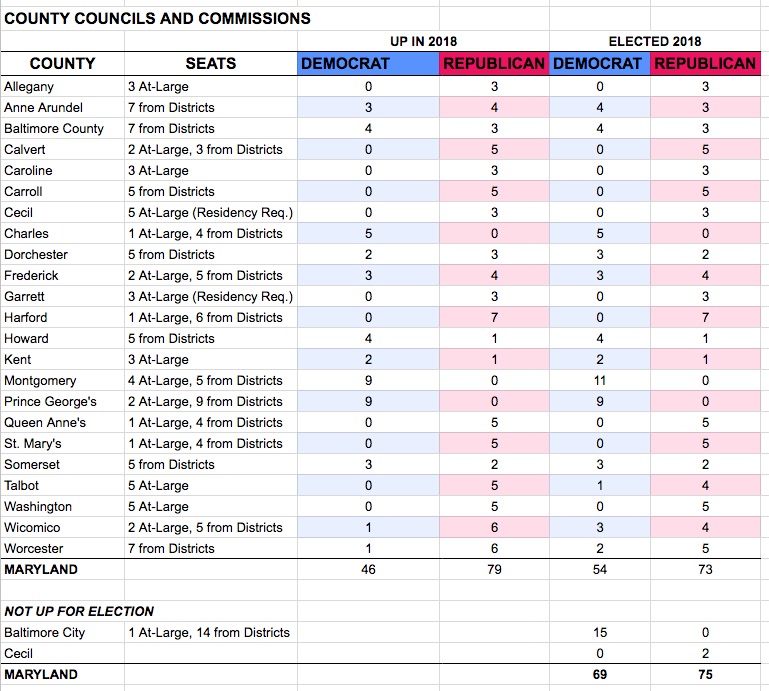
So I can’t add and have had to take down the previous post on the county legislative results. Here are the corrected numbers. Thanks to the readers who caught the error and also reminded me that Prince George’s has added two at-large seats to the county council in this election cycle.

The Democratic pickup of six seats along with their gain of the two new at-large seats in Prince George’s brings their new total to 69, which leaves them 6 seats behind the Republicans once you include the seats not up for election this year in Baltimore City and Cecil County.

The shifts give Democrats new majorities in the Anne Arundel and Dorchester County Councils.

Share

Hogan by the Numbers

The following chart shows the share of the vote received by Gov. Larry Hogan in each county as well as the swing from 2014:

Hogan won majorities in all but four jurisdictions and carried all but the big Democratic three of Montgomery, Baltimore City and Prince George’s. (He won a plurality in Charles.)

In heavily Democratic Montgomery, Hogan won an impressive 44.5%-an unheard of percentage for Republicans in this Democratic heartland. An impressive number of people must have cast ballots both for Larry Hogan and for Marc Elrich.

While Prince George’s was Hogan’s worst county, he made his strongest gains there in picking up an additional 13.4% of the vote, suggesting that the Governor made strong gains in the African-American community. Ben Jealous also lost nearly one-third of the vote in Baltimore City.

Share

Two More Dem Delegate Pickups

Looks like I missed yet two more pickups by the Democrats in the House of Delegates that weren’t even on the map.

In Baltimore County District 42A, Democrat Michelle Guyton looks set to take the second of two delegate seats. She leads Tim Robinson by 306 votes. Meanwhile, in single-member Frederick County District 3B, Democrat Ken Kerr leads incumbent Republican Del. Bill Folden by 552 votes.

That brings the total number of Democratic pickups to 7 seats.

Share

Maryland Morning After Roundup

It was a strange night in Maryland. Republican Gov. Larry Hogan didn’t just win reelection. He crushed it, defeating Democrat Ben Jealous by 56.2% to 42.7%. This handsome 13.5% margin is stunning for a Republican in a state that went for Hillary Clinton by 26%.

But Hogan’s rout was a personal, not a partisan, victory. The Governor had no coattails. Heck, he had anti-coattails as Democrats did very well below the top. Democratic AG Frosh and Comptroller Franchot won reelection by enormous margins.

Results Tracker at https://tinyurl.com/ybtwqv4m has the latest for all the key races in the Senate, House of Delegates, and County Exec races. Check it out.

Senate

In the state Senate, Hogan’s “drive for five” seats needed to sustain his veto melted into “we’ll settle for one.”

Democrats narrowly lost two seats. Baltimore County District 42 was expected to fall to Republican Del. Chris West and did, though by a surprisingly small margin. Democratic Sen. Jim Mathias was always defying gravity on the Eastern Shore and finally fell to Republican Del. Mary Beth Carozza.

But Democratic Sen. Kathy Klausmeier held on to beat back a challenge from Republican Del. Christian Miele in Baltimore County District 8. Democrat Sarah Elfreth held open Anne Arundel District 30 by a solid margin. In Frederick, Democratic Sen. Ron Young was thought to be in deep trouble but won reelection by his largest margin by far.

Democrats scored an upset in Howard/Carroll District 9 where Republican Sen. Gail Bates appears to have narrowly lost to Democrat Katie Fry Hester, as Howard’s highly educated electorate turned hard against the Republicans.

We’ll have to wait on absentees and provisionals but the absentees are unlikely to save Bates. While Democrats compose 39% of active registered voters, they comprise 51% of received absentees.

The new Senate will have 32 Democrats and 15 Republicans.

House of Delegates

Last night was about making gains rather than staunching losses for Democrats. Not a single vulnerable Democrat lost. Instead, Democrats are poised to add five seven more seats to their already hefty majority.

In Howard District 9B, incumbent Republican Robert Flanagan lost by 14 points to Democrat Courtney Watson, who returns to office after losing the 2014 county executive race. In Anne Arundel District 30A (Annapolis), Del. Herb McMillan’s retirement allowed Democrat Alice Cain to take the second seat and join seatmate Speaker Michael Busch in the House.

Baltimore County District 8 will now send two instead of one Democrat to the House. Democrat Eric Bromwell won reelection and will be joined by Harry Bhandari. Republican Del. Joe Cluster lost his seat as Del. Joseph Boteler is the sole Republican.

St. Mary’s County District 29B delivered a real surprise as incumbent Republican Del. Deb Rey lost to Democrat Brian Crosby, an army ranger who ran as a moderate or conservative Democrat.

In Harford District 34A (Havre de Grace), it looks like incumbent Democratic Del. Mary Ann Lisanti will be joined by Steve Johnson, who currently leads incumbent Republican Del. Glen Glass by a whopping 25 votes.

This one will go to absentees and provisionals. Among the received 583 absentee ballots, 271 (46%) were sent back by Democrats, 196 (34%) by Republicans and 116 (20%) by unaffiliated or minor party registrants. Among active registered voters, 49% are Democrats compared to 28% who are Republicans.

Unlike in Senate District 9, the party affiliation of received ballots doesn’t send enough of a signal to suggest a clear winner, so we really will have to wait for the final count on this one.

Two more surprise pickups: In Baltimore County District 42A, Democrat Michelle Guyton looks set to take the second of two delegate seats. She leads Tim Robinson by 306 votes. Meanwhile, in single-member Frederick County District 3B, Democrat Ken Kerr leads incumbent Republican Del. Bill Folden by 552 votes.

Assuming the Democratic pickups in 3B, 34A, 42A holds up, the new House of Delegates will have 97 99 Democrats and 44 42 Republicans.

County Races

Democrats had a really good night at the county level. In two upsets, Steuart Pittman took out incumbent County Exec. Steve Schuh in Anne Arundel, and former Councilmember Calvin Ball defeated incumbent Allen Kittleman in Howard. Ball becomes Howard’s first African-American county executive. Democrats also captured a majority on the Anne Arundel Council.

Democratic County Executive Jan Gardner won reelection over Republican Del. Kathy Afzali in Frederick. In Baltimore County, former Del. Johnny Olszewski defeated Al Redmer by 15 points in what had been billed as a nailbiter.

In Montgomery, Councilmember Marc Elrich easily dispatched not just Republican Robin Ficker but wayward Democratic Councilmember Nancy Floreen, who ran as an independent. State’s Attorney Angela Alsobrooks won the county executive race in Prince George’s without opposition. She becomes the first African-American woman county executive in Maryland.

In Dorchester County, Democrats won one more seat on the county council, giving them a majority (as in Anne Arundel noted above). Democrats also won an additional council seat apiece in Talbot and Worcester, as well as two more in Wicomico. That gives Dems a net gain of 6 county legislative seats and a total of 52. Republicans are down to 73 from 79.

Democrats retained control of all of the seats in Charles, Montgomery and Prince George’s, and held their majorities in Baltimore and Howard Counties.

Republicans can take minor solace that they retained their one seat majority in Frederick and continue to hold all the seats in Carroll and Harford Counties. They also continue to rule in the vast majority of Maryland’s many more rural counties on the Eastern Shore, Western Maryland, as well as in Calvert and St, Mary’s.

Share