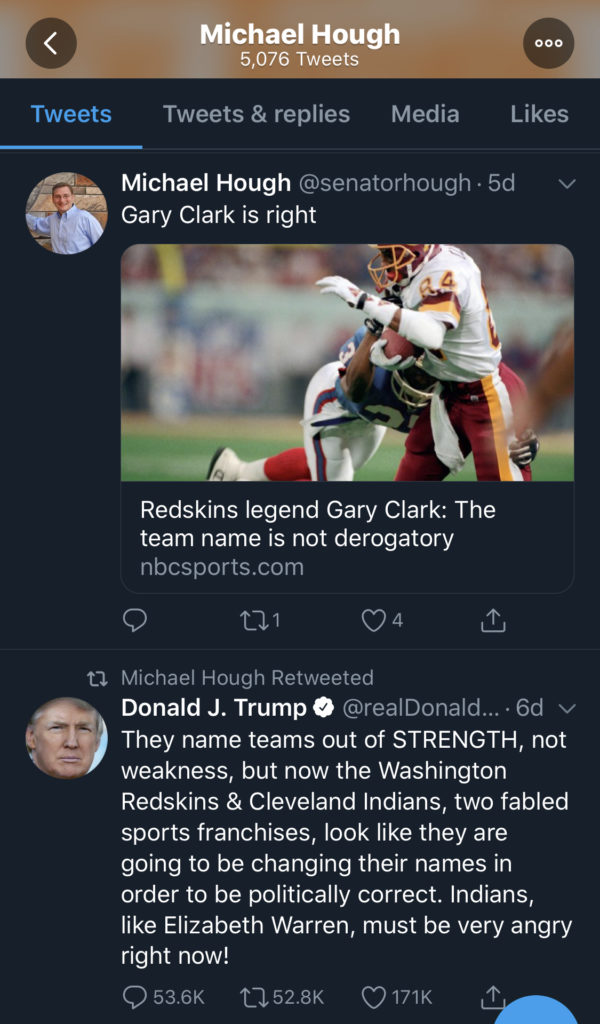
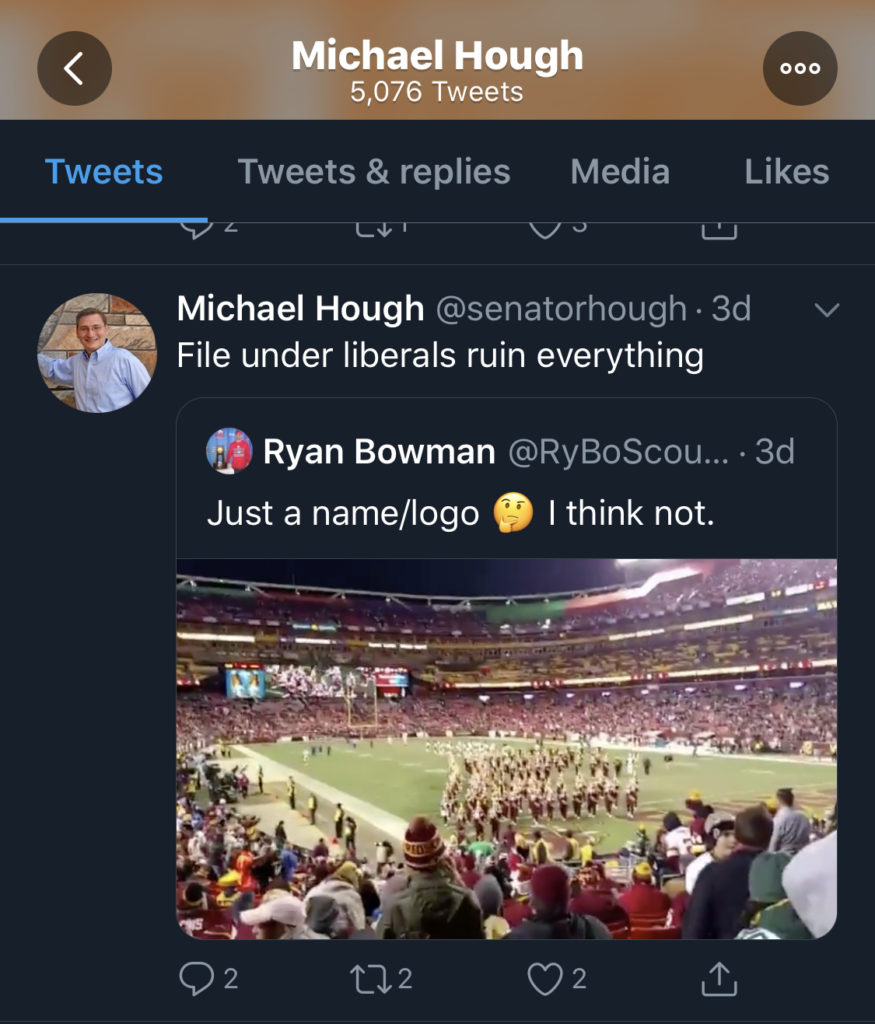
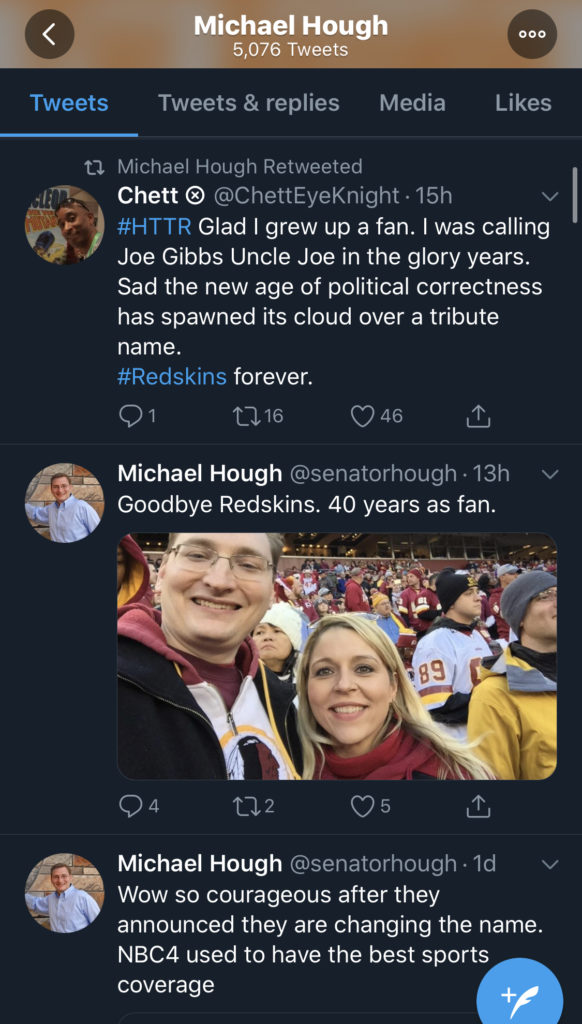
Sen. Michael Hough (R-Frederick and Carroll) has gone on a Twitter tear on the decision to rename the Washington Redskins something else. I guess it goes with his repeated Trumpian bashing of Montgomery and Frederick Counties for not opening more quickly. He also derides NBC4 for no longer using the former team name.
Notwithstanding his ritualized attack on liberals, I don’t see anything especially conservative in choosing to follow a leader who believes against all evidence that he can will the pandemic away and who embraces racist white identity politics as part of his desperate attempt to change the subject. One shouldn’t confuse a personality cult with ideology.
Earlier today, the Washington Post reported that Purple Line Transit Partners has filed a notice of termination if it cannot reach an agreement with the State over massive cost overruns within 60 days. Currently, there are $755 million in cost overruns on the $2 billion project. The State and the P3 consortium disagree over who should pay them.
An anonymous source tells Seventh State that Fluor, a major partner in the deal, has pulled out. Del. Marc Korman told Seventh State that:
What I have heard is talks with Fluor are ongoing but if those collapse, the consortium will walk because Fluor is a large minority party. Not to say I’m optimistic about construction negotiations.
On Twitter, Del. Korman further elaborated:
One way or another, Gov. Larry Hogan and the Maryland Department of Transportation need a plan to complete the Purple Line. We are not leaving a scar through Montgomery and Prince George’s Counties.
The State was ill-positioned to absorb these massive cost overruns before the pandemic. The categorical opposition of federal Republicans to aid to states, as was done during the 2007 economic crisis, only exacerbates the already severe problem.
While an autopsy on the current situation is perhaps premature, key architects of the project have now conveniently left the building. Perpetually purple tied Mike Madden, the deputy director for the project, is gone. Transportation Secretary Pete Rahn, who was critical to gaining Hogan’s support for the project which he opposed during his campaign, has also moved along. No one can say either lacks impeccable timing.
Proponents of the project love to blame the environmental lawsuit for delaying it. But these sorts of suits are utterly typical and expected in major projects. Gov. Bob Ehrlich managed to complete the Intercounty Connector on time and on budget despite major environmental lawsuits that attempted to stop that project.
More important factors include the severe underestimation of costs related to tracks owned by CSX. The consortium has also accused the State of being slow to acquire properties necessary to complete the project.
The prediction track record on the project of Cassandras like Seventh State has proven far moreprescientthan that of supporters who continue to tout that the Purple Line is a “great value” and how the P3 “has overcome challenges that hampered Metrorail’s Silver Line.”
Advocates have a lot of explaining to do. The P3 was sold as a means to insulate the public from exactly these sorts of problems. Instead, we’re faced with the prospect of paying incredibly higher sums to complete the project or left with the priciest ditch in America.
Most of the races in Montgomery and Prince George’s Counties are very sleepy this year. The judicial races have become a surprise exception. Though there are still votes that have yet to be counted, it looks like challengers upset a member of the incumbent judges slate in the Democratic primary for circuit court judge in both counties.
Maryland judicial races have an unusual process. After being appointed by the Governor, the incumbent judges must face the voters and any other candidates that decide to run. All candidates are placed on each party’s ballot. All of the candidates who place high enough on any party’s ballot continue on to the general election.
Though they lost the Democratic primary, the incumbents will also continue to the general because they still won one of the top four spots in the much lower turnout Republican primaries. In both Montgomery and Prince George’s, the challengers are African-American women and the incumbents are white men who were appointed by Republican Gov. Larry Hogan.
Ademiluyi Upsets Bereano in Prince George’s
In Prince George’s County, April Ademiluyi beat incumbent Judge Byron Bereano in the Democratic Primary for Judge of the Circuit Court. The daughter of African immigrants, Ademiluyi is a graduate of the University of Maryland, College Park and received her law degree from George Mason. According to currently available numbers, Ademiluyi won 105,725 votes to 87,017 for Bereano, the son of controversial lobbyist Bruce Bereano.
[Bereano asked] his friends to contribute to something called the Prince George’s Committee to Elect Sitting Judges. This is a campaign committee for five Circuit Court judges — four of whom were recently appointed by Gov. Lawrence J. Hogan Jr. (R) — seeking 15-year terms to the bench in the 2020 election. One of them happens to be his son, Judge Bryon Bereano, appointed first by Hogan to the District Court, then late last year, to the Circuit Court.
Stranger still, consider the identity of the man chairing the sitting judges’ election campaign in Prince George’s County: That would be Alexander Williams, the former federal judge and close Bruce Bereano ally who is surely Hogan’s favorite Democrat. Hogan has rescued Williams from retirement, appointing him to several key appointed posts. Those include his role as chairman of the Appellate Courts Judicial Nominating Commission.
Bruce Bereano has also been heavily involved in Anne Arundel judicial races.
Despite losing the Democratic primary, Byron Bereano will also appear on the general election ballot. He won a spot with just 4,970 votes — all that was needed in heavily Democratic county home to few Republicans. Bereano attended the University of Baltimore School of Law and formerly worked at Lerch, Early and Brewer.
This was Pierre’s second attempt as an insurgent judicial candidate. In 2018, Pierre failed to win either party’s nomination. However, she nevertheless did quite respectably for someone not part of the incumbent slate in a contest that is below the radar of most voters.
Fogleman served for three years as a public defender in the 1980s. The American University law graduate also was appointed by former County Executive Ike Leggett to the county’s Juvenile Justice Commission. Fogleman served for ten years, including as the commission’s chair.
Like Bereano in Prince George’s, Fogleman will advance to the general election due to his success in the Republican primary in which he earned 14,085 votes compared to 6,893 for Pierre.
The outcomes in the two party primaries were strikingly reversed for the other incumbents. Incumbent African-American Judge Bibi Berry ran away as an easy first place in the Democratic primary with 106,128 votes — over 23,000 votes more than the second place candidate. But in the Republican primary, Berry came in fourth with 11,492 votes, which is roughly 3000 votes less than her white male running mates.
One may be the loneliest number, but apparently one documented claim of a rent increase was enough for Councilmember Will Jawando (D-At Large) to introduce rent control legislation that governs the entire county.
When he introduced his emergency rent control bill in response to the pandemic, I made repeated requests to Councilmember Jawando’s office for any evidence he had of rising rents that inspired him to file the bill.
I eventually received a public comment but not a scintilla of hard evidence, so I submitted a formal Maryland Public Information Act (MPIA) request on April 19 via his official email account: “Please consider this a request for any and all documents covered by the Public Information Act you have received related to rent increases during the pandemic. Thank you.”
Cecily Thorne, Jawando’s Chief of Staff, contacted me on April 21 after I wrote my initial post about the lack of evidence or logic “even from an amoral greed perspective” behind the rent control bill. She stated that “Councilmember Jawando asked me to forward some of the information we have been receiving from tenants related to rent increases” and included four redacted pieces of information.
Only one of these documents made a claim of a rent increase that was made both prior to the bill’s introduction and during the pandemic. (Another was notification given prior to the pandemic, while one involved late fees, not rent, and the last one was a somewhat complex situation sent after the bill’s introduction in any case.)
I spoke with Ms. Thorne shortly after receiving the information and told her directly of my MPIA request in the course of our discussion. Nonetheless, my request went completely ignored in violation of the law.
When I followed up on May 30 – after the mandatory 30-day disclosure deadline in state law had passed – Ms. Thorne remembered being made aware of a request (“You mentioned you made a request”), but also texted that “I have not seen one until now in writing” and “I did not receive a request formal from you” despite my having sent it to Councilmember Jawando’s official email and having mentioned it during our call.
The lack of response suggests that either (1) Councilmember Will Jawando’s office is highly disorganized, or (2) unaware of its legal responsibilities under the Public Information Act, or (3) willfully ignored the request in violation of the law. It could also be a combo platter.
Thanks to the efforts of Legislative Attorney Amanda Mihill, I received most, though not all, of the documents late last week. However, Jawando’s office excluded the unredacted copy of a previous document until I made mention that it was missing. Their response still excludes many documents attached to emails in violation of the law.
What’s Not in the Documents?
Despite Councilmember Jawando’s media claims, he had virtually no documentation that this was occurring before he decided to file the bill. Although Cecily Thorne stated that the emails she sent were only “some of the information,” the documents sent show otherwise. There was literally only the one claim mentioned above.
There are no copies of phone records listing people who called with complaints. Nor is there any evidence that the Councilmember’s staff contacted the landlord.
The only other evidence within the documents involves a few back and forth strategy emails with the Renters Alliance in which Councilmember Jawando says “as many examples as you can send will be helpful ahead of bill introduction.” The reply references only increases being seen in the same building as the sole complaint from a renter.
One case.
No wonder Councilmember Jawando was unresponsive to queries on this topic from not just myself but others despite the claims he made in the media.
Glass Bill Provides Meaningful Help
Fortunately, the Council took other action to address the larger problem, which is that many people who have lost their jobs, if only temporarily, cannot pay regardless of the level of rent.
The Council passed legislation introduced by Councilmember Evan Glass (D-At Large) that, among other provisions, appropriated an additional $2 million in rental assistance. This money helps people facing eviction directly. The county has also loosened the requirements to receive rental assistance in light of the ongoing crisis.
Finally! After many years of heated controversy, Montgomery County is about to squarely confront its use of land use moratoria as a part of its growth policy regulations. The County Planning Board, after much study for its regular update of the County’s Growth Policy, has crafted a proposal to largely eliminate land use moratoria in the County. The County Council will ultimately decide the terms and scope of the Growth Policy (titled in more recent years as the Subdivision Staging Policy.)
This correspondent is the former chairman of the Maryland-National Capital Park & Planning Commission and its MoCo Planning Board (appointed in ’89, reappointed in ’93). Let me offer some background and candid insight that may prove useful in the coming months as the proposal enters the political windstorm.
The MoCo Annual Growth Policy (the AGP; that was its name for many years) was created in 1986. Why? Because during the ‘80’s, the County was experiencing high growth. It had previously created an Adequate Public Facilities Ordinance (APFO), which was embedded in the Subdivision Ordinance to apply to all new subdivision proposals.
To manage the APFO, the AGP was later instituted as a timing mechanism to match school and transportation needs with corresponding infrastructure development. Buried in the AGP system was the moratorium nuclear bomb—if school or transportation capacity in any defined area of the County became overloaded, then no new subdivision could be approved in that area until the county’s capital budget (the Capital Improvements Program, or CIP) indicated that help was on the way through public improvements and/or private contributions to fix the identified public need.
The moratorium concept was always intended to be a rare, drastic action of last resort. It was never meant to be a routine tool in the planner’s toolbox. Indeed, the very idea of a moratorium is contrary to comprehensive planning, zoning, and budgeting—i.e., to responsible government. For adopting a moratorium is, by definition, an admission of governmental failure. Doing it on a normative basis should be downright embarrassing.
Land use moratoria were supposed to be as rare as snow in June—they were to delay development approvals for a brief time in order that public and sometimes private funds could then target as quickly as possible where the infrastructure need was and fix it. In fact, the very purpose of a looming moratorium was to immediately direct capital funds to the targeted area in order to avoid the moratorium bomb from exploding.
This system only worked, however, where there was both a high growth rate that continued to pay taxes and where infrastructure spending was duly targeted by the County government to any area about to be thrown into moratorium.
But those two preconditions began sliding away in the late 1990’s, and by the turn of the century, they were largely gone. Montgomery County’s growth rate has been in the basement for some 15 years now. Yet the moratorium mechanism, meant to be only an emergency measure in the AGP, never went away. Indeed, it became a favorite fixture of the no-growth crowd. And that crowd has always controlled certain votes in County government.
The rich irony here is that a moratorium is, in truth, all about fiscal and budgetary policy and not a growth or density matter. Whether density on some tract is to be low, medium, or high, whether growth in some area is to be slow, moderate, or rapid, is a land use dynamic regulated by the community master plan as well as the zoning placed on properties. But during the 1990’s, exclusionary forces in Montgomery County realized that use of moratoria could become a normal convenience to accomplish what they otherwise could not accomplish through planning, zoning, and environmental regulations.
Just starve the CIP of transportation spending on certain projects called for in County master plans, and SURPRISE!, the roads in an area are suddenly over capacity. Just redirect school capital funding projects away from certain developing and redeveloping areas, and SURPRISE!, schools in those areas become over capacity. The most extreme example of this practice was how prior County governments allowed the East County to be frozen for many years in moratorium while significant capital funding flowed west, north, and south.
Today’s County Council can see what moratoria have wrought over the past two decades. When an area is placed into moratorium, neither new taxes nor fees can be generated in that area, creating the perverse effect of killing off the very revenues needed to help solve the identified problem. The County Planning Board knows what moratoria have wrought. The practice telegraphs to the business community to avoid investing in Montgomery when so many other nearby options exist called DC, Frederick County, Prince George’s County, and the multiple jurisdictions in Northern Virginia.
Moratoria are all about erecting walls. The Montgomery County government should be knocking down walls. The County should be using its highly detailed master plans, its incredibly rigorous zoning, its adequate public facilities ordinance, its huge budget, as well as its growth policy, to channel public infrastructure improvements where they are needed.
It is telling that Montgomery County prides itself on having the toughest, most “sophisticated” planning, zoning, environmental, and transportation controls in the region as well as being blessed with a large tax base and corresponding budget, yet, simultaneously, it is the only regional jurisdiction that regularly applies that admission of governmental failure, the moratorium.
To paraphrase the famous presidential campaign slogan of the 1990’s, “It’s the CIP, stupid.”
Gus Bauman is an attorney who lives in Silver Spring. He served two terms as chair of the Montgomery County Planning Board.
Tracey C. Furman won a third term as Kensington mayor on Monday, easily turning back a vigorous challenge from her immediate predecessor and onetime ally, Peter Fosselman.
The race scrambled Kensington’s recent tradition of mostly sedate local politics. Campaign-related advocacy became intense enough on Kensington’s private listserv that Furman posted a call to participants to “find a way to stick to the more mundane topics like bears, plumbers and give aways on the listserv at least until” the election was over.
Running for local office, Furman added, “should not be a blood sport.”
Given the restrictions imposed to counter the Covid-19 pandemic, residents voted by mail with the option to deposit ballots at a drop-box at Town Hall. Participation soared by 42 percent over the contested mayoral election in 2012.
Most remarkable in this year’s voting was the electoral clout demonstrated by the winning candidates for Kensington’s part-time Town Council. Bridget Hill-Zayat, a first-term incumbent, rolled up 549 votes and her campaign ally, Nate Engle, a newcomer to Town politics, won 511 votes. They easily outdistanced the third candidate, Jon A. Gerson, a longtime Kensington resident and former Council member who received 356 votes.
Hill-Zayat and Engle were allied against the controversial Knowles Manor Senior Housing project, which was the subject of a neighbors’ lawsuit challenging parking plans and traffic patterns. The litigation has been settled.
Furman’s relatively easy victory came as a mild surprise, given Fosselman’s local prominence. He previously served 10 years as mayor before stepping down in 2016 — and encouraging Furman to seek the position. She ran, and won without opposition. She was unopposed for reelection in 2018.
Furman has lived in Kensington 40 years and her supporters include many townspeople who attend the local Methodist church, where she works as facilities manager. She also is popular with members of the K’town Ladies Guild, a social club for women.
Furman ran an aggressive campaign, sharply challenging Fosselman in their lone debate nine days before the election.
At one point during the debate, which was conducted on the Zoom video conferencing platform, Furman accused Fosselman of “making this stuff up” — a testy response to his criticism that incivility and disrespect had intruded into Kensington’s official life.
Also during the debate, Furman took issue with Fosselman’s call for close enforcement of regulations on graffiti, signage, and parking, saying he preferred “to live more in a gated-type community.”
For Fosselman, defeat may mark the close of a once-promising career in electoral politics. The loss was his second in row: In 2018, Fosselman sought the Democratic party nomination for the District One seat on the Montgomery County Council, finishing a distant fifth to Andrew Friedson.
Shortly before the mayoral election, unflattering material about Fosselman, a master plan ombudsman for the county, was circulated anonymously through the mail. Fosselman said in an email to supporters that he had been called a liar, anti-Semitic, racist, and unfit to run. He also said the County Attorney “was contacted by someone making the case I have too many conflicts of interest to run … If anyone believes this is coming from some crazy person outside of Town, as has been suggested, think again. I know who some of these people are and you would be shocked.”
He did not go into specific detail, however.
Furman’s call for restraint was posted at the listserv three days before the election. She said she was not intending “to infringe on anyones [sic] right to free speech” but added, “could we possibly find a way to stick to the more mundane topics like bears, plumbers and give aways on the listserv at least until Monday June 1 at 9 p.m.,” when voting closed.
Furman, who likes to be called “Mayor Tracey,” claimed during her campaign to have brought nearly 20 businesses to Kensington. She also noted that her terms in office coincided with movement on development projects, including two senior-living complexes, one of them Knowles Manor.
She characterized herself in campaign literature as an active and engaged mayor, which is a part-time position.
“Under my leadership,” she declared, “the Town has stepped up fast and furious providing information both on our website and through bi-weekly eblasts. The Town created a COVID-19 webpage with links to important resources, virtual classes, shopping and take-out dining guides. The Town also sponsored a webinar for our small businesses to help them in applying for SBA loans.
“Keeping the [town’s] Farmers Market open every Saturday has been a priority,” she said, adding that “I’ve worked with the county to ensure our market met the requirements of the health department in order to remain operating.”
Mail voting was a departure from Kensington’s practice in local elections of voting at Town Hall during three hours in the evening on Election Day — and this year participation surged. In all, 790 votes were cast, not counting 27 ballots that were disqualified.
In the contested mayoral election in 2012, 556 ballots were submitted.
Ballots arrived at an irregular pace this year. Then, when they came, the ballots had the original primary date of April 28th printed on them. What happened?
Late Ballots
Snafus with SeaChange, the vendor used to print and to mail the ballots, explain many of the problems. According to Deputy State Administrator Nikki Charleson at the Maryland State Board of Elections, “the vendor did not meet the schedule for Montgomery or Baltimore City” and ballots were “mailed out later than planned.”
Ballots for Baltimore City, the locale with a number of hot local contests, were supposed to have been mailed on May 8 but SeaChange did not start posting them until significantly later. In a press release, the State Board blamed SeaChange explicitly not only for missing the deadline but misleading Maryland election officials:
On May 7, SeaChange informed SBE that ballots for Baltimore City were printed and would be mailed on May 8 and confirmed on May 11 that some Baltimore City ballots had been mailed. SBE relied on this incorrect information when communicating with the public, advocacy organizations and candidates. While some files were late, it was the misleading information provided by SeaChange that led to the unmet expectations and the confusion over the ballot delivery process.
Will there be a lawsuit? Refund? Unquestionably, this should be investigated by the General Assembly. Mistakes happen, especially during a crisis but the state shouldn’t be misled by its vendors. Lying isn’t a symptom of coronavirus.
Similarly, ballots for Montgomery did not get sent until after the scheduled date. In many households, a ballot arrived for one adult but not for another. The mailing of ballots for a single local jurisdiction on different dates probably explains this strange pattern.
When I communicated with the Montgomery County Board of Elections, I also learned that there was a problem with absentee ballots. Although, everyone was effectively an absentee voter due to the adoption of universal vote-by-mail, voters who requested absentee ballots were on a separate electronic list and were not mailed ballots simultaneously with other voters.
Charlson explained that the vendor, SeaChange, had served as a subcontractor for printing ballots in 2018 as well as the special primary and general election in the Seventh Congressional District this year. She said that the state did not experience any problems that warranted not engaging SeaChange again at that time.
Why Did the Ballots Say April 28th?
The original primary was scheduled for April 28th. Given the timing of the Governor’s executive order mandating both the change of election date and vote by mail, the ballots were already finalized with many already printed. As a result, the State Board did not deem it feasible to reprint ballots with the new date, though notices were included to highlight that they remained valid notwithstanding the later date.
Who Should Receive Ballots?
Although it’s a primary, you should still receive a ballot if there is a school board race in your jurisdiction even if you’re not registered with a party. All school boards in Maryland are nonpartisan, so voters who are not affiliated with a party can participate in the primaries for these contests.
All active registered voters should receive ballots. Active is defined quite broadly and may include people who haven’t voted for a number of elections. People who have moved or died may still be considered “active voters” unless the Board discovered that they were no longer eligible because their mail was returned or through a number of other checks undertaken by the Board. In short, the state errs heavily on the side of keeping someone on the rolls and it is unlikely that you have been wrongly purged from the voter rolls.
If you didn’t receive a ballot, you should contact your local Board of Elections and consider voting at one of the open polling places on Election Day, June 2nd, as time is short for another ballot to get mailed and arrive. Remember that all ballots postmarked by June 2nd will be counted as long as they arrive before 10am on June 12.
Counting the votes for this year’s election will be different. Voters will need to exercise patience in awaiting the final results. Both politicians and voters need to understand it and that the delay is due to the changes made and are not per se evidence of fraud or incompetence.
The delayed primary election will occur primarily by mail. All active registered voters have been sent a ballot. A limited number of polling places will be open on June 2nd but the State is heavily encouraging Marylanders to cast their ballot by mail during the ongoing coronavirus pandemic.
As Donna Duncan at the State Administrative Board of Elections explained to me, counties have not only begun to receive ballots back from votes but also to count them. Each county has a live feed where you can watch the canvass room. Baltimore City has the hottest primaries in the state this year, and you can watch the count live or previous recordings if you find C-SPAN too fast paced for your taste.
After opening the ballot and making sure it complies with the legal requirements, including that the oath on the envelope has been signed, canvassers feed the ballots into machines. Many counties use the normal electronic machines that voters feed the same ballots into on election day. Some of the populous counties have machines that can read ballots much more quickly.
People in each county who have signed non-disclosure agreements have the results but may not legally reveal them until the appropriate time. The State Board of Elections plans to authorize the release of results from all ballots counted as of Sunday, May 31st when the polls close on June 2nd at 8pm, or very shortly thereafter. Recall that in the last general election results were delayed for several hours due to a court order that required keeping some polling places open beyond the normal scheduled closing time.
That same evening, counties should also report the votes cast at the polls. There are fewer polling places, so maybe it will go more quickly. On the other hand, anyone who is in line by 8pm can still vote, so any (hopefully socially distanced) lines will cause delay.
Normally, by the end of election night, we await the absentee vote count to finalize the results. Marylanders have been more prone to vote early instead of absentee, but this year will obviously be different, and the uncounted ballots weigh far more heavily. People tend to mail or to drop off their ballots close to the day, so a blizzard of ballots will still require counting. Any ballot postmarked on or before primary day and received by 10am on June 12th will be tallied.
Think of it as an extended and much larger absentee count. All of those envelopes will need to be opened, checked and counted. Each county will likely need to provide updates on the count as it proceeds. I would expect final counts to occur on June 12th at the very earliest and it could be later for jurisdictions depending on the number of ballots that need processing.
In short, patience is a required virtue this election season.
Candidates in Kensington’s June 1 mayoral election met in a virtual debate over the weekend and clashed about the quality of development in town, enforcement of town regulations, and civility in Town government.
The debate took place on the Zoom videoconferencing platform and revealed sharp differences between the two candidates — the two-term incumbent, Tracey Furman, and her immediate predecessor, Peter Fosselman.
They are erstwhile allies and both said at the outset of the 70-minute debate that they agreed on many subjects.
It didn’t take long for disagreements to become apparent, however.
The mayor was notably pointed in her criticism. At one point, she accused Fosselman of “making this stuff up” — a reference to his criticism about a lack of civility in Kensington’s official life. Furman also took issue with Fosselman’s emphasis on enforcing Town regulations on such matters as graffiti and illegal signage, saying she thought he “would like to live more in a gated-type community.”
The candidates disagreed at some length about the type and quality of development in Kensington, which has about 2,500 residents and a recent tradition of mostly sedate local politics.
Fosselman asserted that “we are on our way to becoming a senior center” for Montgomery County, noting that two housing projects for older people have been approved and another is under preliminary review (but may not be exclusively for seniors).
“We can do better than what we’re getting,” Fosselman said, adding that the Town should seek out developers and encourage them to take on attractive projects. He noted a section of town familiarly known as “Gasoline Alley,” behind the volunteer fire department on Connecticut Avenue, “is long overdue for redevelopment. It would be perfect place to establish a brewery, a distillery, a restaurant-incubator with condos on upper floors.”
Another prospective project he mentioned was a community center with a pool, perhaps with a secondary use such an education center. “We need to put a plan in place and make these things happen,” said Fosselman, who was Kensington mayor for 10 years until stepping down in 2016. He added it is essential that proposed projects be reviewed by the Town’s advisory development review board before they reach the mayor and council.
Furman, who is in her first competitive race for mayor, responded by saying Fosselman’s comments about Kensington’s becoming senior center for the county were “a little bit misleading.” She noted that one of the projects, the 135-unit Modena Reserve on Metropolitan Avenue, hard by CSX Transportation railway tracks, will be “a luxury senior facility” and that two 1930s buildings nearby will be rehabilitated as part of the project’s amenities.
Another, more controversial senior housing project on Knowles Avenue, near the congested intersection with Connecticut, will be for people aged 62 and older. “These will be vibrant people that move in,” Furman said, noting that a retail or mixed-use project at the site would create even more vehicular traffic than senior housing.
Furman said the Modena and Knowles projects “are just going to be great additions to our town and they will fit within our sector plan.”
She also noted the Town’s sector plan, which was revised and updated in 2012 after considerable controversy, imposes building-height restrictions that render some prospective projects “not economically viable.” She said she supports height limitations but noted they “make some of the projects that people want more difficult to get.”
Furman’s “gated-type community” remark came in response to Fosselman’s comments that enforcement of Town code provisions has been wanting. He said he advocates enforcing regulations, which Townspeople backed, to “make the town look better than ever. I don’t find cars parked on grass, overflowing trash cans, and graffiti a nice-looking place to live.”
To such criticism, Furman said, “I know from Pete’s perspective, he would like to live more in a gated-type community where you tell everybody what you should be doing and what you shouldn’t be doing. … I find our residents don’t want that type of code enforcement. They want things to look nice but they’re not interested in the heavy hand of government. And so I try to find that balance.”
She added: “Pete has definitely been my biggest critic. I hear it all the time. But I also hear that we’re doing a great job and that the town looks terrific.”
The candidates also disagreed whether discourtesy and incivility have intruded into Town government.
“I don’t think we have a civility issue,” Furman said. “I was kind of taken by surprise by that because I think our Council meetings have been quite polite. … I don’t see what Pete sees.”
In reply, Fosselman said, “Absolutely, we do” have a civility problem. “People are dismissed, they’re disregarded, they are cut off, interrupted — that’s apparent if you watch videos of Council meetings,” where the mayor presides.
“It has to do with the way people are treated,” Fosselman added, “and there are a number of people who can attest to being treated very poorly, either at Council meetings, [in] making calls to the Town staff, or in any number of situations where they’ve requested things and have been dismissed. And that’s not something I can make up.” He said he often heard such complaints when he went door-to-door early in the year, informing Townspeople he was planning another run for mayor.
Furman disputed Fosselman’s complaints.
“When Pete says, ‘I’m not making this stuff up,’ he is making this stuff up because I have not received those calls. People are not treated that way,” she said and cited complaints about graffiti on a county bridge in town.
“I have seen the graffiti on the bridge and it has been reported to the county, and the county will get to it. We are in a pandemic where it is difficult to get people out to do things right now. And that’s one thing that Pete doesn’t have, is patience. He doesn’t understand when other people have other work that they have to do. And it will get done. But I, for so long, I’ve heard ‘a lot of people are saying.’ Well those people are not saying it to me. And I have suggested that he refer them to me and he never does. Those people don’t exist.”
The debate was moderated by Sean McMullen, a former Town Council member who posed questions based on queries townspeople submitted in advance. On most questions, the candidates were permitted no more than 60 seconds to reply.
Not counting Town staff and others associated with producing the debate, about 65 people logged in to follow the encounter on Zoom. The mayoral debate was followed by a virtual forum for the three candidates for two seats on Kensington’s Town Council. They are: Brigid Hill-Zayat, a one-term incumbent; Nate Engle, a newcomer to Town politics, and Jon Gerson, who served a term on the council in the 1980s.
The elected positions are part-time and non-partisan. Kensington’s day-to-day activities are overseen by a town manager and his staff.
Local politics in Kensington typically is a sedate pursuit and contested elections tend to be the exception. This year, not only has the mayor’s race attracted competition but three candidates are seeking to fill two seats on the nonpartisan Town Council.
Incumbent Duane Rollins, mayoral candidate Peter Fosselman’s husband, is stepping down but Bridget Hill-Zayat is seeking reelection to a second term. She won a seat on the Council in 2018, after having lived in town just three years.
Councilmember Hill-Zayat and Mayor Tracey Furman clashed in 2018 over the Knowles Manor Senior Housing project. In letters to planning staff, Hill-Zayat noted inadequate parking and “our town’s intense dislike of this project” while Furman expressed support on behalf of the Town Council.
A group of Kensington residents appealed the Planning Board’s approval but settled after improvements made regarding parking and the traffic pattern. Nate Engle, a senior climate change specialist for the World Bank who has lived in Kensington since 2011 and active in that group, is now seeking election to the Town Council.
Also running is Jon A. Gerson, a former director of economic development in Montgomery County and longtime town resident. Gerson regularly attends town meetings and helped support the creation of a town dog park. He served on the Town Council in the early 1980s but remains best known as the former political director for the county’s teachers union (MCEA).
Others might simply place Gerson’s actions under the rubric of “politics” and point out that he was an effective advocate. Locally, he played a significant role in trying to clear a path for now Sen. Jeff Waldstreicher when he first ran for delegate in District 18 in 2006.
The last contested Council race in Kensington was in 2017.
Voting this year will be conducted by mail, but ballots also may be deposited at a drop-box at Town Hall, 3710 Mitchell Street. This represents a marked shift from the Town’s normal practice of voting in person during the evening on election day. The impact on turnout is unknown, especially among the town’s apartment residents who usually vote at low rates.