
All posts by David Lublin

Keep Voting and Keep Calm

This is that short time every four years when political science professors become popular with the foreign media, which is how I found myself hanging out in the cold this morning in front of my polling place. Overhearing media interviews with voters entering and exiting the polls turned out to be more interesting than I expected.

One man in his late 20s gave what I think of as the standard small-d democratic answer, speaking about the importance of participating in the electoral process. Like many Americans, he preferred not to disclose his voter choice and to get back home to help take care of his kid.

The interviewers struck gold, however, when they managed to find the rare, outspoken Trump supporter in inner Montgomery County. A woman in her late 40s or early 50s, she very politely took time to explain why she preferred Trump to Biden.

Trump will “keep America as it is” while Biden wants to “change it.” Biden wants to make America “socialist.” The specific reason she cited for supporting Trump was his desire to keep out “illegal immigrants” and protect the border. She wanted to vote in person because she doesn’t trust the mail and is concerned that “the Democrats are going to steal the election” through mail ballots.

Put simply, this perfectly pleasant woman was in complete sync with the FOX and Trump narrative. It’s not something you see a lot of in my part of the world where Trump signs are literally nonexistent, and Biden will easily win over 80 percent of the vote. I suppose it’d be like watching someone explain their Biden vote in Carroll County.

The most unsettling part to me is the easy willingness to believe that somehow Biden can inexplicably steal the election by mail. So it remains important for leaders, officials and experts to keep providing accurate information to counter the deluge of misinformation about our democracy that the president and seems eager to spout. People who care about our democracy in both parties should participate, just like the Texas Republicans who are fighting efforts to disfranchise over 100,000 voters in Harris County.

Meanwhile, Democrats need to keep working to get out the vote in the few remaining hours of this election. Let’s also not buy into the panic over counting the votes. America has done this many times before, so it’s not like it’s a mystery. Pandemic or no pandemic, our officials are well prepared to do it again.

The doubt sown over this very question by President Trump as well as his willingness to peacefully transfer power is what fills many Americans with dread rather than hope as we approach election night. It’s what makes this election year so abnormal.

But by far the best response that Americans can provide is to keep streaming to the polls until they close and then to keep calm while we await the complete count. For a variety of reasons, some states may start out red or blue and then go the other way. It is not a stolen election if Florida starts the night as blue (early voters) and then trends red (election day voters). Nor is it stolen if Pennsylvania is red on election night but then mail ballots turn it blue. All votes are equal.

We, the People, need to show respect for our democratic process even if the president does not and goes ahead with his publicly stated plan to declare victory prematurely. I realize that the repugnance of these sorts of actions amplified by social media encourages the opposite. Just remember that we all lose if those boards in front of stores in downtowns across the country turn out to have been necessary.

Share

Explaining Question A and Why I Voted No. (Definitely Vote No on Question B.)

How Property Taxes Work in Montgomery

Under current law, Montgomery County may only collect the same total amount in property taxes across the county as the previous year – also known as the constant yield tax rate –adjusted for inflation. So if the County collected $100,000,000 in property taxes last year and inflation is 3%, it may collect $103,000,000 this year. The only exception is if the County Council votes unanimously to raise property taxes.

This legal limit forces the county to adjust the tax rate based on changes in total value of assessed property in the tax. If the county’s tax base increases by 10% due to increases in real property values, the County treasury does not because the County must adjust the property tax rate downward, so it collects no more than last year adjusted for inflation. The county can also adjust rates upward if needed to collect the permitted amount.

Question A changes that system. It would cap property tax rates instead of receipts. Montgomery would see great increases in the amount of property tax collected when property tax values grow without changing the rate because they would no longer need to adjust the rate downward so they don’t collect more money.

Councilmembers will claim that they did not increase property taxes because they left the rate unchanged, but the County will collect a lot more. By keeping the focus on the rate rather than amount collected, the county can even nominally reduce the rate and claim that they reduced property taxes even as they go up in real terms and the county collects more than previously.

How Question A Raises Property Taxes

Councilmember Andrew Friedson, the sponsor of the amendment, argues that residents will benefit when housing values go down. However, the Council can vote to increase the rate to collect as much as the previous year as under the current system, just like the 8.7% tax increase that they adopted in 2017. There seems little doubt that they would do this if needed to avoid substantial cuts in spending.

In times when property values rise quickly, this can add up fast, Property taxes increases are limited to 10% a year but this is far above inflation and add up very quickly. If you pay $5000 in property taxes now, you would pay $6655 if you had the maximum increase each year for three years. The key caveat, of course, is that it all depends on how your property values change. But the amendment has no limit on the rate of growth in property taxes.

Confusing Wording

I’m not thrilled that the wording of this charter amendment focuses on limiting rates, and thus gives a rather deceptive impression that it limits, rather than increases, property taxes. (Some proponents argue that it doesn’t but since the unquestionable purpose is to allow the county to reap more revenue, it seems a fair characterization.)

Timing and Impact During an Economic Crisis

Normally, in an economic crisis, it’s not unusual to see housing values fall. But many in Montgomery have paradoxically seen their housing values rise because the crisis is due to COVID and more people are seeking larger spaces with some attached outdoor space. No one knows the future, but this would result in higher property taxes with the next set of assessments.

Many property owners in the county have seen salaries and benefits cut sharply due to the shutdown and economic crisis. Federal government workers haven’t seen pay cuts, but they haven’t had a decent pay raise in years. That’s true of many people.

As a result, a lot of people are ill-positioned to pay a property tax increase even though they may well receive one as a result of this charter amendment the next time that their properties are assessed.

Higher Taxes for Residents, Lower Taxes for Favored Developers

For me, the final straw is that the county council overrode the county executive’s veto of a huge dollop of corporate welfare for developers in the form of 15-year tax breaks (!) by 7-2 the other day. While I realize that opponents as well as the executive support Question A, and I am grateful for their votes and outspokenness on the issue, the Council seems far too inclined to continue down this path after the election. If they can afford giving tax cuts to developers to build high-priced apartments, I don’t see why they need to raise mine.

We Need Property Tax Reform, This Isn’t It

There are unquestionably problems with the county tax system. The three-year assessment cycle creates some odd quirks. Additionally, the current limit doesn’t take into account a growing population as well as other needs. In short, the budget corset is too tight. The unanimity requirement further limits the authority of our representatives too much, even if the voters passed it. But this isn’t the right way to do it, or the time, so I voted no.

But Others See It Differently

Adam outlined previously why some view this property tax increase as a good idea. Even leaving aside one’s desire to fund progressive policies, as I mentioned in the previous section, the current system does not provide sufficient funding with increases over time because it doesn’t into account factors like population growth and other needs. So I can see how other people might see this differently.

I mention this because, like much in politics, I see this as an issue on which reasonable people can disagree. Much of the rhetoric surrounding the ballot questions, even the form of the county council, has been getting more and more vehement on social media. Since we’re in a moment that is already overheated on steroids (now there’s a mixed metaphor!), it seems worth a mention that we’ll manage whatever the outcome of this ballot question.

Question B

Vote No. This is Robin Ficker’s latest very bad idea that would make current problems with the property tax system worse.

Share

Council Must Sustain Elrich’s Veto of Corporate Welfare

On a 7-2 vote, the Montgomery County Council approved a bill that would completely exempt real estate developments on WMATA property from property taxes for 15 years. Councilmembers Tom Hucker and Will Jawando voted against. The Council should sustain County Executive Marc Elrich’s veto of this corporate welfare masked as a social justice housing project.

This bill is such a bad idea that one hardly knows where to begin.

Proponents of transit endlessly sell the considerable funding required for it as the motor for development and smart growth that not only attracts jobs but increases land values and property tax revenues. We are told “if you build it, they will come.” Now, these same people tell us that they won’t come unless we “incentivize” (read: pay) them.

Even stranger, we are to pay these incentives to build high-priced apartments in desirable locations with very little extra affordable housing thrown in above normal requirements. I understand establishing enterprise zones with lower taxes in struggling neighborhoods, but Grosvenor-Strathmore and other Red Line stops don’t fit the bill.

Councilmember Andrew Friedson (D-1) has been quite aggressive in trying to sell Councilmember Hans Riemer’s bill:

None of the WMATA sites are being developed and developers with Joint Development Agreements are walking away all over the region, due to unique infrastructure requirements on these sites, high costs of high-rise construction, etc.

These sites currently collect ZERO property tax, generate ZERO housing, and provide virtually no public benefits aside from surface parking. I view that as an abject public failure, but respect anyone who prefers this status quo.

Multiple fiscal analyses have demonstrated both that high-rise projects don’t work without the incentive and that the Grosvenor project in particular would generate more revenue to the County in impact and income taxes than the property tax abatement (which the county wouldn’t otherwise receive without a project).

Councilmember Friedson argues we need to step up our corporate welfare game to compete when we shouldn’t even play this game. His argument also ignores that demand for homes in Frederick or Fairfax is based on other factors that far outweigh tax incentives linked to individual projects.

The uniqueness of the site argument fails to impress as somehow many buildings have been constructed around the whole region, indeed the whole country, around transit and difficult sites without the magic of tax incentives. (Manhattan exists!) I’m sure WMATA, developers and their supporters on the Council are happy to produce analyses showing otherwise, just as they always have in support of public spending on their agenda.

The incentives are a roundabout subsidy to WMATA. When we establish tax incentives the land becomes more valuable, so WMATA raises the price and recoups much of it. So it’s not even clear what share of this supposedly badly needed incentive the developers will see.

This tax giveaway also won’t increase the housing stock. When it’s built, Councilmembers Riemer and Friedson will point to it and say, “look what we did!” Except there will be another nearby project that didn’t happen because you’ve already pre-satisfied any demand with this one. Montgomery has plenty of land zoned for housing and buildings.

Councilmember Friedson also neglects to mention that the building will not have a zero cost to the county. Providing county services will cost money but Montgomery will receive a lot less than normal to cover those costs.

Andrew Friedson has been touted with much hope, including here, as the Council’s bright new economic light. If he wants to live up to this promise, he needs to shift his focus fast from this old-style ineffective developer welfare to more original ideas to attract commercial business to Montgomery.

The bill reflects Councilmember Hans Riemer’s long-term approach over several terms to housing, which has long dominated the Council. Unfortunately, it has had far more success in pleasing monied interests than it has accomplished in producing affordable housing. No doubt it also pleases David Blair’s developer-heavy crowd.

Councilmember Nancy Navarro has presented herself as second to none as a champion for social justice. She has stood up unflinchingly for often abused undocumented immigrants to the frequent dismay of their opponents around the State. Here, she argued that the Council needed to “be bold” and support this bill.

Except there is nothing remotely new, let alone bold, about giving a tax subsidy to developers. Speeding the production of high-priced apartments strikes me as the opposite of social justice.

I cannot help but wonder why this proudly progressive Council is focused on this legislation at this time when so many county residents are facing far more immediate and desperate problems. Even managing the day to day is still far from ordinary.

Charter Amendment A on Property Taxes

The crowning insult of this legislation is its juxtaposition with County Charter Amendment A. The short version is that the Council majority is now proposing to collect more in property taxes from ordinary residents even as it engages in this tax giveaway that has no valid economic or public purpose.

Charter Amendment A garners support from many because the current property tax system is not ideal for a variety of reasons (not the subject of this post). It effectively asks voters to loosen the very tight tax corset (it can only rise with the rate of inflation) so that the county can collect more if property values rise, as would likely happen now if the measure passes. It’s a tough ask at a time when many have seen incomes drop. One can argue that it is necessary when so many are in need.

But it is insupportable for the majority of the Montgomery County Council to offer a tax holiday to developers while increasing the take from ordinary citizens. It’s not progressive. It’s not liberal. It’s just bad economic policy wrapped in gaudy rhetoric that doesn’t stand up to scrutiny. It goes against this county’s good government traditions.

County Executive Elrich was right to veto this bad bill. The Council should vote to uphold his veto tomorrow.

Share

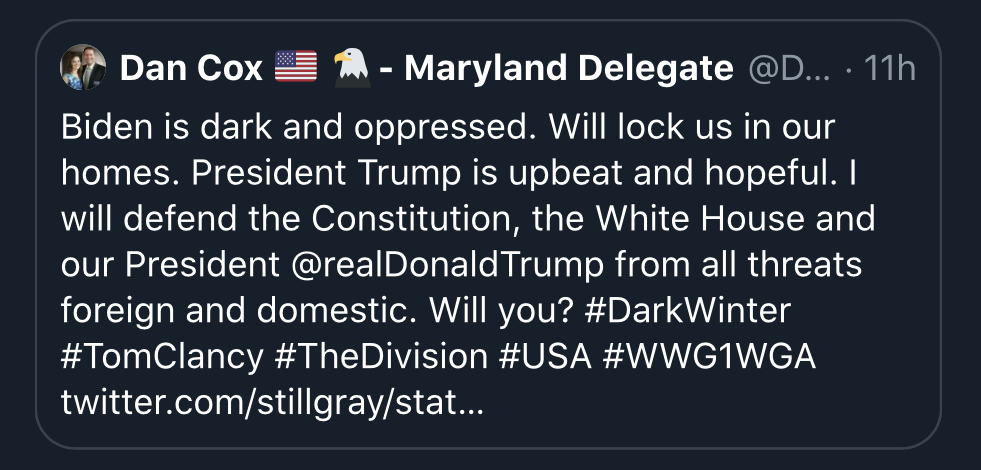
Republican Del. Dan Cox Now Using QAnon Hashtags

The hashtag #WWG1WGA, associated with the dangerous QAnon conspiracies, was used yesterday in a tweet by Maryland Del. Dan Cox (R-4, Frederick & Carroll). Apparently, the hashtag is short for the QAnon slogan of “where we go one, we go all.”

A member of the Maryland General Assembly is now associating himself with QAnon. Once again, the Maryland Republican Party faces a choice once again of normalizing the crazy and dangerous by joining or ignoring this, or facing it down.

I’d note the Senate Republican leadership recently swung right. Sen. Mike Hough, for example, who represents the same district, is enthusiastic for Trump and quit Washington football after decades because they dropped the name. But Gov. Larry Hogan’s brand is as a more sensible mainstream conservative. As leaders of their party, what will they do?

h/t Walter Olson (@walterolson).

Share

That Day When Our County Exec Had to Explain Economics to the Council in a Veto Message

Yesterday, Montgomery County Executive issued the first veto of his administration. It was of a major tax giveaway bill to developers — the county would likely lose over $400 million in revenue according to Elrich — passed in the name of sparking additional housing development around Metro.

My favorite part of the veto message in where Elrich, a progressive often accused of being an impractical lefty by opponents, explained the economics of these sorts of tax subsidies:

Under Federal law, WMATA must seek the highest and best price for their land. Land that is exempted from all property taxes for 15 years is more valuable because the calculation of its value includes the costs to acquire and develop, including taxes, weighed against market rents. If two properties are side by side, one exempt from taxes and the other not, and they were producing the same value of unit, the land value of the exempt property would be greater because its cost of development would be less than the cost to develop the tax-paying property. This would, in turn, likely raise the parcel’s appraised value. The Bill could potentially be counterproductive by raising the value of WMATA’s land.

Put another way, by reducing the tax burden, all the county has done is make WMATA’s land more valuable and increased the amount that they can charge for it. They will capture that value in the sale price of the land with Montgomery County taxpayers, who already heavily subsidize WMATA, having footed the bill.

They say you can’t get something for nothing. But if you’re not careful, you can get nothing for something. Or, at P.T. Barnum put it, “there’s a sucker born every minute.”

Share

Florida Isn’t Maryland: I’m Okay with That

I’m in Florida for personal reasons. Let me tell you that it’s not just warmer, it’s different.

Welcome to Florida!

After leaving the airport, I stopped at a 7-11 to pick up a soda. A woman wearing a blue cap that said VOTE in big white letters was in line to pay and trying to convince the man behind her (wearing a mask over his mouth but not his nose) to vote early. She succeeded in making her purchase but failed in her political mission. After she walked out, the target of her earnest efforts sorta laughed and mumbled to the cashier something about Trump and voting on election day. Welcome to Florida!

Swing States Get All the Love

Commercials are from a different universe down here. It’s political ad after political ad. There seem to be two or three major Trump ads. In the one that leaves me cold, a guy pops up like a used car saleman and tells me Biden comes with scary lefty friends like Sanders and Omar. A more effective ad shows a Latino small business owner calmly explaining why Biden’s tax hikes will hurt.

Leadership Matters

The contrast in the rates of people wearing masks to protect public health between Florida and Maryland (at least the parts of both I’ve seen) is striking. Don’t get me wrong; most people in Florida wear masks. But the rates are different enough to drive home the importance of government in communicating a clear and consistent health message.

The result is that I feel much safer going indoors to businesses in Montgomery County because both customers and employees wear masks properly at very high rates. It was crucial that all of the key leaders at the state and county level united to make the rule and to model this behavior. Unlike Florida Gov. Ron DeSantis, a Trump acolyte, Gov. Larry Hogan has publicly worn masks and held socially distanced press conferences.

In Florida, people frequently sport what I think of as the “half-Trump” (mask over mouth but not nose). Still others favor the mask as a chin strap. I guess it’s a fashion statement if you can call risky behavior a fashion statement (and no, they aren’t just taking a breath while socially distanced). A few just don’t wear it all indoors even where required.

Florida once again showed me how it provides author Carl Hiaasen with such rich material at a small “COVID-19 Supply Store.” I was pondering buying a Biden/Harris mask I saw in the window. I walked in and then promptly walked out when I saw two of three employees wearing their masks as chin straps. Practically all the store sells is masks. No folks, this isn’t satire. This is Florida.

Recently, Gov. DeSantis announced that indoor restaurants and bars can now operate at full capacity. Municipalities can have lower limits but all must allow at least 50% capacity. The White House recently demonstrated how large indoor gatherings can prove to be superspreader events.

The more secure the public feels, the more likely people are to engage in behaviors that fuel these events. Now that the Governor of Florida has paved the way for mass alcohol fueled gatherings in tightly packed spaces, the people of Florida have nothing to fear but the absence of healthy fear.

Share

Harris Won’t Condemn QAnon

U.S. Rep. Andy Harris (MD 1) was among the 18 representatives who didn’t support a resolution condemning QAnon, a dangerous whackadoodle pro-Trump conspiracy theory. As the Washington Post explains:

QAnon, which took root on anonymous message boards in 2017, holds that Trump is battling a cabal of deep-state saboteurs who worship Satan and traffic children for sex.

The baseless worldview has been identified by the FBI as among the extremist views “very likely” to motivate violence. Its adherents, according to law enforcement, have been arrested in numerous incidents, including two murders, a kidnapping, vandalism of a church and a heavily armed standoff near the Hoover Dam.

Harris didn’t vote no, but instead chose to vote “present.” This makes him different but no less absolutely bonkers.

Share

Purple Line Drowns Maryland in Red Ink

Most Maryland pols are heavily invested in the Purple Line. Virtually all discussion by politicians has been on the imperative of finishing it while downplaying the financial cost. In “Hogan’s Purple Passion”, longtime columnist Barry Rascover has taken the opposite approach in his hard look at the epic financial mess that is now the Purple Line.

Though Purple Line supporters sold the P3 (public-private partnership) as insulating taxpayers from rising cost, Rascover explains that we’re now on the hook for the skyrocketing price.

By the time the east-west Purple Line from Montgomery County to Prince George’s County opens years after Hogan leaves office, the state’s total spending on the mass-transit line could exceed $2 billion. It may even top $3 billion.

If the state takes over construction duties of the Purple Line in the next month when the private consortium running the project could leave the job, there’s at least another $1 billion worth of work to finish. Plus, an added delay of six months — or longer. 

Given the line’s history of unexpected delays and under-estimated expenses, that $1 billion projection by the state for future costs could be way off.

This comes on top of the $1 billion in taxpayer dollars already expended by Hogan. 

And this doesn’t count the unpaid $800 million in contested cost overruns the contractor, and a judge, blame on the state.

Either we pay the consortium building the Purple Line what they want or we pay even more and suffer greater delays building it ourselves. Instead of protecting taxpayers, the P3 has turned them into hostages.

Rascover assesses who is to blame for this fiasco:

The state tried to lay the onus on the consortium. But a judge didn’t buy that bit of illogic. He ruled the state was responsible for out-of-control costs. He called it a “self-inflicted” wound.

In hindsight it’s clear [Secretary Pete] Rahn badly under-estimated the Purple Line‘s complexity and its costs. Lawsuits by unhappy residents along the route were inevitable — but Rahn plowed ahead anyway, never anticipating these almost certain legal delays of almost a year.

Rahn also didn’t anticipate lengthy fights over obtaining rights of way along the route, or expensive re-designs to separate the Purple Line from CSX tracks. Both were predictable.

The governor’s determination to privatize this project and get it completed while he is still in office overtook common sense. Now taxpayers will foot the bill for Hogan’s and Rahn’s terribly flawed miscalculations.

It’s even worse than Rascover outlines.

The Governor campaigned against the Purple Line and the gas tax passed under O’Malley to fund transportation improvements. He didn’t repeal the gas tax but instead used the monies raised to fund new road projects around the state.

Pressured by the Washington Post, which then endorsed him for reelection, Hogan changed his mind on the Purple Line. But instead of paying for much of the construction up front as originally planned by Democrats, he put it all on credit via privatization, so he could continue to pay for his road projects.

Excepting perhaps Anthony Brown, Democrats shouldn’t feel too smug. They pushed the P3 forward in their eagerness to move the project ahead and also went along with Hogan’s magically cheaper numbers that have now turned out to be wildly unrealistic.

The state’s ability to borrow to cover the monumental additional cost is consequently highly limited. Many sacred cows are going to be gored to finish the Purple Line.

Share

Transit Cuts are Just Starting: They’re Going to Get Much Deeper

The League of Conservation Voters (LCV) has authored an open sign-on letter (posted below) to Gov. Larry Hogan vehemently protesting major cuts in transit service and calling for more capital expenditures on transit.

The reality is that these cuts are just the start.

Due the economic devastation wrecked by the pandemic, revenues are down substantially. The federal government has shown no inclination thus far to help bail out the states, viewed as a “blue state” bailout by President Trump, so no money is coming from that source. The Maryland Constitution requires a balanced budget, requiring substantial cuts ahead. Gov. Hogan will not support a tax hike and there is little enthusiasm among Assembly Democrats either.

The drastically higher than expected costs for the Purple Line to the tune of over $750 million are about to suck even more funds away from other projects. The State has already indicated that the funds will come from other transit projects, like MARC. Even without the pandemic hit, the transit budget was set to take an enormous hit. The Washington Metro, unmentioned in the LCV letter, has already seen its funding cut.

The signatories to the open letter are notably a Baltimore heavy group. The absence of either Purple Line Now or the Action Committee for Transit, both staunch Purple Line supporters, from the letter signatories is perhaps telling. Both are normally easy gets for these sorts of letters but it tacitly recognizes the reality that the Purple Line will not be finished unless major cuts are made elsewhere.

Here is the LCV letter:

AN OPEN LETTER TO GOVERNOR LARRY HOGAN, MARYLAND TRANSPORTATION SECRETARY GREG SLATER, AND MARYLAND TRANSIT ADMINISTRATOR KEVIN QUINN:

Last week, the Maryland Department of Transportation and Maryland Transit Administration announced major cuts to the MTA system, including cutting bus service by 20%, reducing MARC, commuter local bus, and paratransit service, and cutting the MTA’s already strained six year capital budget for critical safety needs by $150 million. We, the undersigned, urge rejection of these cuts, which would be devastating to many Marylanders that live in low-income communities, communities of color, and people with disabilities.

Rather than take steps to relieve the strain of a veritable tsunami of challenges to Maryland’s most vulnerable communities, MTA’s plan would exacerbate residents’ difficulties and hobble the state’s recovery. TransitCenter found that 40% of transit commuters in Baltimore City and 35% of transit riders in the state work in essential job sectors, with hospital and health care workers being the largest share of riders. A large number of essential workers – nurses, grocery store workers, child care professionals, nursing care staff, and so many more – rely on public transit to get to their jobs. The proposed cuts would make it harder for these vital workers to get to their jobs, which would threaten their employment and exacerbate the devastation the pandemic has wrought to our economy. A shortage of these critical workers will also add strain to a healthcare system that is already spread too thin.

Maryland should be investing in more public transportation, not less. We should be increasing access to job centers from the communities most in need, not cutting it. We should be prioritizing cleaner transportation alternatives that reduce pollution and the health conditions that make marginalized communities especially vulnerable to the impacts of coronavirus and other respiratory illnesses like asthma. Vehicle emissions also create NOx that ultimately contributes roughly one-third of the nitrogen pollution to the region’s rivers, streams, and the Chesapeake Bay.

Among the problematic cuts to service, the proposed changes eliminate any route from Baltimore City (the jurisdiction with the highest reliance on public transportation) to Annapolis. Even in its current state, public transit to Annapolis is extremely limited, but at least it was available and provided mobility services. With the cuts, Annapolis would become inaccessible by public transportation, limiting the ability of many Marylanders to participate in our state’s Democracy. Public participation is always essential to a free and fair government, but never more so than in a crisis.

In reference to Maryland’s essential workers, the Maryland Transit Caucus has stated in their letter to the administration following the proposed cuts: We rely on them. They rely on MTA. We call on the administration to take immediate action. Funding from the Transportation Trust Fund should be allocated to public transit that benefits all Marylanders, rather than to highway expansion and construction projects that benefit only the wealthiest.

Signed,

  1. Maryland League of Conservation Voters
  2. Maryland Sierra Club
  3. Common Cause Maryland
  4. Clean Water Action
  5. Climate Law & Policy Project
  6. Safe Skies Maryland
  7. Maryland Legislative Coalition
  8. Maryland Consumer Rights Coalition
  9. Maryland Campaign for Human Rights
  10. Coalition for Smarter Growth
  11. Baltimore Transit Equity Coalition
  12. Transit Choices
  13. Central Maryland Transportation Alliance
  14. Maryland United for Peace and Justice
  15. Sunrise Movement Baltimore
  16. League of Women Voters Maryland
  17. Maryland Nonprofits
  18. Nuclear Information and Resource Service
  19. Labor Network for Sustainability
  20. Family League of Baltimore
  21. Bikemore
  22. Eastern Shore Land Conservancy
  23. Maryland Center on Economic Policy
  24. Job Opportunities Task Force
  25. NAACP Maryland State Conference
  26. Public Justice Center
  27. Our Revolution Maryland
  28. Indivisible Baltimore
  29. Indivisible Howard County
  30. Chesapeake Physicians for Social Responsibility
  31. Echotopia, LLC
  32. Maryland Conservation Council
  33. Ji’Aire’s Workgroup
  34. Indivisible Towson
  35. ATU Local 1300
  36. Food and Water Watch Action
  37. Chesapeake Bay Foundation
  38. Disability Rights Maryland
  39. Consumer Advocates for Ride Services
  40. Progressive Maryland
  41. Unitarian Universalist Legislative Ministry of Mary
  42. Showing Up for Racial Justice (SURJ) – Baltimore
  43. WISE Maryland
  44. Maryland Climate Justice WIng
  45. Takoma Park Mobilization Environment Committee
  46. Interfaith Partners for the Chesapeake
  47. Accessible Resources for Independence
  48. League for People with Disabilities
  49. Climate X-Change Maryland
  50. The Nature Conservancy – Maryland/DC Chapter
  51. Saltzberg Consulting
  52. Chesapeake Climate Action Network
  53. Sunrise Howard County
  54. Baltimore 350
  55. The Parent and Community Advisory Board, Baltimore City Public Schools
  56. Sunrise Rockville
  57. Marylanders for Patient Rights
  58. Bus Workgroup 14
  59. South Baltimore Community Land Trust
  60. Free Your Voice
  61. Represent Maryland
  62. Green Team at St. Vincent de Paul Church, Baltimore
  63. Baltimore People’s Climate Movement
  64. The Climate Reality Project: Baltimore Chapter
Share