All posts by David Lublin

Ginsburg hoped to reshape district she looks to represent

Bethesda Beat reports that Friends of White Flint Executive Director Amy Ginsburg is looking at running for the Montgomery County Council from newly crafted District 4.

Prior to announcing her interest in running for the Council, Ginsburg used her position at Friends of White Flint to advocate vocally for a very different version of District 4. Here is one email sent out by Friends of White Flint:

From an email sent by Friends of White Flint on November 18th.

The map configurations promoted by Ginsburg would almost certainly have excluded Takoma Park, home to Mayor Kate Stewart–the other publicly interested candidate–and included more territory in closer proximity to White Flint (a.k.a. North Bethesda).

Friends of White Flint is one of those “neighborhood” organizations that is put together by developers and business to advocate for their interests. A quick glance at the its leadership confirms that business and developer representatives compose two-thirds of the board.

While Ginsburg says her background makes her a natural candidate for “the most progressive district in the county,” Friends of White Flint has consistently argued in favor of business and development interests. Supporters of developer interests regularly repackage them in social justice language, but I suspect Ginsburg’s record at other nonprofits, such as Neediest Kids and Manna Food Center, does more to burnish her progressive credentials.

Share

Smart Choice, Puzzling Choice

Two Democratic gubernatorial candidates have already chosen running mates for the Lt. Governor slot on their ticket. One created buzz but the other inspired head scratching.

Wes Moore Picks Aruna Miller

Former Del. Aruna Miller (D-15) is well-liked and well-respected among her former colleagues in the General Assembly and more generally among people active in Montgomery politics. For Wes Moore, a running mate from the D.C. area balances his own roots in Baltimore. It also is a choice that indicates not only that Moore is dead set on becoming governor but also that he’s supported by a respected former legislator and cares seriously about governing.

Four years ago, Miller ran for the U.S. House in the Sixth District. Despite having a good base of volunteer support and solid fundraising, she lost to now Rep. David Trone, who had pots of money and was already well-known in the media market due to his unsuccessful run in the neighboring Eighth. Though ending in disappointment, the run raised Miller’s profile and created a positive impression.

Rushern Baker Picks Nancy Navarro

Baker has thrown any sense of geographic balance to the wind by reaching out all the way from Prince George’s to Montgomery to pick Nancy Navarro. Though a former County Council President, Navarro’s profile in the county is not especially high outside of her council district. Navarro’s emphasis on being a tribune for the Latino community has limited her broad appeal without nailing down the Latino vote, which is sticking with Tom Perez. Navarro is known neither as a prolific fundraiser nor a relentless campaigner.

At the Committee for Montgomery Forum, Rushern Baker touted Navarro’s racial equity legislation that requires analysis of all legislation from a racial equity perspective as what he’d bring to Maryland to address racial disparities. Whatever one thinks of expanding the diversity bureaucracy, it’s a proposal that connects with a narrow base rather than a broad swath of voters and jars with Baker’s image as a proud Black but non-identity based politician.

Share

First Impressions

Doug Gansler, Wes Moore, Tom Perez and Rushern Baker

The Committee for Montgomery’s annual legislative breakfast at the Bethesda Marriott Conference Center is one of those annual events that brings together the political class of Montgomery County for a good schmooze. This year, CfM also held a forum moderated by Washington Post Reporter Ovetta Wiggins that was open to all gubernatorial candidates. For me, it was either the first time seeing the candidate or the first time in a long while.

Wes Moore is the candidate that stood out as a comer. By far the best speaker in the group, he came across as authentic rather than simply silver tongued. Getting former Del. Aruna Miller to be his running mate adds legislative experience. I still don’t know much about him but he’s one to watch.

After getting shellacked by Anthony Brown in 2014, former Attorney General Doug Gansler is back for another go. He’s running as a practical liberal—moderate by Maryland standards—who has the experience to get things done. The subtext is that he’s also matured and grown since his time out from politics.

Tom Perez would be the first Latino governor but is also running as the insider, establishment candidate who knows just everyone. As well he should. Since he finished his one term on the Montgomery County Council in 2006, he’s served as Assistant Attorney General for Civil Rights, Secretary of Labor and DNC Chair. That gives him a lot of chits and fundraising ability but also means that he’s little known by voters.

Former Prince George’s County Executive Rushern Baker, one of the most decent people in Maryland politics, lost the primary for governor in 2018 but left many thinking he would’ve been the better nominee. The forum left me wondering exactly why he wants to be governor. He highlighted his Montgomery running mate, Nancy Navarro.

Ashwani Jain is campaigning as young, smart and passionate progressive, but I just don’t get it. He ran for one of four at-large county council seats in 2018 and came in eighth in the primary. Not a signal to run for governor. Likes to consult his diary.

Former New York Education Commissioner and Secretary of Education John King seems like another smart guy who nobody knows and who failed to stand out, even on education, in a crowd of candidates who are better known and more experienced on the Maryland scene. Left me wondering why he’s running.

Jon Baron struck me as yet another earnest, perfectly likeable candidate with primarily Washington experience who won’t gain traction. This year’s Alec Ross?

Comptroller Peter Franchot is from Montgomery County yet didn’t show. Not especially popular with the political class, he returned the compliment. They aren’t the base of this former hard progressive, now moderate, so I doubt it matters.

Robin Ficker showed up with his hackneyed anti-tax message. He promised to cut the sales tax by 2%, which he oddly labelled a rebate, but per usual didn’t mention one spending item he’d cut. He attacked teachers “Where were they?” for not teaching and went after mask mandates for school kids, though he’s vaccinated.

Neither Del. Dan Cox, (R-QAnon) nor former Del. and Maryland Commerce Secretary Kelly Schulz showed. Perhaps a missed opportunity for Schulz. Though a Democratic heartland, Montgomery still casts a lot of Republican primary votes and she’ll need to make inroads here like Larry Hogan to win in the general.

Libertarian Larry Lashar came across as what Republicans used to be—a bit dull but with a coherent viewpoint and some innovative ideas, like school choice. If the Republicans nominate a wackadoodle, he could get more votes than your usual third-party candidate.

Ovetta Wiggins did an excellent job as moderator by asking straightforward policy-oriented questions and letting the forum be about the candidates.

Share

Redistricting Plan analysis

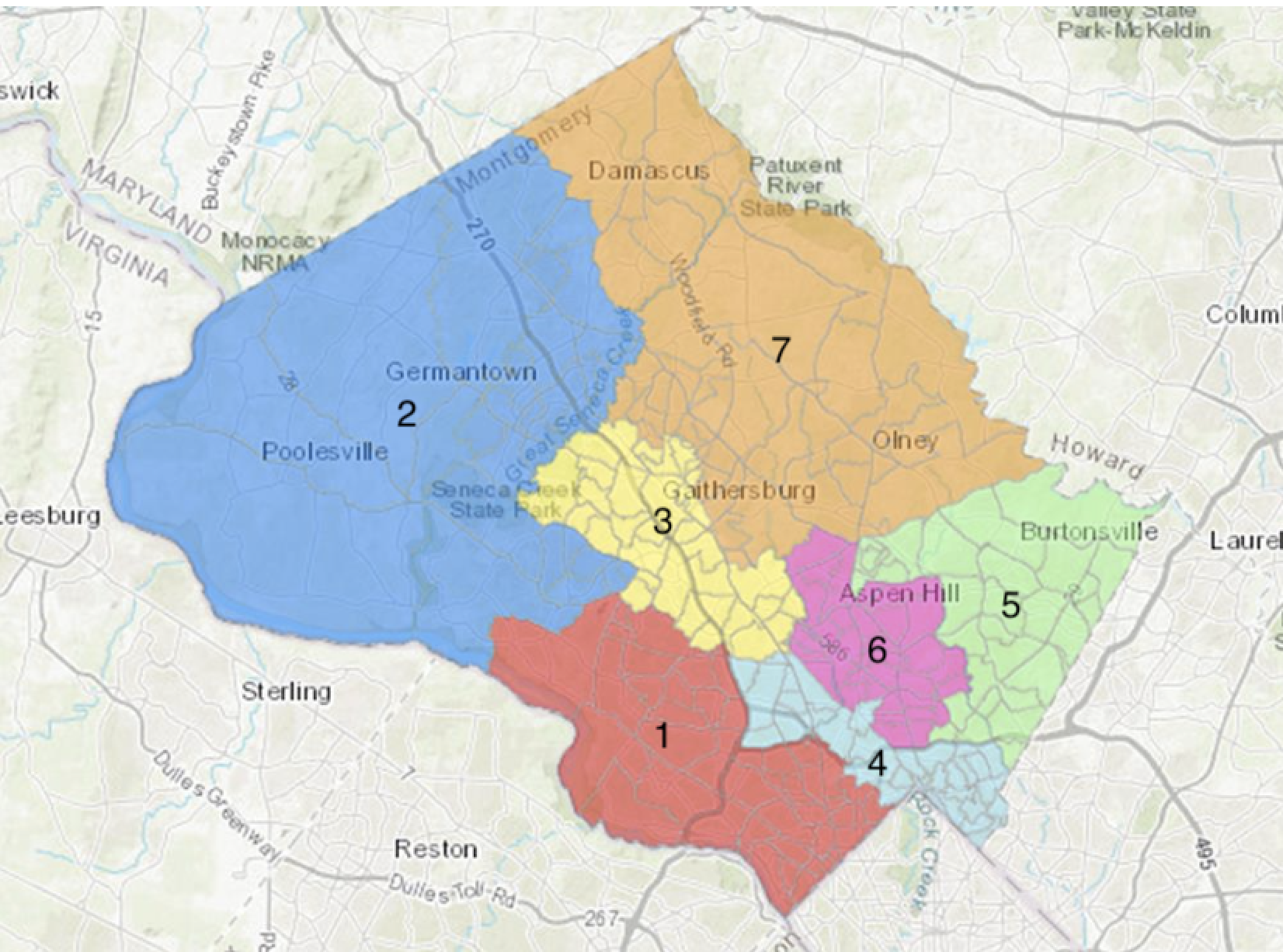
Montgomery County’s decennial redistricting not only had to equalize populations but also had to squeeze in two new districts in addition to the existing five. The County additionally elects four at-large members.

Montgomery County Council Districts 2022-2030

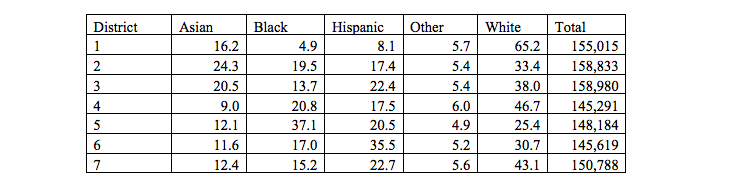
All of the districts in the final plan are within 5% of the ideal district population of 151,816. At 4.7% above the ideal, the new Third (Gaithersburg-Rockville) is the most populous. But the new Second (Germantown-Poolsville) is not far behind at 4.6%. The new Fourth (Kensington-Takoma) is the smallest–4.3% undersized–followed closely by the new Sixth (Wheaton), which is 4.2% too small.

The 65% White First (Bethesda-Potomac) is the only district where a single race predominates. The 47% White Fourth and the 43% White Seventh (Olney-Damascus) are the only two other districts where a single group forms more than 40% of the population.

Whites form pluralities in two more districts–the Second and the Third–but Blacks (37%) are the largest group in the Fifth (Burtonsville) and Latinos (35%) in the Sixth. Blacks will likely comprise a much larger share in the open Fifth’s critical Democratic primary due to lopsided Democratic registration rates among African Americans.

On the other hand, the share of Latinos in the primary remains cloudier. Latinos are also disproportionately Democratic, but less so than Blacks. More importantly, immigrant communities have many non-citizens who cannot participate.

Participation rates among Latinos who are citizens is generally lower than for other groups. One reason is that eligible Latino voters skew young, as they are more likely to be citizens, and young people vote at far lower rates than older voters.

A multiplicity of Latino candidates could also split the vote. Former Planning Board Member Natalie Fani-Gonzalez and former Del. Maricé Morales are among the candidates seeking the seat. Councilmember Nancy Navarro currently represents the area.

I’d be careful not to overestimate the extent to which Montgomery voters cast ballots on racial lines. African-American Councilmember Craig Rice now represents the district with the highest share of Whites and lowest share of Blacks in the county. Both Black and Latino candidates won at-large seats in 2018.

Asians are not the most numerous group in any district. The Second has the highest share of Asians at 24%. No Asian American has ever been elected to the Montgomery County Council. Will that change in 2022 with the addition of two new districts?

Share

Planning Board Chairman casey anderson calls county exec. Marc elrich’s idea “Dumb”

Though he doesn’t say his name, Planning Board Chairman Casey Anderson disparaged County Executive Marc Elrich at the Board’s Thrive Montgomery meeting, saying it was a “dumb idea” for Elrich to suggest that the Purple Line be single tracked under Wisconsin Ave. to save money. Just to make it extra clear who he is thinking isn’t too bright, Anderson references an Elrich proposal from 2009.

Only the discussion doesn’t make clear that the idea now is simply to single track under Wisconsin Ave.–a distance of 900 feet–to save money rather than all the way from Bethesda to around Connecticut Ave. as in the idea from over a decade ago. [Note: The Purple Line was originally planned as entirely single track.]

No discussion of the merits of the idea occurs. Nor does the Planning Board Chairman suggest a means to fund this expensive project. Anderson’s comments would likely have been even worse if a planning board staffer had not cut him off in the midst of another negative comment.

When asked for comment, Chairman Anderson said:

Well, I said it, and if I had it to do over again I might say it’s a bad idea, or even a terrible idea, but whatever word is used to describe it the fact is that It was suggested in 2009 and rejected for reasons that were pretty obvious at the time and I don’t think it has improved with age.

Not exactly an apology. Even worse, it reiterates the false claim that this is the same as the 2009 proposal. It’s not. The 2009 proposal planned for single-tracking over a much longer distance, so I queried: “Except that Elrich’s proposal in 2009 had a single track to CT—not just under Wisconsin—so that’s not true, right?” Anderson texted back:

It’s pretty obvious that it creates the same problem – single tracking limits the ability to improve frequency of service because it limits the number of trains you can run. In places where it’s been tried the result has been to come back later and make expensive fixes to add back the second track.

Except that what’s more far obvious is that single-tracking over a very short distance at the end of the line could well have quite different effects than doing the same over a much longer distance. It’s a very strong, unsupported assumption in service to his preferences. More to the point, repeatedly stating that the two proposals are the same is not playing straight with the public.

Around the same time as I heard back from Anderson, I also received a comment from County Executive Elrich:

Not quite sure what Casey’s referring to but when it was first suggested, the single track went all the way to the country club. We’re talking about pulling into and out of the station on a single track. It’s nine hundred feet – a fraction of the distance to the country club. And the trains have to switch tracks over there any way because the train entering on the westbound track has to leave on the eastbound track.

At the headway’s the system uses, there’s no way that two trains would conflict and there would be no bottleneck or degradation in service. It would save $50 million that could be spent on other important things. And without a second track you get a nice wide path.

Of course, the state would have to study it, I can’t mandate it, so we’ll see if it works. And if it does, why would a sane person say no. In the meantime his policies of developer giveaways is wrecking our ability to build the capital projects we need. Which schools, libraries, or public facilities should we kill to spend $50 million on a 500 ft tunnel if you can solve the problem and get the project done faster for far less cost. I’m trying to get it done quickly, without damaging our budget.

I don’t think many would contest that the two-track tunnel would be better. The question that Elrich raises is whether it’s worth studying the alternative in light of other pressing needs demanding the county’s scarce capital dollars. He also points out, correctly, that we’d get a much better bike path and trail through the tunnel.

Bottom Line: The public contempt by the Planning Board Chairman for an idea proposed by the County Executive to deal with the decline in projected capital funds is irresponsible and inappropriate for an official chairing a public meeting. Indeed, it’s the sort of remark that the Council reacted to sharply when Elrich said something similarly tactless–and, unlike Elrich, Anderson knew he was being taped.

What’s even worse, however, is intentionally misleading the public into believing that Elrich’s current proposal for single tracking just under Wisconsin had been studied when he could have simply said that he didn’t think it is a good idea. The Planning Board Chair should not misrepresent facts. It undermines the public trust.

Share

Friedson’s Tax Cuts Come Back to Bite Him

Adam Pagnucco wrote a lengthy post about how Councilmember Andrew Friedson (D-1) is upset that the County Executive is proposing single-tracking the Purple Line to accommodate the Capital Crescent Trail in the other tunnel. It is indeed less ideal.

Except that Friedson is now reaping the results of his own actions. Earlier this year, Friedson vehemently supported legislation sponsored by Councilmember Hans Riemer (D-AL) to provide corporate welfare in the form of tax breaks for developments on Metro properties.

As County Executive Marc Elrich explained in his veto message, the property tax subsidies proposed for Grosvenor-Strathmore alone cost the county over $100 million in revenue. And that’s just one project and the start of the giveaway bonanza the Council insisted upon when it overrode Elrich’s veto.

Moreover, this is likely the first step, as ideas for providing similar subsidies on private property around Metro have been bandied about by both councilmembers and the Planning Board. Yet the Council seems much happier contemplating additions than subtractions to the budget.

The Council has also been busy reducing impact tax fees that go directly into the capital budget as part of its “no developer left behind during a pandemic” program. They may call it social justice but it sure looks like a giveaway to connected, wealthy interests known for generous campaign contributions.

It’s too bad that Friedson wasn’t around during the days of the U.S. House of Representatives Committee on the Post Office. Its members had two core beliefs: (1) stamp prices should never rise, and (2) the wages of postal workers should always go up.

I sympathize with Friedson’s desire for a two-track Purple Line and a separate tunnel for the Capital Crescent Trail. I just wish someone touted so often as a financial wizard would pay greater attention to the budgetary impact of his desire to engage in tax giveaways to developers on the Council’s other priorities.

Share

Untangling vaccine confusion

As we roll out the big effort to vaccinate everyone, there has been some confusion. Here’s some information that will hopefully help you sort out what’s going on and why.

State Announcement Jumped the Gun

Governor Larry Hogan announced that people 75 and older in Priority Group 1B would be eligible to receive the vaccine beginning this past Monday. Hogan notified the counties around two hours before the announcement.

The problem, however, is that many counties have not finished vaccinating the people in Priority Group 1A, which includes healthcare providers who could easily become vectors of spreading the virus. As Adam detailed yesterday, Montgomery has received comparatively little vaccine but been vaccinating at a high rate.

Each group is also divided into three tiers. In 1B, Tier 1 includes people 75 and over. Some thought that everyone in Tier 1B would become eligible at once but the county is starting with Tier 1. If you are a Montgomery resident in this tier, you can now preregister for an appointment.

The Governor’s announcement has preceded availability here in Montgomery. This naturally created confusion and unhappiness among some that residents over 75 who thought that they could get the vaccine or even cannot be legally barred from receiving it.

Appointment Software SNAFU

The State has mandated that all county governments use the same appointment software, which was originally designed for the flu vaccine. Flu vaccine is usually plentiful, but we unfortunately have to ration COVID-19 vaccine and have eligibility requirements.

Designed for a situation with plenty of vaccine and the desire to vaccinate as fast as possible, the state-mandated software spits out offers for appointments as soon as they are available and doesn’t take into account eligibility.

This has resulted in people in 1B who thought they were eligible making appointments and then getting turned away because they weren’t. Even though Montgomery is still trying to finish vaccinating 1A, the county began on Thursday to allow anyone who is 75 and over (i.e. Tier 1 of 1B) and showed up for an appointment to get the vaccine.

Councilmember Email Blasts Exacerbated Confusion

Email blasts from some county councilmembers compounded the problem created by the Governor’s announcement by indicating that the county was moving to 1B now and urging people to sign up in all tiers.

Hospitals v. County Vaccination Centers

For whatever reason, 40-50% of people working in hospitals have decided not to get the vaccine. As a result, hospitals have extra. Rather than let it go to waste, they have sensibly been vaccinating people 75 and over, so hospitals have operated differently from county centers.

Ready for More Vaccine

I have heard that vaccination centers have far more people ready to do the vaccinations than people to receive it. While this may seem bizarre, it’s good news because it means that Montgomery may be better prepared for mass vaccinations as more vaccine becomes available.

Share

Did Andy Harris Commit Voter Fraud?

Republican Rep. Andy Harris endorsed serious allegations regarding fraud in the presidential election. But by his own standards, his own election was far more fraud prone than the presidential contest in either Georgia or Pennsylvania.

Applying the Harris standard, it is clear that there are grave questions surrounding his election.

  • Mail ballots applications were mailed out statewide in Maryland but neither in Georgia nor Pennsylvania.
  • There were signature checks on all mail ballots in Georgia and Pennsylvania but none in Maryland, where the law prohibits this ballot-security measure.
  • The election in the First District was overseen by partisan Republican county governments. Though there is no evidence of bias and vote rigging, Harris didn’t provide any when he cast suspicion on vote counting in Philadelphia.
  • Maryland accepted mail-in ballots after election day—and not just from the armed forces or people living abroad.
  • Maryland took a very long time to finalize its count.

Harris needs to step down until a lengthy investigation can take place and we review the process. No matter how many recounts we conduct, I know he understands that we cannot trust the results based on his stance on the Georgia electoral votes. The voters deserve answers. We can hold a special election sometime late in 2022.

Or we could just acknowledge that this is all hogwash. Rather like Harris’s specious challenges to the legitimacy of Joe Biden’s victory that attacked our democracy and stoked violence at the Capitol resulting in the death of five people, including the murder of a police officer.

Share