All posts by David Lublin

Gubernatorial Debate

I live tweeted it @theseventhstate. I’ll leave you to decide who won but here are some quick thoughts.

Gutsy Moments: Doug Gansler sticking up for a corporate tax cut in a Democratic debate; Heather Mizeur calling for full marijuana legalization. As the front runner, Anthony Brown played it safe.

Anthony Brown Strengths: Looked comfortable and gubernatorial. Linked himself to Gov. O’Malley successes on issues from marriage equality to raising the minimum wage. No mistakes that should cause him trouble in the future.

Heather Mizeur Strengths: Good on specifics but not too bogged down in details–a tough balance. She deftly took advantage of Gansler/Brown attacks on each other to look like a leader and the  adult in the room.

Doug Gansler Strengths: Very convincing on the economy–came across as the practical progressive who has a real plan for the State to move forward. Turned around reprimand attack by Brown in a devastating way. Made it look sleazy.

Share

Town of Chevy Chase Election Results

The Town of Chevy Chase had an usually competitive election with seven candidates for the three seats. The Council has a total of five seats with staggered two-year terms.

There are 2574 registered voters in the Town and 889 cast ballots for a 35 percent turnout. Our Town’s oldest resident, Kathleen Williams who is a very young 102, not only voted but came to the Town’s Annual Meeting where she received a round of applause.

And now to the results with the percentages being out of total ballots cast:

Vicky Taplin: 492 (55.3%)
Kathy Strom: 467 (52.3%)
Al Lang: 400 (45.0%)
Kathie Legg: 390 (43.9%)
Grant Davies: 366 (41.2%)
Donald Farren: 163 (18.3%)
Deborah Vollmer: 74 (8.3%)

There were a total of 2352 votes, fewer than the 2667 votes cast. While some were encouraging bullet votes (casting fewer votes than the maximum of three) in this election, it had a smaller impact than in previous elections where this was a major factors. All but 11.8% of votes were cast.

Both incumbents, Kathy Strom and Al Lang, were reelected but Al beat newcomer Kathie Legg by just 10 votes. Kathie knocked on the door of every single Town resident in a really impressive effort and very good campaign that fell just short.

Don Farren ran on a pro-Purple Line platform–the centerpiece of his campaign. He expressed repeatedly the belief that there was less opposition and much more support for the light-rail line in the Town than realized. That appears to have been repudiated at the polls, as Don received less than one-fifth of the vote.

Note: I voted for Kathy Strom, Vicky Taplin, and Kathie Legg.

Share

Thoughts on the D18 Delegate Fracas

Recently, Candidate Rick Kessler launched an attack against incumbent Del. Ana Sol Gutiérrez for traveling to El Salvador as part of a delegation invited by the Salvadoran parliament to observe the legislative election. CASA Director Gustavo Torres criticized Rick’s statements in the strongest terms (see Rick’s reply here).

An interesting analysis of the politics of Rick’s choice to make an issue out of Ana’s travel from my email:

I had not seen Rick Kessler‘s attack on Del. Ana Sol Gutierrez.  Beyond my disagreement with the point he was trying to make, I don’t get it as a political tactic.  She was the first place finisher in the 2010 primary, not the third, so it seems likely that if you were picking someone to target [it wouldn’t be Ana].  So beyond angering at least one group of voters, what does he hope to accomplish?

A serious candidate, as Kessler appears to be, can’t seriously think he’ll beat Del. Gutierrez, so he must hope that by making this kind of attack he can get some Waldstreicher or Carr voters to give him their third vote.  The funny thing about that, given the approx. 1100 vote gap between Gutierrez and Carr, and the 500 vote gap between Gutierrez and Waldstreicher, is that if the strategy works he’s more likely to take down one of the other incumbents than Gutierrez.

A plausible analysis of the potential impact.

Others were taken aback by Gustavo’s claim that Rick’s attack was race-baiting. District 18 Resident Molly Hauck sent me a letter that included this paragraph:

[Mr. Torres] called Mr. Kessler‘s opinion “thinly disguised race-baiting.” I find this offensive and incendiary. If Ana Sol Gutierrez were to disagree with Mr. Kessler, would we attribute her opinion to his race, religion, country of origin, age, sex, or other personal characteristic? No. It would simply be described as a difference of opinion. When people play the race card, it creates conflict and increases discomfort between different ethnic groups. It is destructive. I hope that if in the future Mr. Torres disagrees with what a candidate says that he will find a different way of expressing it.

My own view is that Rick’s attack was a political mistake in a couple of different ways. First, his original statement suggested merely that Ana left for El Salvador only to vote but did not also mention that she was part of an official delegation to observe the elections and invited by the Salvadoran National Assembly and with the knowledge and approval of the the House Speaker.

Democracy promotion, particularly in a country where many of her constituents have close ties and fled for reasons related to a past civil war and human rights abuses, is a worthy public goal. While I can see why some might think she should stay in Maryland, this set her travel in a very different light.

Even more important, while I understand the desire of challengers to stand out from the pack, attacks generally don’t pay in these multi-candidate delegate elections. Instead of alienating supporters of another candidate, challengers should want to go around and get their votes too because voters possess multiple votes.

On the other hand, precisely because of the ability to give a very good explanation for Ana’s travel, Gustavo’s reply was overkill and polarizing. While it may galvanize support among some Latinos for Ana, it also left some whites, including some of Ana’s supporters, with a bad taste in their mouth.

Share

Duchy v. Roger: The Verdict

duchyandrogerSuch a bad photo, they can agree that they hate it

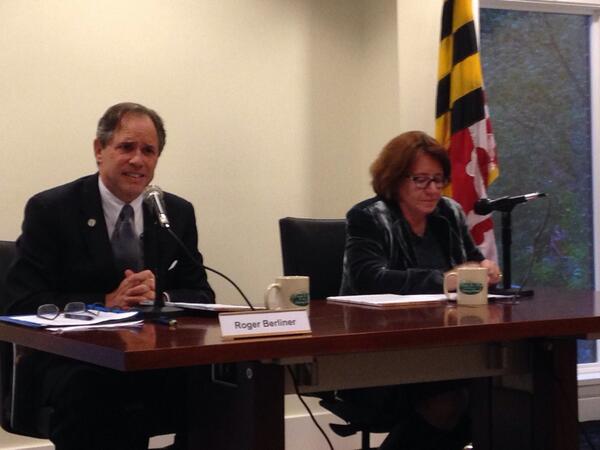
Last night, District 1 Candidates Duchy Trachtenberg and Roger Berliner debate in the Town Hall of the Town of Chevy Chase. I live tweeted the debate, so can follow the blow-by-blow there. Overall, it was “disappointingly cordial” in the eye of one observer looking for more heat and light and less combative than the debates in District 5 according to reports.

So who won?

Sorry to disappoint but it was more or less a draw. Here are some quick takeaways:

Best Moment: When asked about the event that changed their life the most, Duchy spoke about her son’s mental illness and how it led to her involvement in NAMI. It was honest, authentic, and the one moment when there was a moment of real connection.

Honest Moment: Duchy called the race a “battle royale” between the government employee and school system unions. It’s one of those truths that is increasingly obvious but that few want to say out loud. No doubt others will label it a gaffe for exactly this reason but the straightforward honesty was refreshing.

Missed Opportunity: Roger attacked Duchy’s support for the restoration of effects bargaining despite the decision by the voters repeatedly and effectively. Duchy could have countered effectively with Roger’s willingness to overturn the referendum on ambulance fees. Instead, she went with unconvincing speculation that the resulting decline in police morale has caused crime to rise.

Roger’s Strengths: He managed to disagree with Duchy while appearing calm and civil yet still setting himself apart crisply from her on certain key issues, such as effects bargaining. Roger was also good at simultaneously calling for working for common ground but also standing up for the public interest, as in Ten Mile Creek. His final words about fighting special interests trying to oust him were among his best in the debate.

Duchy’s Strengths: Conversely, Duchy managed to attack calmly  without appearing too disagreeable–a very difficult line to walk, especially for a challenger who simply has to differentiate herself from the incumbent in order to convince voters to fire him. She came across well.

Roger’s Weaknesses: Was it smart to repeatedly attack Maintenance of Effort? Voters have no idea what you’re talking about but it sure tees off MCEA. That endorsement is still out there and one would think it’s Roger’s to lose, especially after Duchy characterized the budget as a tradeoff between schools and the rest of the budget in a way that should make MCEA worry.

Duchy’s Weaknesses: She just refused to take a real position and called for bringing people together on way too many issues (and more often than Roger). You can do that on some issues but not every issue. The tactic of handing out a list of her and Roger’s contributions from developers offended some and was unconvincing as the last reporting period was in January.

In Attendance: Nice to finally meet Brian Kildee and Liz Matory after the debate. Also in attendance: George Leventhal, Almina Khorikiwala, Pat Burda, Linna Barnes, Pat Baptiste, Cindy Gibson, Jon Gerson, Andy Harney, Jonathan Sachs and many others. And last, but not least, thanks to Charles Duffy for moderating. Great to see so many come out despite the torrential rains.

Note: I’m supporting Roger but have tried to call it as I see it.

Share

Progressive Neighbors. . . Again

PNWebanner

I only intended to write two posts about PN (this one and that one).

Really.

But then PN reversed itself on a previously inexplicable decision, which led to another post. And now, people have sent in yet more stories about PN that merit reporting:

(1) School Board Member Judy Docca (District 1) did not win endorsement from PN at least in part because of her “health issues” as the email from PN’s co-chairs to Docca explained. Docca was sick and now uses a wheelchair.

Maryland law prohibits discrimination on the basis of “physical disability” but Progressive Neighbors has, of course, an absolute First Amendment right to decide whether or not to take physical disabilities into account in its endorsement process.

I would hope people would pause before deciding to shove me out the door because I faced new health challenges. Betty Ann Krahnke served ably on the County Council even as she fought Lou Gehrig’s disease.

PN does not mention physical disabilities as part of their commitment to fairness and equality:

Fairness and equality for all regardless of race, ethnicity, gender, religion, income, sexual orientation or immigrant status.

Still, PN’s general commitment to civil rights would make me think that most of its members would strongly oppose such discrimination despite the Steering Committee’s decision to take Docca’s “health issues” into account in its reconsideration its earlier decision not to endorse her for reelection.

(2) PN has withdrawn its endorsement of Republican Laurie Halverson in her race against Pat O’Neill in District 3. This is the second reversal of an endorsement decision by PN. In the past, Halverson has forcefully opposed to the individual mandate to buy health insurance that is a critical part of the Affordable Care Act.

More related to the job, she testified in favor of allowing the Boy Scouts to distribute flyers in student backpacks even when they still discriminated against gay scouts. The organization still prohibits gay scoutmasters. As noted above, PN opposes discrimination the basis of sexual orientation.

In this case, it is more surprising that PN endorsed Halverson in the first place due to the seeming clash of values.

Share

Uber Bad Idea

I became an Uber convert quickly after trying the service. Using the Uber app, anyone can request a driver to pick you up. Thanks to the marvels of GPS, you can even track where the car that takes your request is currently located and estimated time to arrival. The fee is charged to your credit card with no tip expected. In my experience, the cars are consistently clean and in good condition.

Oddly, despite the absence of tips, Uber drivers seem on average friendlier in my experience. Perhaps the certitude of payment rather than hoping for a decent tip helps. No doubt the social media rating system for individual drivers also helps assure clean cars and courteous service.

Along with other similar services like Lyft, Uber is a major threat to Barwood Taxi, the dominant taxi service in Montgomery County. Like many, I have had the experience of Barwood drivers not showing up for short trips because they don’t think it is worth the fare. The length of a wait for a pickup has also been much longer than promised.

The Public Service Commission–the same one that did such a poor job of supervising Maryland’s power companies in recent memory–is now proposing to clamp down on Uber and other similar companies by regulating them as taxis. The irony is that Uber provides a better service even without the regulation.

Moreover, Uber has supported legislation designed to assure safety and allay other natural concerns:

Uber supported state legislation this year that would have required background checks, vehicle inspections and rideshare insurance of up to $1 million. The bills, which would have allowed Uber to continue calling itself a smartphone app, and not a cab company, failed.

One sponsor of the legislation said any decision that would push the company out of the state would be “a great detriment to consumers.”

“We’d be first state in the nation to have Uber pull out,” said Del. Ben Barnes, a Prince George’s County Democrat. “I think that would be a big mistake.”

Del. Barnes is right. Uber and Lyft create jobs and improve service for consumers. The purpose of the Public Services Commission should be to improve public service, not to protect an industry threatened by companies that provide better service.

Rather than squelching Uber, the PSC should review its regulations to see if any changes are needed to their regulations as places like Montgomery shift away from the previous near monopoly of taxi services like Barwood.

Share