All posts by David Lublin

Mediocre Bethesda Terminus

The Bethesda Master Plan Appendix provided a blunt assessment of the need to redevelop the Apex Building beyond the desirability of the tunnel under Wisconsin Ave and the substantially reduced likelihood of the Apex Building ever being redeveloped:

Ventilation Tower in Bethesda’s Heart
The area in front of Barnes and Noble at Woodmont and Bethesda Ave. is the epicenter of Bethesda. Without redeveloping the Apex Building, there will need to be a ventilation tower right across the street in Woodmont Plaza that will be “40 feet wide by 18 feet long by 90 feet high.” But it could be incorporated into a redeveloped Apex building.

Longer Tail Track in Bethesda’s Heart
In his responses to my questions about the tail track, Mike Madden did not mention that the failure to tear down the Apex Building will result in a much longer tail track. According to the Master Plan Appendix, “the Purple Line tracks would extend 100 feet into the plaza.”

These tail tracks would be right next to Mon Ami Gabi, the movie theaters, and the restaurants in the new development. But if the Apex building is redeveloped, the tail tracks “would extend only about 30 feet into the plaza.”

It’s hard to see how a ventilation tower and tail tracks right smack dab in the middle of Bethesda comport with the desire to promote new development–a major Purple Line goal. It also will hardly aid the County’s effort to promote a vibrant nightlife.

Worse Purple Line Platform
Purple Line Project Manger Mike Madden says that the platform will now have 7 columns but the Master Plan Appendix indicates that “12 support columns for the Apex Building would be located on the platform” unless the building is redeveloped. I don’t know whose information is accurate. It gets worse:

The platform is on a slight curve so there would be small gap between the train and the platform. The estimated pedestrian level of service at this station is the lowest along the alignment under current plans.

No Bicycle Storage
As the Bethesda Master Plan Appendix explains:

With the redevelopment of the Apex Building site it is possible to reserve space for a full-service bicycle storage facility that is adjacent to the Capital Crescent Trail, the Red Line station entrance, and the Purple Line platform. A bicycle storage facility . . . is important to provide access to and from transit and for commuters to Bethesda.

Worse Red Line Entrance and Pedestrian Access
Mike Madden says sidewalk space will be preserved by eating further into Elm Street where the elevators will be installed. But the Master Plan Appendix states:

These elevators have a visual presence on Elm Street and provide a circulation area that is adequate but not ideal. . . . The elevators could be incorporated into the redeveloped Apex Building with additional space for pedestrian circulation. This would reduce the cost of the high-speed elevators by approximately $10 million (emphasis added).

Vision Fail
The failure of vision and to provide infrastructure needed to support a project designed to aid the County’s economic development and long-term growth is an increasingly typical mistake in Montgomery County. It also seems part of a bait-and-switch tactic that Bethesda residents should expect as the Council moves forward with its current Master Plan review.


Share

Where’s WABA?

whereswaba1

When the Montgomery County Department of Transportation (MCDOT) moved to change the proposed trail crossing at Connecticut Ave. from grade separated to at-grade, the Washington Area Bicyclist Association (WABA) went ballistic and sent out an action alert demanding the restoration of the grade separated crossing.

Understandably. Having to wait for a long light slows down a bike trip and grade separated crossings are safer. WABA’s fast action worked and MCDOT backed down fast.

However, the County Council with the backing of the County Executive has now moved to eliminate the grade separated crossing under Wisconsin Ave. While they’ve expressed interest in this issue in the past, WABA has said not a peep about this major change.

whereswaba2bWABA has really fallen down on the job

Very strange since the current tunnel provides an excellent grade separated crossing under Wisconsin (and there isn’t currently one now at Connecticut). MTA had repeatedly promised that a narrow tunnel would continue to exist before pulling that promise once key decision points has passed.

More recently, Montgomery County officials got strongly behind a proposal to revive the tunnel in conjunction with redevelopment of the Apex Building. But they have now pulled their support–after the crucial Democratic primary.

The failure to redevelop means a much less promising Purple Line station, as well as less development above the station. For bicyclists, it will mean a very tricky crossing at-grade crossing at Wisconsin Ave. with bikers needing to watch out for cars and many pedestrians–more than now as 24,000 trips are projected to begin or to end at the new station.

Equally crucial for bicyclists, there will now be no bike storage facility adjacent to the Capital Crescent Trail without the redevelopment of the Apex Building. Of course, the change should also result in a more difficult transfer from bike to light rail or Metro–something you would think should interest WABA and its constituency. Neither should be positive for Purple Line ridership.

But WABA has said nothing, abandoning the bicyclist interests they aver to represent. WABA did not return repeated calls for their thoughts on the change of plans.

Where’s @WABADC?

Share

Mike Madden on Changes to Bethesda PL Station

Tierra TurtleTierra Terrapin is one the characters that promotes
the Purple Line on the Purple Line Kids’ Page.

Mike Madden, the Project Manager for the Purple Line, was kind enough to answer questions I put to him regarding the revised Bethesda Station in light of the County’s decision not to purchase the APEX Building. Here are the questions and answers:

Seventh State: First, it is is my understanding that the elevators to the PL and Red Line will now need to be on Elm Street. Can you tell me how much width do you currently think will be left on the sidewalk after the placement of the elevators? Are there any other measures that MTA or the County plan to take to facilitate the ease of movement pedestrians and cyclists through this area?

Mike Madden: First let me explain that there will only be two elevators on Elm Street itself. The other four elevators will be in the area of the Purple Line station and elevator lobby area (which is one level below the street). The other four elevators will take people down to the Metro Red Line mezzanine.  People will also be able to reach the Purple Line station by stairs down to the station from Elm Street, by walking in from Woodmont Ave., and by walking in from the east along the narrow walkway that extends to the Purple Line station and elevator lobby from under the Air Rights building.

The existing sidewalk along Elm Street near Wisconsin is about 12 feet in width, and once the two elevators are built, the sidewalk width will remain the same. Not using up any of the existing sidewalk width is accomplished by extending into what today is a curb lane in which the two elevators would be located.  For this portion of Elm Street, there will be two 11 foot lanes for traffic.

7S, I read in the paper today that there will be pillars in the station. How many will there be? And how much less area will be available on the platform? Can you also explain to me why riders will now need to cross the tracks?

MM: There are 7 columns within the 200 foot long Purple Line platform. The columns are approximately 2.5′ by 4.5′ oval shaped columns (including the architectural wrapping). Typical center platforms are about 15 feet wide but this Purple Line platform will be 18 feet wide so that there is sufficient area on the platforms for passengers.

In terms of crossing the tracks, this is standard practice for light rail systems throughout the world, including at Purple Line stations. If a rider is headed to the Purple Line station from Woodmont Ave., they would just walk onto the center platform and not have to cross the tracks. The only place where patrons would be crossing the tracks is at the east of the platform; if they are transferring from the Purple Line to the Red Line, getting off the Red Line and transferring to the Purple Line, walking into the station from the east along the narrow walkway, or if they are getting off the elevator or stairs from Elm Street to access the Purple Line.  The crossing of course would be well marked for safe crossings.

7S: Finally, does the change in plans mean that the tail track on Woodmont Ave. will now need to come back.

MM: The design for the station with the Apex Building remaining in place has always required a tail track that would extend outside of the existing tunnel no more than 100 feet. However, the trail track would be used only in emergency conditions. Trains would not be stored on the tail track under normal operations.

Share

Riemer Proposes Change to Public Financing Bill

In the public financing of elections, as in much legislation, the devil is in the details. And the legislation proposed by outgoing Councilmember Phil Andrews has a lot of details, so it can be hard to keep up.

During the Government Operations Committee’s review of the proposal, Montgomery County Councilmember Hans Riemer sponsored an amendment that altered the public financing bill  in a crucial way.

The original bill allowed only donations made within Montgomery  to be matched by public funds. Hans’s amendment eliminated that limitation so that donations made anywhere in the U.S. would be matched by County funds as outlined in the law.

Councilmembers Hans Riemer and Nancy Navarro voted for the amendment, and Councilmember Cherri Branson voted no. Of course, the full Council can reconsider the issue when it takes up the bill.

The argument against the change is that it makes it easier for individuals who don’t live in Montgomery County to influence the outcome of our elections. The amendment also aids the many MoCo residents who have good DC networks but fewer County ties. It further augments the power of interests within the County who have the ability to gather checks from people elsewhere.

For the other side of the argument, I asked Hans to explain why he sponsored the amendment:

I’m a strong supporter of publicly-funded elections and I am confident that this system will help revolutionize Montgomery County politics.  As I supported the bill at committee last week, I proposed several amendments to strengthen it and make it more attractive to potential candidates.

[One] amendment removes the requirement that donors be county residents, because I support a limited amount of fundraising from outside of the county. I believe the most important goal of this bill is to give candidates a viable alternative to raising large donations from corporations and special interest PACs.

In Montgomery County, we are part of a large metropolitan area where many people grew up somewhere else, and many residents work outside of the County. As any first time political candidate can attest, a lot of initial fundraising comes from family, friends, colleagues–the people that know you best and support you because they believe you will be a great public servant.  Removing this base of support from the matching system risks making public financing a nonviable option for some candidates, and they will either opt-out or not be able to run a competitive campaign.

At the same time, my proposal retains the provision that only in-county donations count towards the qualifying thresholds. This will ensure that no candidate can base their campaign on out-of-county supporters.  In order to qualify, a candidate will have to have a huge base of support in the county, because the thresholds are appropriately high.

As is no secret, Hans is originally from California and has benefited from financial contributions from outside the County so cynics might say he knows of what he speaks. However, he makes good points here. Moreover, Councilmember Riemer is now announcing a proposed new change to the legislation that would limit the impact of the committee amendment:

I also plan to propose limiting the amount of money that can be matched for out-of-county donors, to 10% of the total — the current law in the Connecticut public finance system, a model that advocates have pointed to as an example on many points.

I think these measures make the system more attractive to potential candidates, and thus strengthen the system.  The goal is to give candidates a good alternative to raising large checks from wealthy individuals, corporations, and PACs.

As I alluded in my original post on the bill, a balance is important to strike. On the one hand, goals include preventing any one interest or individual, particularly from outside the area, from gaining too much influence. But in order for the bill to work, the incentives to opt into the system need to be strong enough to dissuade candidates from just raising money on their own under the current arrangements.

As John outlined the other day, making hard for people to raise money can serve as a strong disincentive to opt in–not to mention result in the unintended consequence of increasing call time. No one wants candidates to spend even more time raising money rather than meeting with voters.

On the smart decision front, the County has already indexed the limits to inflation. This choice will help avoid the problem with the original Federal Election Campaign Act of 1974, which set fixed limits that inflated away before the were raised in 2002.

One major remaining flaw with the bill is that it fails to address the problem of self-funding candidates who can afford to drop hundreds of thousands of their own money on the race and avoid the system. There are solutions, such as substantially raising the match, so that candidates in the system find it easier to participate. The Council should address this problem when it takes up the bill.

Share

MCGEO Paves the Way for Alcohol Reform

[UPDATE at the end of this post.]

During his campaign for the Democratic nomination in Montgomery County District 5, Evan Glass pushed hard for liberalization of Montgomery’s antiquated monopoly on the sale of alcohol in the County. Despite his narrow defeat, the next four years presents the best opportunity for reform in ages.

MCGEO, the union that represents the employees at County owned liquor stores, bet disastrously on the wrong candidates in the recent Democratic primary. The attempt by MCGEO under the leadership of Gino Renne to flex its muscle and become the leading force among unions and possibly in County politics backfired and earned the union far more enemies than friends.

Montgomery County Council
Let’s look first at County Council races. In District 1, MCGEO endorsed Duchy Trachtenberg’s bid to return to the Council in a challenge to incumbent Roger Berliner. Duchy even hired MCGEO’s former executive director as her campaign manager. Trachtenberg lost with 21% of the vote. MCGEO didn’t just lose; it looked puny and ineffectual.

The big race in District 3 went no better for MCGEO, Gaithersburg Mayor Sid Katz defeated their choice of Ryan Spiegel, who won less than one-quarter of the vote. In Districts 2 and 4, MCGEO did not endorse either incumbent in the primary even though they were unopposed. No relationships built there.

Tom Hucker, who was expected to win by more, limped home to the District 5 nomination in his battle against newcomer Evan Glass. While MCGEO should have a friend in Hucker, his narrow victory hardly impresses and its not clear yet how much weight this new member of the Council will carry with his colleagues.

In the at-large races, MCGEO supported incumbent Marc Elrich so a bright spot for them there. However, they also supported Beth Daly, the most serious challenger to the other incumbents, who all won reelection. No real reason for Nancy Floreen, George Leventhal, or Hans Riemer to prioritize MCGEO’s interests. And Hans has already expressed public interest in alcohol reform.

General Assembly
MCGEO played it safer in the General Assembly but surely has teed off the three incumbents whose opponents it supported in District 18. It gave $1000 to Sen. Rich Madaleno’s opponent. Madaleno won despite being heavily outspent by his self-funding opponent who dumped over $300K in the attempt. Unfortunately for MCGEO, he is already one of the more influential insiders on the Budget and Taxation Committee.

While MCGEO supported Jeff Waldstreicher, it also gave $1000 to Natali Fani-Gonzalez, which certainly cannot especially please incumbents Al Carr and Ana Sol Gutierrez. The two incumbents romped home easily with Fani-Gonzalez placing sixth out of seven candidates.

The Results
MCGEO spent a lot of money and political capital in an effort to look strong but made its weakness apparent. Its ill-conceived campaign to plant friends on the Council and instill respect of its power has left it vulnerable. Montgomery officials can move ahead with alcohol reform. They know they have nothing to fear.

UPDATE: MCGEO made another terrible investment in the District 17 Senate race. They donated $6000 to Del. Lou Simmons, another heavy self-funder. Despite having a clear financial advantage, Lou lost the nomination to former Del. Cheryl Kagan by 9 points.

Share

Purple Line Station Downgrade, No Tunnel Under Wisc. Ave.

In closed session yesterday, the Montgomery County Council concurred with the recommendation of County Executive Ike Leggett and decided not to go move forward with the funding to facilitate redevelopment of the APEX building and a much improved Purple Line stop in Bethesda.

The Council had already greatly expanded the size of the building that could be built on the spot in the hopes of enticing the owner to redevelop or to sell to a developer. However, they balked at agreement with the roughly $70 million in costs to the County to facilitate the deal and make it economically feasible.

There are three major effects of this decision:

Less Well-Designed Purple Line Station

The Maryland Transportation Administration (MTA) had pressed the County to move forward with the APEX acquisition to allow construction of a well-designed Purple Line station. While the State now claims that the new station, projected to handle around 24,000 trips per day, will still be adequate, the failure to acquire the building requires major changes.

Passengers will need to cross the tracks–something MTA previously described as problematic but now says will be alright. Additionally, one of the platforms will have to be much smaller and the ease of accessibility to the system will decline. There will still be elevator banks for direct Purple to Red Line connections, though the entrances will need to be moved.

No Tunnel under Wisconsin Avenue

People wanting to continue on the much-used Capital Crescent Trail will have to make their crossing of Wisconsin Ave. at grade. Currently, there is a wide tunnel under the Air Rights Building that facilitates bike trips under Wisconsin Ave.

The original plans promised a new smaller tunnel under the Air Rights Building in tandem with the new Purple Line. This promise  evaporated after the project had moved on to a later stage when it became deemed to expensive.

Hope for the tunnel reemerged with the redevelopment of the APEX building. Indeed, Montgomery County government leaders expressed greater enthusiasm for the tunnel, most recently at a publicly televised debate before the Democratic primary.

The lack of a grade separated bicycle crossing will also likely anger area bicyclists concerned not just about ease of travel but public safety. The Washington Area Bicyclist Association (WABA),  has predicated its strong support on grade-separated crossings of major thoroughfares along the trail.

Less Development at APEX Site

One of the major goals of the construction of the Purple Line has been to stimulate development and economic growth, crucial to expanding the County’s tax base to pay to maintain infrastructure and services.

It will be more difficult and therefore much more expensive to tear down and construct a new larger building on the APEX site after the construction of the new Purple Line stop. As a result, it may never happen. Any redevelopment would be pushed much further into the future until (if ever) it become a profitable venture.

Conclusion

The developers working to arrange the deal (i.e. the purchase of the building from the current owners and money need to render its redevelopment economically feasible) could come back with a better set of numbers. So maybe it will all work out.

Right now, however, the County will be left will a Purple Line stop described to me as “adequate” or “functional” at best at its critical terminus and economic engine in Bethesda. It does nothing for trust in government, due to repeated broken promises from both MTA and the County over the tunnel and the politically convenient timing of these decisions.

Share

Surprise! Silver Spring Transit Costs Up Again

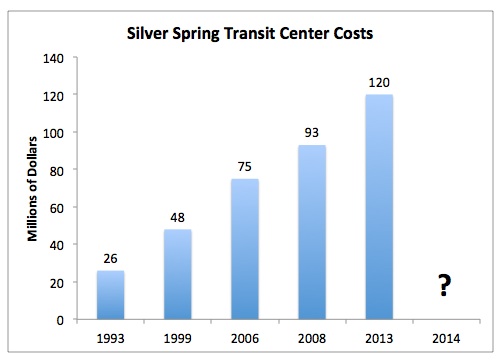
Silver Spring Transit CenterThe costs of the Silver Spring Transit Center are set to rise by significant amounts again in 2014:

The additional expense could be considerable. Since early summer, contractors have drilled and excavated portions of the structure to install additional supporting steel. The “cap ties” are intended to strengthen the building. . . . Dise placed the cost of that work at about $1.6 million.

But more costly fixes are on the way. In coming weeks, workers will apply a two-inch layer of latex-modified concrete to roadways and other surfaces, a task that requires highly specialized equipment. The final major fix will be the addition of 255 strut beams to reinforce interior girders.

The new appropriation request is expected to include other costs, such as continued operation of the interim Silver Spring site for buses and fees for engineering consultant Allyn Kilsheimer, who was hired by the county to oversee the repairs.

This sort of fiasco does not exactly raise confidence in the ability of the County government to handle larger projects.

Share

AFL-CIO Disses MoCo Council Incumbents

MD AFLIn the Democratic primary, the AFL-CIO endorsed incumbent Marc Elrich as well as challengers Beth Daly and Vivian Malloy for the at-large seats. Only Elrich won the nomination. The AFL-CIO did not endorse incumbents Nancy Floreen, George Leventhal, or Hans Riemer. They have now decided not to endorse any of these three (or anyone else) for the general election.

The AFL-CIO have also made no endorsement in District 1 (Roger Berliner), District 2 (Craig Rice), or District 3 (Sidney Katz). They had endorsed unsuccessful candidates Duchy Trachtenberg (District 1) and Ryan Spiegel (District 3).

District 4 Incumbent Democrat Nancy Navarro is their only new endorsed candidate. They had already endorsed Tom Hucker in District 5–their only other Montgomery County Council winner besides Marc Elrich.

So two-thirds of the new Council will have the election without the endorsement of the AFL-CIO in either the primary or the general election–7 out of 9 if you include the primary.

Share

Rapid Transit at the MoCo Fair

Councilmember Roger Berliner: “There is nothing more fundamental to the future of Montgomery County than making this happen. And making it happen during the next four years.”

Councilmember Marc Elrich: “This is the best answer we have to both the need for capacity and the limited dollars available.”

Councilmember Cherri Branson: “I cannot tell you how important a bus-rapid transit system would be for Route 29 not only to alleviate some of the current congestion but even more importantly to help us develop the east part of the county.”  –

County Executive Ike Leggett: “It will happen in Montgomery County. This is the right thing for our future.”

Share

Public Financing in MoCo

PF AtLarge PF DistrictPF Exec

The Cost and Impact of Public Financing

Montgomery County has moved closer to adopting a public financing system for county elections with approval of the bill by the Government Operations and Fiscal Policy Committee. As the Council packet explained, the bill proposed by retiring Councilmember Phil Andrews would encourage candidates to raise money in small amounts.

A candidate would need to obtain a specific number of small contributions from a County resident of between $5 and $150 in order to qualify for public funding. Each of these qualifying contributions must be received within 365 days before the primary election and at least 45 days before the primary. A candidate for Executive would need to collect at least 500 qualifying contributions and an aggregate total of at least $40,000 to qualify. A candidate for At-Large Councilmember would need 250 qualifying contributions and an aggregate total of at least $20,000. A candidate for District Councilmember must collect at least 125 qualifying contributions and an aggregate total of at least $10,000.

A candidate for Executive certified to receive public funding would be eligible for a matching contribution of $6 for each dollar of a qualifying contribution for the first $50 of the contribution; $4 for each dollar of the second $50; and $2 for each dollar of the third $50. The match for a candidate for Councilmember would be $4 for each dollar of the first $50, $3 for each dollar of the second $50, and $2 for each dollar of the third $50. . . . The maximum public contribution for a candidate for Executive would be $750,000 for the primary and $750,000 for the general election. The maximum public contribution for At-Large Councilmember would be $250,000 and the maximum public contribution for each election for District Councilmember would be $125,000.

A candidate who voluntarily accepts a public contribution must pay for all campaign expenses with the qualifying contributions, the matching public contributions, and a personal loan from the candidate and the candidate’s spouse of no more than $6000 from each.

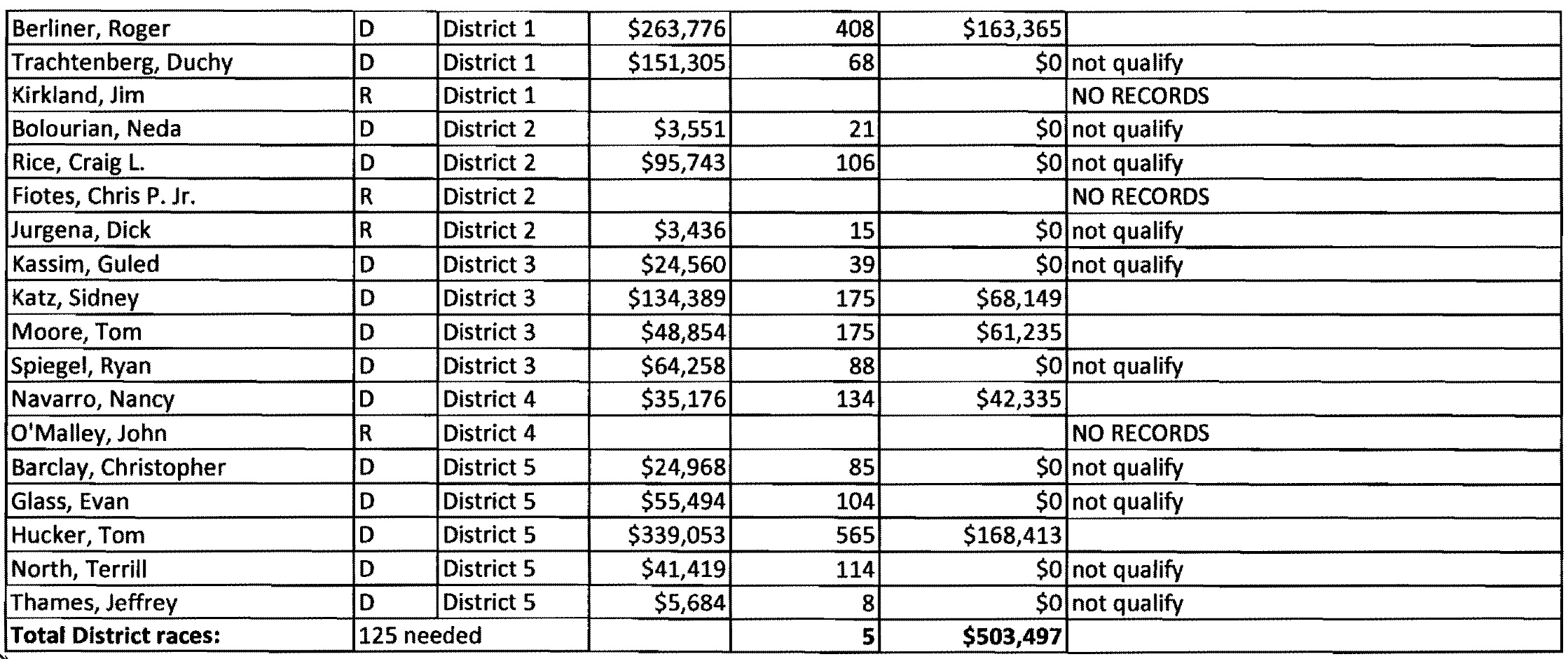
But the really interesting part–the impact on the candidate funds–was placed at the far end of the report and has been highlighted in the screenshots at the top of the post. A key caveat in any examination of the Council analysis–and indeed, the point of the system–is that some candidates would change their behavior in response to the new incentives. So take these projections of its impact with a dollop of sour cream.

Would the Bill Achieve Its Goals?

The reason that the presidential public financing system died was the ability of candidates to raise far in excess of the amount available through the system. The rise of expenditures by outside groups and their legalization by the Supreme Court has also contributed to the demise of the system.

Not all candidates would necessarily want to participate in the system. The Council Staff report explained that only two district candidates and one executive candidate could have raised more through the proposed system than they raised without it. On the other hand, three of four at-large candidates could have raised more through the public financing system. Over time, the incentive to participate could decline and even disappear as in presidential elections. It will have no impact on candidates who can afford to self-finance their own campaigns.

Another issue that the bill cannot address is the participation of outside groups. Though the incentives to participate in the public financing system could constrain large donations and the total amount spent, it has no impact on expenditures by outside groups from MCGEO to the Koch brothers.

Moreover, it is not fully clear to me that it would necessarily level the playing field for candidates. In some cases, it might increase the advantage of incumbents or the person who has raised the most money. Challengers or less-well funded candidates might still like it because the initial dollars are the most crucial to viability. The marginal impact of expenditures tends to decline as the amount spent rises.

Some final potential quirky effects. First, potential donors might like if they cannot give such large amounts because they would not be asked to write such large checks. Second, candidates may perversely have to spend more time raising money if they have to raise it in small amounts rather than in large chunks from fewer people. The problem will get worse over time unless the limits are adjusted for inflation, like the federal limits in the Bipartisan Campaign Reform Act (a.k.a. McCain-Feingold).

Share