All posts by David Lublin

UPDATE: Carroll County GOP Frazier Follies

Over at Free State Notes, Walter Olson has a valuable update on the Carroll County Republican Central Committee’s (CCRCC) appointment of whackadoodle Robin Frazier to fill the vacancy caused by Sen. Joe Getty’s acceptance of a position in the Hogan administration:

(1) Although I wrote that “nobody puts crazy in the corner,” I had not realized that Frazier had ran a write-in campaign for County Commissioner against her own party’s nominee after losing the primary that garnered a whopping 9% of the vote. Makes her a doubly news of the weird choice by CCRCC.

(2) One of the people who voted on the vacancy was an employee of outgoing Commissioner Frazier.

(3) 2000 people have already signed an online petition against the appointment–more than voted for Frazier in the Republican primary–and they have gained support from one member of the Carroll County Commission.

(4) Michael Stewart over at Red Maryland has inveighed against both the secret process (the vote and who was considered were secret) and the decision to appoint this person twice rejected by the voters at the polls. Republicans are livid over this travesty.

(5) Frederick County Councilmember Kirby Delauter must be eternally grateful that Robin Frazier has distracted attention from his own stupidity and public humiliation.

Gov. Martin O’Malley found a way out of having the follow through with a disastrous appointment by the Prince George’s County Democratic Central Committee. Let’s hope that Gov. Elect Larry Hogan can do the same.

Question: Will this help inspire bipartisan support for reform of the appointment process?

Share

Bizarro World of Carroll County GOP Politics

Former Carroll County Commissioner Robin Frazier made herself blogger bait when she decided to sing part of the 2014 State of the County address. Unfortunately, her oeuvre has been taken down from YouTube and now, I fear, lost to posterity.

Frazier made the big time news when she violated a court order (follow link for video) regarding prayer at Commission meetings:

Carroll County Commissioner Robin Frazier opened a meeting of the Commission with a prayer invoking Jesus Christ despite a federal court order. She views the order as a wrongly issued violation of her First Amendment rights.

Frazier is “willing to go to jail” and said that America will soon be “all the way to Communism if we don’t start standing up and saying no.” She lumped the anti-prayer ruling with plots to take away guns, palm scan her children, and take away property rights through Plan Maryland.

As I mentioned at the time, her raving looney views (rather than her commitment to religion) and odd behavior placed her in electoral danger even in a Republican primary. Indeed, this former member of the Ehrlich administration lost the primary to Stephen Wantz by 56% to 38%–a sound thrashing for the incumbent.

But nobody puts crazy in the corner.

Highly regarded Sen. Joe Getty is giving up his Senate seat to work in the Hogan administration. According to Maryland’s process for filling General Assembly vacancies, the Carroll County Republican Central Committee chooses his replacement. And they’ve selected Frazier over Del. Justin Ready.

Please tell me that only Carroll Republican Central Committee members think that an incumbent losing renomination after acting like a guest star on Law & Order or the latest Nancy Grace vehicle is grounds for promotion to a Maryland Senate seat. You can’t blame Carroll’s Republican voters–they tried and now they will be “represented” by Frazier in the General Assembly for the next four years.

Share

States Gaining and Losing CDs

EDSApportionment

The Bureau of the Census has released population estimates for 2014. Election Data Services calculated changes in the number of congressional districts that would be allocated to each state based on the 2014 numbers:

Gaining One Seat
North Carolina
Texas

Losing One Seat
Minnesota
Pennsylvania

They have also projected changes in the number of CDs in each state after the 2020 Census:

Gaining Three Seats
Texas

Gaining One Seat
California
Colorado
Florida
North Carolina
Virginia

Losing One Seat
Alabama
Illinois
Michigan
Minnesota
Ohio
Pennsylvania
Rhode Island
West Virginia

Other potential gainers of one seat include Arizona and Oregon. Virginia’s seat gain is the most tenuous–they would get the last seat according to this projection. Other potential losers of one seat include New York. Florida has now surpassed New York to become the country’s third-largest state.

Maryland

No one is projecting that the number of Maryland’s congressional districts will change from eight after the 2020 Census. In 2014, the estimated American population increase was 3.27% since the 2010 Census. Maryland’s gain was slightly higher at 3.51%–the 21st highest rate in the country–suggesting that there is little danger of losing a seat. However, Maryland is growing at a somewhat slower rate than similarly sized states that might gain seats.

Slow-Growing States

West Virginia, -0.15%
Maine, 0.13%
Vermont, 0.13%
Rhode Island, 0.21%Michigan, 0.26%
Illinois, 0.38%
Ohio, 0.50%
Connecticut, 0.63%
Pennsylvania, 0.66%
New Hampshire, 0.79%
Mississippi, 0.88%

All of the New England state, except Massachusetts, have grown at very slow rates. Rhode Island could lose one of its two CDs, leaving it with one very highly populated CD with over one million people. like Montana. So far, Maine and New Hampshire are not projected to lose one of their two CDs, though that would eventually happen unless their growth rates pick up.

Fast-Growing States and DC

North Dakota, 9.95%
District of Columbia, 9.49%
Texas, 7.20%
Colorado, 6.49%
Utah, 6.48%
Florida, 5.79%
Arizona, 5.31%
Nevada, 5.12%
Washington, 5.01%
South Dakota, 4.79%
South Carolina, 4.48%

Washington, DC is growing gangbusters and now has an estimated population of close to 659,000.


Share

Exactly what we don’t need in Annapolis

This statement by conservative Richard Viguerie sums up perfectly the approach that we should endeavor not to import into our newly divided government in Annapolis:

“There’s a certain willingness among conservatives to reconsider our Cuba policy, but the fact that it’s been negotiated by Obama — whom we have no confidence or trust in — makes it suspect,” said Richard Viguerie, a longtime conservative leader. “If this had been done by a trustworthy, conservative Republican, it would have been different.”

Share

ACT Sees Purple Line Dream Fade; MCDOT Follows 7S

The Action Committee for Transit (ACT) sees its Purple Line dreams moving out of reach and has sent out an email trying to rally support:

The Purple Line is again in grave danger — at the very moment when it is about to begin construction.

ACT’s definition of “about to begin construction” is different from most. While this phrase invokes visions of bulldozers ready to go, no federal funding has been awarded and the State has yet to receive–let alone evaluate–proposals from concessionaires (i.e. contractors) for the public private partnership (P3) who would still need to design the system.

Social Justice Out, Jobs Program In

The reasons that ACT believes we need to save the Purple Line have altered in focus:

Maryland will lose thousands of jobs in construction and future growth if we don’t build the Purple Line now.

Here, ACT has jettisoned its social justice rhetoric, formerly at the center of Purple Line appeals, so easily that it should give pause to those who support the Purple Line Compact to protect residents and businesses likely to be displaced by it. It’s now (and probably always was) all about something else.

Interestingly, the new front-and-center focus is on construction jobs. A temporary jobs program requiring massive public spending seems an odd way to appeal to our Governor-Elect and shows a tin ear in an attempt to bootstrap synchronicity with Hogan’s values by former Brown supporters.

Still Confusing Purple Line with Metro

Not all ACT rhetoric has changed:

The new Silver Line has four stations in Tysons Corner because Virginia understood the economic importance of rail transit; Maryland must not fall behind. Businesses and commuters are counting on the state to keep the commitments it has made and go forward with the Purple Line.

ACT  continues to equate the building of the light rail Purple Line, which will not be part of the Metro system, with the heavy rail Silver Line, which is integrated into Metro and will terminate at Dulles Airport. This effort to obfuscate the differences through the use of a color name similar to Metro lines has long been one of the most clever parts of ACT’s communications strategy. Light rail and heavy rail are quite different–the former is more similar to bus-rapid transit systems (RTS), though RTS is far less expensive.

Give to Aid the Land Company Now

ACT’s email closes with the traditional fundraising appeal:

If you can do one more thing for the Purple Line, ACT needs your financial help to continue our campaign. Please make a special contribution now.

By allowing for increased development, Purple Line proponents argue that it will raise land values around stations. Indeed, that is the goal. For example, the wealthy Chevy Chase Land Company is keen to see the Purple Line built–they’re organizing a letter to Hogan arguing for the pricey project–because it will increase the value of their holdings in that area. Yet we are asked to pay for the privilege of aiding the Land Company by donating to ACT.

Ironically, virtually all of the development over the short and medium terms will occur at Chevy Chase Lake without the Purple Line. The revised sector plan added 1.7 million square feet that will move forward with construction even if the Purple Line isn’t built. This will include about 700 apartments and 70 town houses, a hotel and over 250,000 square feet of commercial development. This is more than than the 1.3 million square feet that would be built much later on condition of Purple Line construction.

New Twitter Follower

I am happy to welcome the Montgomery County Department of Transportation Director’s Office as a follower to @theseventhstate.

Correction: Earlier version had MDOT instead of MCDOT. Apologies for the Error.

Share

Miller Announces Committee Assignments

From the Press Release:

Senate President Miller Announces New Committee Assignments

Annapolis, MD – Today, Senate President Thomas V. Mike Miller Jr., announced new committee assignments effective upon the swearing in of the newly elected Senate.

“These committee assignments reflect the diversity and unique background and knowledge of each of our Senators and Senators-Elect. I am pleased to announce these appointments and know that these Senators will be very successful in these roles,” said Senate President Miller. “We have incredible talent and knowledge in the Maryland Senate and I am certain all of these appointments will serve our State well.”

The following Senators and Senators-Elect have been appointed to the following committees.

Budget & Taxation Committee

·         Senator Edward J. Kasemeyer (D-12, Howard & Baltimore Counties) – Chair
·         Senator Richard S. Madaleno (D-18, Montgomery County) – Vice-Chair
·         Senator Ulysses Currie (D-25, Prince George’s County)
·         Senator James “Ed” DeGrange (D-32, Anne Arundel County)
·         Senator-Elect Adelaide C. Eckardt (R-37, Caroline, Dorchester, Talbot, and Wicomico Counties)
·         Senator George Edwards (R-1, Garrett, Allegany, and Washington Counties)
·         Senator Bill Ferguson (D-46, Baltimore City)
·         Senator Joseph Getty (R-5, Carroll County)
·         Senator-Elect Guy J. Guzzone (D-13, Howard County)
·         Senator Nancy J. King (D-39, Montgomery County)
·         Senator Roger Manno (D-19, Montgomery County)
·         Senator Nathaniel McFadden (D-45, Baltimore City)
·         Senator Douglas J. J. Peters (D-23, Prince George’s County)

Education, Health, & Environmental Affairs Committee

·         Senator Joan Carter Conway (D-43, Baltimore City) – Chair
·         Senator Paul G. Pinsky (D-22, Prince George’s County) – Vice-Chair
·         Senator-Elect Gail Bates (R-9, Howard & Carroll Counties)
·         Senator-Elect Cheryl C. Kagan (D-17, Montgomery County)
·         Senator Karen S. Montgomery (D-14, Montgomery County)
·         Senator-Elect Shirley Nathan-Pulliam (D-44, Baltimore County & Baltimore City)
·         Senator Jim Rosapepe (D-21, Prince George’s & Anne Arundel Counties)
·         Senator-Elect Johnny Ray Salling (R-6, Baltimore County)
·         Senator Bryan Simonaire (R-31, Anne Arundel County)
·         Senator-Elect Steve Waugh (R-29, St. Mary’s & Calvert Counties)
·         Senator Ronald N. Young (D-3, Frederick County)

Finance Committee

·         Senator Thomas “Mac” Middleton (D-28, Charles County) – Chair
·         Senator John C. Astle (D-30, Anne Arundel County) – Vice-Chair
·         Senator Joanne C. Benson (D-24, Prince George’s County)
·         Senator Brian J. Feldman (D-15, Montgomery County)
·         Senator Stephen S. Hershey, Jr. (R-36, Kent, Queen Anne’s, Cecil, and Caroline Counties)
·         Senator J.B. Jennings (R-7, Baltimore & Harford Counties)
·         Senator Delores Kelley (D-10, Baltimore County)
·         Senator Kathy Klausmeier (D-8, Baltimore County)
·         Senator James N. Mathias (D-38, Somerset, Wicomico, & Worcester Counties)
·         Senator Catherine Pugh (D-40, Baltimore City)
·         Senator Edward R. Reilly (R-33, Anne Arundel County)

Judicial Proceedings Committee

·         Senator Bobby Zirkin (D-11, Baltimore County) – Chair
·         Senator Lisa Gladden (D-41, Baltimore City) – Vice-Chair
·         Senator Jim Brochin (D-42, Baltimore County)
·         Senator-Elect Bob Cassilly (R-34, Harford County)
·         Senator-Elect Michael J. Hough (R-4, Frederick & Carroll Counties)
·         Senator C. Anthony Muse (D-26, Prince George’s County)
·         Senator-Elect Wayne Norman (R-35, Harford & Cecil Counties)
·         Senator Victor R. Ramirez (D-47, Prince George’s County)
·         Senator Jamin “Jamie” Raskin (D-20, Montgomery County)
·         Senator Christopher Shank (R-2, Washington County)
·         Senator-Elect Susan C. Lee (D-16, Montgomery County)

Share

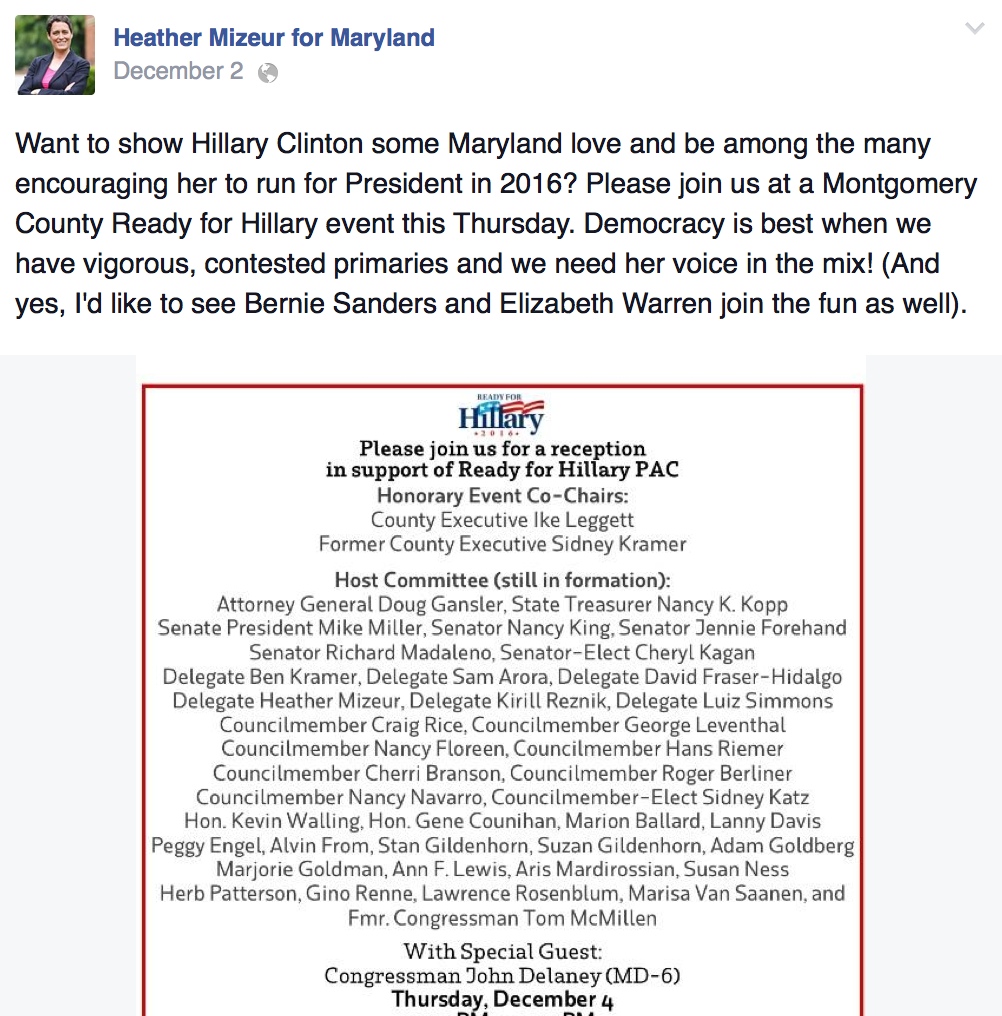
Mizeur is Ready For. . .

Former Del. Heather Mizeur lined up to support Hillary Clinton at a recent Ready for Hillary event with many major Maryland heavy hitters:

MizeurRfH

Initially, the most notable part of the invitation was Mizeur joining with erstwhile opponent Gansler to support Clinton and not Gov. Martin O’Malley, who put his muscle behind Brown. But then Heather attacked the budget compromise on her Facebook page and called for progressives to support Sen. Elizabeth Warren:

MizeurWarren

Outgoing Appropriation Chair Barbara Mikulski, a Democratic icon in this state, was working the phones to urge support for the budget compromise. As became clear to all this year, Heather is a campaign expert and perhaps tying herself to Warren makes it easier to position herself as a progressive alternative to Mikulski in 2016.

However, looking lower on Heather’s Facebook page reveals that Heather has not jumped from the Clinton to the Warren bus but was never committed to either campaign. In fact, she’s also supports Bernie Sanders:

MizeurClinton

The many who read the Washington Post and see the Ready for Hillary invitations but do not read her the fine print on her Facebook page might not realize that Heather is more Ready to Consider Hillary rather than Ready for Hillary.

Share

The Giant Purple Credit Card, Part III: Is Pro-Purple Anti-Transit?

Opportunity Costs

The choice to spend vast sums of money on one project requires foregoing other choices. The tangled finances for the Purple and Red Lines (see also here) render it especially obvious. When the fares from Baltimore’s public transit system are needed as a backstop in case Purple Line fares are lower than hoped, the use of the Transportation Trust Fund (TTF) for non-Purple purposes is obviously going to be quite limited.

The plans to move ahead also with Baltimore’s Red Line should further assure that the TTF is tied up for literally decades. Indeed, the two projects have been closely tied together in order to build political support. It is hard to imagine moving ahead with one project without the other, as legislators in one metro area are unlikely to want to fund an incredibly expensive project in the other unless their constituents share in the benefits.

Existing Transit Needs

Montgomery and Prince George’s County already have an extensive public transit system. Both are integrated into WMATA’s Metro and Metrobus system. Each operates its own bus system: RideOn and TheBus. Both are also tied into the MARC system.

All parts of the system have suffered from cutbacks and need investment in infrastructure. Metro, the lungs of Washington’s transit system, remains in particularly dire need of money to maintain and to upgrade its infrastructure. Placing so many chips on the Purple Line will constrain the ability of the State to aid Metro–Montgomery and Prince George’s cannot expect to get all of Maryland’s transportation funding.

Less widely heralded in Montgomery in the face of perennial Metro problems–endless single tracking, escalators that don’t work, overly crowded trains at rush hour despite stagnating ridership–have been the cutbacks to MARC and Ride-On. Oddly, we reduced transit service designed to connect to the Purple Line even as we move forward with building it.

Foregoing Other Transit Opportunities

Some key supporters of the Purple Line recognize these implicit tradeoffs even if they don’t advertise them. In the at-large County Council debate in Chevy Chase, new Council President George Leventhal derided Councilmember Hans Riemer’s support for additional Ride-On service. He and other Purple Line supporters have also expressed great skepticism about the proposed countywide bus-Rapid Transit System (RTS).

The irony here is that for the cost of building the Purple Line, we could build a RTS that would serve all parts of the County. Indeed, a Purple Line incorporated into an RTS would accomplish most of the goal at far less cost than the proposed light-rail system even according to MTA’s own analysis (see also here).

Purple Line supporters like to accuse opponents of being anti-transit–it’s a good simple communication meme that boils down a complex decision to good versus bad. Except that wanting to spend transportation dollars wisely and get the most for our tax dollars is pro-transit. Opposition to expanding bus service and continued negativity regarding an RTS that could serve the whole county sure doesn’t sound pro-transit.

The Bottom Line

We shouldn’t starve our existing transit system and forego future opportunities in order to build the Purple Line and the Red Line. Ironically, we could build cheaper RTS versions of both that would save the State billions–not chump change–and allow for additional transit and road improvements that would truly aid economic development and the ability of all Marylanders to reach jobs far more broadly. Now that’s smart growth.

Share

Darrell Anderson is the New MCDCC Chair

mcdcceboard

The New MCDCC Executive Board

Last night, the Montgomery County Democratic Central Committee (MCDCC) elected former Washington Grove Mayor Darrell Anderson as its new Chair. The rest of the Executive Board remains the same–these positions were not up for election.

MCDCC faces a lot of hard work now that the election is over not just to fix existing problems but to reenergize the party for the 2016 election. I hope that they will use metrics to assess progress on their goals. Similarly, accountability and transparency will be critical as MCDCC moves forward.

Now that the election is over, MCDCC has more time to approach problems in a more thoughtful, less pressured atmosphere. Fortunately, even its critics among Democratic officials and other constituencies have remained publicly and privately committed to working with MCDCC to achieve more success in the future.

Share

The Giant Purple Credit Card, Part II: Thank You, Baltimore!

faux-card-purple

Mike Madden, the Project Manager for the Purple Line, was once again kind enough to answer questions on the topic. I appreciate his willingness to take the time. Today, I publish some of my questions and Mike Madden’s answers along with comments.

Show Me the Money

Seventh State Question: My understanding is that the service payments will come from fare costs. Is this correct (and, if not, where do they come from)? How does MDOT estimate the takings in fares as it hasn’t set the fares or negotiated a transfer agreement with WMATA for Metro yet? It is not correct that the payments come from farebox revenues.

Mike Madden: The annual payments will come from the Maryland Transportation Trust Fund, as does all the state investment and support for transportation projects and services. Farebox revenues go into the Transportation Trust Funds as do the other sources of revenue for transportation purposes. Again, the Pre-Solicitation Report provides further information on this topic.

Seventh State Comment: I followed Mike’s suggestion and looked at the report, which states that:

[T]he forecasted fare revenues generated by the Purple Line are estimated to be on average greater than the concessionaire’s debt service. Therefore, even though MTA would collect and account for the Purple Line fare revenues, the MTA revenues generated by the project are sufficient to cover the borrowed capital repayment share of the availability payment. (Source: “Presolicitation Report to the Maryland General Assembly, August 2013, pp. 17-18).

So in essence, MTA is claiming that the revenues from the Purple Line will be enough to pay back the cost of building it. There are major, serious problems with this claim. MTA has no idea what the fares will be at this point if only because they have no agreement negotiated with WMATA about how transfers between the Purple Line and Metro will be handled. As a result, we have no idea how the revenue from transfer trips–a significant number of trips including the PL–will be divided. Heck, MTA doesn’t even know how they will collect the fares on the open (i.e. no fare gate) system yet or how much it will have to spend on enforcement of it.

Next, if ridership has been overestimated, and Randall O’Toole explains why it almost certainly has been, MTA will either collect less money and or have to reduce fares in order to attract more ridership. MTA and Parsons-Brinckerhoff’s record along with their complete unwillingness to explain how they calculated ridership does not inspire confidence.

Operating Costs

Finally, notice that there is no mention of the operating cost, which will also be factored into the bids and for which the State will also have to pay. The sources of payment for this cost remain shrouded in mystery. My inquiry to Mike Madden didn’t reveal more:

7S Question: As fares usually do not even cover operating costs, where will the funds to operate the Purple Line come from?

MM: The payment for operating costs are included in the annual payments, which will come from the Maryland Transportation Trust Funds, as does all the state investment and support for transportation projects and services.

7S Comment: I imagine that the funds to fill the Transportation Trust Fund are expected to come from the planned gas tax increases–the same one our incoming Governor has vowed to stop and to repeal.

Thank You, Baltimore!

7S Question: Is it correct that the State’s ability to pay the concessionaire is backed by its income from public transit in Baltimore?

MM: No. The farebox revenues from transit services in the Baltimore region go into the Transportation Trust Funds.

7S Comment: Despite the flat denial, since the fares from the Baltimore region go into the Transportation Trust Funds, they are obviously going to be used to help guarantee that the State can pay for the Purple Line. It seems obfuscatory to pretend otherwise, especially as MTA has explained this to legislators.

More to Come in Part III

Share