
Last night, the Montgomery County Democratic Central Committee (MCDCC) accepted Chair Kevin Walling’s resignation. Vice Chair Arthur Edmunds will serve as Acting Chair until the members of the committee elect a new chair on on December 2nd.

Massacre of the Moderates
Moderates in the House of Delegates did not have a good election. The following is a list of the 21 most moderate delegates going into the 2014 elections, according to Boris Shor and Nolan McCarty’s measure of state legislator ideology:
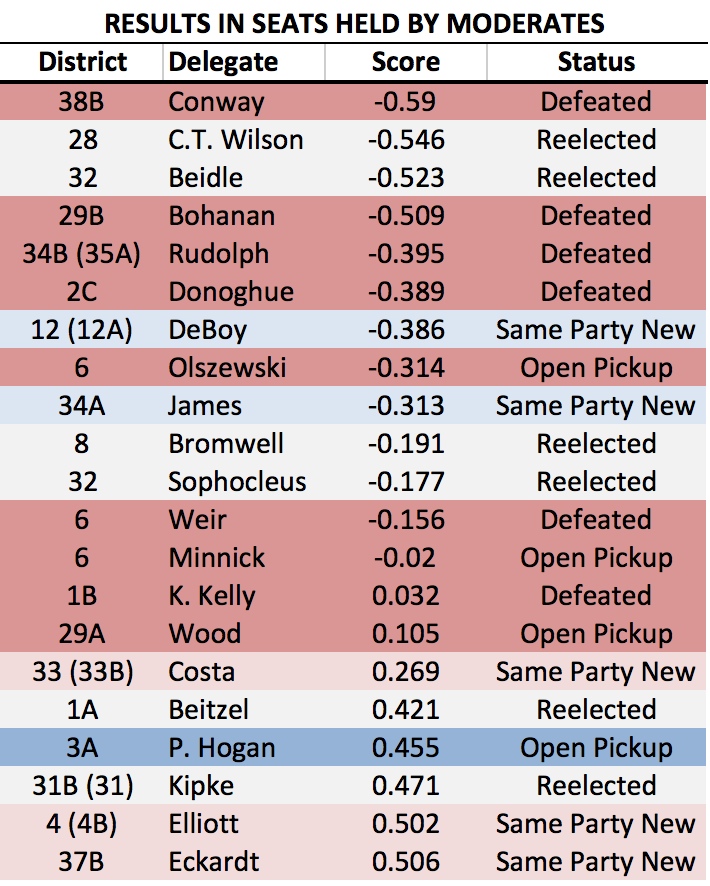
Among the 21 moderates, only six ran and won reelection. All but one seat that flipped parties was held by a moderate. Seven moderate incumbents went down to defeat: six Democrats and one Republican. Additionally, three seats vacated by Democratic incumbents were picked up Republicans.
The replacement of nine moderate Democratic incumbents by Republicans will push the Democratic Caucus to the Left. It may also make the Republican Caucus more conservative; junior members of both parties have tended to be less moderate than senior members of their party in Congress.
All of the nine seats picked up by Republicans were in territory that leans Republican in other elections, which should make it easier for the GOP to hold them in the future and for their delegates to take conservative positions. In safe seats, candidates fear primaries more than general elections.
Five moderates were replaced by new members of the same party. In three cases (Districts 4, 33, and 37B), these seats are safe for the Republicans. One more district also leans strongly, if slightly less securely, toward the Democrats. As a result, it would not surprise if the four new members were less moderate than their predecessors. (Only District 34A, previously held by Democratic Del. Mary-Dulany James, is tough territory for their party.)
Previously, the ideological distance between the most moderate Democrat and Republican was only 0.164. Based on who is left, that gap would rise to 0.598, leaving the two parties more clearly divided into clean camps than before the election.
Cardin Defends PL, Blasts K-XL, GOP
Sen. Ben Cardin blasts the Republicans for favoring the Keystone XL pipeline and their lack of support for the Purple Line:

The comments are mixed.
Busch Announces New Leadership Team Members
The following is a press release from Speaker Michael Busch’s office:
SPEAKER BUSCH ANNOUNCES NEW COMMITTEE LEADERSHIP APPOINTMENTS
ANNAPOLIS, MD – House Speaker Michael E. Busch today announced his first round of leadership appointments following the 2014 general election. Speaker Busch describes the group collectively as “the right additions to the existing House leadership team to help move us forward into the coming term.” He adds, “We are fortunate to have such a talented group of individuals to help lead the House.” Speaker Busch plans to announce additional leadership appointments and committee moves in the coming weeks.
Delegate Maggie McIntosh (Baltimore City, D43) will become Chairman of the Appropriations Committee. Delegate McIntosh has chaired the Environmental Matters Committee since 2003, but served on the Appropriations Committee early on in her legislative career. Said Speaker Busch, “Maggie McIntosh is one of the most well respected leaders in Annapolis and I have total confidence in her ability to manage the myriad of subjects that fall within the jurisdiction of the committee, most importantly legislative review and oversight of the State’s annual budget. She is the right person to take the lead on budget issues as we continue to provide critical services to the citizens of our State and to use our resources to foster a growing economy.”
Delegate Kumar Barve (Montgomery County, D17) will become the Chairman of the newly designated Environment & Transportation Committee (formerly Environmental Matters). Moving forward, transportation policy issues will be consolidated within the Committee’s subject matter jurisdiction. Delegate Barve has served as Majority Leader since 2003 and prior to that served on the House Economic Matters Committee under then-Chairman Busch. He currently sits on the Ways and Means Committee. Said Speaker Busch, “Delegate Barve has demonstrated time and time again his command of complex issues and he is a natural choice of someone to guide State environment and transportation policy.”
Delegate Adrienne Jones (Baltimore County, D10) will remain Speaker Pro Tem and will now oversee State higher education policy as Chairman of the Education and Economic Development Subcommittee in the Appropriations Committee. Delegate Jones was Busch’s first appointment as a newly elected Speaker in 2003. Said Speaker Busch, “Delegate Jones is one of the most versatile leaders in the House. She is a consensus builder and an extremely hard worker. With job growth and economic development at the forefront of our agenda in the coming term, I can think of no better person to lead on policy and budget issues related to our system of higher education.” Delegate Jones will also continue to serve as the Chairman of the Capital Budget Subcommittee.
Having served as an instrumental member of the Ways and Means Committee since 2003 and as the Chair of the Education Subcommittee since 2007, Delegate Anne R. Kaiser (Montgomery County, D14) has been appointed as the Majority Leader. Delegate Kaiser will also maintain her roles on the Ways and Means Committee. “Anne Kaiser has worked tirelessly for the House Democratic Caucus and demonstrated leadership capabilities on crucial legislative priorities,” said Speaker Busch.
Assuming the role of Vice Chairman of the Environment and Transportation Committee will be Delegate Dana Stein (Baltimore County, D11). Stein was first elected to the House in 2006 and serves on the Environmental Matters Committee. Said Speaker Busch, “Delegate Stein is a thoughtful legislator whose considerable knowledge and even temperament make him an ideal choice for Vice Chairman.”
Delegate Sally Jameson (Charles County, D28) will become Vice Chairman of the Economic Matters Committee. Delegate Jameson is a long-time member of the Committee (since 2003) and is known for her work on energy issues. Said Speaker Busch, “Delegate Jameson brings a business background and a pragmatic approach to the important workforce and economic development issues handled in the Economic Matters Committee.”
Delegate Marvin Holmes (Prince George’s County, D23B) will become Chairman of the Joint Committee on Legislative Ethics. Delegate Holmes has been a member of the House since 2003 and has served in a number of leadership roles. “Delegate Holmes is a model public servant and a person of great integrity. He is the clear choice to Chair this important committee,” said Speaker Busch.
Delegate James Proctor (Prince Georges and Charles Counties, D27A), Vice Chairman of the Appropriations Committee, will remain in that role and also assume the House Chairmanship of the Spending Affordability Committee. The Committee plays a critical role in the budgeting process as it annually establishes State spending guidelines based on current and projected economic conditions. Said Speaker Busch, “Delegate Proctor’s commitment to public service and his budgetary experience is unparalleled and I look forward to his continued leadership in this new role.”
Republican Senate Conservatism Varies–But Not Too Much
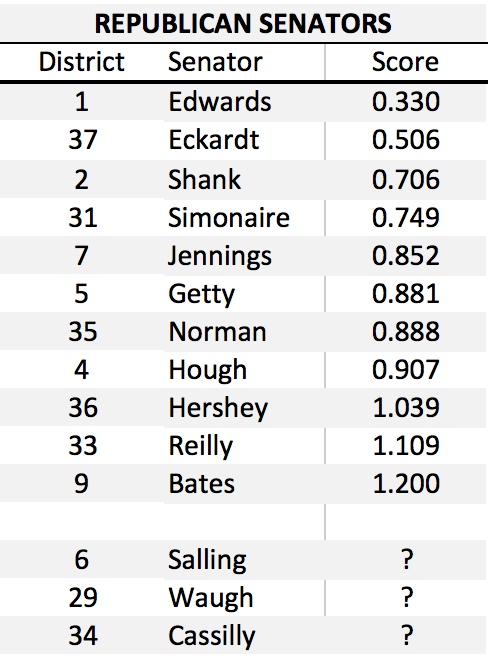 Today, 7S looks at Republicans using the data provided by Boris Shor and Nolan McCarty of state legislator ideology. Remember that a more positive score indicates a more conservative senator, so the bottom of the table are the most conservative. Put another way, the closer to zero, the more moderate the senator. These scores are for the legislator’s entire career in the General Assembly and include House as well as Senate service.
Republican scores range from 0.330 for Sen. George Edwards (R-Garrett, Allegany and Washington) and 1.200 for Senator-Elect Gail Bates (R-Howard). (Three incoming Republican senators do not have scores because they have never served in the General Assembly.) In contrast, the most progressive Democrat, Sen. Rich Madaleno (D-Montgomery), has a score of -1.864 and the most moderate Democrat, Sen. Jim Brochin (D-Baltimore County) receives a rating of -0.285.
Two of the three most moderate Republicans represent Western Maryland–Edwards and Sen. Christopher Shank (R-Washington). However, the two Eastern Shore Republicans are not close ideologically with Senator-Elect Addie Eckardt (R-Mid Shore) more moderate than Sen. Steve Hershey (R-Upper Shore).
Similarly, the two Anne Arundel senators are not an ideological matched set. Sen. Ed Reilly (R-Anne Arundel) is the second most conservative senator while Sen. Bryan Simonaire (Anne Arundel) is more moderate, though the ideological distance is smaller than for the two Shore Republicans.
Perhaps most critical is that all Republicans are notably more conservative than all Democrats. The distance between the most moderate Democrat and Republican (0.615) is greater than that between the most conservative Republican, Senator-Elect Bates, and the second most “moderate” Republican, Senator-Elect Eckardt. And even the most moderate Republcian, Sen. Edwards, is closer to all but three Republicans than the most moderate Democrat.
Ten Most Conservative Democratic Senators
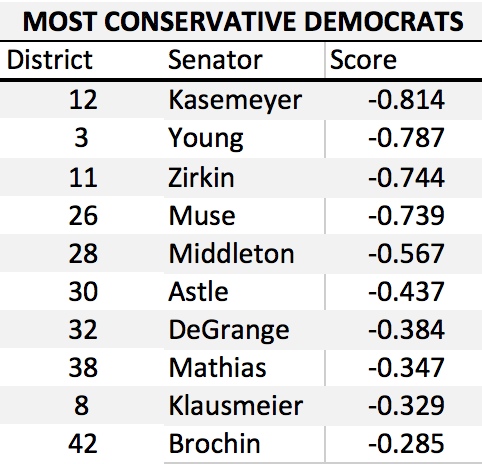
While yesterday’s post focused on the most progressive members of the Democratic Senate Caucus, today 7S looks at the most conservative Democrats using the same data provided by Boris Shor and Nolan McCarty of state legislator ideology. Remember that a more negative score indicates a more progressive senator, so the bottom of the table indicates the most conservative senators. These scores are for the legislator’s entire career in the General Assembly and include House as well as Senate service.
Interestingly, only one of the most moderate Democrats hails from Baltimore City, Montgomery, or Prince George’s County. Prince George’s Sen. Anthony Muse, who backed Larry Hogan in the Governor’s race following a quixotic primary challenge to U.S. Sen. Ben Cardin, is the seventh most conservative Democrat.
Baltimore County Sen. Jim Brochin is the most moderate Democrat, followed by Sen. Kathy Klausmeier, who also hails from Baltimore County. Sen. Bobby Zirkin, the eighth most moderate senator, is the final Baltimore County senator on the list. The other members of Baltimore County’s Senate delegation will be either African-American Democrats or Republicans. Sen. Jim DeGrange and Sen. John Astle, the fourth and fifth most conservative Democrats, represent Anne Arundel.
The final members of the list come from different counties. Sen. Jim Mathias, the third most moderate Democrat, represents the lower Eastern Shore. Sen. Mac Middleton is from increasingly Democratic Charles. Sen. Ron Young represents Frederick, a county that has become more Democratic than in the past in recent elections but went strongly for Larry Hogan.
Finally, Sen. Ed Kasemeyer, the most liberal member of this group of moderates is from Howard, a county that is now solidly Democratic in federal contests but that elected a moderate Republican, Alan Kittleman, as County Executive, and also voted for Larry Hogan.
Ten Most Progressive Senators
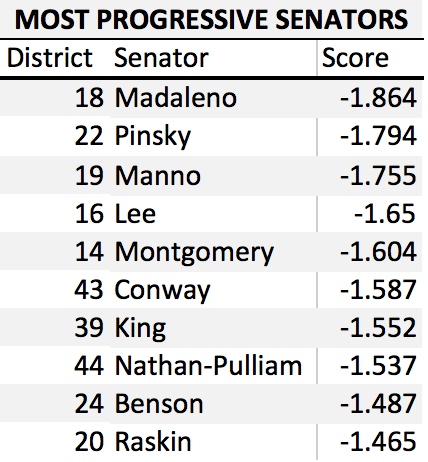
In the Maryland Senate, all of the incoming Democrats will be more liberal than all of the Republicans. But who are currently the most progressive of the 47 state senators?
Using the same dataset provided by Boris Shor and Nolan McCarty of state legislator ideology mentioned in previous posts, the above table lists the most progressive senators. Remember that a more negative score indicates a more progressive senator. These scores are for the legislator’s entire career in the General Assembly and include House as well as Senate service.
The most consistently progressive member of the Maryland Senate is Rich Madaleno, who represents District 18 (Chevy Chase, Kensington and Wheaton) in Montgomery County. Indeed, six of the most liberal senators represent MoCo–Madaleno (#1), Manno (#3), Lee, (#4) Montgomery (#5), King (#7), and Raskin (#10).
Three of the others on the list are African-American women from Prince George’s or Baltimore: Conway (#6), Nathan Pulliam (#8), and Benson (#9). The final member of the list is Paul Pinsky, who hails from Prince George’s and is the second most progressive member of the Senate after Madaleno.
New Senate Set for Greater Polarization

Past posts have mentioned that the new Maryland General Assembly will be more polarized than the previous one. But what is the measurable impact of the election? Fortunately, since many new senators were formerly delegates, there are measures of their ideology in relation to other legislators.
Using the same dataset provided by Boris Shor and Nolan McCarty of state legislator ideology mentioned in previous posts, this post examines directly the ideology of incoming senators as compared to the people they are replacing. (The scale ranges from around -1.9 for the most liberal Democrat to 1.2 for the most conservative Republican with moderates closest to zero.)
In two cases, measures are not available but the impact is clear. Sens. Roy Dyson and Norm Stone were among the most very moderate members of the Democratic Caucus. They are being replaced by conservative Republicans. These changes will leave the Democrats more liberal and quite possibly also make the Republicans more conservative.
Two cases of Republicans being replaced by fellow Republicans will clearly make the GOP Caucus more conservative. Del. Gail Bates is more conservative than Alan Kittleman. Similarly, Del. Wayne Norman is also more conservative than Sen. Barry Glassman.
There are seven cases with less dramatic changes. Despite the fierce primary, Del. Michael Hough’s voting record has not been dramatically more conservative than Sen. Michael Brinkley. Theirs may be a difference more of style than of substance. But a more confrontational style likely exacerbates polarization.
In Howard County, Del. Guy Guzzone is a bit more liberal than outgoing Sen. Jim Robey. Del. Susan Lee is just a tad more liberal than AG-Elect Brian Frosh. Retiring Sen. Verna Jones-Rodwell has a somewhat less liberal voting record than Del. Shirley Nathan-Pulliam. The impact of the replacement of conservative Sen. Nancy Jacobs by Bob Casilly is less clear but it would be surprising if he turns out to be less conservative than Jacobs.
In two cases, changes may mildly reduce polarization. During her previous service in the House, Cheryl Kagan was a bit less liberal than outgoing Sen. Jennie Forehand. Similarly, Del. Addie Eckardt is a tad less conservative than defeated Sen. Richard Colburn. She is also viewed as a more thoughtful and productive member of the General Assembly than Colburn, who focused on scoring political points rather than shaping legislation.
The Overall Impact
Excluding the three seats won by people who have not served previously in the General Assembly, here are the calculations for the overall ideology of the Senate.
Median D: -1.107 (change of -0.005).
Mean D: -1.115 (change of -0.047).
Median R: 0.881 (change of 0.124).
Mean R: 0.883 (change of 0.062).
Increase in Polarization (Medians): 0.13 (7% increase).
Increase in Polarization (Means): 0.11 (6% increase).
Remember that these calculations underestimate increases in polarization because they exclude the two cases that will have the most dramatic impact–the replacement of Dyson and Stone–especially on the Democratic side as they were among the five most moderate Democrats in the Senate.
Leventhal Throws Elrich Off PHED Committee
The Washington Post reported previously on Councilmember George Leventhal’s desire to exact revenge for Marc Elrich’s support for Beth Daly in the Democratic Primary. And now Leventhal, the new Council President, has defenestrated Elrich from the Planning, Housing, and Economic Development (PHED) Committee, a powerful committee at the heart of Councilmember Elrich’s interests and desire to promote public transit in MoCo.
In this year’s elections, Elrich came in first in the primary and the general election. Leventhal came in fourth in the primary and third in the general election. Perhaps Jonathan Shurberg best captured social media reaction with his Facebook comment: “Not even to the start of the term and the knives are out. Unbelievable.“
MCDCC Sample Ballot Controversy Grows
Bethesda Magazine’s Lou Peck has written about the controversy over the Montgomery County Democratic Central Committee’s (MCDCC) botched job on the Democratic sample ballot. Chair Kevin Walling, who works as a campaign professional, took direct control of the sample ballot and taken the brunt of the heat.
See my previous posts on problems with the sample ballot here and here.