Del. Kramer Critiques BDS, Part II

I accidentally cut off the second half of Ben Kramer’s (D-19) comments on BDS (Boycott, Divestment, Sanctions) when I posted them earlier today. Here is the rest of his response to those who oppose legislation that would prevent businesses that support the BDS movement against Israel from doing business with the State of Maryland. The post got cut in the middle of thought, so I’m afraid the beginning here is a bit abrupt.

[In Israel, g]ays and lesbians serve openly in the military and there are no directives such as “don’t ask, don’t tell.”

Resolving the challenges of the West Bank are difficult and finding a path toward Palestinian self-determination is fraught with obstacles.

Israel unilaterally withdrew from the Gaza in 2005 without any assurances of peace from its occupants. Since that time, the governmental authorities in Gaza have been taking tens of millions of dollars in foreign aid and have been using it, not to build new hospitals and schools and to create a homeland, but to purchase tens of thousands of rockets from Iran to be launched against Israeli civilian targets from the decrepit medical facilities and schools that do exist in the Gaza. Millions of dollars are spent to build multiple, sophisticated tunnels into Israel, from which to launch terror raids on children in school buses.

Lesson learned…Israel does not have the luxury of making the same mistake in the West Bank.

The BDS movement is driven by Israel’s enemies who are cleverly using relentless propaganda and lies to manipulate the willing, the naive and the uninformed in a time proven strategy to create enmity toward Jews.

From the blood libel of the Middle Ages, in which Jews were accused of murdering Christian children for ceremonial purposes, to the Protocols of Zion and the government sponsored hate-mongering of Nazi Germany…the playbook of the anti-Semites has remained the same…tell the lie, and continue to repeat the lie often enough until the willing, naive, uninformed and misinformed, whether at a conscious or subliminal level, begin to accept it as fact.

How else can we explain the difference of the pro-BDS advocates total disinterest in the nations that are committing egregious human rights violations (including the beneficiaries of the BDS movement) from the impossible standard, for defending its citizens, they have set for Israel…a standard that has never been applied to any other nation, including that of our own.

Perhaps the efforts of those BDS supporting groups, who claim that they are motivated by a desire for peace, would be better off directing their efforts at convincing the Arab world to stop the formal (and informal) education process, of each generation, to hate the Jews. Maybe, if the governmental authorities of the West Bank and Gaza were willing to accept the right of the Jewish people to live in peace, in their homeland, there might actually be peace in the Middle East.

After thousands of years of persecution culminating in the Holocaust, Jews are no longer playing the role of the willing victim and this undoubtedly has caused angst for those who are more comfortable with the Jew in her/his former role.

Finally, for those who claim that boycotts are a time honored, peaceful means of protest, I completely agree with you.

Yes, the apartheid government of South Africa was rightfully boycotted.

However, the absurd effort to draw parallels between the South African government’s system of apartheid and the conflict between Israel and its Arab neighbors is simply fantastical…but clearly a critical element of the propaganda strategy as the BDS proponents never fail to mention Nelson Mandela and the racist South African regime in their endeavor to confuse and fraudulently link the two movements, to justify BDS.

Those individuals who choose to participate in the discriminatory BDS movement are welcome to do so…that is called freedom of speech.

However, the people of Maryland do not have to see their PUBLIC dollars being used to support such discriminatory behavior, particularly when it undermines Maryland’s policy as articulated in its Declaration of Cooperation with Israel. An agreement which created a cooperative relationship which has benefited the citizens of Maryland and Israel through economic development, tens of millions of dollars in trade, the creation of jobs, as well as, significant achievements through joint scientific and medical research.

Not using public dollars to support discriminatory behavior is also freedom of speech…and as you appropriately pointed out, David…if the boycotters truly believe in the right to boycott…then we should be free to boycott the boycotters.

Like a classic garment carefully folded away in a drawer to be brought out and worn when fashionable again, anti-Semitism is once more all the rage in Europe. Nicely accessorizing it, on this year’s runway, is anti-Zionism. We should resist the urge to emulate the Europeans and reject the misguided, albeit chic, BDS movement fomented by propagandists whose end game has never been the well-being of the Palestinian people, but the destruction of the Jewish homeland and its occupants.

Share

Kramer Calls BDS Movement Anti-Semitic

Last week, several testified at the Montgomery Legislative Priorities Hearing against legislation that would prevent businesses that support the BDS (Boycott, Divestment, Sanctions) movement against Israel from doing business with the State of Maryland.

I asked Del. Ben Kramer (D-19) for this thoughts on the hearing and the BDS  movement, as he vocally opposed their agenda at the hearing. Here is his response:

The BDS movement is unequivocally a propaganda tool being utilized by Israel’s enemies to do what they haven’t been able to do militarily, defeat Israel. The goal of the BDS movement is to force a collapse of the Israeli economy, and in doing so, force Israel to withdraw from the small area of land, that Israel has not returned to its Arab neighbors, captured when the Arab nations (yet again) attacked Israel in 1967.

To their credit, Israel’s enemies have done a phenomenal job of rewriting Middle East history to cast Israel as the aggressor in its dealings with the Arab world.

Quickly being forgotten is the fact that the Arab nations have repeatedly unified (a feat in and of itself, because when they are not focused on efforts to rid the Middle East of Jews, they are often caught up in sectarian violence against one another) and launched wars against Israel for decades.

In defending itself, in 1967, Israel captured considerable Arab territory.

However, in a pursuit for peace, Israel has returned 94% of the captured lands to the Arab nations, which attacked Israel.

My question to the BDS supporters, at the hearing, was to name another occasion in the history of the world when a nation that was repeatedly attacked by its neighboring countries, returned the land captured while defending itself, in an effort to achieve peace and stop further military aggression and war.

Additionally, I discussed the egregious human rights violations that are rife throughout the Arab world. More particularly, I quoted the UN Human Rights Chief, Navi Pillay, who recently offered the following: “Across the Arab world, people continue to struggle for their fundamental civil, cultural, economic, political and social rights. The roots of those struggles lie in social injustice, marginalization, and lack of human rights protections.”  He then added: “Unfortunately, intolerance, marginalization, impunity, sectarianism and violence remain significant challenges.”

I further discussed the violent treatment of women, gays and lesbians in the West Bank and Gaza, which is a routine topic of human rights organizations, and that such treatment is not only condoned, but encouraged by the Fatah led Palestinian Authority in the West Bank and Hamas in Gaza. Furthermore, both the Palestinian Authority and Hamas arrest, jail, torture and execute (if suspected of collaborating with Israel) those who dare to openly challenge their governmental authority.

Therefore, my question of the BDS supporters was to identify which of the myriad of Arab countries, with their laundry lists of human rights violations, were they pursuing boycotts, divestment and sanctions against.

The answer was zero, none, nothing . . . not one.

Evidently, the xenophobic Palestinian governmental authorities in the West Bank and Gaza, with their extremist ideologies that call for the relentless pursuit of the destruction of Israel and the death of all Jews in the Middle East, are quite acceptable to those who support the BDS movement.

Apparently, honor killings of wives, daughters and sisters and the treatment of women as chattel, along with intolerance and violence toward the gay and lesbian citizens of Palestinian controlled lands, is of little interest to the ..progressive.. thinkers of pro-BDS.

I then questioned the BDS supporters as to which of the many nations in the world, dominated by despots and dictators, with unspeakable crimes against their own people and horrific human rights violations, were they pursuing a boycott, divestment, and sanctions movement against.

Once again, the response was a resounding. . . NONE.

The only nation on this planet that they are trying to bring to financial ruin is the only democratic nation in the region and ..coincidentally.. the only nation on our planet with a majority population of, yes . . . you guessed it . . . Jewsl

And then they have the shameful nerve to be indignant that their actions are being construed, by some, as being rooted in anti-Semitism. Evidently, human rights don’t apply to the right of Jews, in the Middle East, to live in peace.

The glaring hypocrisy of the BDS movement is simply blinding. And a group with the name Jew in the title, that supports the BDS movement against Israel, does not make the movement any less hypocritical.

No one says, not even the Israeli people, that Israel is perfection. Yes, just like with all democratic nations there is room for improvement. However, amongst all of the nations in the region, Israel is the only one where all citizens, including the Arab ones, are free to express their sentiments. Either good, bad or that which is ugly, all are welcome to express their thoughts about Israeli society and the democratically elected officials who govern it.

In fact, just two years ago, the Valedictorian at the most prestigious medical school in Israel was a Muslim Arab woman. This woman would never have had the opportunity to achieve such an accomplishment in the majority of the countries surrounding Israel and who are sworn to Israel’s destruction. Israel is a nation that fully includes women, minorities, Muslims, Christians and the LGBT community at the highest levels of academia, government, industry and business.

Share

Raskin Internal Poll Shows Lead

Sen. Jamie Raskin’s campaign has released an internal poll of 500 likely Democratic voters that shows him with a lead over his opponents:

  • Jamie Raskin, 30 percent
  • Kathleen Matthews, 21 percent
  • Ana Sol Gutiérrez, 11 percent
  • Kumar Barve, 5 percent
  • David Anderson, 3 percent
  • Will Jawando, 2 percent
  • Joel Rubin, 0 percent

Twenty-eight percent of voters remain undecided. The margin of error is +/- 4.4 percent, which means that the true values should be within that range in 19 out of 20 polls.

The Raskin campaign also claims that Jamie has higher favorable to unfavorable ratings than other candidates:

Raskin enjoys a 5:1 favorable: unfavorable rating, compared to 2:1 for Matthews, just under 2:1 for Sol Gutierrez, 1.5:1 for Barve, while the other candidates are unknown to voters.

According to the press release, Raskin leads Matthews by 43 percent in LD 20, which he now represents in the State Senate. He also leads Gutiérrez by 21 points in LD 18.

Analysis

This is essentially a pre-campaign poll, as no commercials have been aired on TV. Little in the way of direct mail has been sent, though I’ve seen one well-done lit piece for former television broadcaster and Marriott Exec Kathleen Matthews.

Right now, it looks as if the race is shaping up largely as most expect with Raskin and Matthews in the lead but neither near being able to claim that they have the nomination locked down. Matthews will likely have the edge in money but Raskin has a strong pre-existing base of supporters and volunteers.

Del. Ana Sol Gutiérrez benefits from her name recognition due her long service on the School Board and a delegate in LD 18. Right now, she looks like a solid bet for third place but will need to raise substantial sums of money or grassroots support to surprise the early frontrunners.

Del. Kumar Barve’s poor showing may surprise. It reflects that he has lower name recognition than the other state legislators in the race because his district–LD 17–is split between CD 8 and CD 6, so fewer voters have seen his name on the ballot.

The other candidates are unknowns. They are likely to remain so unless they can raise money and attract volunteers to assist their campaigns. They also need to win support from people who can validate their message and signal to voters that they merit consideration and deserve a vote.

Finally, as always, take campaign polls with a healthy dollop of salt. Inevitably, they focus on the cream rather than the lemons for their campaign. Moreover, it’s early, so most voters probably do not have fixed opinions.

Final Note

I am supporting Jamie Raskin’s campaign–not exactly shocking news as he is my colleague at American University. Beyond his generally active and effective work as a state senator, I appreciate  his hard work for marriage equality. Jamie will be an excellent advocate for the Eighth and liberal values in the U.S. House. I will still call it as I see it here but thought I should mention it.

Share

Anti-BDS Bill Causes Controversy at Montgomery Priorities Hearing

Several members of the Freedom2Boycott coalition came to testify against legislation that would prevent businesses that support the BDS (Boycott, Divestment, Sanctions) movement against Israel from doing business with the State of Maryland.

The legislation is supported by the Baltimore Jewish Council (BJC) and the Jewish Community Relations Council (JCRC) of Greater Washington. Thomas Nephew spoke for the Montgomery County Civil Rights Coalition:

While I personally agree with many of my friends here about boycotting Israeli-based companies, organizations, and institutions because of the Israeli occupation and illegal Israeli settlements, I want to emphasize the wider significance of efforts to officially stigmatize or penalize boycotts. . .

As we saw once with the South Africa divestment campaign, one of the points of free speech is the ability to nonviolently — and victoriously! — challenge the status quo and challenge an outdated consensus.  One of the points of free association is to be able to pick and choose whom we combine efforts with — and conversely, whom we will not support.  Boycotts, divestments, and sanctions are a time-honored, honorable, nonviolent way of doing both.  I hope you will resist all efforts to penalize companies or organizations engaged in such actions.

Indeed, I hope you will go further, and support efforts to explicitly guarantee that political boycott, divestment, or sanctions campaigns can not be penalized by the state of Maryland in any way.  Don’t just oppose using the state pension fund or the university system to chill speech — affirm that the state of Maryland, its counties, and its cities are not and may not be in the business of regulating free speech and free association in the first place.

The problem with this argument is that, if one support strongly the right to boycott, presumably the State is allowed to boycott people who boycott. Clearly, the author doesn’t oppose state boycotts, as he cites the South Africa divestment movement an example–a movement that had promoting governmental sanctions against South Africa as a core goal.

The real heat and light appeared, however, around claims that the BDS movement is justified by Israel’s human rights record. For example, Whit Athey of Peace Action Montgomery said:

If this anti-BDS legislation goes forward in the next session it will be very divisive, particularly to members of the Democratic Party, and it will unnecessarily take up time and resources from productive activities in the legislature.  There are many real priorities for the Montgomery County delegation, which will need the support and attention of the progressive organizations and legislators of the county.  Anti-BDS legislation will distract you from work that is important for the citizens of this state.

Odd for him to stake his horse on opposition to being divisive, since BDS’s efforts are extremely divisive. Athey went on to attack efforts to label the BDS movement as anti-Semitic:

Proponents of the anti-BDS legislation claim that supporters of BDS are anti-Semitic and that the state can’t be seen as supporting anti-Semitism.  This was specifically stated by the Republican governor of Illinois as he signed that state’s legislation.   “We need to stand up to anti-Semitism whenever and wherever we see it,” Gov. Rauner said. This statement is a ridiculous attempt to smear the proponents of BDS.  The people whom you will hear today speak against the anti-BDS legislation have spent most of their adult lives working for human rights and civil rights, and to characterize them as anti-Semitic is the height of specious nonsense.  Jewish people themselves are well represented among those promoting BDS.  Smear tactics are the tools of those whose ideas can’t stand on their own merits.   Furthermore, using the term “anti-Semitic” inappropriately and recklessly for political reasons, trivializes real anti-Semitism and demeans the experience of Jewish people who have suffered from it.

Del. Ben Kramer had a lot of fun with this argument, asking repeated questions about the human rights records of various countries with abysmal human rights records and whether BDS was organizing any boycotts of these regimes.

Share

Delaney Votes No on Syrian Refugees

Earlier today, Rep. John Delaney (D-6) voted in favor of Republican sponsored American Security Against Foreign Enemies Act. Passed by the U.S. House. that would make it make it significantly harder for Syrian refugees to gain admittance to the United States:

The Republican bill would require the FBI director to certify the background investigation for each Syrian or Iraqi refugee admitted to the United States, and Homeland Security and intelligence officials would have to certify that they are not security threats.

Delaney’s office issued a press release explaining his vote:

WASHINGTON- Congressman John K. Delaney voted for the American SAFE Act (H.R. 4038), which would require the Federal Bureau of Investigation (FBI) and relevant national security agencies to ensure that each refugee receives a thorough background investigation before U.S. refugee admission.  This legislation does not prevent the U.S. from safely accepting refugees that have been carefully screened

Delaney releases the following statement:

“Regarding Syrian refugees, we should not have an arbitrary cap of 10,000, we should expedite the screening of women and children, and the screening process should be of the highest standard. My vote today reflects that belief.”

Rep. Dutch Ruppersberger (D-2) did not cast a vote on the legislation. The other five Democrats in the Maryland delegation voted no, while the sole Republican voted in favor.

Share

Residents Speak Out Against the Liquor Monopoly

Del. Bill Frick Proposes to Allow Voters to Decide

The movement to end the Montgomery County liquor monopoly is gaining momentum. Six legislators plan to introduce legislation to allow voters to decide the question. Comptroller Franchot penned an opinion piece last week arguing for its end. But I suspect that it’s the political potency of the issue with voters that will give it continued forward momentum.

The following is by Adam Pagnucco:

As of this writing, over 900 people have signed the petition asking Montgomery County’s State Senators and Delegates to end the county’s archaic liquor monopoly. Here are a few comments from petition signers that truly say it all.

*****

First of all, I appreciate Roger Berliner’s and the other County leaders’ embrace of this cause. Montgomery County, Maryland’s liquor laws are an embarrassing and harmful anachronism. County sales of alcohol do not serve any public purpose but they do perpetuate an expensive and useless bureaucracy. The County should not be a seller of alcohol but rather should serve as a responsible regulator of private restaurants and stores selling alcohol.

Retaining the current system discourages the entry of businesses into the County and results in a conflict of interest for the County as both a regulator and a vendor selling to and competing with private businesses. Getting the County out of the liquor business would allow private enterprise to offer consumers more choices and more reasonable prices. At the same time, it would allow the County to focus on its regulatory role, while gaining additional tax revenue from businesses to lower individual taxes.

I have lived in this County for more than sixty years. This useless charade cannot be ended too soon.
Kenneth Markison, Chevy Chase, MD

I own 2 restaurants in Montgomery County, both well known for the breadth of their beer, wine and liquor lists. The difficulty in creating and maintaining these lists because of the county controlled system is extraordinary. It adds hours of unnecessary labor to my payroll costs, diminishes the quality of my beverage programs through the inconsistency of stock, unavailability of products and errors in delivery, and drives up the cost of the products we sell – which must either be absorbed by us (therefore diminishing our profits) or passed on to the consumer resulting in higher menu prices. This system causes all but the most intrepid restaurant owners to dumb down their offerings because it’s far far easier and ensures Montgomery County will never compete with DC in terms of the quality and creativity of its restaurants.
Jackie Greenbaum, Washington, DC

[Editor’s note: Ms. Greenbaum is an owner of Jackie’s Restaurant and the legendary Quarry House Tavern in Silver Spring. She has written about the Monopoly before.]

I’m signing because this is 2015, not 1925.
Debra Van Alstyne, Potomac, MD

Ridiculous that this is still in place. Way past time to do away with it.
Deborah Grossman, Takoma Park, MD

I’m signing because I’m sick of being forced to drive out of MoCo to get the wines I want. It causes MoCo restaurants time, money, and frustration. It discourages new restaurants from considering moving to MoCo. The current system is cumbersome, useless, embarrassing, archaic, and typically paternalistic. I don’t need this County to make my buying decisions for me, thank you.
Lezlie Crosswhite, North Potomac, MD

I’m tired of having to go to DC or VA to have a wide choice of wines plus the prices are so much better.
Sandra Satterfield, Rockville, MD

I am an economist, retired from the FTC after over 30 years. I worked exclusively on anti-trust cases. Monopolies hurt consumers.
Russ Parker, Bethesda, MD

According to the Maryland Declaration of Rights “monopolies are odious”. If monopolies are so odious then why does Montgomery County have a monopoly on the sale of alcoholic beverages in Montgomery County?
Justin McInerny, Chevy Chase, MD

… because the monopoly is outdated, stifling, and ridiculous. And annoying.
Diana Conway, Potomac, MD

It has been proven to be a flawed system that restricts the store owner’s ability to maximize sales and be self-reliant on their success. The internal inventory controls have been called into question as of late as well. Time to open it up to the free market!
John Hodges, Rockville, MD

I am tired of County stores with poor quality and customer service. I have to shop with a cart that has a pole on it so I can be tracked through the store, then I have to stand behind a piece of blue tape on the floor to be helped by someone who doesn’t want to be there. The selection is poor and I find myself shopping elsewhere. It’s time to get rid of soviet era liquor stores.
Richard Neimand, Silver Spring, MD

We’re tired of driving to Total Wine in Laurel and Calvert-Woodley in D.C. to find good selections of beer and wine at reasonable prices. We want to spend our money here, but not at the premium we have to pay because of this ridiculous set up. Also, we want to see more restaurants locate here and they need access to good selections of fine wines, craft liquors, etc.
Mike Diegel, Silver Spring, MD

This system no longer (if it ever did) makes sense.
Michael Webb, Germantown, MD

It is time for the free market to work its magic and for the county to cure its addiction to alcohol (revenues). A remarkably inefficient, and at times corrupt, system should not be tolerated by consumers and businesses directly affected by its protection. Let voters decide what happens.
Allen Perper, Silver Spring, MD

I spend money out of county in an effort to avoid the ridiculous monopoly in Montgomery County. It is insulting to my intelligence.
Stephen Sugg, Rockville, MD

Business is for the private sector, governing is for the government.|
Yovav Sever, Rockville, MD

I buy much of my alcohol outside MoCo. I want a wider selection and to not have to drive!
Laurie Wilner, Potomac, MD

The county should NOT be selling alcohol at all! I always thought that was stupid. The county has anti-drink programs and yet sells the stuff…let’s teach our kids hypocrisy, shall we?
Pat Burton, Gaithersburg, MD

I’m signing because I do purchase all of my beer and wine in Washington, D.C.
Michael Reust, Takoma Park, MD

I live in MoCo and have to go to Frederick County (or Virginia) to get a couple of things that the county won’t allow to be sold. The current system is a total joke.
Victoria Cross, Gaithersburg, MD

I’m signing because I resent the county’s imposing a monopoly on its citizens. We’re grownups. Let us decide who to buy our alcohol from, and what to buy. I love Mo Co except this liquor business is an embarrassment.
David Austin, Bethesda, MD

I don’t believe the county should have a monopoly on the liquor we buy or the choices restaurants have in what they provide customers. Currently, and for MANY years, I’ve purchased all my liquor in DC. Too bad for Maryland and time to smarten up.
Anne Claysmith, Bethesda, MD

I hate having to drive to neighboring counties to find liquor stores with a decent variety to choose from.
Mark Eakin, Silver Spring, MD

I worked at a bar in Silver Spring for 4 years, and during that time we were frequently unable to keep regular beers, liquors, and supplies we relied on in stock due to the County’s apathy towards customer interests
Jennifer Burrell, Laurel, MD

The county should not be allowed to continue its monopoly on alcohol sales to our businesses. I fully support allowing private sellers to compete with DLC in Montgomery County and putting this issue to a referendum so that it is clear how many county citizens desire a private competition approach.
Michael Fetchko, Bethesda, MD

What he said.
Ralph Bennett, Silver Spring, MD

Share

More Giraffes Than Black People

UPDATE: Visit Maryland has now removed the video from YouTube. Twitter reports that it is also gone from Baltimore’s Penn Station. @visitmaryland is so far quiet on the subject.

Visit Maryland has air-brushed African Americans out of Baltimore. If the above official tourism promotion video, playing on an endless loop in Baltimore’s Penn Station, is to be believed, more giraffes live in Baltimore than African Americans.

Black people should not be deemed too scary to feature in videos touting any part of Maryland. Nevertheless, their absence is especially glaring–and I imagine galling–in a video about majority-black Baltimore City.

Del. Jeff Waldstreicher (D-Montgomery) noticed the video during a visit to Charm City and has written the Commerce Secretary to demand its removal from public circulation:

Letter to Secretary GillBeyond the blatant racism, the video is also economically foolish. African Americans have a lot of tourism dollars to spend. As Del. Waldstreicher points out, there is enormous cultural and historical richness in Baltimore black history. Don’t we want African-American tourists to think of Baltimore as a potential destination?

Whitewashing Baltimore is not going to make Baltimore more appealing or its well-known problems go away.

Share

Political Opening in Alcohol

Politicians often have trouble finding major issues that they can use successfully in campaigns. The Montgomery County Liquor Monopoly provides a rare opportunity for politicians who wish to advance or outsiders who want to crash the incumbent party.

Why It is a Good Campaign Issue

Good campaign issues have several key attributes. First, they have to divide you from your opponent. Voters cannot  differentiate between candidates when they agree. Put another way, “I’m even more pro-choice” is usually not going to unseat an incumbent. Montgomery County’s liquor monopoly is an easy issue for candidates to differentiate themselves.

Second, the subject has to be easy to communicate. If an issue requires jargon, like Maintenance of Effort, to explain it, it is not going to work. Clear and concise are critical. Opposition to the monopoly is the rare issue that works well on a postcard.

Finally, voters have to care about the issue and favor the candidate’s position. Unlike with many issues, many voters have direct experience of the monopoly and have formed opinions about it. Put simply, they don’t like it and would like to see it go away. Recently, a poll confirmed the well-known widely shared antipathy for it.

Opportunity in Opposing the DLC Monopoly

The existing Department of Liquor Control monopoly over the distribution of all alcohol and the sale of hard liquor provides a fat, juicy target. Through personal experience, many County voters know that the DLC assures higher prices in unattractive stores.

Comptroller Peter Franchot has already raised the issue’s profile.
The natural coalition favoring reform is powerful. Consumers receive no benefit from the monopoly, as it raises prices and forces them to travel farther to find greater selections at lower prices. They just don’t get why the County needs to be in this business. In short, they’ll only benefit if perestroika arrives in MoCo.

Business also hates the monopoly because it makes it much harder for the critical restaurant sector to thrive. More broadly, it is a barrier to expanding business around the County’s nightlife. Getting rid of the monopoly is a leading priority for the Chamber of Commerce. Fighting the monopoly looks like an excellent way to open doors to an untapped source of campaign donations.

Moreover, the defenders of the monopoly make excellent foils. Its main supporter is MCGEO–the union that represents the current DLC stores. While they claim to protect union jobs, the industry is highly unionized, so their real fear is that the workers would be represented by other unions.

Moreover, MCGEO acts like a union out of Republican central casting, attempting to bully its opponents into submission. Union President Gino Renne is not just a character but a caricature of the well-paid union boss. MCGEO slings mud in a way that attracts bad publicity rather than support.

Moreover, MCGEO is incredibly ineffective. It tried to take down numerous incumbents in the last election and failed all around. Unlike the Teachers (MCEA), MCEGO just doesn’t carry much weight with voters or show an ability to accomplish much on behalf of its candidates. Councilmember Roger Berliner wiped the floor against MCGEO’s well-funded candidate in 2014.

Conclusion and Petition

This is a rare bipartisan opportunity. Opposition to the monopoly is shared among Democrats and Republicans. It’s great issue for either primary or general challengers to wield against local or state incumbents who don’t join those who have gotten out in front on this issue.

Six members of the General Assembly–Del. Kathleen Dumais, Sen. Brian Feldman, Del. Bill Frick, Sen. Nancy King, Del. Aruna Miller, and Del. Kirill Reznik–are sponsoring a bill so that Montgomery voters can decide the issue in a referendum.

You can sign the petition, launched yesterday, to support their efforts.

Share

Barve Touts Asian American Support

The following is a press release from the Barve campaign:

ASIAN AMERICAN LEADERS UNITE BEHIND BARVE

Members of Congress, Maryland Leaders Endorse Congressional Campaign

Rockville, November 5, 2015 – Kumar Barve for Congress announced today the endorsement of Asian Congressional and Maryland leaders for his campaign for Congress.

“Kumar Barve is a leader in the innovation and technology sectors and is a proven job creator. He is a fighter for the middle class and working families,” said U.S. Rep. Ami Bera (D-CA). “His family history is the American immigrant success story and I would welcome him as a partner in Congress”.

“The AAPI community is united behind Kumar Barve in Maryland”, stated U.S. Rep. Grace Meng. “Kumar is a fighter for social justice. AAPIs are underrepresented in Congress and Delegate Barve has been a long been a national leader in promoting and protecting the civic and political rights of the Asian American and Pacific Islander communities”.

“Kumar Barve rose through the Montgomery County Public School system to become a groundbreaking leader in our community. His story – from his grandfather’s fight for citizenship to his historic election as the first Indian American state legislator – is our story” said Delegate Aruna Miller, who represents state legislative District 15 which is included with the 8th Congressional District. “Kumar has been a great mentor to those of us who have followed in his path”.

Barve is one the headliners tonight of the Maryland Democratic Party’s Mid-Autumn and Diwali Celebration in Gaithersburg that will gather AAPI leaders throughout the state. AAPIs, comprising about 8-9% of the population, represent a growing and increasingly active community within the 8th District of Maryland. Since his historic election in 1990, Barve has worked to increase the participation of the AAPI community in the civic and political life of their communities.

List of Endorsements
U.S. Rep. Ami Bera (D-CA)
U.S. Rep. Madeline Bordallo (D-GU)
U.S. Rep. Judy Chu (D-CA)
U.S. Rep. Mike Honda (D-CA)
U.S. Rep. Grace Meng (D-NY)
Norman Mineta, former U.S. Secretary of Transportation and Member of Congress
Maryland Delegate Mark Chang
Maryland Delegate Clarence Lam
Maryland Delegate Aruna Miller
Maryland Delegate Kriselda Valderrama
Virginia Delegate Mark Keam
Tufail Ahmad
Alan Cheung, former Member, Montgomery County Board of Education
Ed Chow, former MD Secretary of Veterans Affairs
Suresh Gupta
Rajan Natarajan, former MD Deputy Secretary of State
Farook Sait
Congressional Asian Pacific American Caucus Leadership PAC
Asian American Action Fund

Share

MoCo Doesn’t Need Its Liquor Money

Today, I am pleased to present a guest post by Adam Pagnucco:

Even though MoCo consumers are fleeing the county’s archaic liquor monopoly, county officials are going all out to save it. Their arguments boil down to essentially one point: we need the money, and terrible things will happen unless we get it. The County Executive’s spokesman has said that a reduction in liquor monopoly money “means a reduction of county services or an increase in taxes.” And Council Member Hans Riemer has said that a loss of liquor money would mean “jeopardizing our ability to hire teachers or police officers.”

Are they right? Let’s look at the data.

First, let’s consider the nature of the county’s budget. It is not a static, zero-sum thing. Rather, it is a dynamic and growing thing that increases almost every year. The county deliberately sets property tax rates to increase collections at the rate of inflation (its charter limit) regularly. Income and energy tax collections rise with private-sector growth. State aid, mostly going towards public schools, has been rising. All of these factors have contributed to a steadily growing county budget.

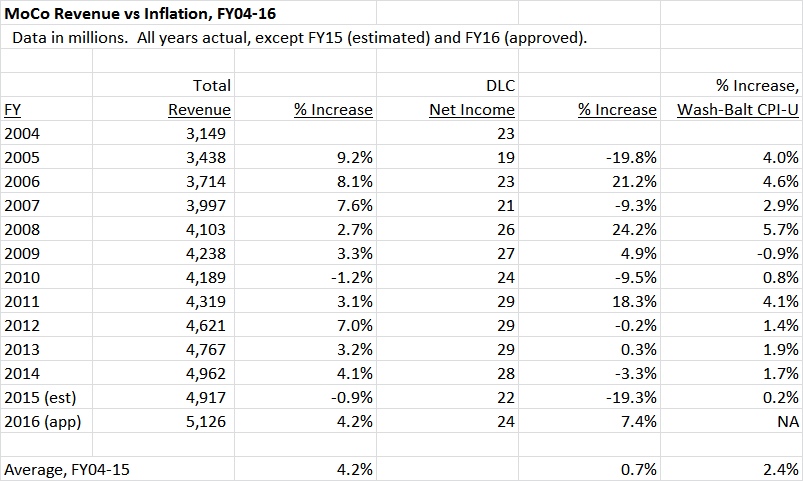
The chart below shows a comparison of total county revenues, net income from the county’s Department of Liquor Control (DLC), and the rate of inflation in the Washington-Baltimore metro area from Fiscal Year 2004 through Fiscal Year 2016.

MoCo Revenue vs Inflation

A few things stand out. First, total revenues grew in ten of these twelve years, with small declines occurring in 2010 and 2015. (Data for the latter year is still an estimate). Second, total revenue has been growing at an average rate (4.2% a year) that is almost double the rate of local price inflation (2.4%). Third, net income from the liquor monopoly is a tiny fraction of the county’s budget and has been largely stagnant. In 2004, liquor money was 0.74% of the county’s budget; in 2016, it is projected to be 0.47%. Part of this is because the county has begun issuing bonds against liquor profits and thus must pay debt service. But another part is that the monopoly is poorly managed. Over this period, the county saw an average annual revenue gain of $25 million from liquor and $140 million from other sources.

That means county revenues would still go up even without liquor monopoly money. There would be no need for cuts.

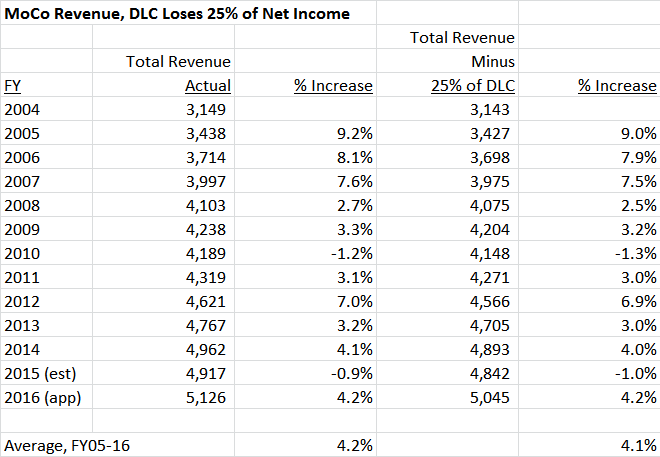
Comptroller Peter Franchot has proposed allowing the private sector to compete with the county’s Department of Liquor Control (DLC). What would happen to county revenues if that were to occur? That depends on how retailers, restaurants and consumers react. Let’s consider what would happen if DLC were well-managed, price competitive and truly focused on customers. Under this scenario, it might lose just 25% of its net income. Here’s how county revenues would have performed since 2004 if that were the case.

DLC loses 25 percent

In the real world, the county’s total revenues grew by an average 4.2% a year. If DLC had lost 25% of its net income, the county’s total revenues would have grown by an average 4.1%. There would be almost no difference to the county’s bottom line.

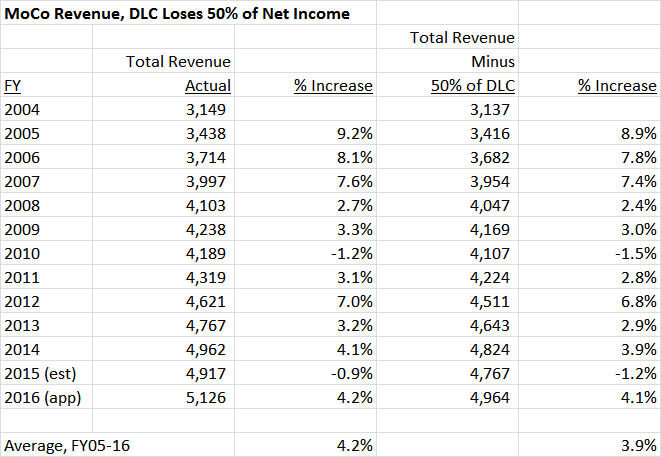
Now let’s suppose that DLC loses 50% of its net income. Here’s how that scenario would have played out.

DLC loses 50 percent

The county’s average annual total revenue growth changes from 4.2% to 3.9%. Again, not much difference.

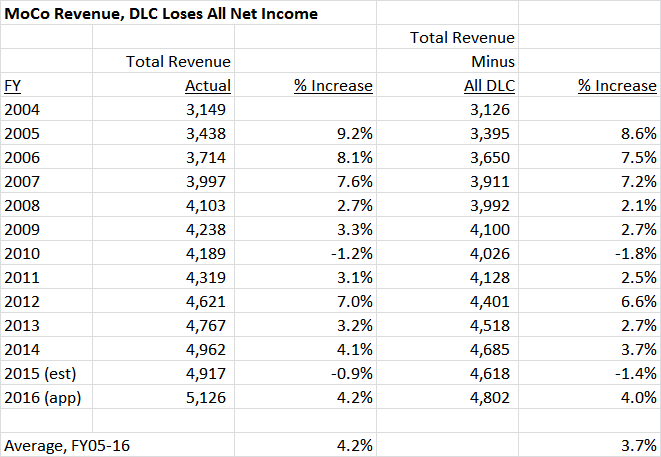
Finally, let’s look at what would have happened had DLC net income disappeared entirely.

DLC loses 100 percent

The county’s annual total revenue growth changes from 4.2% to 3.7%. The latter number is still 55% greater than the average rate of price inflation in the Washington-Baltimore area (2.4%). Furthermore, let’s keep in mind that this scenario would only occur if DLC were so awful that all of its customers fled. If that’s the case, why should DLC be protected by a monopoly at all? And the data above completely omits any extra revenue the county would earn from a revitalized private sector free of the monopoly that it calls “an Evil Empire.” Extra money from property taxes and income taxes could close some of this gap.

This discussion is not exclusively hypothetical. In July, the County Council passed a mid-year savings plan that trimmed $54 million from the budget it had passed only two months before. That amount is more than twice as much as the county earns from its liquor monopoly. Public education and public safety were not jeopardized. That’s because the overall budget provided for a $209 million increase from the prior year’s estimated revenue. County government continues to grow and no apocalypse has occurred.

Finally, consider this. There are more than three thousand counties in the United States. Very few of them have MoCo’s resources. All of them except us have figured out how to pay for their priorities and balance their budgets without needing a liquor monopoly. Are MoCo’s elected officials the only county leaders in the entire United States who can’t figure out how to live without one? I think not; I have seen them deal with much more serious budget problems effectively.

The county government doesn’t need its liquor money. So let’s End the Monopoly.

Share

Maryland Politics Watch