Term Limits Will Be on the Ballot

Term limits for the Montgomery County Council will be on the ballot next month. After losing in the Montgomery County Circuit Court, the No on B team appealed to the state’s highest court, the Maryland Court of Appeals. Yesterday, the Court denied certiorari in Moore v. Montgomery County Board of Elections, meaning that they decided not to even hear the appeal.

The decision surprised the No on B team, as they believed that they had strong arguments. Moreover, the circuit court judge had been overturned twice before on cases involving major ballot initiatives. Attached is the brief written for No on B by Jonathan Shurberg, so you can assess the strength of the argument and whether the Court of Appeals made the right call.

Share

Is This the Dumbest Lobbying Campaign of All Time?

By Adam Pagnucco.

Suppose you want to persuade an elected official to vote in a certain way.  Which of the following tactics would you choose?

  1. Prepare the best case on the merits of the issue that you can.
  1. Mobilize a large part of the public to agree with you.
  1. Insult the elected official’s integrity and criticize his or her salary.

If you picked Tactic 3, congratulations!  You could get hired by one of Maryland’s top PR firms to run the Dumbest Lobbying Campaign of All Time!

What is this campaign, you ask?  It involves a Battle of Developers in Downtown Bethesda.  (Ring the bell, folks!)  On one side is Clark Enterprises, one of the nation’s largest real estate and construction firms that is headquartered at Bethesda Metro Center.  On the other side is Brookfield Properties, another giant real estate firm based in New York and Toronto, which bought 3 Bethesda Metro Center for $150 million in 2011.  Brookfield would like to place a new high-rise on the concrete Bethesda Metro plaza and the Planning Board agreed to it in its proposal for the area’s new master plan.  Clark, whose existing building would be right next door to Brookfield’s new building, opposes it.

The Montgomery County Council has final say over all master plans, and so Clark paid for a grass-roots lobbying campaign.  A website proclaiming a need to “Protect Bethesda Open Space” was registered in May and emails from constituents started arriving in council inboxes.  While the emails varied a bit in content, the following two sentences appeared word-for-word in a great many of them.

“The County Council has sided with the developers one too many times here in our recent history.”

“After recent raises to our taxes and to your salaries, we ask that the same priority be given to the people who live and work in downtown Bethesda.”

picard-face-palm

Your author has worked for and with elected officials for a long time.  There are many differences among them.  But one thing absolutely every single one of them HATES is to be called a tool.  The only thing worse is to get hundreds of their constituents to call them tools.  You may as well burn down their houses, vandalize their cars, loot their bank accounts and then ask them to give you a vote.  See how that works for you!

And on top of that, is it really wise for a campaign financed by a real estate company to encourage residents to criticize Council Members for siding with developers?  What will those residents say the next time Clark wants to build something?

But Clark is only the client.  They hired someone to run the campaign for them.  One clue appears in this notice listing a certain Bassam Tarbush as a contact for the website.  Tarbush is also named in the campaign’s response emails.  According to his Linkedin profile, Tarbush is employed by KOFA Public Affairs, one of Maryland’s most prominent public relations firms.  That is astounding for two reasons.

  1. KOFA’s principals, who are regarded as professional and competent in Maryland’s political circles, have lots of experience working for elected officials. They include senior aides to former Governor Martin O’Malley, former Baltimore County Executive Jim Smith and U.S. Senator Ben Cardin. If anyone understands how outraged elected officials can get when their integrity is impugned, these people do.
  1. The firm’s roots are deeply planted in the Democratic Party. Its principals have devoted substantial parts of their careers to helping Democrats like O’Malley and Cardin succeed. And yet, here is a group of Democratic operatives running a campaign that depicts Democratic elected officials as tools of developers.

Clark Enterprises is a well-respected real estate firm that has other priorities here in addition to what happens at Bethesda Metro Center.  Burning its bridges with the County Council through such a ham-handed lobbying campaign goes against its long-term interests.  For its own sake, Clark should go back to the drawing board, figure out a different message, hire someone else to implement it and end The Dumbest Lobbying Campaign of All Time.

Share

The Magic of Freedom from the Liquor Monopoly

By Adam Pagnucco.

Montgomery County is witnessing an historic craft beer renaissance.  New small breweries are popping up all over the county offering an incredible array of IPAs, Belgian tripels, pilsners, ESBs, saisons, stouts and even rum rye.  Politicians and customers alike are celebrating, even if they might be a wee bit late to work on the following day.  But this renaissance has been caused by one factor that few so far are talking about.

These breweries are exempt from having to sell their products through the county’s Department of Liquor Control.

brookeville-beer-farm-1

Montgomery County Executive Ike Leggett and members of the County Council at a ribbon cutting for Brookeville Beer Farm.  Photo courtesy of Delegate David Moon.

Until recently, there were three small breweries in MoCo: Growlers in Gaithersburg, Rock Bottom in Bethesda and Gordon Biersch in Rockville.  The latter two are part of chains.  While each establishment could sell to individual customers, they had to go through the Department of Liquor Control (DLC) to sell to restaurants and retailers.  For the most part, it wasn’t worth the bother.

That changed in 2014 when a group of craft brewers wanted to open Denizens Brewing Company in Downtown Silver Spring.  The condition they imposed was that the DLC must not be allowed to carry their beer.  Denizens co-owner Julie Verratti told the Sentinel, “There’s no freaking way in hell I would ever trust my product to the Department of Liquor Control.”  According to the article:

Veratti said the main reason she does not trust the DLC to deal with her product is because she believes the warehouse employees would not properly handle it.

“It’s not their product so they don’t give a sh**,” Veratti said. “They don’t care if it sits out and I doubt half the people in the warehouse have knowledge of how to handle beer.”

Paul Rinehart, founder of Baying Hound Aleworks, whose brewery had to go through the DLC prior to the change in law, called using the DLC as a distributor “not fantastic.”

Rinehart said when using the DLC his brewery “ran into issues where our product would get lost” and would often hear from clients that their product orders had been either delivered incorrectly or not delivered at all.

Despite the DLC upgrading their inventory system to Oracle, which rolled out on Feb. 1 and has its own problems, Rinehart said he has no plans to use the DLC to distribute again.

“I’m just afraid of my product getting lost again,” Rinehart said.

The result of Verratti’s advocacy was a 2014 state bill that allowed micro-breweries to bypass the DLC and sell craft beer directly to restaurants and retailers as well as on-site customers.  This was the key reform that enabled Denizens to grow in MoCo.  Once again, from the Sentinel:

Had it not been for the change in law that gave breweries the ability to deliver their product directly to their customers, Julie Veratti, co-owner and director of business outreach for Denizens, said her brewery would not have distributed inside the county at all and instead would have just distributed the product to Washington, D.C. Denizens opened for business after the change of law came into effect.

And so MoCo micro-breweries are now free of DLC entirely.  Disasters like DLC’s week-long meltdown in last year’s holiday season do not affect them at all.

The result of all this is a BOOM in craft brewing.  Since the DLC exemption was passed, Denizens (Silver Spring), 7 Locks (Rockville), Waredaca (Laytonsville) and Brookeville Beer Farm (Brookeville) have opened.  A fifth brewery attempted to open in Rockville but encountered permitting and zoning issues with the city government and moved to Baltimore.  The chart below shows all active licenses and permits pertaining to MoCo microbreweries.  Fifteen of eighteen originated in 2014 or later.

moco-brewery-licenses

The lesson to be learned here is that removal of the county’s liquor monopoly leads to economic growth and job creation.  Those are important considerations for a county that has seen its private sector jobs base shrink between 2001 and 2014 and has just raised property taxes by 9 percent.  The state’s Bureau of Revenue Estimates has found that the county could create more than 1,300 jobs and nearly $200 million in annual economic activity by tossing its liquor monopoly into the dustbin of Prohibition.

Will the county embrace economic prosperity and job creation?  Or will politicians continue to defend the monopoly while cutting ribbons for breweries who are exempted from it?

Share

Will Smith for Senate

This is a guest post by Terrill North:

Knocking on doors in District 20 will introduce you to national-level union bosses, campaigners for Nepal, law professors, and hundreds of professionals committed to social justice.  Our community is lucky to have so many people who care, but unfortunately, they are not always people who know.  They may not know D20 is home to the largest concentration of poverty in Montgomery County, or that the majority of children in public school qualify for free and reduced-price meals.  They may know we’re diverse, but cannot name 10 Black or Brown people whose families form the majority of the population.

I can’t knock any of the names under consideration for our soon to be vacant Senate seat, I know most of them well and can say they legitimately care.  Will Smith, however, has demonstrated the deepest connections to every corner of District 20.  I first met Will while volunteering for IMPACT Silver Spring, where he worked with AmeriCorps connecting our most vulnerable neighbors with social services. He and I later chaired Montgomery County’s Community Development Advisory Committee, which decides how to allocate several million dollars of federal funding to organizations serving marginalized communities.  Will has planted strong roots across populations that don’t always show up at the voting booth through long-term work with Gapbusters Learning Center and Gandhi Brigade.

And I don’t just mean to say that Will knows African-Americans, he started a scholarship fund for immigrant youth who did not qualify for most grants and scholarships because of their status.  He is a natural problem solver who has taken his commitment to people at the margins from this community to the state legislature.

Will has already established himself as a leader in Annapolis. In fact, Delegate Smith passed more pieces of legislation last year than any other freshman legislator and was a strong supporter and leader in getting the Second Chance Act passed.  He sponsored legislation creating tax incentives for employers who hire returning citizens (ex-offenders) and worked to create a reporting system for SWAT team deployments in communities of color.

As important, Will was appointed by the House Speaker to serve on two important working groups on justice reinvestment (think: reducing mass incarceration) and reforming the Law Enforcement Officers Bill of Rights (think: establishing civilian review of police misconduct).  Will already has the confidence of leaders in Annapolis to represent the interests of people at the edge.  Jamie Raskin always claimed the mantle of the effective progressive – he didn’t just talk a good game, he got things done for people that need advocates to get things done.  Will has made building the necessary relationships to be effective a priority and will be the effective leader D20 needs in the State Senate.

It would be a big deal to send an African-American to the Senate from Montgomery because we have never done it before.  But Will represents much more than that.  I think people need to understand that Will is the first member of his family to graduate from college, a dream shared by many of the young D20 residents eating free lunch each day.  His service as a Naval Officer and journey to Obama appointee and civil rights attorney is relatively unique, even in Montgomery County (where only half of high school grads attend college).

Half of arrests in MoCo are of black men, despite blacks making up roughly 19% of the population (34% in D20).  Quite frankly, the American dream is at risk here as much as anywhere else. Will is unquestionably progressive and unquestionably qualified, but also brings a set of experiences that are unlike any other Senator from Montgomery.  We need his voice at the table in the Senate and that is why I enthusiastically support Will Smith for Senate!

Share

Beware of Social Media Perception Bias

By Adam Pagnucco.

Politician X is a happy man.  His advocacy for Issues A, B and C is wildly popular.  His constituents adore him.  He basks in praise every single day, with only a few complaining misanthropes – likely from the other political party – who can be safely ignored.  He can do no wrong and is a lock for reelection.

How does he know this?  Because he has a few dozen friends on Facebook who tell him so!

Politician Y is a happy woman.  Her advocacy AGAINST issues A, B and C – the very things X is promoting – is also wildly popular.  Her constituents shower praise on her every ten minutes and there is no way she can lose.  Higher office surely beckons.

How does she know this?  Because her Facebook friends are just as adoring as X’s friends.

X’s world is just as real – and just as unreal – as Y’s world.  Look at two examples.

In Montgomery County, Robin Ficker’s term limits charter amendment is a hot local issue.  Those County Council Members who criticize it are lionized by the huge majority of their Facebook friends who weigh in.  Judging by their comments, there is no way that term limits will pass.  But go to Robin Ficker’s page and the world changes.  He is surrounded by dozens of people – sometimes much more when he runs ads – who encourage him to keep it up.  Judging by what is said on Ficker’s page, the voters will surely approve term limits by an overwhelming margin.

It happened again at the state level when Governor Larry Hogan issued an Executive Order mandating that public schools start after Labor Day.  Critics of the order who based their opposition primarily on educational considerations were egged on by three-quarters or more of their Facebook friends who commented.  But the Facebook pages of Hogan and the policy’s original architect, Comptroller Peter Franchot, swarmed with supporters who celebrated the order.  Each side is convinced they’re right.  Each side is convinced they will be vindicated – both on the policy merits and politically – in the end.  And each side is backed up by enthusiastic supporters, so how can either of them be wrong?

Why does this happen?

Social media is a great tool for political communications, but it is subject to two forms of bias that can mislead politicians.

  1. Friend Bias

Politicians’ Facebook pages almost never contain representative samples of the public.  For the most part, Facebook friends or fans are personal friends and acquaintances mixed with people who are inclined to support the politician.  Those who are indifferent or hostile to the politician, but still vote, are much less likely to enroll on the politician’s page.  The effect is akin to an elementary school play, in which the audience is comprised of parents and relatives of the children who are performing.  Those children can do no wrong!  Friend bias can be overcome to an extent by running ads from a fan page, as this will attract viewers who do not have a relationship with the politician.  But don’t run an ad unless you’re prepared for what the outside world thinks!

  1. Comment Bias

While a relatively small number of loud voices tend to dominate social media, the vast majority of folks don’t like to fight in public.  So when Politician Y puts up a political statement, those who agree will say “Yes!” and those who don’t will be more likely to stay silent.  The latter people simply don’t want to be flamed and drawn into name-calling, shaming or other nastiness.  Some of them may have another matter before the politician and don’t want to risk retaliation.  The combination of friend bias and comment bias creates a powerful illusion of mass approval even when it’s not there.

This is high-tech tribalism.  Every politician leads a tribe – the few dozen (or for the higher-ranking ones, several hundred) people who publicly agree with them on almost everything.  This tribalism is so rigid that disagreeing tribes are barely acknowledged to exist.  When they are, they are depicted as misguided and inferior.  Politicians who lap up public adulation like cats who lap up milk love it.  And some are deceived by it.

There’s a lesson to be learned here.  Social media is a valuable political, communication and organizing tool that is still evolving.  If you can use it to get a couple thousand people to support your cause – and there are examples out there – good for you.  But if it results in the same group of a few dozen people always saying Yes to what you’re proposing, don’t believe that it represents genuine public opinion.  If you do, then you’re vulnerable to REAL public opinion catching up with you!

Share

Judge Tepid on Term Limits Foes’ Arguments; Ficker Still Ficker

Attorney Jonathan Shurberg made the argument for No on B–the group fighting term limits–but the judge wasn’t inclined to buy because (1) he doesn’t think he’ll rule that the Board of Elections improperly validated the signatures, and (2) they didn’t have enough evidence to support their case.

No on B has over the weekend to continue to hone their argument and put together their evidence. But I’d expect council term limits to go to the voters. Meanwhile, Bethesda Beat reports that Attorney Robin Ficker is still Robin Ficker:

Ficker, who fought for and won the right to be a defendant in the case Wednesday, arrived nearly two hours after the hearing started. He told Greenberg he needed to leave at 3 p.m. to be at CNN studios in Washington where he was taping “Nancy Grace.”

This is after Ficker fought to become a co-defendant in the case. He’s laser focused on press attention. Not so much on the case.

Share

Term Limits Goes to Court

Today, at 9:30am, the Circuit Court will hear arguments as to whether No on B’s case against the referendum on term limits can go forward. The argument is purely about whether the proposal has met the legal requirements to be placed on the ballot–not the constitutionality of the referendum.

No on B’s argument rests on two points: (1) Robin Ficker marked up the petition pages and made changes before their submission to the Board of Elections in violation of the law, and (2) the petition lacks sufficient number of legal signatures. Having checked 28% of the pages so far, they have found 63% of the number of flaws required to knock the referendum off the ballot.

Weighing heavily on the pro-referendum side will be that the Board of Elections–the main defendant in this case–has certified the petition has a sufficient number of valid signatures. The judge could well regard the Board as more neutral party, as their job here is to carry out a bureaucratic process, not to advocate. At the same time, neutral does not immunize them against legal errors–and they may not have known of Ficker’s changes.

Robin Ficker, the petition’s proponent, has received permission from the Court to be an additional defendant. Whether Ficker’s brand of obnoxious vocal advocacy aids the case remains to be seen. While bringing strong support for the referendum, his presence could undermine any view of the Board as a more neutral party.

There is also the little underlying problem that Ficker is a walking advertisement against his own proposal. After all, the voters managed to unseat the Republican after his one and only term in the House of Delegates. While irrelevant to the case, it isn’t the sort of background that aids the pro-term limits side.

Democrat Jonathan Shurberg, a former candidate for delegate in District 20 who now blogs and has remained active in County politics, will serve as the attorney for No on B. While No on B aspires to pay him, they have not raised the funds so far.

Share

Is Help Save Maryland Violating its Tax Status?

By Adam Pagnucco.

Anti-immigration group Help Save Maryland (HSM) has a political agenda which it characterizes as “Working to make our elected officials accountable to the citizens of Maryland.”  More specifically, the group seeks to make the State of Maryland inhospitable to illegal immigrants through influencing a variety of public policy decisions.  HSM, like any other group, has a First Amendment right to express its political views.  But it also claims a tax-exempt status with the federal Internal Revenue Service and that could be a problem.

Non-profit organizations may file with the Internal Revenue Service (IRS) to obtain tax-exempt status.  One such category is governed by section 501(c)(3) of the Internal Revenue Code, which allows non-profit organizations (and contributions to them) to be exempt from federal taxes if they are organized for one or more of the following purposes: religious, charitable, scientific, testing for public safety, literary, educational, fostering amateur sports competition and the prevention of cruelty to children or animals.

HSM states on its website:

Help Save Maryland.org is a multi-ethnic, grass roots, citizens’ organization with members state-wide. As a volunteer, nonprofit 501(c) 3, we accept donations (tax-deductible) to help defray our costs. Let’s work together through outreach and other activities to educate fellow Marylanders regarding the financial, social and economic costs of illegal immigration. Please donate by credit card online or postal mail your tax deductible donation to:

Help Save Maryland

PO Box 5742

Rockville, MD 20855

In return for being exempt from federal taxes, the IRS imposes restrictions on political activities that may be undertaken by 501(c)(3) non-profits.  The first is an absolute prohibition on advocating for or against candidates in elections.  The IRS states:

Under the Internal Revenue Code, all section 501(c)(3) organizations are absolutely prohibited from directly or indirectly participating in, or intervening in, any political campaign on behalf of (or in opposition to) any candidate for elective public office. Contributions to political campaign funds or public statements of position (verbal or written) made on behalf of the organization in favor of or in opposition to any candidate for public office clearly violate the prohibition against political campaign activity.  Violating this prohibition may result in denial or revocation of tax-exempt status and the imposition of certain excise taxes.

HSM has broken this rule at least three times.  In January 2008, the organization formally endorsed GOP candidates Andy Harris (CD1) and Steve Hudson (CD8) for Congress.  In May 2009, HSM advocated for the defeat of Nancy Navarro in the 2009 Council District 4 special election.  In an email to its supporters, HSM stated plainly, “We need your help this Saturday and Sunday May 2 & 3 in Montgomery County. HSM is fighting the election of Democratic Candidate Nancy Navarro for County Council in a District 4 special election scheduled for May 19.”  The group called for volunteers to help defeat Navarro.  And in June 2009, HSM openly called for the defeat of four state legislators for allegedly supporting illegal immigrants: Senator Jennie Forehand (D-17) and Delegates Ana Sol Gutierrez (D-18), Sheila Hixson (D-20) and Saqib Ali (D-39).

Help Save Maryland makes endorsements for Congress.
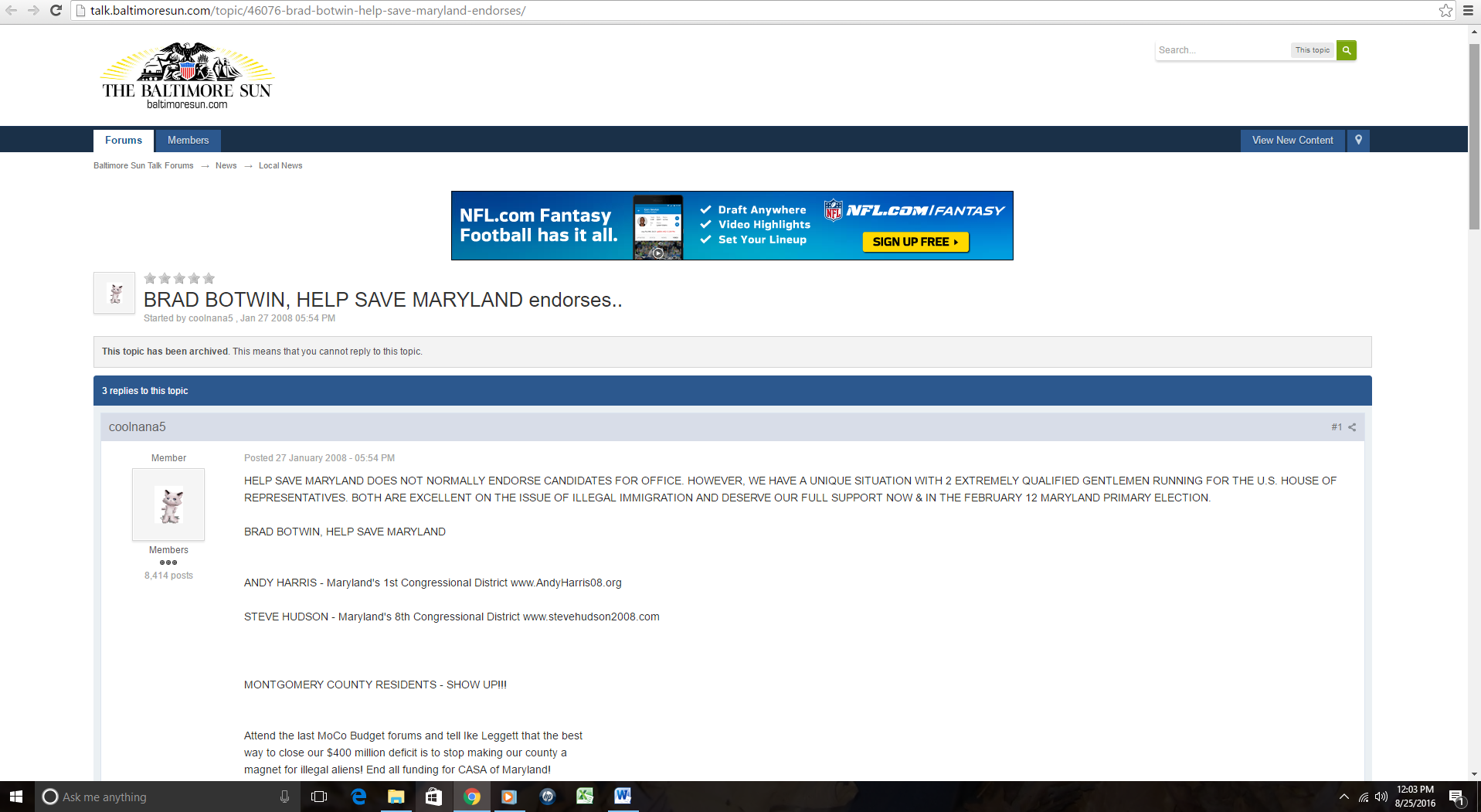
hsm-endorses

Organizations with 501(c)(3) status are allowed to engage in other forms of political activity, but restrictions apply.  On the topic of lobbying by 501(c)(3) groups, the IRS says this:

In general, if a substantial part of the activities of your organization consists of carrying on propaganda or otherwise attempting to influence legislation, your organization’s exemption from federal income tax will be denied. However, a public charity (other than a church, an integrated auxiliary of a church or of a convention or association of churches, or a member of an affiliated group of organizations that includes a church, etc.) may avoid this result. Such a charity can elect to replace the substantial part of activities test with a limit defined in terms of expenditures for influencing legislation. Private foundations cannot make this election.

A general question for the reader.  Check out HSM’s website.  Do you see anything OTHER than propaganda there??

Let’s go back to the IRS.  The agency defines “attempting to influence legislation” as:

  1. Any attempt to influence any legislation through an effort to affect the opinions of the general public or any segment thereof (grass roots lobbying), and
  1. Any attempt to influence any legislation through communication with any member or employee of a legislative body or with any government official or employee who may participate in the formulation of legislation (direct lobbying).

There are exceptions, including “making available the results of nonpartisan analysis, study, or research” and “examining and discussing broad social, economic, and similar problems.”  HSM no doubt would claim that its activities fall within these areas.  But take a look at content like this attack on Gold Star father Khizr Khan as a “Muslim Brotherhood agent who wants to advance sharia law” and decide for yourself if this qualifies.

The IRS’s monetary limits on allowable lobbying expenditures, including “grass roots expenditures” intended to “affect the opinions of the general public or any segment thereof,” are complicated.  For small non-profits with limited resources, a key rule is “the lobbying nontaxable amount for any organization for any tax year is the lesser of $1,000,000 or 20% of the exempt purpose expenditures if the exempt purpose expenditures are not over $500,000,” with different limits for larger organizations.  Clearly, any organization that spends most of its resources on lobbying, including grass roots activities to affect public opinion, would have problems complying with this provision.  HSM’s gathering of signatures for Robin Ficker’s term limits amendment, its email on the petition’s behalf and its defense of Donald Trump are definitely intended to “affect the opinions of the general public.”  And more broadly, an individual perusing HSM’s website and blog would have difficulty spotting content that is NOT political in nature.

Help Save Maryland has every right to express political opinions.  That’s not the issue here.  But it does not have a right to engage in little other than political activity while being exempt from federal taxes and collecting tax-exempt contributions.  Your author is no tax lawyer, but from the facts presented above, it seems possible that Help Save Maryland’s activities may run afoul of the IRS’s 501(c)(3) rules.

Share

Help Save Maryland Issues Call to Defend Trump

  • By Adam Pagnucco.

Help Save Maryland, a non-profit organization opposed to illegal immigration, sent out the following email on Friday, September 9 calling for its supporters to counter-protest an anti-Trump rally in the District.  Note the email’s overtly political message.  We will have more to say about this in an upcoming blog post.

*****

Members of the Hispanic illegal immigrant community, bused in and fed by their pimp handlers from CASA of Maryland, National Council of La Raza (The Race), and other taxpayer subsidized “citizen hate groups”, are holding a rally in front of the new Trump Hotel in DC on Monday, September 12, from 12 noon – 4PM.  You can count on members of the DC City Council, always opposed to private sector investment and job creation, to be their as well.

Despite the fact the Trump Corporation has refurbished and remodeled the entire Old Post Building on 12th Street and Pennsylvania Avenue, NW, turning an eyesore into a new luxury hotel in record time and under budget, these groups are going to rally against the opening of this new landmark Trump Hotel.

I guess CASA and others were opposed to the many construction workers, Black, Hispanic and others who actually worked day and night on the project for over 1 year, rather than collect welfare, food stamps, free healthcare, housing and more like their illegal immigrant clientele.  Same opposition I suppose for the hundreds of minority workers who will run and maintain this new hotel.

The Anti-Trump Rally Facebook page says 600 people are signed up as attending.

Facebook link:

https://www.facebook.com/events/175161309556207/

The Counter Protest, also from 12 noon- 4pm, will be to show our opposition to the illegal alien’s support for open borders, uncontrolled illegal immigration, and mass refugee resettlement.  We fully support legal immigration and private sector job creation.

If you can make it, we will be on the opposite side of Pennsylvania Ave., near the Fogo de Chao Restaurant.  Location is corner of 12th and Pennsylvania Ave, NW.  Short walk from the Metro Center Station – Red, Blue, Orange lines at Metro Center.

Bring signs, Gadsden flags (the illegals love them), US flags, banners, etc.  There will be some extra signs on site.

Contact person is:

Jim MacDonald

(917) 656-5658

jamesmacdonald5239@gmail.com

Share

Maryland Politics Watch