SBE Explains Mistake; Rutherford Calls for Lamone’s Resignation

By Adam Pagnucco.

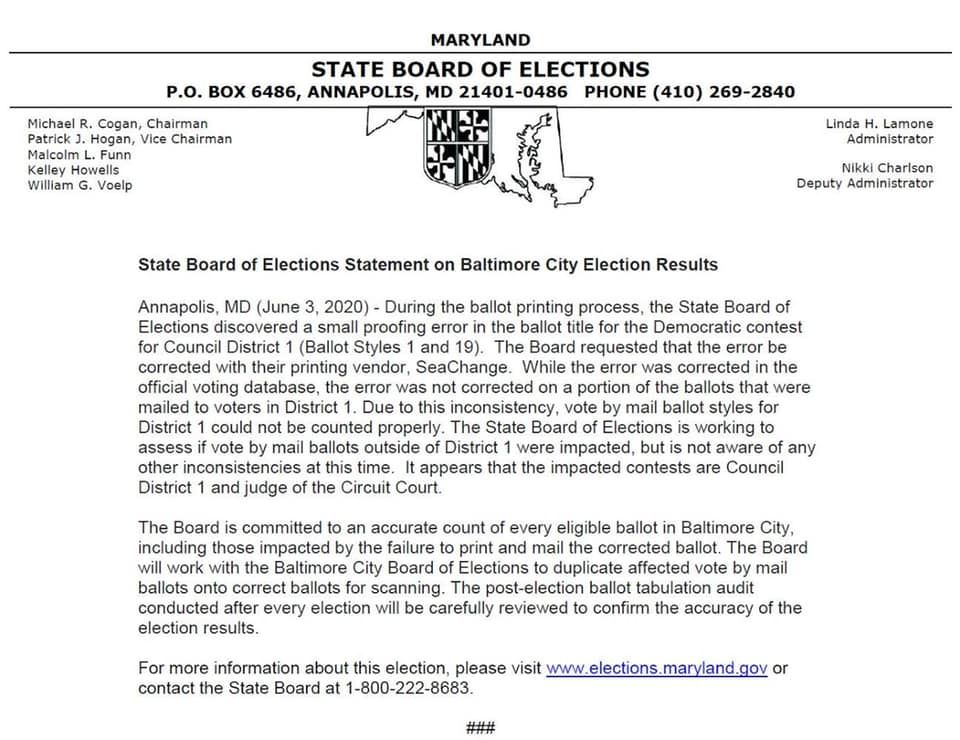
The State Board of Elections (SBE) has issued the statement below on vote counting problems in the City of Baltimore’s Council District 1.

Simultaneously, Lieutenant Governor Boyd Rutherford called on State Board of Elections administrator Linda Lamone to resign. He said the following at this morning’s meeting of the Board of Public Works.

Yesterday was primary day in Maryland. There were reports of several challenges associated with it. There is some information that’s coming out today with regard to some challenges in Baltimore City. I have not had a chance to review it but with regard to the ballots in the first councilmanic district, that is just another example of the challenges that have been occurring with the State Board of Elections. And I did say earlier in a radio interview that I really think it’s time for the administrator at the Board of Elections to step down. I think it’s time for new leadership there and to be done early, before we – with enough time to correct all of these issues before we get to November’s general election. And so I call on the Senate to work with us to find new leadership and I encourage the administrator to step down.

Getting rid of Lamone is easier said than done and the Governor has no power to do it. As I wrote eleven years ago, when former Governor Bob Ehrlich tried to oust Lamone, the General Assembly changed state law to make it virtually impossible to fire her without the consent of the Senate. The Gazette wrote at the time, “The bill is so restrictive that the elections administrator could not be removed from office even if all five members of the State Board of Elections vote to fire her, even if she were convicted of first-degree murder, sentenced to death row and stripped of her voting rights. Only when the state Senate approves a replacement could she be removed. Now that’s job security.”

Only one thing is certain: the fallout from Baltimore’s botched Council District 1 election is just beginning. What will happen next?

Share

Baltimore City’s Election Has a Problem

By Adam Pagnucco.

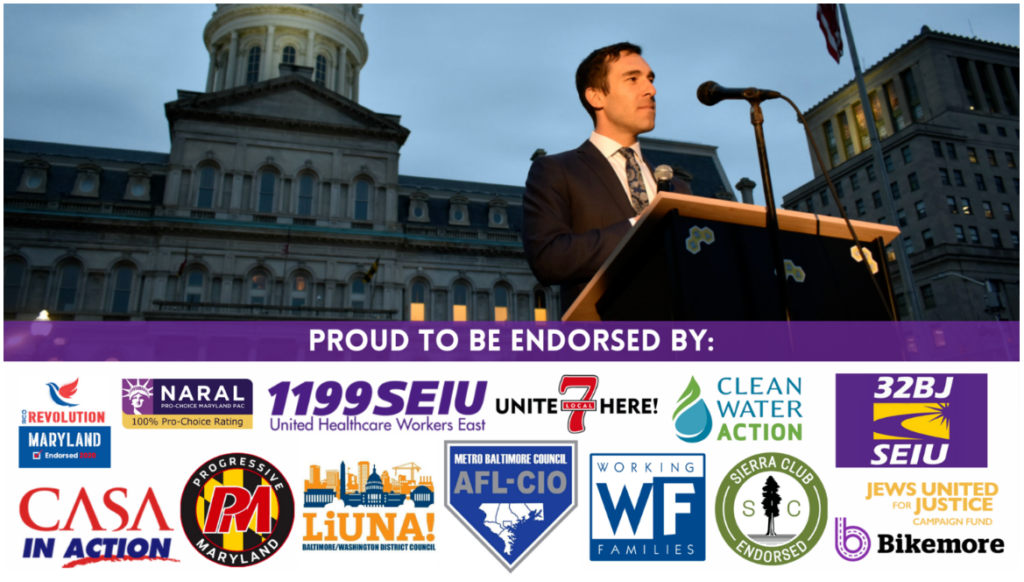
Baltimore City Council Member Zeke Cohen was riding high. A first term incumbent in District 1 (Southeast Baltimore/Canton/Fells Point), Cohen was running for reelection and was endorsed by most of the major progressive institutional players in city politics.

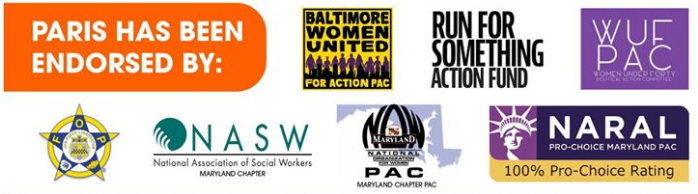
Cohen’s challenger, Paris Bienert, was a credible candidate but her endorsement list was no match for the incumbent.

For the cycle, Cohen outraised Bienert by $322,837 vs $170,795 through May 17, a nearly 2-1 edge. Cohen also outspent Bienert by $194,015 vs $124,069. Cohen was so confident of victory that he reported a cash balance of $206,174 on May 17.

So this looks like a big win for the incumbent, yeah?

Not exactly.

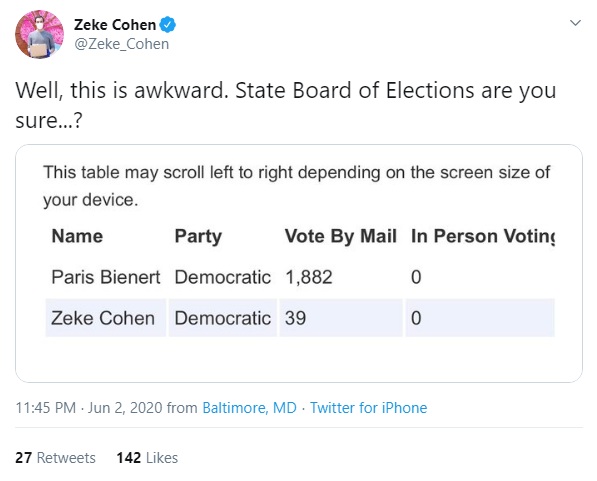
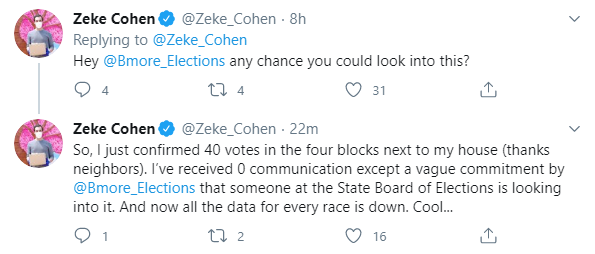
Last night, Cohen tweeted the following after seeing early results showing Bienert getting 98% of the vote.

Cohen called out the county board of elections and the results came down.

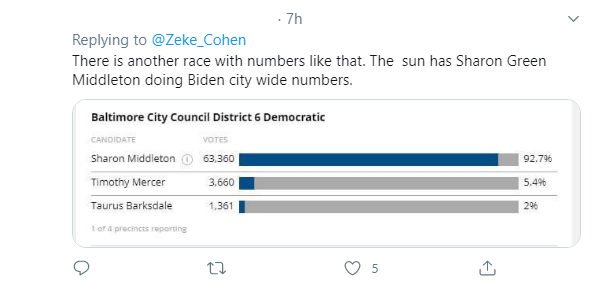
Another person caught this aberrant result. (I redacted the person’s identity from the tweet.)

Even Bienert didn’t believe it. She told the Baltimore Sun, “I’m very excited by these numbers, but I do think there’s been a misreporting.”

All of this will remind folks of the botched city election of four years ago, when activists alleged “irregularities, including late-opening polling stations; alleged conflicts of interest among campaign staffers who worked as election judges; polling-machine memory sticks that were missing for about 24 hours; and problems with resources, including shortages of ballots and ballpoint pens at some centers.” Future federal convict Catherine Pugh wound up winning the race for Mayor.

I am hearing that the State Board of Elections will address the matter today. For now, this tweet on Cohen’s thread says it all.

Share

In-Person Vote Helps Dasgupta Over Austin

By Adam Pagnucco.

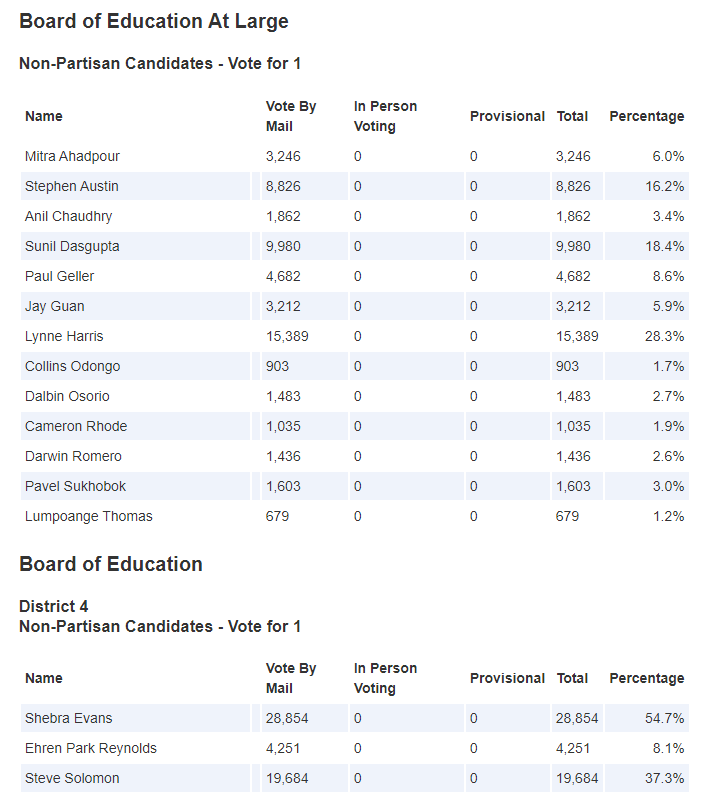
Last night’s first results in MoCo’s at-large school board race had a partial count of vote-by-mail ballots. In that count, Lynne Harris had 28.3% of the vote, followed by Sunil Dasgupta (18.4%) and Stephen Austin (16.2%). Dasgupta led Austin by 1,154 votes.

This morning, in-person votes have been posted along with the early vote-by-mail votes. Jay Guan did really well on in-person votes but not enough to break into the top three overall. Meanwhile, Dasgupta added another 186 votes to his lead over Austin. The top two candidates advance to the general election.

Tens of thousands of votes remain to be counted. Final results won’t be available for a while, so keep watching!

Share

Baltimore City Election Results Taken Down

By Adam Pagnucco.

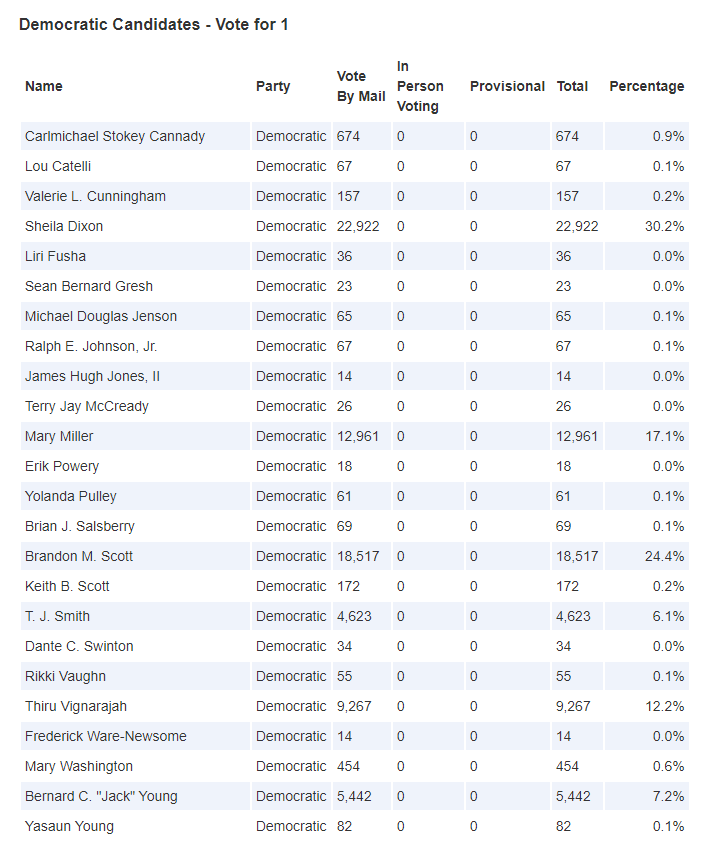
Last night at 11:20 PM, these early results for Mayor of Baltimore City were posted on the State Board of Elections website.

The city’s other races had early results too.

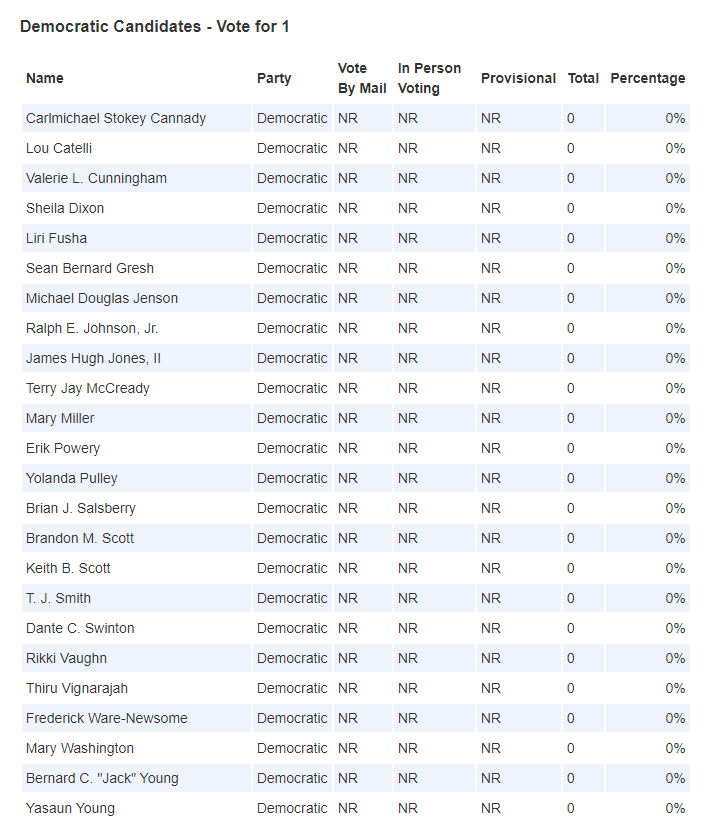
As of this writing, this is what the early results for the mayor’s race looks like.

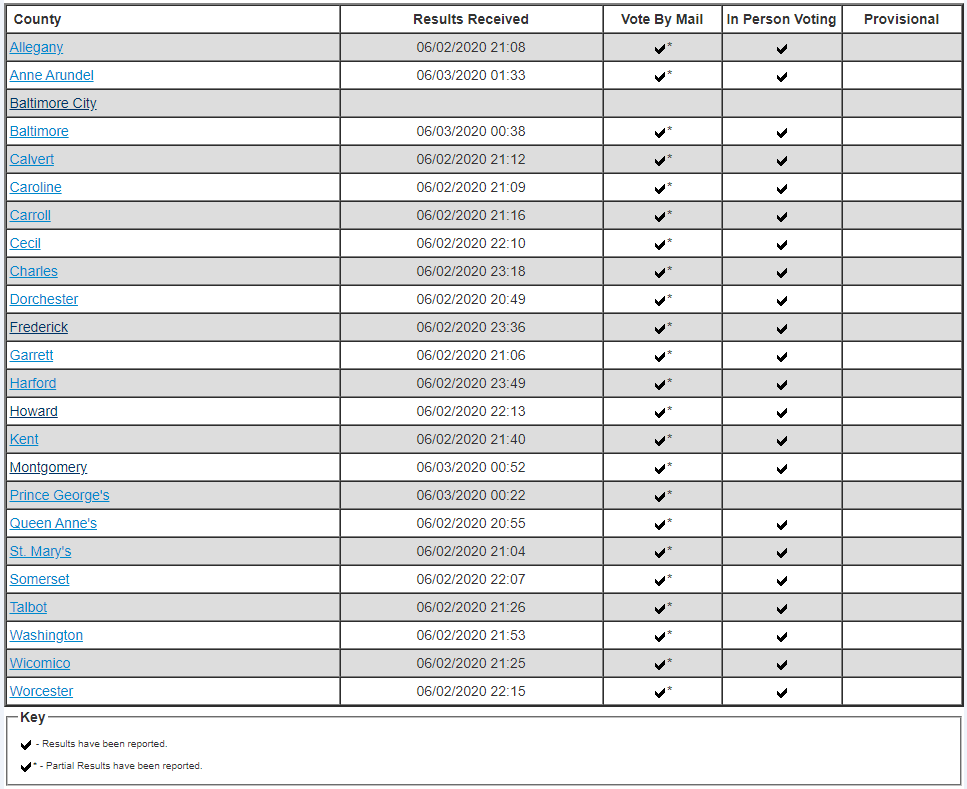
Last night, the State Board of Elections’ county status page showed Baltimore City as sending in partial vote-by-mail results. Below is what that page looks like now. The city is the only jurisdiction shown as not sending any results despite the early returns posted last night.

What is going on?

Share

First School Board Results Favor Harris

By Adam Pagnucco.

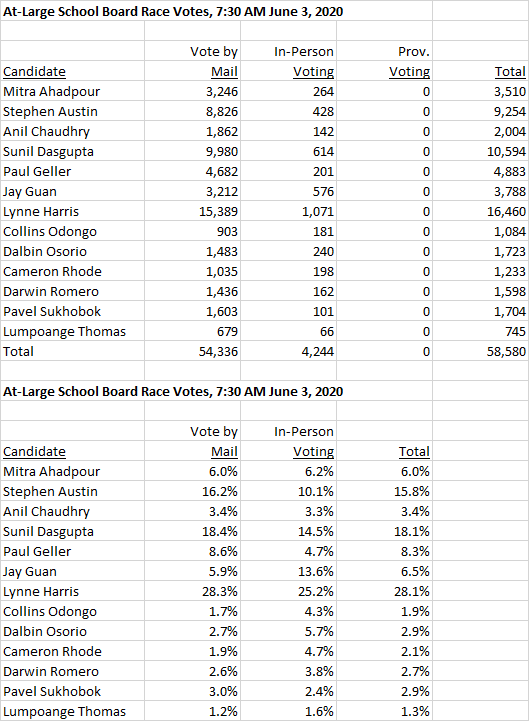
The first batch of MoCo school board results released by the State Board of Elections (SBE) at approximately 11:20 PM tonight favor former county PTA president Lynne Harris.

The results below were posted by SBE minutes ago.

This is still a very early report. The number of votes cast in the at-large school board race (54,336) is roughly half the 103,555 ballots reported as received by the county’s board of elections this morning. The tally does not include in-person voting today, provisional ballots or ballots not yet received. So far, 59,627 votes have been cast for president, indicating that many ballots have not yet been counted. (Joe Biden has received 42,203 votes from MoCo Democrats for 86% of their vote and Donald Trump has received 8,142 votes from MoCo Republicans for 77% of their vote.)

Harris was endorsed by the Washington Post. Universities at Shady Grove professor Sunil Dasgupta, currently in second place, was endorsed by the Montgomery County Education Association. Financial analyst Stephen Austin is in striking distance of Dasgupta in third place. The top two finishers in the primary advance to the general election.

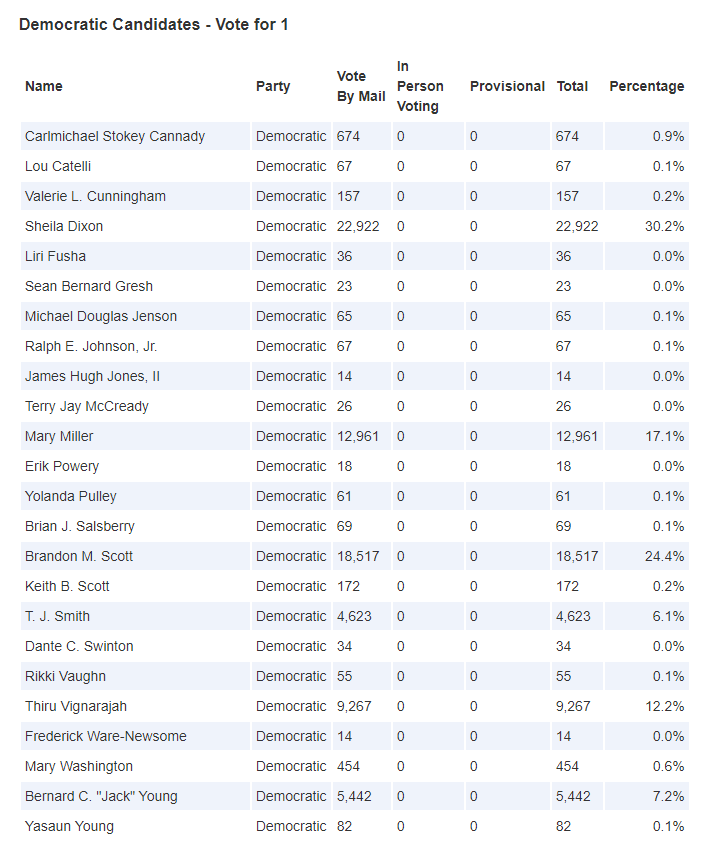
Sheila Dixon, who resigned her office as Mayor of Baltimore in 2010 after being convicted by a jury of misdemeanor embezzlement, is currently leading in the city’s Democratic primary for mayor. Like MoCo’s school board race, a lot of votes remain to be counted.

Share

Incumbent turns aside former ally’s challenge in Kensington mayoral race

from a correspondent:

Tracey C. Furman won a third term as Kensington mayor on Monday, easily turning back a vigorous challenge from her immediate predecessor and onetime ally, Peter Fosselman.

In the town’s first contested mayoral election in eight years, Furman won 420 votes to Fosselman’s 368 – a six percent margin.

The race scrambled Kensington’s recent tradition of mostly sedate local politics. Campaign-related advocacy became intense enough on Kensington’s private listserv that Furman posted a call to participants to “find a way to stick to the more mundane topics like bears, plumbers and give aways on the listserv at least until” the election was over.

Running for local office, Furman added, “should not be a blood sport.”

Given the restrictions imposed to counter the Covid-19 pandemic, residents voted by mail with the option to deposit ballots at a drop-box at Town Hall. Participation soared by 42 percent over the contested mayoral election in 2012.

Most remarkable in this year’s voting was the electoral clout demonstrated by the winning candidates for Kensington’s part-time Town Council. Bridget Hill-Zayat, a first-term incumbent, rolled up 549 votes and her campaign ally, Nate Engle, a newcomer to Town politics, won 511 votes. They easily outdistanced the third candidate, Jon A. Gerson, a longtime Kensington resident and former Council member who received 356 votes.

Hill-Zayat and Engle were allied against the controversial Knowles Manor Senior Housing project, which was the subject of a neighbors’ lawsuit challenging parking plans and traffic patterns. The litigation has been settled.

Furman’s relatively easy victory came as a mild surprise, given Fosselman’s local prominence. He previously served 10 years as mayor before stepping down in 2016 — and encouraging Furman to seek the position. She ran, and won without opposition. She was unopposed for reelection in 2018.

Furman has lived in Kensington 40 years and her supporters include many townspeople who attend the local Methodist church, where she works as facilities manager. She also is popular with members of the K’town Ladies Guild, a social club for women.

Furman ran an aggressive campaign, sharply challenging Fosselman in their lone debate nine days before the election.

At one point during the debate, which was conducted on the Zoom video conferencing platform, Furman accused Fosselman of “making this stuff up” — a testy response to his criticism that incivility and disrespect had intruded into Kensington’s official life.

Also during the debate, Furman took issue with Fosselman’s call for close enforcement of regulations on graffiti, signage, and parking, saying he preferred “to live more in a gated-type community.”

For Fosselman, defeat may mark the close of a once-promising career in electoral politics. The loss was his second in row: In 2018, Fosselman sought the Democratic party nomination for the District One seat on the Montgomery County Council, finishing a distant fifth to Andrew Friedson.

Shortly before the mayoral election, unflattering material about Fosselman, a master plan ombudsman for the county, was circulated anonymously through the mail. Fosselman said in an email to supporters that he had been called a liar, anti-Semitic, racist, and unfit to run. He also said the County Attorney “was contacted by someone making the case I have too many conflicts of interest to run … If anyone believes this is coming from some crazy person outside of Town, as has been suggested, think again. I know who some of these people are and you would be shocked.”

He did not go into specific detail, however.

Furman’s call for restraint was posted at the listserv three days before the election. She said she was not intending “to infringe on anyones [sic] right to free speech” but added, “could we possibly find a way to stick to the more mundane topics like bears, plumbers and give aways on the listserv at least until Monday June 1 at 9 p.m.,” when voting closed.

Furman, who likes to be called “Mayor Tracey,” claimed during her campaign to have brought nearly 20 businesses to Kensington. She also noted that her terms in office coincided with movement on development projects, including two senior-living complexes, one of them Knowles Manor.

She characterized herself in campaign literature as an active and engaged mayor, which is a part-time position.

“Under my leadership,” she declared, “the Town has stepped up fast and furious providing information both on our website and through bi-weekly eblasts. The Town created a COVID-19 webpage with links to important resources, virtual classes, shopping and take-out dining guides. The Town also sponsored a webinar for our small businesses to help them in applying for SBA loans.

“Keeping the [town’s] Farmers Market open every Saturday has been a priority,” she said, adding that “I’ve worked with the county to ensure our market met the requirements of the health department in order to remain operating.”

Mail voting was a departure from Kensington’s practice in local elections of voting at Town Hall during three hours in the evening on Election Day — and this year participation surged. In all, 790 votes were cast, not counting 27 ballots that were disqualified.

In the contested mayoral election in 2012, 556 ballots were submitted.

The winners begin their terms next month.

Share

What Happened to MoCo’s Racial Equity Law?

By Adam Pagnucco.

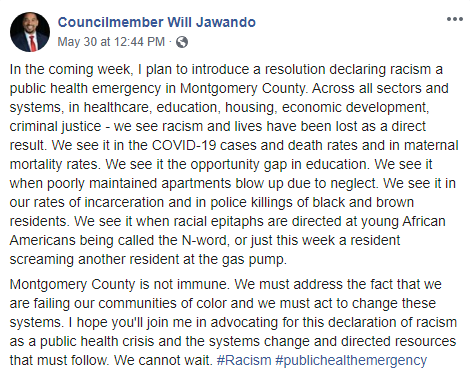
Over the weekend, Council Member Will Jawando announced his intention to introduce a resolution “declaring racism a public health emergency in Montgomery County.” His statement on Facebook appears below.

Of course, the county already has a law designed to deal with racial disparities of all kinds: the Racial Equity Law.

What happened to it?

Work on the law began in April 2018, when the county council passed a resolution lead-sponsored by Nancy Navarro and Marc Elrich calling for “an equity policy framework in county government.” The resolution stated:

The Council is committed to examining the data needed to develop an equity policy framework that would require the County to question how budget and policy decisions impact equity.

This effort must be a partnership between the County Council, County Executive, County Government, county agencies, institutions, and our community. The County Government must challenge itself to bring new and different partners to the table. Partnering with other jurisdictions as members of the Government Alliance on Race and Equity (GARE) will also enhance the County’s effort and commitment to fostering equity.

Equity analyses should be part of capital and operating budget reviews, appropriation requests, and legislation. Program and process oversight should be undertaken viewing programs and processes through an equity lens. Equity targets and measures of progress must be put in place.

The resolution was followed by three different reports by the Office of Legislative Oversight: Racial Equity in Government Decision-Making: Lessons from the Field, Racial Equity Profile Montgomery County and Findings from 2019 Racial Equity and Social Justice Community Conversations. Navarro and Elrich held meetings in Silver Spring, Germantown, White Oak and Gaithersburg to discuss the issue that were reportedly attended by 750 people. Legislation to create an Office of Racial Equity and Social Justice and a Racial Equity and Social Justice Committee was introduced in September 2019, passed unanimously by the council in November and signed into law on December 2. The legislation was scheduled to take effect on March 2, 2020.

So what are the major provisions of the law and how is the county doing on implementing them? Let’s discuss a few.

1. The executive must appoint, and the council must confirm, a 15-member Racial Equity and Social Justice Advisory Committee that would develop and distribute information about racial equity, promote educational activities and advise the executive and council on the issue.

Status: The council’s cumulative agenda for the year does not record any nominations sent over by the executive for this committee.

2. The executive must adopt a “racial equity and social justice action plan” by Method 2 regulation that would provide for community engagement and a host of requirements and metrics for every department in county government. Under Sec. 2A-15 of the County Code, a Method 2 regulation must be sent to the council for approval or disapproval.

Status: Four different sources inside the council building reported not seeing this regulation yet. The council’s cumulative agenda has no record of it.

3. The executive must “explain how each management initiative or program that would be funded in the Executive’s annual recommended operating and capital budgets promotes racial equity and social justice.” This is a time-consuming requirement as the executive’s operating and capital budgets contain hundreds of items each.

Status: The executive’s FY21 recommended operating budget, which was released after the racial equity law took effect, contains none of this language.

4. The law requires that “racial equity and social justice impact statements” must be drafted to accompany each bill introduced at the county council. The statements are due no less than 21 days after a bill’s introduction and no less than 7 days before the bill’s hearing, although the council president may change the deadlines.

Status: As of this writing, 13 bills were introduced after the racial equity law took effect on March 2. Six of the bills were passed. None of their action packets contained racial equity and social justice impact statements. The bill specifies that the Office of Legislative Oversight (OLO), which is part of the legislative branch, is responsible for drafting the impact statements. To be fair, the part of the bill referring to the impact statements takes effect on August 1, 2020 – five months after the rest of the bill – and $119,170 was added to OLO’s budget to pay for a “Racial Equity Legislative Analyst Position.”

5. The bill creates an “Office of Racial Equity and Social Justice” to perform “equity assessments” on county policies, provide racial equity and social justice training to county employees, develop short and long term goals with metrics to redress disparities, work with departments to create the county’s “racial and social justice action plan” and staff the racial equity advisory committee.

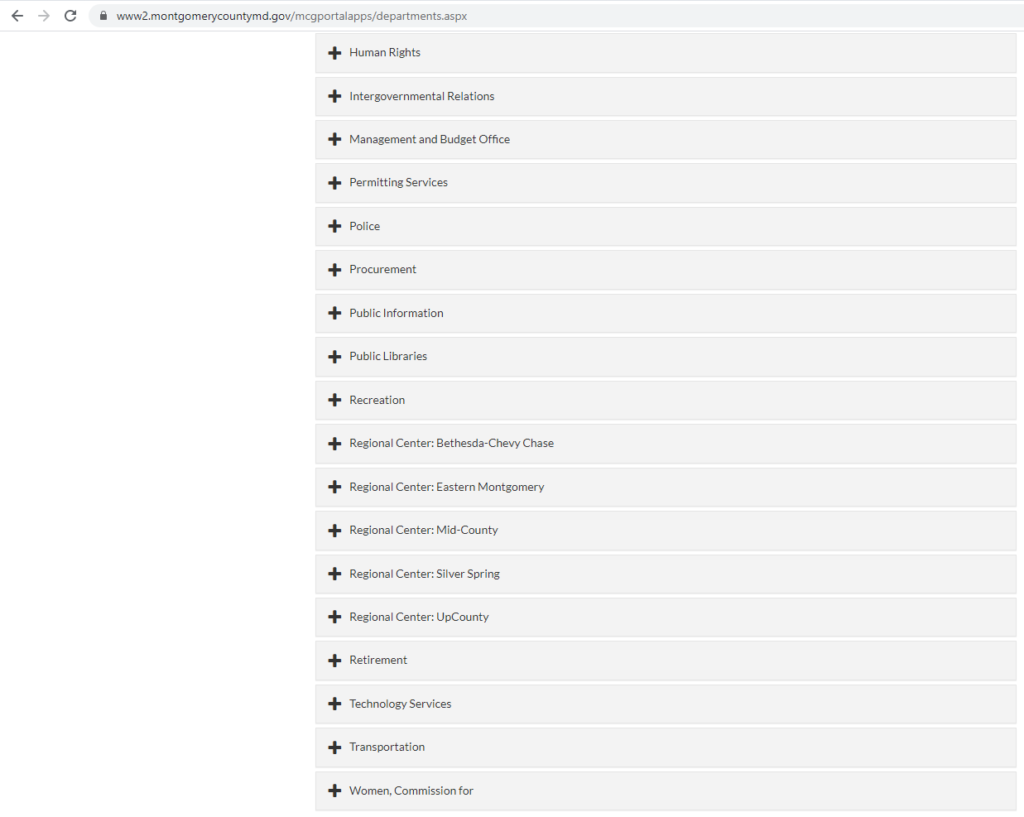
Status: Days before the law took effect, the council confirmed one of Elrich’s former council staffers as the new “Chief Equity Officer” at a salary of $150,000. The office had a budget of $584,072 in the executive’s recommended budget and includes two full-time positions plus money for operating expenses. Despite the Chief Equity Officer being on the job for three months, the racial equity office does not appear on the county’s list of departments and offices as shown below.

There are a host of other requirements in the law, such as one mandating that every department designate a “racial equity and social justice lead” to work with the racial equity office. Has that been done?

Because of its sweeping nature, the racial equity law goes beyond the bare bones of its structure in the legislation. For example, it mandates that “equity assessments” must be performed “to identify County policies and practices that must be modified to redress disparate outcomes based on race or social justice.”

One program for which that might have been helpful was the county’s grant program to small businesses affected by the COVID-19 crisis. When the county’s grant program went live on April 15 at around 3 PM, the first wave of applicants found out mainly through emails from chambers of commerce or direct notifications from council members. The county’s official blast emails announcing the grants started going out around 4:30 PM and continued into the evening. That means that the best-connected, best-informed businesses got first dibs on the grants. Did that have an impact on the demographic distribution of the grant recipients? We will never know because the grant application did not ask for the applicant’s race. Think about this: in the aftermath of the racial equity law’s passage, the county launched its biggest business assistance program ever – $25 million for more than 6,700 businesses – and the county has no apparent way to measure how much of this money went to minority business owners.

And so at this writing, the only tangible outcome from MoCo’s much-publicized racial equity law is the budgeting of roughly $700,000 in tax dollars and the creation of three full-time positions. If anything else has been accomplished after the law’s passage, there is no evidence of it.

MoCo officials have talked a lot about racial equity over the last two years. The reality is that they have a ton of work to do.

Share

Why Was Your Ballot Late?

Ballots arrived at an irregular pace this year. Then, when they came, the ballots had the original primary date of April 28th printed on them. What happened?

Late Ballots

Snafus with SeaChange, the vendor used to print and to mail the ballots, explain many of the problems. According to Deputy State Administrator Nikki Charleson at the Maryland State Board of Elections, “the vendor did not meet the schedule for Montgomery or Baltimore City” and ballots were “mailed out later than planned.”

Ballots for Baltimore City, the locale with a number of hot local contests, were supposed to have been mailed on May 8 but SeaChange did not start posting them until significantly later. In a press release, the State Board blamed SeaChange explicitly not only for missing the deadline but misleading Maryland election officials:

On May 7, SeaChange informed SBE that ballots for Baltimore City were printed and would be mailed on May 8 and confirmed on May 11 that some Baltimore City ballots had been mailed. SBE relied on this incorrect information when communicating with the public, advocacy organizations and candidates. While some files were late, it was the misleading information provided by SeaChange that led to the unmet expectations and the confusion over the ballot delivery process.

Will there be a lawsuit? Refund? Unquestionably, this should be investigated by the General Assembly. Mistakes happen, especially during a crisis but the state shouldn’t be misled by its vendors. Lying isn’t a symptom of coronavirus.

Similarly, ballots for Montgomery did not get sent until after the scheduled date. In many households, a ballot arrived for one adult but not for another. The mailing of ballots for a single local jurisdiction on different dates probably explains this strange pattern.

When I communicated with the Montgomery County Board of Elections, I also learned that there was a problem with absentee ballots. Although, everyone was effectively an absentee voter due to the adoption of universal vote-by-mail, voters who requested absentee ballots were on a separate electronic list and were not mailed ballots simultaneously with other voters.

Charlson explained that the vendor, SeaChange, had served as a subcontractor for printing ballots in 2018 as well as the special primary and general election in the Seventh Congressional District this year. She said that the state did not experience any problems that warranted not engaging SeaChange again at that time.

Why Did the Ballots Say April 28th?

The original primary was scheduled for April 28th. Given the timing of the Governor’s executive order mandating both the change of election date and vote by mail, the ballots were already finalized with many already printed. As a result, the State Board did not deem it feasible to reprint ballots with the new date, though notices were included to highlight that they remained valid notwithstanding the later date.

Who Should Receive Ballots?

Although it’s a primary, you should still receive a ballot if there is a school board race in your jurisdiction even if you’re not registered with a party. All school boards in Maryland are nonpartisan, so voters who are not affiliated with a party can participate in the primaries for these contests.

All active registered voters should receive ballots. Active is defined quite broadly and may include people who haven’t voted for a number of elections. People who have moved or died may still be considered “active voters” unless the Board discovered that they were no longer eligible because their mail was returned or through a number of other checks undertaken by the Board. In short, the state errs heavily on the side of keeping someone on the rolls and it is unlikely that you have been wrongly purged from the voter rolls.

If you didn’t receive a ballot, you should contact your local Board of Elections and consider voting at one of the open polling places on Election Day, June 2nd, as time is short for another ballot to get mailed and arrive. Remember that all ballots postmarked by June 2nd will be counted as long as they arrive before 10am on June 12.

Share

Vote, MoCo, Vote!

By Adam Pagnucco.

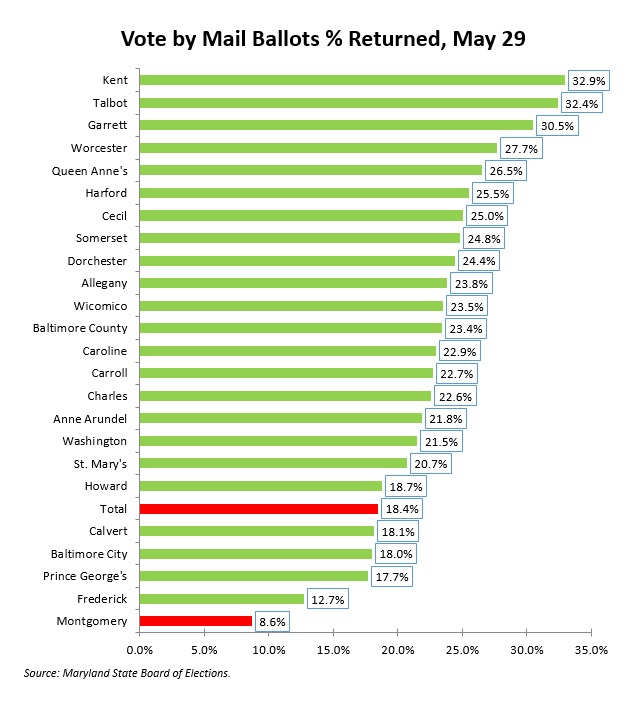
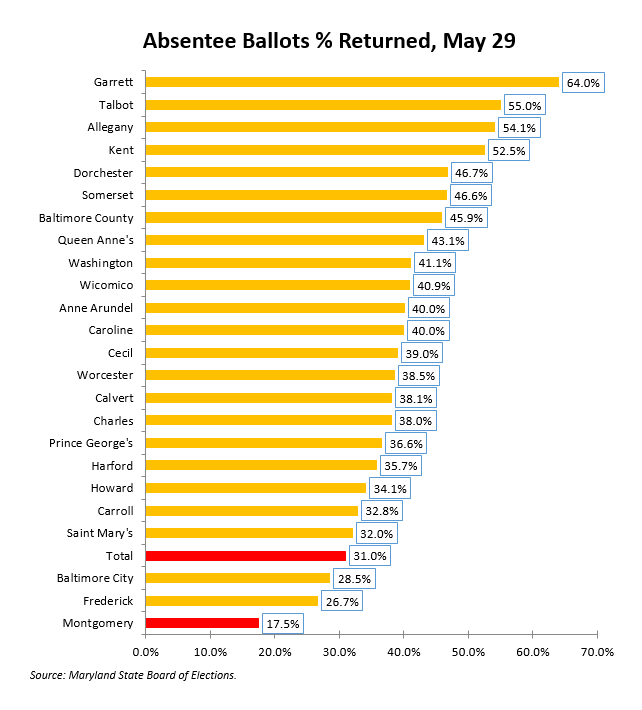
Just as I reported yesterday and the day before, MoCo’s rate of returning vote-by-mail ballots remains the lowest in the state. The chart below shows return rate by county through May 29.

The data is also bad when looking at party splits. MoCo’s return rate among Democrats (10.2%) is the worst in the state, which had a return rate among Democrats of 19.6%. MoCo’s return rate among Republicans (8.6%) was also the worst in the state, which had a return rate among Republicans of 20.2%. MoCo is one of thirteen counties in which unaffiliated and third party voters vote in presidential primaries. Among those thirteen, MoCo’s return rate among unaffiliated and third party voters was 5.0%, ranking 9th and not much lower than the statewide rate (6.0%).

As if that were not enough, MoCo is also last in return rate of absentee ballots. Even though the state sent 3,488,628 regular ballots to voter addresses, an additional 97,373 absentee ballots were requested and mailed. MoCo’s return rate of absentee ballots was the worst in the state among Democrats, Republicans and unaffiliated and third party voters. Here is an interesting fact: despite having about a sixth of the state’s population, MoCo voters requested a third of all absentee ballots in the state.

I’m not going to speculate on what is happening here. But with 4 days to go until election day, MoCo’s abysmal turnout rate has emerged as a consistent trend which has not yet gone away.

In the meantime, if you have received your ballot, don’t let it sit with the bills and junk mail. Fill it out and vote!

Share

Miscreants Run Wild at Elrich Press Conference

By Adam Pagnucco.

It was supposed to be a good moment for Montgomery County. County Executive Marc Elrich was set to announce a phase 1 reopening of county businesses, mirroring in part the recent announcement by Governor Larry Hogan. It was an occasion for cautious optimism with sober recognition of the challenges ahead.

Instead, it turned into a mud-splattered free-for-all.

That was probably inevitable given how the event was staged. The county announced through a press release the night before that the event was taking place at the Kentlands and Bethesda Beat published it. That gave protesters time to prepare and they weren’t planning on handing out cupcakes and milk. Just two weeks ago, they descended on Annapolis – many without masks – to resist “tyranny” and “trampling the U.S. Constitution.” Why would they behave differently in Rockville?

The smart thing to do would have been to hold the event in a controlled environment in the executive office building with attendance limited to press. But the administration decided to go for a photo-op in the Kentlands’ business district instead. Well, a photo-op was had – for the protesters. They got ample coverage from NBC4, WJLA, WTOP, Bethesda Beat and even Baltimore TV that they would not have received at a controlled indoor event.

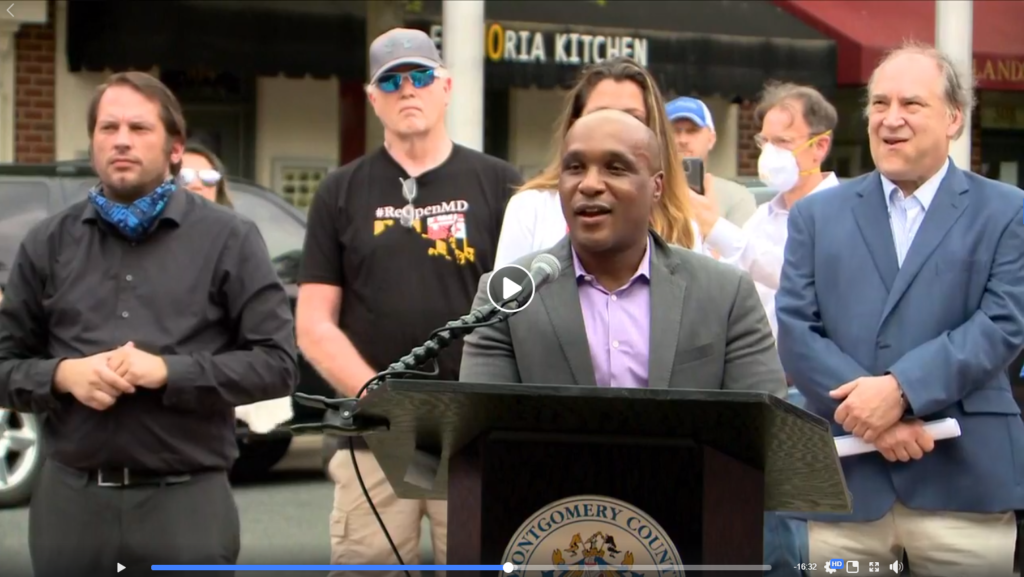
“Dictator!” “Fascist!” “Nazi!” “Liar!” “Recall!” “Trump 2020 baby, that’s what this is all about!” Those were the nice comments. The protesters repeatedly interrupted and shouted down the executive, preventing others from hearing him. At an event with such heckling, a communications person normally steps forward to cut it off early. Instead, Elrich actually took questions and prolonged the event, which went on for more than 20 minutes. The sign language interpreter even interpreted the hecklers’ comments while standing right next to Elrich.

The look on Elrich’s face (far right) says it all. Also appearing: county health officer Travis Gayles (at podium) and the sign language interpreter (far left). Credit: WJLA Facebook stream.

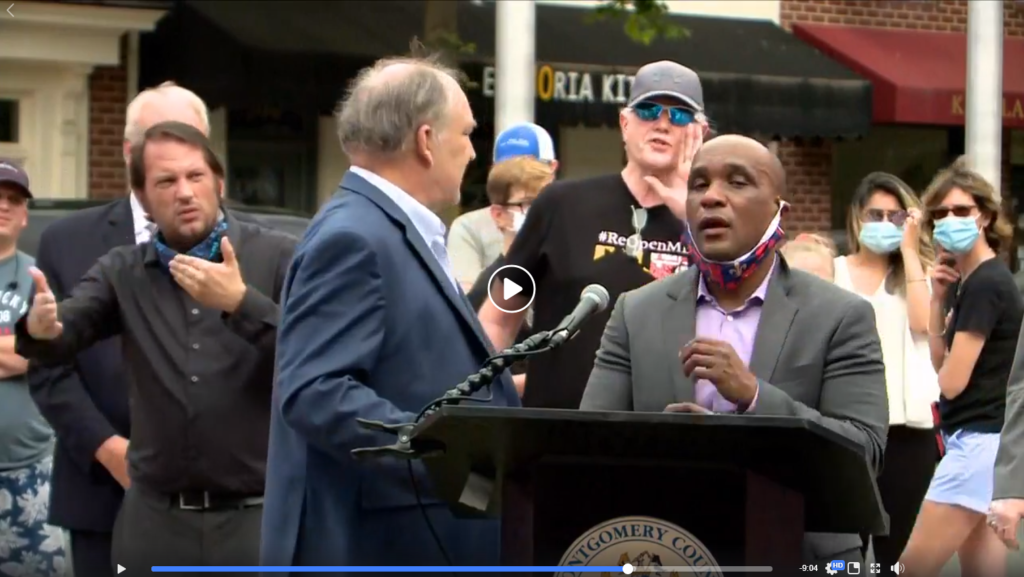
Besides the relentless yelling, a number of unmasked protesters stood within spitting distance of the executive and his staff. One unmasked fellow in a hat and sunglasses stood behind him for nearly 15 minutes and, at one point, got dangerously close to the executive. Police officers were present. Why did they not move unmasked protesters away from the executive and his staff to protect their health?

How could security allow an unmasked man to get this close to the executive? Credit: WJLA Facebook stream.

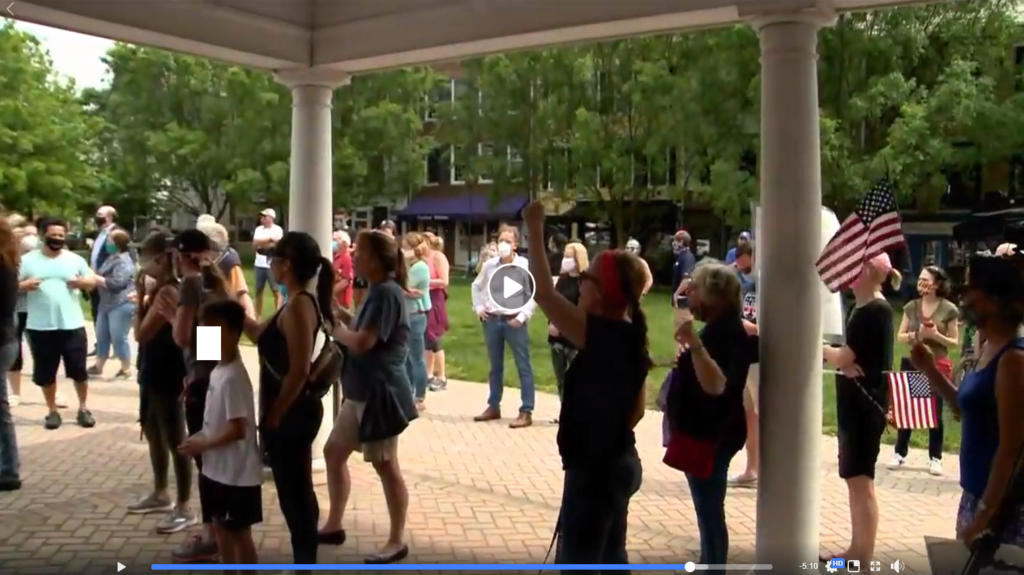
As for the protesters, there were enough of them to make serious noise. Just like in Annapolis, the event turned into a mass gathering with unmasked people. The COVID-19 crisis is not over. It’s a complete contradiction to the county’s message to allow – much less to CREATE – a mass gathering including unmasked individuals. It’s not just a PR blunder, it’s a threat to public health.

Note the lack of masks by some at the event. The identity of the child, who was not wearing a mask, has been protected in this photo. Bethesda Beat has several more pictures of unmasked people at the event. Credit: WJLA Facebook stream.

Let’s not mince words: the protesters were boorish miscreants who should be held responsible for their own actions. They are an embarrassment to the county. All of that said, they should never have been given a grand stage on which to run amok in front of TV cameras. Someone on Elrich’s communications team should have raised what a bad idea it would be to hold the event in public with notice to anyone who wanted to attend. Some shutdown protests around the country have turned violent and armed protesters even stormed the Michigan Capitol. The protesters succeeded in turning an announcement which should have furthered stability and progress into one that spotlighted division and chaos.

This event should not have happened.

But it did. And once again the administration has endured a communications debacle that could have been avoided.

Share

Maryland Politics Watch