Ademiluyi and Pierre Beat Incumbent Judges in Democratic Primary

Most of the races in Montgomery and Prince George’s Counties are very sleepy this year. The judicial races have become a surprise exception. Though there are still votes that have yet to be counted, it looks like challengers upset a member of the incumbent judges slate in the Democratic primary for circuit court judge in both counties.

Maryland judicial races have an unusual process. After being appointed by the Governor, the incumbent judges must face the voters and any other candidates that decide to run. All candidates are placed on each party’s ballot. All of the candidates who place high enough on any party’s ballot continue on to the general election.

Though they lost the Democratic primary, the incumbents will also continue to the general because they still won one of the top four spots in the much lower turnout Republican primaries. In both Montgomery and Prince George’s, the challengers are African-American women and the incumbents are white men who were appointed by Republican Gov. Larry Hogan.

Ademiluyi Upsets Bereano in Prince George’s

In Prince George’s County, April Ademiluyi beat incumbent Judge Byron Bereano in the Democratic Primary for Judge of the Circuit Court. The daughter of African immigrants, Ademiluyi is a graduate of the University of Maryland, College Park and received her law degree from George Mason. According to currently available numbers, Ademiluyi won 105,725 votes to 87,017 for Bereano, the son of controversial lobbyist Bruce Bereano.

Bruce Bereano was convicted of campaign finance fraud in 1994–he got his employees to make campaign donations and then illegally reimburses them under the guise of lobbying expenses. Besides going to jail, he was disbarred and lost his license to practice law.

Neither stopped him from coming back as a highly influential lobbyist or from exerting influence on judicial nominations and elections.

As Josh Kurtz explained:

[Bereano asked] his friends to contribute to something called the Prince George’s Committee to Elect Sitting Judges. This is a campaign committee for five Circuit Court judges — four of whom were recently appointed by Gov. Lawrence J. Hogan Jr. (R) — seeking 15-year terms to the bench in the 2020 election. One of them happens to be his son, Judge Bryon Bereano, appointed first by Hogan to the District Court, then late last year, to the Circuit Court.

Stranger still, consider the identity of the man chairing the sitting judges’ election campaign in Prince George’s County: That would be Alexander Williams, the former federal judge and close Bruce Bereano ally who is surely Hogan’s favorite Democrat. Hogan has rescued Williams from retirement, appointing him to several key appointed posts. Those include his role as chairman of the Appellate Courts Judicial Nominating Commission.

Bruce Bereano has also been heavily involved in Anne Arundel judicial races.

Despite losing the Democratic primary, Byron Bereano will also appear on the general election ballot. He won a spot with just 4,970 votes — all that was needed in heavily Democratic county home to few Republicans. Bereano attended the University of Baltimore School of Law and formerly worked at Lerch, Early and Brewer.

Pierre Edges Out Fogleman in Montgomery

In Montgomery, challenger Marylin Pierre beat incumbent Christopher Fogleman. Pierre gained 79,673 votes to 77,976 for Fogleman who was appointed by Gov. Hogan. Pierre, a former army lieutenant and Howard law graduate, ran as a progressive alternative to the incumbent slate. Somerset Mayor Jeffrey Slavin was her sole endorsement from an elected official.

This was Pierre’s second attempt as an insurgent judicial candidate. In 2018, Pierre failed to win either party’s nomination. However, she nevertheless did quite respectably for someone not part of the incumbent slate in a contest that is below the radar of most voters.

Fogleman served for three years as a public defender in the 1980s. The American University law graduate also was appointed by former County Executive Ike Leggett to the county’s Juvenile Justice Commission. Fogleman served for ten years, including as the commission’s chair.

Like Bereano in Prince George’s, Fogleman will advance to the general election due to his success in the Republican primary in which he earned 14,085 votes compared to 6,893 for Pierre.

The outcomes in the two party primaries were strikingly reversed for the other incumbents. Incumbent African-American Judge Bibi Berry ran away as an easy first place in the Democratic primary with 106,128 votes — over 23,000 votes more than the second place candidate. But in the Republican primary, Berry came in fourth with 11,492 votes, which is roughly 3000 votes less than her white male running mates.

Share

Top Seventh State Stories, May 2020

By Adam Pagnucco.

These were the top stories on Seventh State in May ranked by page views.

1. Miscreants Run Wild at Elrich Press Conference
2. MoCo is a Turnout Outlier
3. MoCo’s Nasty School Board Race, Part One
4. MoCo’s Nasty School Board Race, Part Two
5. MoCo’s Nasty School Board Race, Part Three
6. Who Signed the Anti-Austin Letter – and Who Did Not
7. How MoCo Can Balance Public Health and the Economy
8. Turnout Off to Slow Start
9. Campaign Finance Reports, School Board Primary
10. Elrich’s Hidden Tax Hike

For the most part, the leaders reflected the two big stories of the month: MoCo’s mud-splattered school board contest and the county’s low turnout in the primary. (It turns out that despite early data from the State Board of Elections, MoCo probably won’t be last in the state.) Also, the county deserves credit for posting a COVID-19 dashboard just two days after we called for one.

June promises to be another busy month. Thank you for reading Seventh State!

Share

Updated Turnout: MoCo is Low but not Last

By Adam Pagnucco.

In the days leading up to the primary election, turnout reports from the State Board of Elections consistently showed MoCo as last in the state. Updated numbers released this morning now show MoCo is one of the lower turnout jurisdictions in Maryland but no longer last.

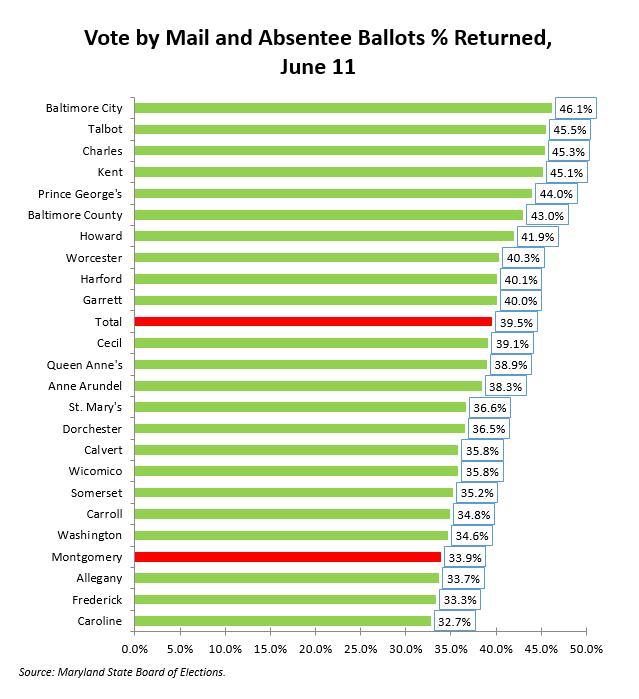
The chart below shows the combined return rate of vote by mail ballots and absentee ballots. (Vote by mail ballots dominate this statistic as 3,485,891 of those were sent to voters while 99,718 absentee ballots were sent to voters statewide.) The state has so far not released turnout counts for election day votes.

MoCo now ranks 21 of 24 jurisdictions in turnout in these two categories. Baltimore City, despite huge problems with late ballots and counting in City Council District 1, ranks first. That’s a testament to city voters who decided Baltimore’s future in this election.

In terms of party splits, MoCo ranked 13th of 24 in Democratic turnout, 23rd of 24 in Republican turnout and 5th in unaffiliated/third party turnout among the 13 jurisdictions that received ballots from those voters.

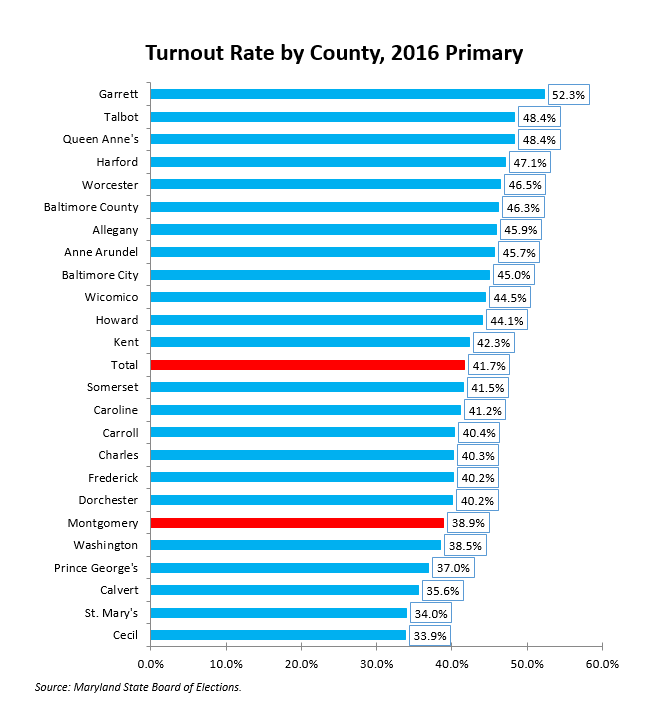
MoCo was also one of the lower turnout jurisdictions in the 2016 primary as shown in the chart below.

In addition to turnout, another issue is how long it is taking to count ballots. At the moment, the county has received 227,383 in combined vote by mail and absentee ballots along with an indeterminate number of election day ballots. At the moment, 137,060 ballots for president have been counted and 124,764 ballots for at-large school board have been counted. That means the county board of elections has a ways to go before all ballots are counted. The board has scheduled canvasses through June 20.

Share

Jawando Ignored Public Information Act, Had Scant Evidence Before Filing Rent Control Bill

One may be the loneliest number, but apparently one documented claim of a rent increase was enough for Councilmember Will Jawando (D-At Large) to introduce rent control legislation that governs the entire county.

When he introduced his emergency rent control bill in response to the pandemic, I made repeated requests to Councilmember Jawando’s office for any evidence he had of rising rents that inspired him to file the bill.

I eventually received a public comment but not a scintilla of hard evidence, so I submitted a formal Maryland Public Information Act (MPIA) request on April 19 via his official email account: “Please consider this a request for any and all documents covered by the Public Information Act you have received related to rent increases during the pandemic. Thank you.”

Cecily Thorne, Jawando’s Chief of Staff, contacted me on April 21 after I wrote my initial post about the lack of evidence or logic “even from an amoral greed perspective” behind the rent control bill. She stated that “Councilmember Jawando asked me to forward some of the information we have been receiving from tenants related to rent increases” and included four redacted pieces of information.

Only one of these documents made a claim of a rent increase that was made both prior to the bill’s introduction and during the pandemic. (Another was notification given prior to the pandemic, while one involved late fees, not rent, and the last one was a somewhat complex situation sent after the bill’s introduction in any case.)

I spoke with Ms. Thorne shortly after receiving the information and told her directly of my MPIA request in the course of our discussion. Nonetheless, my request went completely ignored in violation of the law.

When I followed up on May 30 – after the mandatory 30-day disclosure deadline in state law had passed – Ms. Thorne remembered being made aware of a request (“You mentioned you made a request”), but also texted that “I have not seen one until now in writing” and “I did not receive a request formal from you” despite my having sent it to Councilmember Jawando’s official email and having mentioned it during our call.

The lack of response suggests that either (1) Councilmember Will Jawando’s office is highly disorganized, or (2) unaware of its legal responsibilities under the Public Information Act, or (3) willfully ignored the request in violation of the law. It could also be a combo platter.

Thanks to the efforts of Legislative Attorney Amanda Mihill, I received most, though not all, of the documents late last week. However, Jawando’s office excluded the unredacted copy of a previous document until I made mention that it was missing. Their response still excludes many documents attached to emails in violation of the law.

What’s Not in the Documents?

Despite Councilmember Jawando’s media claims, he had virtually no documentation that this was occurring before he decided to file the bill. Although Cecily Thorne stated that the emails she sent were only “some of the information,” the documents sent show otherwise. There was literally only the one claim mentioned above.

There are no copies of phone records listing people who called with complaints. Nor is there any evidence that the Councilmember’s staff contacted the landlord.

The only other evidence within the documents involves a few back and forth strategy emails with the Renters Alliance in which Councilmember Jawando says “as many examples as you can send will be helpful ahead of bill introduction.” The reply references only increases being seen in the same building as the sole complaint from a renter.

One case.

No wonder Councilmember Jawando was unresponsive to queries on this topic from not just myself but others despite the claims he made in the media.

Glass Bill Provides Meaningful Help

Fortunately, the Council took other action to address the larger problem, which is that many people who have lost their jobs, if only temporarily, cannot pay regardless of the level of rent.

The Council passed legislation introduced by Councilmember Evan Glass (D-At Large) that, among other provisions, appropriated an additional $2 million in rental assistance. This money helps people facing eviction directly. The county has also loosened the requirements to receive rental assistance in light of the ongoing crisis.

Share

It’s the CIP, Stupid!

By Gus Bauman.

Finally! After many years of heated controversy, Montgomery County is about to squarely confront its use of land use moratoria as a part of its growth policy regulations. The County Planning Board, after much study for its regular update of the County’s Growth Policy, has crafted a proposal to largely eliminate land use moratoria in the County. The County Council will ultimately decide the terms and scope of the Growth Policy (titled in more recent years as the Subdivision Staging Policy.)

This correspondent is the former chairman of the Maryland-National Capital Park & Planning Commission and its MoCo Planning Board (appointed in ’89, reappointed in ’93). Let me offer some background and candid insight that may prove useful in the coming months as the proposal enters the political windstorm.

The MoCo Annual Growth Policy (the AGP; that was its name for many years) was created in 1986. Why? Because during the ‘80’s, the County was experiencing high growth. It had previously created an Adequate Public Facilities Ordinance (APFO), which was embedded in the Subdivision Ordinance to apply to all new subdivision proposals.

To manage the APFO, the AGP was later instituted as a timing mechanism to match school and transportation needs with corresponding infrastructure development. Buried in the AGP system was the moratorium nuclear bomb—if school or transportation capacity in any defined area of the County became overloaded, then no new subdivision could be approved in that area until the county’s capital budget (the Capital Improvements Program, or CIP) indicated that help was on the way through public improvements and/or private contributions to fix the identified public need.

The moratorium concept was always intended to be a rare, drastic action of last resort. It was never meant to be a routine tool in the planner’s toolbox. Indeed, the very idea of a moratorium is contrary to comprehensive planning, zoning, and budgeting—i.e., to responsible government. For adopting a moratorium is, by definition, an admission of governmental failure. Doing it on a normative basis should be downright embarrassing.

Land use moratoria were supposed to be as rare as snow in June—they were to delay development approvals for a brief time in order that public and sometimes private funds could then target as quickly as possible where the infrastructure need was and fix it. In fact, the very purpose of a looming moratorium was to immediately direct capital funds to the targeted area in order to avoid the moratorium bomb from exploding.

This system only worked, however, where there was both a high growth rate that continued to pay taxes and where infrastructure spending was duly targeted by the County government to any area about to be thrown into moratorium.

But those two preconditions began sliding away in the late 1990’s, and by the turn of the century, they were largely gone. Montgomery County’s growth rate has been in the basement for some 15 years now. Yet the moratorium mechanism, meant to be only an emergency measure in the AGP, never went away. Indeed, it became a favorite fixture of the no-growth crowd. And that crowd has always controlled certain votes in County government.

The rich irony here is that a moratorium is, in truth, all about fiscal and budgetary policy and not a growth or density matter. Whether density on some tract is to be low, medium, or high, whether growth in some area is to be slow, moderate, or rapid, is a land use dynamic regulated by the community master plan as well as the zoning placed on properties. But during the 1990’s, exclusionary forces in Montgomery County realized that use of moratoria could become a normal convenience to accomplish what they otherwise could not accomplish through planning, zoning, and environmental regulations.

Just starve the CIP of transportation spending on certain projects called for in County master plans, and SURPRISE!, the roads in an area are suddenly over capacity. Just redirect school capital funding projects away from certain developing and redeveloping areas, and SURPRISE!, schools in those areas become over capacity. The most extreme example of this practice was how prior County governments allowed the East County to be frozen for many years in moratorium while significant capital funding flowed west, north, and south.

Today’s County Council can see what moratoria have wrought over the past two decades. When an area is placed into moratorium, neither new taxes nor fees can be generated in that area, creating the perverse effect of killing off the very revenues needed to help solve the identified problem. The County Planning Board knows what moratoria have wrought. The practice telegraphs to the business community to avoid investing in Montgomery when so many other nearby options exist called DC, Frederick County, Prince George’s County, and the multiple jurisdictions in Northern Virginia.

Moratoria are all about erecting walls. The Montgomery County government should be knocking down walls. The County should be using its highly detailed master plans, its incredibly rigorous zoning, its adequate public facilities ordinance, its huge budget, as well as its growth policy, to channel public infrastructure improvements where they are needed.

It is telling that Montgomery County prides itself on having the toughest, most “sophisticated” planning, zoning, environmental, and transportation controls in the region as well as being blessed with a large tax base and corresponding budget, yet, simultaneously, it is the only regional jurisdiction that regularly applies that admission of governmental failure, the moratorium.

To paraphrase the famous presidential campaign slogan of the 1990’s, “It’s the CIP, stupid.”

Gus Bauman is an attorney who lives in Silver Spring. He served two terms as chair of the Montgomery County Planning Board.

Share

Harris, Dasgupta Hold on to Leads

By Adam Pagnucco.

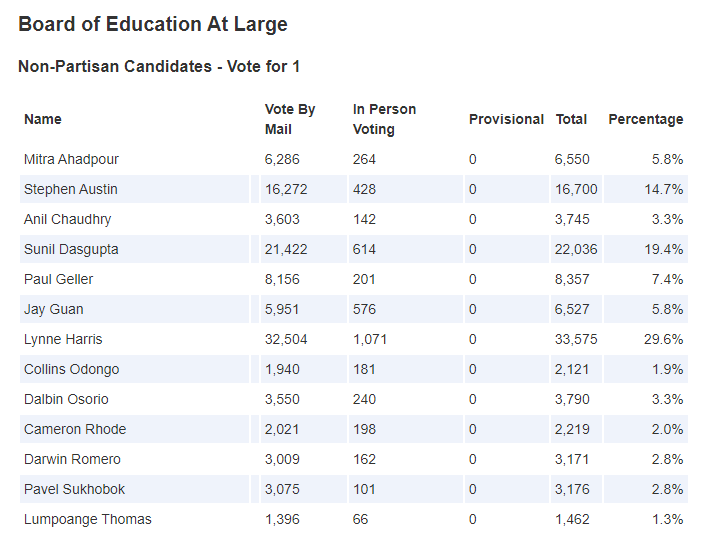
Moments ago, the State Board of Elections updated its vote count of MoCo’s at-large school board race. Lynne Harris and Sunil Dasgupta have been in first and second place since the first counts were released and that has not changed.

At this point, 113,429 votes have been recorded in this race and 123,568 votes have been cast for president. Bethesda Beat reported last week that the county board of elections had received “more than 271,450 ballots” as of Thursday. That number has no doubt gone up since then. That probably means at most half the ballots in MoCo have been counted as of a week after the primary election.

In the District 4 race, incumbent Shebra Evans and Steve Solomon look like they will advance to the general election.

Share

Why the Democrats Must Get Rid of Lamone

By Adam Pagnucco.

State elections administrator Linda Lamone is one of the great survivors in Maryland political history. Ensconced in her perch since 1997, she has weathered crisis after crisis over the years. Think about the folks holding power when Lamone was first appointed: Governor Parris Glendening, Attorney General Joe Curran, Comptroller Louis Goldstein, Senate President Mike Miller and Speaker of the House Cas Taylor. All are long gone except for Miller, who is still in the Senate but has relinquished his post as president. And yet Lamone remains.

It is time for state Democrats to bring that to an end.

In light of everything that just happened in the primary, consider this. For Democrats, voting rights are a core issue. In Maryland, Democrats passed early voting, same-day voter registration and automatic voter registration. They were outraged when MoCo’s Republican-majority county board of elections resisted opening early voting centers in heavily minority communities in 2015 and 2019. Democrats all over the country accuse Republicans of trying to suppress voting, especially in predominantly black and Latino precincts.

What went on in the recent primary is far worse than any squabbling over early voting centers. I bet there are not many adults in this state who don’t know someone who got a late ballot, got no ballot at all or got ballots for people who no longer lived at their address. The botched count in Baltimore City’s Council District 1 is disgraceful and may be beyond redemption. The city’s elections director admitted to Baltimore Brew that he was asleep when city results were pulled overnight and added, “I have no idea why it happened.” Observing the wreckage, Lamone herself told the Sun, “As I said before, I’m really proud of the way everybody pitched in and helped and tried to make everything work as best it could.”

Donald Trump could not have asked for a better example for his case against voting by mail than what happened in Maryland. The fact that the epicenter of our electoral meltdown was majority-black Baltimore City enables Trump and his allies to argue that voting by mail disenfranchises black voters.

Think about that for a minute.

Ballot problems were probably inevitable given the long history of audits finding issues with the state’s custody of voter registration records. Here is a sample of what legislative audits on the State Board of Elections (SBE) conducted over the last decade have said.

June 2010: “Our audit disclosed several deficiencies with respect to oversight of the local election boards. Procedures were not sufficient to ensure the propriety of the Statewide voter registration database. For example, processes put in place to ensure the propriety of critical database changes (such as to add or delete voter registrations) processed by the local boards were not comprehensive and SBE did not ensure that local boards removed convicted felons from the voter registration database.”

March 2014: “Known security concerns over the Online Voter Registration System, which allows citizens to register to vote and update voter registration records online, were not being properly addressed until recently. In addition, adequate procedures were not in place to ensure convicted felons serving court-ordered sentences were removed from the voter registration database.”

April 2017: “SBE did not establish certain controls to maintain the integrity of the Statewide voter registration records and to protect certain voter data. For example, user access to the voter registration system was not effectively controlled; consequently, numerous system users had unnecessary access to the voter registration database, which was removed after our inquiries. We also noted that SBE did not ensure that personally identifiable information from the database was either properly safeguarded when transmitted to a third party contractor or removed from its own records. In this regard, the full social security numbers from over 590,000 voters were retained by SBE in the database even though only the last four digits are needed.”

December 2019: “SBE’s oversight processes were not adequate to ensure that local boards of election appropriately corrected voter registration data based on the results of internal reviews of voter registration activity and the reports of possible ineligible voters that it received from external sources.”

Did anyone in authority actually read these audits?

Other than Lamone herself, the key figure in all of this is State Senate President Bill Ferguson. Under the structure of the Linda Lamone for Life law, the state elections administrator serves until her successor is confirmed by the Senate. In the old days, then-President Mike Miller, Lamone’s great protector, was in charge so Lamone was safe. But Miller is now out of power and Ferguson sits on the throne. Ferguson, who was elected to the Senate in 2010, was not in office when the Lamone for Life law was passed. (That probably applies to a majority of the current General Assembly.) Ferguson is a young, thoughtful consensus seeker who wants to show that government can make a positive difference in people’s lives. Lamone’s continued tenure is a threat to that perspective. Let’s remember that Baltimore City Council District 1, where the worst mistakes were committed, overlaps with Ferguson’s own legislative district. How many constituent complaints has Ferguson received? Because he now runs the Senate schedule, if Ferguson were to call for Lamone’s resignation, that would be a game changer. So far he has not.

The big winner from the blow-up is Governor Larry Hogan, who can point out that the Lamone for Life law prevents him from removing her. Whenever anything goes wrong, now or in the future, Hogan can simply blame the Democrats. What happens if Hogan activates his massive social media machine around the issue? The potential public shaming capacity is almost beyond comprehension.

Then there is Comptroller Peter Franchot, who is running for governor on a “disrupt the machine” platform. Franchot has openly called for Lamone’s resignation. The Democratic leadership detests Franchot even more than Hogan and would rather gargle transmission fluid than see him become governor. One of them acidly reminded me that Franchot voted for the Lamone for Life bill when he was a Delegate minutes after getting his anti-Lamone email. Regardless, the last thing that the Democratic leaders want to do is gift-wrap a campaign issue for Franchot. And as long as Lamone remains in her job, Franchot will cite her as Exhibit A of “the machine.”

All of the above said, here is the bottom line. Long ago, the Democrats created Lamone. They passed a law to protect her. They kept her at the state board of elections despite two decades of problems. Whether they like it or not, they own what she does. The rampant issues in our latest primary are now calling the question, which is this: the Democrats cannot be the party of voting rights and also the party of Linda Lamone. It’s time to make a choice.

With voters all over the state looking on, what will they choose?

Share

Franchot to General Assembly: Time for Lamone to Go

By Adam Pagnucco.

Comptroller Peter Franchot, who has previously called for the resignation of state elections administrator Linda Lamone, has sent the email below to every member of the General Assembly.

*****

Dear Senators and Delegates:

In case you missed it, I wanted to share with you this piece by The Seventh State’s Adam Pagnucco regarding the fiasco that unfolded earlier this week in our primary elections as well as the historical context of Linda Lamone’s leadership of the State Board of Elections.

Like you, I was deeply disappointed and remain very frustrated by the manner in which the June 2 elections were administered by the State Board of Elections, specifically in Baltimore City. The City of Baltimore, the State of Maryland, and our country are already facing far too many existential challenges without corroded public confidence in the integrity of our democratic process and in the legitimacy of the outcomes.

As you may know, during Wednesday’s Board of Public Works meeting, Lt. Governor Rutherford and I joined together in a bipartisan fashion to call for Administrator Lamone’s resignation. The failure to properly execute the June 2 election, along with the challenges that we are all aware of in previous elections, warrant Administrator Lamone’s resignation or removal from office.

However, as you know, thanks to a 2005 bill enacted by the General Assembly, widely referred to as the “Linda Lamone for Life” law, her termination by the State Board of Elections is made all the more challenging thanks to the passage of this legislation. The law now requires that the Administrator – even if terminated by the State Board of Elections – can remain in office until the Senate advises and consents to a replacement. No other employee of state government enjoys this level of statutory job protection.

The choice that the Senate makes on the future of Linda Lamone is one between efficient stewardship of our elections and gross administrative incompetence. It is a choice between voter empowerment and voter disenfranchisement. It is a choice between a system in which people can have confidence in the integrity of their institutions of government and one in that makes them question the legitimacy of our elections and outcomes. It is my sincere hope that the Senate will come to the same conclusion that I and the vast majority of Marylanders have made: it is time for new, competent leadership at the State Board of Elections.

Thank you for your consideration.

Sincerely,

Peter Franchot
Comptroller

Share

Repeal the Linda Lamone for Life Law

By Adam Pagnucco.

Imagine a senior state employee appointed by the governor to a politically sensitive position. Now imagine the following hypothetical situation: the employee commits a heinous crime covered by every TV station in the state. Imagine this employee is then convicted and imprisoned. One would think that such an employee – any state employee, really – would be terminated from employment by the state in such a hypothetical circumstance.

You would be right – EXCEPT for one key position in state government: the State Administrator of Elections. Under current state law, that position would continue to be occupied by its current holder for a potentially indefinite period.

That law is commonly known as the “Linda Lamone for Life” law.

It must be repealed.

To understand how this law came to be, let’s go back in time. Linda Lamone, who is the State Administrator of Elections today, was appointed by Governor Parris Glendening to the position in 1997 but Republican Bob Ehrlich was elected governor in 2002. By 2005, Ehrlich had decided to get rid of her. But Lamone had an ace-in-the-hole – Mike Miller, who was then in his prime as Senate President and was determined to protect her. To thwart Ehrlich, Miller pushed through Senate Bill 444 to protect Lamone’s job. Ehrlich vetoed it but General Assembly Democrats overrode the veto, thereby winning one of Maryland’s uglier partisan battles of the last couple decades.

The bill’s fiscal note concisely states its purpose.

The State board may remove the State Administrator provided that the board is fully constituted with five duly confirmed members. Removal requires the affirmative vote of four duly confirmed members. The State Administrator is authorized to continue to serve subsequent to a valid vote of removal until a successor is confirmed by the Senate of Maryland.

And so it did not matter if Ehrlich’s appointees to the State Board of Elections (SBE) voted to remove Lamone. It did not matter if they got a super-majority for removal. Lamone would continue to serve regardless until the Senate voted for a successor. That meant Lamone was accountable to just one person – the person who scheduled Senate business. You guessed it – that person was Mike Miller.

At the time, the Gazette put it this way.

The bill is so restrictive that the elections administrator could not be removed from office even if all five members of the State Board of Elections vote to fire her, even if she were convicted of first-degree murder, sentenced to death row and stripped of her voting rights. Only when the state Senate approves a replacement could she be removed. Now that’s job security.

Lamone has been a controversial administrator over the years. Her tenure has seen problems with campaign finance reporting software, a 2010 state audit finding “seriously deficient” financial practices (some of which had been previously found in 2006), a 2016 election in Baltimore City in which 800 votes were improperly counted, a 2017 state audit alleging that SBE had put 600,000 social security numbers at risk of hacking and the 2018 revelation from the FBI that an SBE vendor hosting election data was owned by a Russian oligarch with ties to Vladimir Putin. In 2018, a fed-up former member of the Montgomery County Board of Elections penned a Washington Post op-ed titled “Maryland Can’t Protect its Elections.

Last year, Governor Larry Hogan and Comptroller Peter Franchot complained to Lamone about long lines in the previous general election. Franchot said, “This was a black eye for Maryland around the country.” Hogan added, “They were making fun of us on the national television about how bad the Maryland election was being administered… You are the Maryland state election administrator.” Lamone blamed the local election boards, responding, “I have no control.”

In December 2019, a General Assembly audit of SBE stated the following:

Our audit disclosed that improvements were needed to SBE’s existing processes and controls to ensure the integrity of the Statewide voter registration records. Specifically, SBE did not perform periodic documented reviews of the voter registration system to ensure that access capabilities were properly restricted. Furthermore, SBE’s oversight processes were not adequate to ensure that local boards of election appropriately corrected voter registration data based on the results of internal reviews of voter registration activity and the reports of possible ineligible voters that it received from external sources.

In addition, SBE systems, including the online voter registration website and the electronic pollbook system used for voter check-in, were at risk since controls were inadequate to ensure that only properly authorized program changes were placed into production for these systems.

Perhaps most noteworthy was Lamone’s allegiance to flawed vote counting machines manufactured by Diebold Election Systems, which went on for years despite clear evidence of problems. Among other issues, the machines were shown to be vulnerable to hacking, the company employed at least five felons in management roles and the company’s CEO once promised to “deliver” Ohio to George W. Bush. The machines had no paper trail and Lamone vowed that they would have one “over my dead body.” In a particularly bizarre 2006 incident, three SBE computer disks with voting machine source codes were left outside the office of former Delegate (and current State Senator) Cheryl Kagan, a longtime Lamone critic. Kagan said, “How many copies of this software are there? If they sent it to me, is it possible that there are a dozen other copies out there?… My understanding is that, with this software, a person of ill intent could disable a machine or skew an election.” The state wound up suing Diebold in 2008 and the machines were scrapped.

Lamone concedes nothing to her critics. Why should she? They are powerless to hold her accountable. None of their jobs are protected by state law! Here is video of Lamone arguing with press over the doomed Diebold machines, eventually walking out of an interview.

Not all election problems are Lamone’s fault. The state and county boards of elections work together to hold elections in every cycle. Some mistakes are made by county boards. There are also occasional problems with vendors that even well-run boards have to confront.

But there is a national context to SBE’s recent problems that is inescapable. Because of the COVID-19 crisis, many states around the country – probably including Maryland – will be using mostly vote-by-mail elections in November. President Donald Trump and the Republican Party, fearing massive turnout from hostile voters, are doing everything possible to discredit vote-by-mail elections. The huge number of issues in Maryland’s primary with late ballots, ballots not received, ballots sent to departed voters and of course Baltimore’s Council District 1 race will be exploited by Republicans – and maybe even hostile foreign powers – to erode faith in the voting process. That’s why it’s absolutely crucial to hold top election officials accountable when things go wrong.

And in order to do that, the Linda Lamone for Life law must be repealed.

Share

Franchot: Lamone Must Go

By Adam Pagnucco.

Comptroller Peter Franchot has joined Lieutenant Governor Boyd Rutherford in calling for the resignation of State Board of Elections administrator Linda Lamone in the wake of the botched Baltimore City Council District 1 election. Franchot made the following statement on Facebook.

*****

Yes, we do have a problem with the Baltimore City elections. A very big problem, in fact. Namely, voter disenfranchisement through gross administrative incompetence and widespread, citywide irregularities.

Inexcusable delays in the disbursement of ballots.

Inaccurate, misleading information on those same ballots.

Firsthand accounts, of which there are far too many to reference here, of Marylanders enduring unacceptable barriers to their constitutional right to vote.

Such as ballots that were never received in the mail.

Unacceptably long lines at the limited number of polling stations that were actually open. And people being told at the polls that they had already voted when, in fact, that wasn’t the case.

Bizarre and obviously mistaken vote totals being posted to the our state’s official board of elections website that caused undue public confusion.

And this morning, more than 12 hours after the polls were supposed to have closed in Baltimore City, the residents and business owners of this city in crisis had no timely updates on the outcome of the races for mayor, council president, city comptroller and various city council seats.

All we can be sure of today is that people who had the right to vote didn’t receive a ballot. People who didn’t have the right to vote DID. And that, regardless of whatever outcomes are eventually posted by our state and city elections boards, they will be subjected to widespread skepticism if not credible legal challenges.

Our city, state and country are already facing far too many existential challenges without corroded public confidence in the integrity of our democratic process and in the legitimacy of the outcomes. Yet that’s what is happening today, yet again, in our state.

It’s time for an end to the endless excuses. It’s time for a new culture of accountability and competence. It’s time for our longtime state elections administrator, Linda Lamone, and our city’s election director, Armstead Jones, to resign from their respective positions.

Share

Maryland Politics Watch