Free-For-All

By Adam Pagnucco.

Marcus Jones, chief of the Montgomery County Police Department (MCPD), earns praise from my sources as competent, well-intentioned and not wedded to the practices of the past despite his decades of experience at MCPD. But Jones has a problem: he faces far more obstacles in running his department than any other senior manager in county government. That’s because a tornadic swirl of national and local politics has provoked a free-for-all over MCPD that is unprecedented in recent county history.

Monday night saw the first meeting of the county executive’s “Reimagining Public Safety Task Force.” I couldn’t find the task force’s roster online so I asked the county’s public information office, which gave me a member list: all 43 of them. Attendance at the first meeting totaled 73 people, some of whom were county employees assigned to attend. The task force member roster given to me by the county does not include any member of MCPD management. It also does not contain any of the leaders of Fraternal Order of Police (FOP) Lodge 35, which represents MCPD’s rank and file sworn officers. With 43 seats available, you might figure that at least one or two of them would go to management or labor.

The FOP did not respond to a request for comment, but I asked MCPD Captain Tom Jordan, the police department’s public information officer, about MCPD’s participation on the task force. He replied:

The MCPD does not have a representative on the task force. We provide subject matter experts to the task force when requests for information are received. I do not have information on how the task force was selected nor do I know if the MCPD was asked to provide recommendations for representatives. That is a better question for the CE’s [county executive’s] office since they formed the task force.

The 43-member task force along with future consultants joins the county council’s 13-member policing advisory commission in providing advice on MCPD. At least the council’s commission includes the MCPD chief and the FOP president as ex officio members. The commission held its first meeting on August 24 while the executive’s task force held its first meeting on August 31. Multiple council members say the two entities are duplicative but the executive says they’re wrong. Come on now. How could two large appointed bodies of community members discussing the exact same thing a week apart possibly be duplicative??

The council, of course, has not sat idly by while the executive and his folks get to have all the fun of scrutinizing MCPD. Since January 2019, the council has introduced five bills regarding police department operations and passed four of them. The fifth will be considered this fall. The council also passed a sixth bill requested by the executive creating a new assistant chief position. (When asked about this latter bill desired by his boss, Chief Jones shrugged, “I had no heartburn over it.”)

The disconnected approaches taken by the executive and the council, as well as their creation of separate advisory bodies, reflect the feelings the two branches hold about each other. The executive thinks the council is “fact proof” while the council feels the executive is ineffective and incapable of leadership. These mutual feelings of disdain affect many aspects of county government, not just the police. Now the two branches are in competition over what to do with MCPD.

That’s not all. Annapolis, which preempts counties on police (and virtually all other) legislation is getting involved too. The House of Delegates has created a “Work Group to Address Police Reform and Accountability in Maryland” that is now questioning the long-standing state law called the Law Enforcement Officers’ Bill of Rights. Expect MANY state bills on police issues. The involvement of Annapolis is expected given the central role of state law in regulating law enforcement agencies, but of course, Rockville is not going to wait on the state.

Add together the task force, the commission, the interest groups, the activists, the consultants and the interested politicians in Rockville, Annapolis and beyond and it’s almost impossible to count all the players who want to reimagine, defund and/or outright abolish police.

Pity Chief Jones. In addition to all of this, he has to deal with an FOP contract that constrains him from running his department, a workforce unhappy with the council’s abrogation of their collective bargaining agreement, persistent recruiting problems, the lingering radiation from last year’s thin blue line flag controversy, disagreements over school resource officers, the problems of policing in the era of COVID-19 and national issues outside of his control. Some in his rank and file are close to revolt. Some in the community would like to throw some of those rank and file out of work by defunding the police. Now anonymous flyers are appearing on doors in downtown Silver Spring predicting mayhem from the council’s recently passed use of force bill. What’s going to happen next?
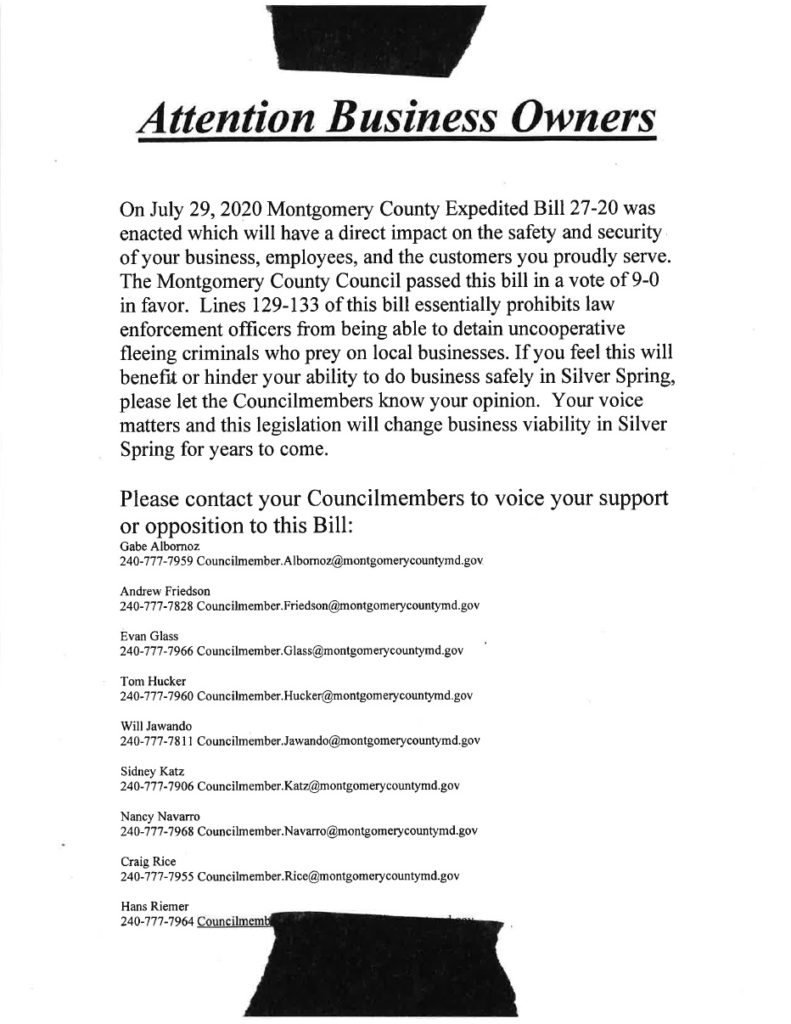
These flyers have been taped to doors of commercial spaces in downtown Silver Spring. Who is distributing them?

The issue here is not whether the police department deserves to be scrutinized. It does, as do police departments around the rest of the country. For example, I have previously written about provisions in the FOP contract that require the county to destroy records and fight public information act requests in court. What needs to happen is a grand, holistic effort by all the major players – police management, the FOP, the counties, Annapolis and interested groups – to work out a package of complementary improvements that makes sense. Instead, the efforts above appear random, uncoordinated and in some cases duplicative. This is not measured, strategic and purposeful reform – it’s a free-for-all. How does this get us to a better place?

Think about how all of this looks to potential police recruits. If you were offered a job with oversight that looked like this, would you take it?

At stake is something that no one is talking about – crime in MoCo is at an historic low. Politicians in most jurisdictions would be jumping up and down to take credit for that, but not in our county. We take low crime rates here for granted. Social justice is important and the experience of people of color in dealing with police needs to be addressed. But if the free-for-all outlined above disrupts MCPD’s operations and crime starts going up again, all of us – regardless of our views on policing – will pay the price.

Share

Jawando Pushes Back on Misleading Nine Districts Video

By Adam Pagnucco.

Council Member Will Jawando, who is shown in a video by Nine Districts for MoCo in alleged support of their position, has denounced the video as intended to “mislead the public.”

The video, for which Nine Districts has taken out a Facebook ad, shows footage of Jawando speaking at a session of the county’s charter review commission in February. The video prefaces his remarks with the statement, “Why Montgomery County needs 9 Districts…” The video then shows him saying the following in an edited clip:

People should elect who represent their values, and to some points earlier, you know, there’s growing upcounty population… I do think the issue of representation is important. You know, I don’t… everyone in the county is not equally heard. Right, big surprise.

Here is what the Nine Districts group is not telling people: not only does Jawando not support their position, he actually argued against it in front of the charter review commission at that very same event. The commission posted a video showing Jawando’s full comments (along with everyone else) and he mentioned Prince George’s County, which had a nine district council for decades and added two at-large seats in 2018:

I’d also add that the Prince George’s County model that was mentioned is not insignificant because they were in that district model for a long time and, again, added two members, went to eleven, added two at-large members because they were having these parochial fights that they couldn’t get anything done and were not as collegial as they wanted to be. And I’ve spoken to a lot of them and they think it’s working pretty well with the at-large members.

And I think you don’t want to give people less representation, you want to have more. Right now, it’s true, you can decide whether you think this is good or not, but every person in the county votes for five members of the council, a majority of the council, and I just think that’s such a significant and powerful point. Now whether they come to your community or not, or they’re representing… I certainly try, you know, when anyone wants me to come, I’ll come, and I don’t know what’s been true in the past, but I think that is a powerful, powerful tool and to lose that, I think it’s not good for the voter.

The commission’s video, starting at the point when Jawando’s full remarks begin, is below.

I asked Jawando for a statement on the Nine Districts video. He said:

It is disappointing but perhaps not surprising that the Nine District campaign is using a partial clip of a longer statement of mine in order to mislead the public. Let me be very clear that I support Question C, which adds two additional district seats while maintaining At-Large Councilmember seats. Voters deserve more representation not less and must be able to have their voices heard by five councilmembers – four at-large and one representative for their district. The Nine District proposal to eliminate at-large seats actually disenfranchises voters by limiting their voice on the council to one elected member.

It’s clear that Jawando opposes nine districts. He argued against the proposal at the same event from which the Nine Districts group uses an edited video clip to allege that he supports them. Jawando also voted in favor of a rival proposal to keep the at-large seats and add two district seats. Nine Districts knows all of this very well. Their video is indeed misleading and should be taken down.

Share

School Board Candidates Need Public Financing

By Adam Pagnucco.

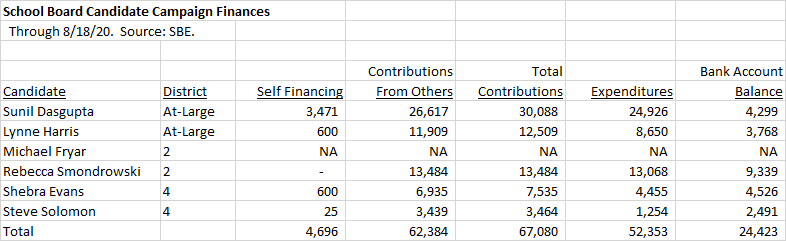
This week, MoCo’s school board candidates reported their campaign finances through August 18. The results for the cycle are below. Here’s a three-word summary: they’re all broke.

Let’s put this in perspective. In 2018, seven candidates for county council at-large raised $200,000 or more to communicate with a Democratic primary electorate which ultimately totaled 134,212 voters. That means they had $1.50 or more per voter.

This year, 272,697 people of all parties voted in the MoCo primary. That was the universe of folks with whom school board candidates had to communicate. But unlike council at-large candidates, school board candidates who win primaries also have competitive general elections. In 2016 (the last presidential year), 483,429 people voted in MoCo’s general election. This year, it will be well over 500,000 voters. If the leading school board fundraiser, at-large candidate Sunil Dasgupta, is able to raise $50,000 this cycle – a very big if! – he would effectively have 6 cents per voter counting both the primary and the general.

It’s basically impossible to run an effective campaign with that little money available for that many voters.

School board races take a back seat to gubernatorial, state legislative and county races in mid-term years, to presidential races in presidential years and to congressional races in all years. The result is that candidates can’t run real races and the outcomes are driven by factors like incumbency, the Apple Ballot and the Washington Post endorsement. Holders of all three of those advantages win MoCo school board races more than 90% of the time. Hardly anyone knows these candidates at election time but the ones who win go on to oversee a $2.8 billion school system.

Public financing has pluses and minuses and we learned a lot about it in 2018. But let’s be clear. Because of the presence of other more attention-getting (and much better funded) races on the ballot, school board candidates will probably never be able to raise adequate money in the traditional system, particularly since all of them (even the district members) are elected at large. Without change, they will continue to be heavily reliant on influential endorsements and even the alphabet(!) to get elected.

And so, if we are going to have public financing for county executive and county council elections, we should definitely have it available for school board.

Share

MoCo Doesn’t Want You to Know What it Pays for COVID Tests

By Adam Pagnucco.

Stories in Bethesda Beat and the Washington Post have confirmed a disturbing aspect of the dispute between Montgomery County and Rockville lab AdvaGenix, with which the county had a contract to provide COVID tests that was later terminated. Specifically, the county’s contract with AdvaGenix prohibits it from disclosing to the public how much it is obligated to pay the company.

Bethesda Beat filed a Maryland Public Information Act (MPIA) request with the county to obtain its contracts with AdvaGenix and Bio-Reference Laboratories, another testing lab. According to Bethesda Beat, the county took 53 days to answer the request despite plainly having the contracts in its possession, a violation of the 30-day requirement in state law. Both contracts had pricing terms redacted.

The images below are from the AdvaGenix contract as posted online by the Washington Post. Note how pricing references are redacted and the parties agreed to keep “all information and matters regarding pricing” confidential.

The county’s public information officer cites provisions in the MPIA preventing disclosure of trade secrets as the reason for redacting pricing data in the contract. He has a point: according to the state’s Attorney General, the MPIA indeed “prevents disclosure of trade secrets, confidential commercial or financial information, and confidential geological or geophysical information, if that information is furnished by or obtained from any person or governmental unit.” However, that doesn’t mean that the county had to agree to specific contract provisions keeping pricing confidential. In fact, the county’s MPIA response database is full of requests for and disclosures of county contract information, including pricing schedules.

A contractor’s pricing schedule for inmate phone calls released in response to an MPIA request.

Pricing secrecy benefits a county contractor in two ways. First, if the company’s pricing is protected from disclosure, that makes it harder for a potential competitor to undercut it in the future. Second, secrecy makes it easier for a contractor to charge higher prices to other customers. For example, if another county knows that the company is charging MoCo X dollars per unit, why would it agree to pay more? This is all very helpful to contractors but not so helpful to taxpayers.

MoCo’s secrecy agreement occurs in a context of widespread variation of COVID test prices. The New York Times reported that COVID test charges in Texas vary from $27 to $2,315 per test. That range is facilitated by the common practice of hospitals and insurers to keep COVID test prices secret, as MoCo does. Last year, President Donald Trump issued an executive order requiring hospitals “to publicly post standard charge information, including charges and information based on negotiated rates and for common or shoppable items and services, in an easy-to-understand, consumer-friendly, and machine-readable format using consensus-based data standards that will meaningfully inform patients’ decision making and allow patients to compare prices across hospitals.” When the American Hospital Association sued to keep prices secret, it lost in U.S. District Court. (It will no doubt appeal.)

Montgomery County Government is actually more anti-transparency in the case of COVID test pricing than Donald Trump. Think about that.

Unlike out-of-pocket costs paid by hospital patients, MoCo’s testing costs don’t directly hit the wallets of those being tested. But they do hit residents’ wallets through their tax bills. On top of that, possible litigation with AdvaGenix looms. The fact that MoCo taxpayers do not know how their tax dollars are being spent is highly problematic. And that is the case because their county government wants it that way.

Share

Is This Going to Work?

By Adam Pagnucco.

In announcing the resignation of Chief Administrative Officer (CAO) Andrew Kleine, County Executive Marc Elrich also announced that budget director Rich Madaleno would be the next CAO. Madaleno, who served one term as delegate and three terms as state senator from District 18 before running for governor two years ago, is a well-known and well-liked figure in MoCo politics. (Disclosure: I was his slate treasurer from 2008 through 2012 and I did work for his gubernatorial campaign.) The replacement of Kleine by Madaleno provoked sighs of relief all over Rockville. But Rich is a 16-year elected official who as recently as two years ago had a handful of staffers and will now be managing a 10,000-person county government.

Is this going to work?

In terms of the skillset necessary to succeed as a politician, Rich Madaleno is one of the very best. He is brainy, unpretentiousness, funny and charming. He disagrees with folks on some issues and happily works with those very same people on other issues. He can balance between warring parties. For example, when he was a state legislator from District 18, he was the hero of anti-Purple Line activists in Chevy Chase while not making himself a target of pro-Purple Line activists in the eastern part of the district. He understands the viewpoints of other politicians and can work out deals. He explains complicated things in simple terms without coming across as condescending. He enjoys great respect in Annapolis and retains a loyal base in District 18. Rich adds to all of this a true facility with numbers that is unusual for anyone (especially a politician). Conversations with Rich can veer between stories of his kids, discussion of his beloved Washington Capitals and comparisons of county reserve policies all in five minutes.

Think about this, folks: super-progressive, LGBTQ Rich was able to build a constructive relationship with good old boy Senate President Mike Miller and get him to allow a vote on gay marriage – which passed over Miller’s no vote. That alone is one of the great political feats of our time.

But the CAO position is a wholly different thing from being an elected official. Consider the backgrounds of those who have held that position since it was created under the current charter in 1970.

William H. Hussmann, 1970-1978 (Under Jim Gleason) and 1990-1994 (Under Neal Potter): City of Rockville planning director for 7 years before his first CAO stint, construction company executive between his CAO tenures and planning board chair after his second CAO stint.

Robert W. Wilson, 1978-1983 (Under Charlie Gilchrist): Had been CAO in Prince George’s County and the county executive in Fairfax County (an appointed managerial position) before working in MoCo.

Lewis T. Roberts, 1983-1990 (Under Charlie Gilchrist and Sid Kramer): Deputy Director of Planning, Assistant CAO for 10 years.

Gene Lynch, 1994-1995 (Under Neal Potter and Doug Duncan): Construction company founder, chief assistant to county executive. He served in multiple positions in Governor Parris Glendening’s administration and was a planning board member after he left the CAO position.

Bruce Romer, 1995-2006 (Under Doug Duncan): City manager in Rockville.

Tim Firestine, 2006-2018 (Under Ike Leggett): Decades of experience in MoCo government, including 15 years as finance director.

Andrew Kleine, 2018-2020 (Under Marc Elrich): City of Baltimore budget director for 10 years.

These seven people share two things: years of experience as senior directors and/or managers before appointment as CAO and no experience as elected officials.

It’s important to understand exactly how complex the county government is. It provides public safety services like police, fire and rescue, 911 and corrections. It runs libraries and recreation centers. It provides social services. It builds and maintains transportation projects. It provides courts, consumer protection and protection from discrimination. It subsidizes housing. It permits development projects. It finances public schools, a community college and parks. It sets a minimum wage. It protects public health. In our case, it even sells liquor. Few if any private organizations engage in such a broad range of activities. The CAO is responsible for all of this on a day-to-day basis.

Now let’s understand exactly what the CAO job is. It’s not being a politician. It’s not being a political advisor, legislative strategist or deal maker. The CAO is the top manager in county government. If a problem happens in a department that exceeds the ability of the department director to deal with it, the CAO must go in and fix it. Some issues are technical. (What happens if an IT project fails and affects multiple functions of county government?) Some issues are ethics related. (What happens if a department director is accused of harassment or improper spending?) Some issues are budgetary. (What should be done about a department that relies too much on overtime and regularly exceeds its budget?) Some issues involve contracting. (Remember the Silver Spring Transit Center?) Some issues are structural. (What happens when multiple departments have competing authority over the same issue and disagree?) Politicians don’t deal with these issues directly. Politicians hire professional managers to deal with them and report back. That’s what the CAO is – the manager of managers.

Here is how Tim Firestine, Ike Leggett’s CAO, described the job.

Ike [Leggett] made it clear from the start that my responsibility would be to run day-to-day operations. We have 21 [department] directors who are appointed. They all reported directly to me. I have three assistant CAOs who help me manage the government. In my day-to-day, we would set up work programs and performance plans for each of the departments. At the end of the year, we would meet with them and go through their performance plans to hold [the department directors] accountable. And then we’d meet with the county executive, based on what they accomplished, to see whether it met what he was looking for.

My style [has been] to hire good people and let them run their departments — unless you’re a department where things aren’t going quite right, and then I’ll bring you in here on a regular basis, and we’ll keep working through it.

When asked about why he was able to last in county government, Firestine replied:

I’ve tried to stay out of the political aspects of it. I’ve never contributed to a campaign; I’ve never worked in a campaign for county executive. And I think being in the subject area I was in—because it’s complicated, it’s complex and people don’t know a lot about it—helps with longevity… The fact that I know a lot about the county finances, more than other people, that’s probably the advantage I’ve had. You combine that with working hard, and helping people get what they want to get as elected officials.

Bruce Romer, Doug Duncan’s CAO, said this to the Washington Post: “There’s no element of the limelight that I care to be involved in. We’re here to keep everything running… I don’t like talking about me.”

Stay out of politics. Stay away from the limelight. I don’t like talking about me. These are sentiments that are as alien to politicians as chastity is to brothel madams.

Can Rich do this job? Maybe, but going from having a handful of subordinates to managing thousands of people in two years is a heavy lift for anyone, even someone as smart as Rich. The big question my sources ask about Rich is whether he has completely shut the door on running for office again. If he has not, that’s going to make being a CAO really complicated. What happens when a tough managerial decision in the best interest of the county offends an influential endorsing organization? Such things never worried Firestine or Romer, who were never going to run for office. What happens if a county council full of people who might like to be executive someday comes to believe that the CAO will be an opponent in a future election? To them, every managerial decision will look like a political decision – and they can be counted on to act accordingly.

There is no room for two politicians in the executive branch. There can only be one.

Rich was probably the best short-term option Elrich had in replacing Kleine, whose ethics-related resignation was unprecedented for a MoCo CAO. There is no question that Rich is a well-intentioned and enormously gifted person with deep roots and lots of respect in the county. The question is whether a longtime politician’s skillset can be adapted to manage a 10,000-person government on a day-to-day basis. In fifty years of charter government, no prior MoCo administration has tried to do this before.

Will it work?

Share

MoCo Board of Elections Certifies Nine Districts for the Ballot

By Adam Pagnucco.

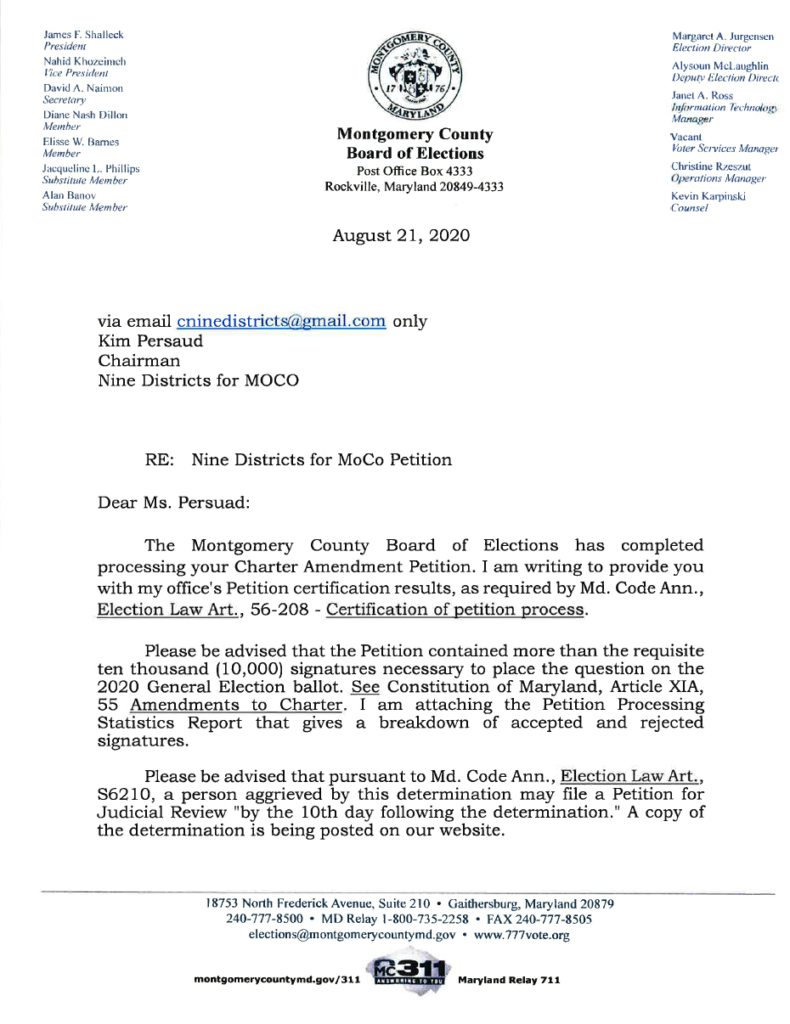
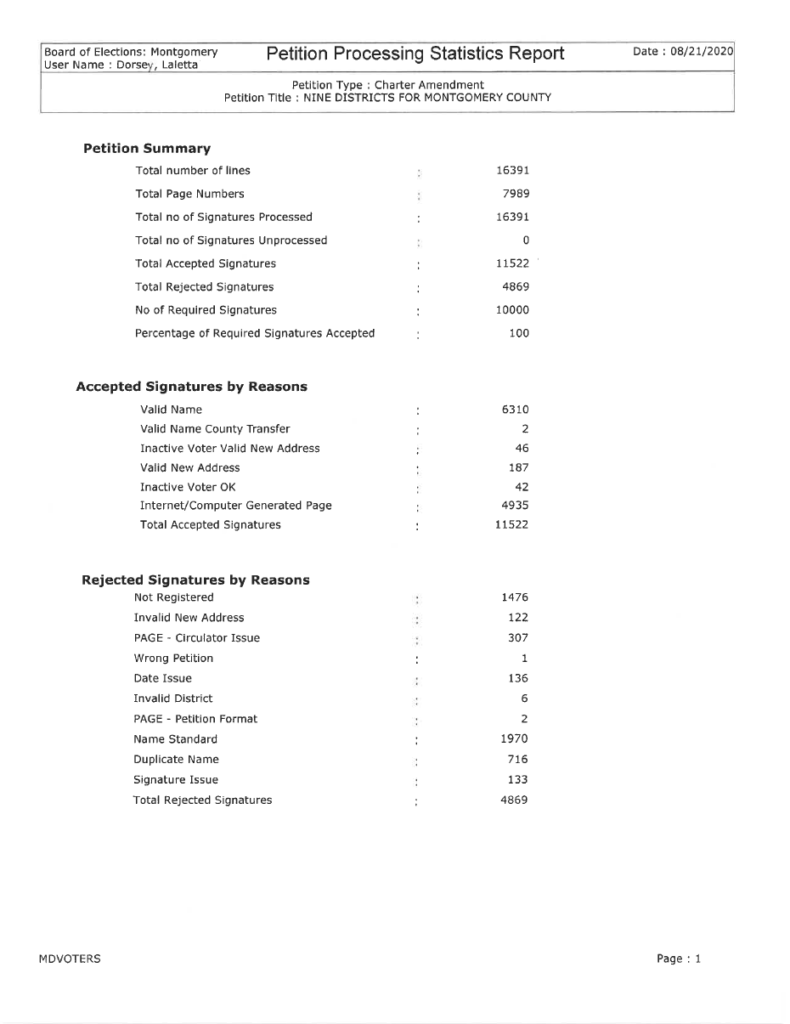
The Montgomery County Board of Elections has certified the Nine Districts for MoCo group’s charter amendment for the ballot. The amendment would convert the county council from its current structure of 4 at-large seats and 5 district seats to 9 district seats, which is the same council structure used by Prince George’s County from 1982 through 2018. The amendment needed 10,000 valid signatures to qualify. The group submitted 16,391 signatures and the board found 11,522 to be valid.

The board’s letter to the group is reprinted below. It contains a tally of the reasons why signatures were accepted and rejected. The home address of the group’s chair is redacted to protect her privacy.

Share

The Voting Wars Come to Maryland

Where Matters Stand Now

Maryland has been in quite a ferment over whether to mail out ballots to everyone as opposed to sending out mail-ballot applications to everyone. Gov. Larry Hogan (R) insisted on the latter and got his way. But Democrats vehemently want the former and mail-ballot applications have yet to hit mailboxes.

Originally, the Governor wanted all polling places to open too but has now bowed to the reality that there are not enough people to staff them and reluctantly allowed the State Board of Elections (SBOE) to combine them into many fewer. Let’s hope the remaining polling places have more voting kiosks than usual, so they can process more people than a standard polling place.

Early voting should continue relatively normally. I’d anticipate high demand not just due to interest in the election but also to concern about mail ballot delivery and voting on election day.

We will also have many more drop off boxes. According to the WaPo, Montgomery County plans to go from two or three to forty this year. Prince George’s plans on adding an additional thirty-six boxes. Sen. Cheryl Kagan, who has been very active on election issues, tells me we should have even more than anticipated. The more, the better.

How Are We Doing on that Shift to Mail Voting?

Not so good. The adjustment to much higher rates of mail voting has been far from glitch free. Some of our ballots for the all-mail primary got sent to South Carolina. Those of us who applied for mail ballots did not receive them initially even though people who had not requested them had.

In general, ballots arrived later than they should’ve with delays especially long in some areas of the state. It’s a good thing we opened up polling places, after a lawsuit, but the lines were too long and the state should have known they were required without being sued.

We don’t seem off to a roaring start for the general in which mail voting is heavily encouraged but not every voter will be sent a ballot. Again, the state has failed so far to send mail ballot applications. The Governor can blame the State Board of Elections but surely should have some responsibility for making sure that they can implement a plan before mandating it.

Will It Matter?

The switch from away from all-mail might depress turnout as voters won’t have the ballot sent directly to their home unless they request it. The State Board of Elections has very belatedly made the online application less intimidating. Speaker Adrienne Jones was quite right to highlight that issue.

At the same time, polling places will be open both for early voting and election day voting, so the overall impact of the switch is hard to assess. The chances for any impact on contests seems low because there just aren’t a lot of hot races.

Compared to many other states, we’re not voting for much in Maryland this year. No state legislative elections and few local elections. We don’t even have a U.S. Senate race. I can call the winners of Maryland’s ten presidential electors and eight congressional races now.

The few partisan local races don’t look very exciting. My knowledge of Baltimore City and Cecil County politics is relatively slim. But I do know that Democrats are usually a lock in Baltimore and Republicans the same in Cecil. I’m afraid I can’t speak to the contest for a seat on the Wicomico County Council.

I suppose the change in voting might have an impact if some of the nonpartisan school board and judicial races turn out very close. Judicial contests operate below the radar for most people. Several challengers, however, upset incumbents in the primary, so these contests are more heated than usual. Still, while I’m sure the cognoscenti are interested, Maryland’s judicial races lack the partisan juice of Wisconsin.

If the switch away from all-mail depresses turnout, the main concern might be that it somewhat lightens the weight of Maryland’s contribution to Joe Biden’s national vote margin. That’s of more interest than usual since Donald Trump seems intent on doing his tinpot dictator impression by casting doubt on any ballots that are not cast for him.

On the other hand, if more people vote in person out of concern over the mail, it will also lead to fewer invalidated votes. Unlike at polling places, mail-ballot voters who make a mistake, such as failing to sign the ballot oath, have no chance to correct their errors and the ballot gets tossed.

Problems with Both Mail and All-Mail Voting

We don’t have signature checks in Maryland to make sure that the person who voted and mailed the ballot was the voter. In fact, they are illegal under Maryland law. As a result, even if we shifted to all mail, we could not implement them in the manner of every state that normally does all-mail voting (and California) unless the General Assembly changed the law. Interestingly, this seems to have eluded both sides in the debate over the Governor’s election plan.

This hasn’t been much of an issue in the past as Maryland usually has a lot of early voters but comparatively few mail voters.

We have the signatures on file, so we could do signature checks if the General Assembly changed the law. Some argue against them as unnecessary because there are few problematic ballots in states with checks. But this type of fraud seems a lot less likely when people are checking up on it. Absentee ballot manipulation is exactly how Republicans attempted to steal a 2018 North Carolina congressional election. (In person fraud is different and extremely rare notwithstanding vehement Republican partisan demands for voter ID to solve a non-problem.)

If you have signature checks, you also must find a way to give voters a chance to cure (i.e. validate) any questionable ballots to avoid disfranchising voters. This isn’t always easy and needs improvement. But it’s vital because checking signatures is not an exact science and we want to protect against disfranchisement.

Precinct Reporting

In Maryland during the all-mail primary, the Board of Elections did not attribute ballots cast by mail back to the precinct. The ballots didn’t have codes on them that made that easy. Local county boards can still do if they’re willing. Many won’t because it’s a lot of work but I was pleased to learn that the Montgomery County Board of Elections is going to do it.

For the general, the SBOE tells me that the ballots will have precinct codes, but the proof is in the pudding. Precinct results are very nice to have not just for political researchers and junkies like me but because they are a critical tool in detecting fraud or other problems.

Two Bright Spots

During the primary, the State allowed jurisdictions to count mail-in ballots when they were received but not to release the vote totals until after the polls closed on election day. This allowed for faster reporting of initial results. The same is planned for the general election.

The Governor’s election plan to encourage mail voting by sending ballot applications but not mailing ballots is much more expensive and places real burdens on county boards to process applications. Originally, the Governor and SBOE wanted counties to foot one-half of the bill for the postage paid return envelope. Thanks to efforts by Sen. Kagan along with the Maryland Association of Counties (MACO) and Montgomery County, SBOE has now agreed to cover the substantial cost of this unfunded mandate.

Final Note: Stop Playing Trump’s Game

As Law Professor Richard Pildes explained, disagreement between Donald Trump and Democrats over mail and all-mail voting has no point. Excepting Nevada, the only states using all-mail voting are the same ones that always use it. Democrats would be better served by emphasizing that all the swing states are using absentee voting (the same as mail voting in Maryland), which Trump has declared okele-dokele. Use his own argument against him to fight very doubt he’s manufacturing. In other words, don’t have an argument to no purpose that benefits him instead of Democrats even if he’s wrong.

The post office, however, bears watching. I can’t regard the lack of mail service at my home yesterday as an encouraging sign. The claims that all is well are belied by Trump’s blunt statements that he doesn’t want funding for USPS because it would aid in mail voting, which he sees as bad for him. Dismantling sorting machines also seems unlikely to increase postal efficiency. It’s also a terrible issue for Republicans.

Share

Why Republicans Want Nine Districts, Part Two

By Adam Pagnucco.

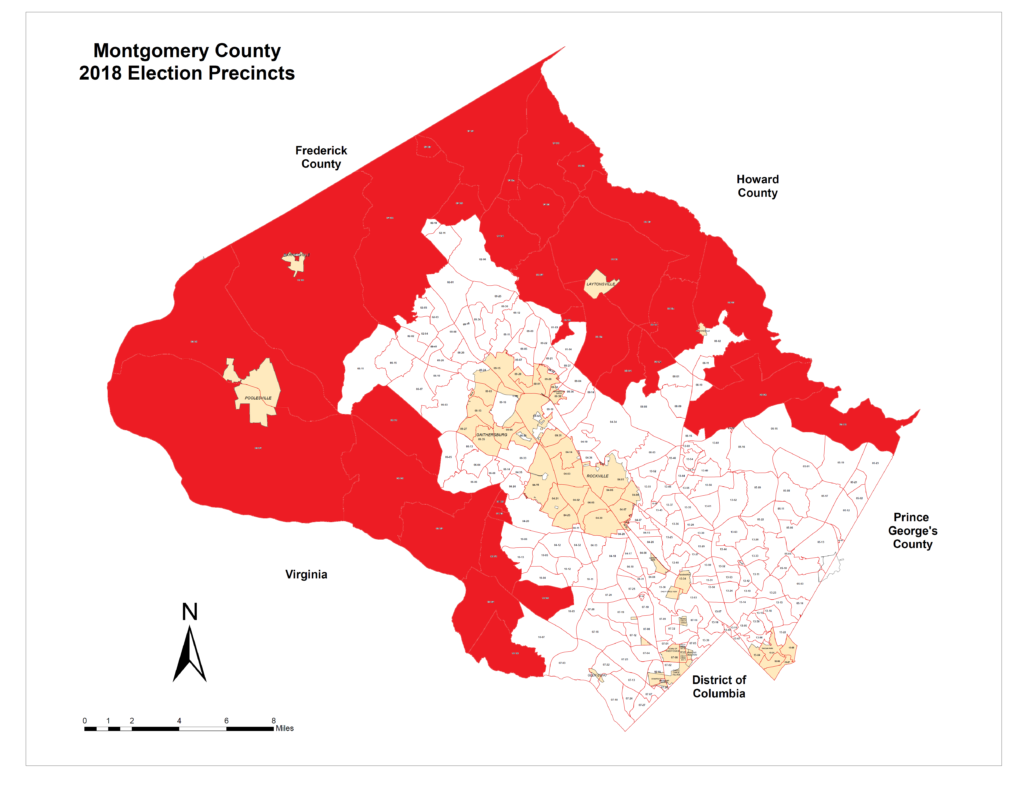
In Part One, I explained the primary reason why the county’s Republican Party leadership supports Nine Districts, even going so far as to use the party’s official website to raise money for the group. The Republicans believe that having nine county council districts instead of five could produce one (or more) districts in which Republicans could compete. Using 2018 general election data, I built a 32-precinct district that accounts for one-ninth of the county’s registered voters and maximized Republican electoral participation while minimizing Democratic participation. (I used registered voters as an admittedly imperfect proxy for population.) Here is what my so-called Red District looks like on a precinct map.

The Red District has the strongest presence of Republicans and the weakest presence of Democrats of any contiguous district I can construct. But could it actually elect a Republican to the county council? Let’s find out.

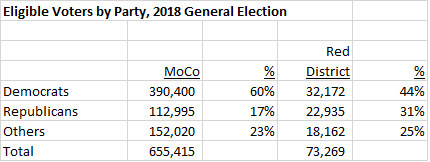
First, let’s compare the eligible voters by party as of the 2018 general election between the county as a whole and the Red District.

In the county as a whole, Democrats had a 43-point advantage over Republicans in eligible voters. In the Red District, the Democratic advantage shrank to 13 points. Democrats still held a plurality in the Red District, but with 44% of eligible voters, they were not a majority.

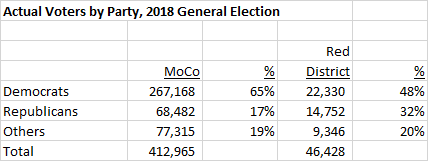
Now let’s look at actual voters.

Among actual voters, Democrats had a 48-point advantage over Republicans countywide. (2018 was a year in which Democrats were highly motivated to vote by the current occupant of the White House.) But in the Red District, the Democratic advantage shrank to 16 points. Once again, Democrats were a plurality but not a majority of Red District voters.

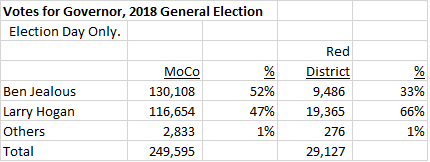
The table below shows the performance of the two major-party gubernatorial candidates, Democrat Ben Jealous and Republican Larry Hogan, in the county as a whole and in the Red District. Only election day votes are shown because precinct data does not include other voting modes.

Jealous won the election day vote countywide by 5 points. (Counting all voting modes, Jealous won MoCo by 11 points.) But in the Red District, Hogan blew out Jealous by 33 points on election day. Clearly, the Red District is VERY different from the rest of the county in its preference for governor.

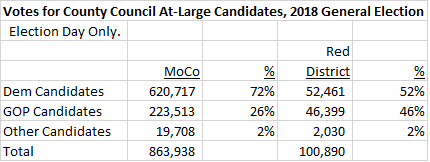
But Hogan is an unusual Republican whose popularity extends well into the Democratic voting base. Judging a propensity to favor the GOP by looking at Hogan’s vote tallies alone is problematic. And so, as a proxy for hypothetical support for a generic Republican, I calculated the combined votes for the Democratic council at-large candidates (Gabe Albornoz, Evan Glass, Will Jawando and Hans Riemer) and the Republican council at-large candidates (Robert Dyer, Chris Fiotes, Penny Musser and Shelly Skolnick) for both the county as a whole and the Red District. Those results are shown in the table below.

In the county as a whole, the Democratic council at-large candidates totally blew out the Republicans by 72-26%. That’s why the Republican leadership hates the at-large seats as much as they do – Democrats can roll up their vote totals in Silver Spring, Takoma Park, Chevy Chase, Bethesda and Kensington and Republicans can’t pick up enough votes elsewhere to win. But in the Red District, the Democratic council at-large candidates only had a 6-point edge. Compared to the rest of the county, that’s a narrow margin.

Let’s remember that 2018 saw massive Democratic turnout in reaction to the individual in the Oval Office. That makes it an unusual year. Given that fact, the above data suggests that in a more normal year, a strong Republican council candidate could defeat a weak Democrat in the Red District. That’s the dream of MoCo Republicans. And that’s why they support Nine Districts.

Now, would something like the Red District actually be created in a nine district system? That’s hard to know. Redistricting is nominally within the purview of a commission appointed by the council every ten years, but the council can substitute its own map if they wish. That means if Nine Districts passes, council Democrats will effectively design the districts directly or indirectly. They could scatter rural Republicans around two or three districts (perhaps one based in Potomac, another based in Clarksburg and maybe a third based in Damascus). Doing that would create two or three competitive general elections. Or they could do what state-level Democrats did in designing the current congressional districts, which was to pack Republicans in one district (Congressman Andy Harris’s District 1). If they elected to go that route, they would design something very close to my Red District.

One thing is for sure: the Republican Party would be jumping up and down to get a chance to compete. They don’t have that in the current system. But they might have it if voters approve nine districts.

Share

Nine Districts Appears Headed to the Ballot

By Adam Pagnucco.

Multiple sources confirm that Kevin Karpinski, counsel to the Montgomery County Board of Elections, told the board yesterday that the charter amendment petition to convert the Montgomery County Council to a nine district configuration has received enough valid signatures to qualify for the ballot. The threshold is 10,000 signatures or 20% of the registered voters of the county. Nine Districts for MoCo submitted 16,448 signatures on August 3.

Margaret Jurgensen, the county’s election director, told me, “Mr. Karpinski did confirm that it appears that the Petition has succeeded garnering the number of valid petitions.”

The board still needs to complete its verification process and release a formal determination, which should occur later in the week. Once it does so, the county attorney must draft language for the ballot. At that point, only one thing could stop the question from appearing on the ballot: litigation, which has happened before. In 2016, a group opposing Robin Ficker’s term limits petition tried to get it thrown out in court over signature issues but was unsuccessful. I have heard of no such entity willing to challenge Nine Districts’ signatures.

That means Nine Districts could be officially headed to the ballot within days.

Share

MoCo Terminates AdvaGenix COVID Testing Contract

By Adam Pagnucco.

Montgomery County Government has announced that it is terminating its contract with AdvaGenix, a Rockville lab, to provide COVID-19 testing. When the county signed the contract in May, County Executive Marc Elrich called it “a game changer” and the company was expected to provide up to one million tests over the course of a year. Instead, the county has stated that about 19,000 tests were provided under the contract and has advised residents and county employees who received them to get retested.

The company is pushing back hard. Its founder, Dr. William Kearns, told WJLA-7, “We are being slandered… I think there’s a lot more going on here than meets the eye.” Kearns further said, “Our tests are very accurate… Saying anything otherwise is nonsense.”

AdvaGenix was a major player in the county government’s testing program, although the private sector has supplied many more tests than the county. It’s unclear what the county’s plan to resume ongoing testing will look like going forward. There are also MANY more questions to be asked about this and, so far, few answers.

The county’s press release appears below.

*****

Montgomery County Announces Termination of AdvaGenix Contract
For Immediate Release: Tuesday, Aug. 18, 2020

Montgomery County announced today that it has terminated its contract with AdvaGenix, the Rockville-based company that had been providing and processing tests for the County Government’s free COVID-19 test clinics. This action was taken following the cease and desist directive and order issued by the Maryland Department of Health on Aug. 14, 2020, prohibiting AdvaGenix from processing COVID-19 tests.

In response to the State’s announcement last week, the County has been working to restore its testing capacity and reopen testing sites. The Maryland Department of Health has committed to replace the weekly supply of tests for the next four weeks. County officials are working to identify additional test sources to support the County Government’s effort to offer broadly available free tests.

On Thursday, Aug. 13, the County announced it was temporarily suspending tests at County-sponsored clinics. Testing at these clinics was designed primarily to serve asymptomatic individuals. The County continues to provide testing to symptomatic individuals using existing partnerships with other labs. Since the beginning of the COVID-19 pandemic, more than 265,000 COVID-19 tests have been administered to County residents. Tests provided by AdvaGenix were approximately 8 percent of these tests.

Share

Maryland Politics Watch