JOF, Progressives Take on Ficker

By Adam Pagnucco.

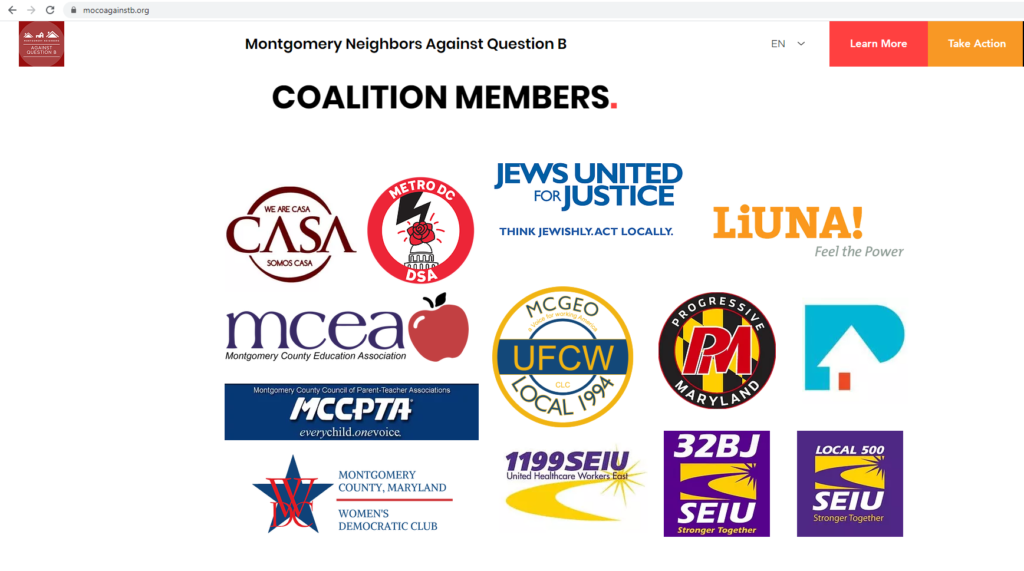
Former school board member Jill Ortman-Fouse is co-chairing a new group opposing Question B, Robin Ficker’s charter amendment on property taxes, along with former Jamie Raskin staffer William Roberts. The group has attracted a large number of progressive institutional supporters as shown from its website below.

Right out of the gate, MoCo Against B has released this video going after the architect of Question B, Robin Ficker himself.

MoCo Against B’s press release appears below.


FOR IMMEDIATE RELEASE
Contact: Daniel Koroma
info@mocoagainstb.org

SCATHING NEW AD LAUNCHED AGAINST QUESTION B

New coalition of concerned citizens, voters, religious organizations, area non-profits and unions drops tough new ad opposing Robin Ficker’s Question B on Montgomery County ballots.

MONTGOMERY COUNTY, September 23, 2020 — Montgomery County residents today saw the first political advertisement on the contentious “Question B” that will be appearing on their ballots this election. The ad, called “Dangerous”, takes aim at the ballot question, which according to the clip, would hinder the County’s COVID response, cause slashes to schools and essential services, and threaten Montgomery County’s AAA bond rating.

The coalition behind the new ad is called Montgomery Neighbors Against Question B and is made up of concerned citizens, faith groups, teachers, firefighters, unions, and local non-profits. Montgomery Neighbors Against Question B is co-chaired by former Board of Education member Jill Ortman-Fouse and current Chair of the Upcounty Citizens Advisory Board, William Roberts. Their treasurer, Daniel Koroma, is a White Oak community advocate and serves as the Business Liaison for the Montgomery County Government. The group aims to defeat Question B by shining a spotlight on its own plain language, its disastrous outcomes, and the intentions of its creator.

“With this new ad, we want to show Montgomery County voters exactly what Question B says and just how damaging it would be to our schools, our essential services, and our economy,” said Laura Wallace with Jews United for Justice, one of the many organizations in the coalition. “Jewish tradition teaches that each of us has a duty to ensure that everyone in our community has the resources they need to thrive — especially during this pandemic. Now is not the time for fiscal irresponsibility.”

Question B is the brainchild of notorious heckler and right-wing operative Robin Ficker. If it were to pass, it would limit the County’s ability to generate revenue by limiting it to the previous year’s revenues, adjusted for inflation. It would strip the Council of its override power and could strangle local schools, emergency services, and other essential services.

“Question B is bad for communities of color. Black and Brown communities were already facing gaps in education, employment and small business support services before the COVID-19 pandemic. If Question B passes, our communities, already facing the devastation of COVID-19, would face the brunt of the negative impact of Question B” said Daniel Koroma.

Following the launch of this ad, Neighbors Against B will be working until polls close to educate voters on the fiscally irresponsible nature of Question B and encouraging them to oppose it with their vote.

#

For additional information, please contact Daniel Koroma at info@mocoagainstb.org.

Share

Balcombe Co-Chairs New Group Opposing Nine Districts

By Adam Pagnucco.

Marilyn Balcombe, a Germantown resident who ran a strong fifth in the 2018 Democratic Party council at-large primary, is co-chairing a new group opposing the Nine Districts charter amendment (Question D). Balcombe has previously written a guest blog for Seventh State making the case for Upcounty to increase its voter turnout as a way to gain influence in county politics. The press release from Balcombe’s new group is reprinted below.


NEWS RELEASE
For Immediate Release
September 23, 2020

Press Contacts:
Marilyn Balcombe, marilyn@marilynbalcombe.com (Co-chair)
Michelle Graham, michelle@grahamstrategies.com (Co-chair)

Residents for More Representation

County Leaders Form Ballot Committee to Oppose Nine Districts

MONTGOMERY COUNTY, MD — A broad coalition of grassroots, labor and business leaders from across Montgomery County today announced the formation of Residents for More Representation to support the expansion of the County Council to 11 members and oppose the creation of nine separate districts.

Upcounty leader Marilyn Balcombe of Germantown and East County leader Michelle Graham of Olney will co-chair the effort in support of Montgomery County Ballot Question C, which would expand the number of council districts from five to seven, while retaining the four at-large seats. Residents for More Representation will also actively oppose Ballot Question D, which would eliminate the four at-large seats and replace them with four individual districts.

“As a resident of Germantown, I know that residents of Montgomery County need more representation, not less,” said Marilyn Balcombe. “The county’s population has increased by 50% over the last 30 years, which is why we need to expand and modernize our council structure so that it better reflects our incredible growth and brings local government closer to our residents. Question C is the best approach to achieve a shared goal by many in our community. Adding two additional districts will help increase the level of constituent service and protect the important role of our at-large councilmembers.”

“We live in an incredibly diverse county of 1.1 million residents and the at-large councilmembers play an important role in reflecting that diversity,” said Michelle Graham. “The current council is the most culturally diverse council in our history, with two Black, two Latino and one LGBTQ councilmember, three of whom are at-large. Adding two more councilmembers will increase the number of voices and help increase the diversity of views represented on the council.”

Montgomery County voters will vote on six ballot measures in this election. Questions C and D would both restructure the County Council from the current configuration of electing five by districts and four at-large. Question C would create two new district seats, while maintaining the four at-large seats. Question D would eliminate the four at-large seats and create nine separate geographic districts. Changing the council structure to nine separate districts would result in reducing each resident’s representation on the council from five to one.

Residents for More Representation is a registered ballot committee formed to support expanded representation and more geographic and cultural diversity on the County Council.

Marilyn Balcombe is the current President/CEO of the Gaithersburg-Germantown Chamber of Commerce and has been actively engaged in the County for over 26 years. As a former At-Large candidate for the Montgomery County Council and as an Upcounty resident, Balcombe has a strong understanding of the needs in her community and the importance of expanding representation.

Michelle Graham grew up in Montgomery County where she has resided for more than 40 years. An active member of a grassroots organization formed, in part, to educate and raise the level of civic engagement, particularly among communities of color, she is dedicated to ensuring that citizens, especially underrepresented groups, are informed about local issues and the potential impact to their lives and community.

Share

Smart Growth or Corporate Welfare? Part Two

By Adam Pagnucco.

In making the case for Bill 29-20, which would grant developers at Metro stations 15-year property tax breaks, supporters claim that Metro high-rise development is not currently happening. And they say that’s the case for the entire region.

Is it true?

WMATA had a spate of development projects at Metro stations from 2002 through 2007, when the region’s real estate market was hot. There are much fewer proposals in the works now. They include:

Grosvenor-Strathmore, Montgomery
WMATA selected Fivesquares Development as its ground lease development partner at the Grosvenor-Strathmore station. In 2018, the Montgomery County Planning Board approved a sketch plan for 1.9 million square feet of mixed use development at the site. The original plan was supposed to include seven buildings, two of which would be 300 feet tall and another 220 feet tall. However, Fivesquares subsequently claimed that it needed tax breaks to finance the high rises, thus giving rise to Bill 29-20. Fivesquares wrote the following in its testimony about the bill:

Simply put, but for this legislation, Montgomery County’s goals to promote high density growth at transit accessible locations and, specifically, to implement the Grosvenor-Strathmore Minor Master Plan Amendment that the Montgomery County Council and Montgomery County Planning Board unanimously approved in 2017, would not be feasible due to the prohibitive economics of building high-rise projects. There is a significant gap in building high rise projects due to the gap between costs and revenue and the unique infrastructure requirements of Metro sites.

In the absence of this legislation, instead of the potential at the WMAT A property at the Grosvenor Strathmore Metro station for over 2,100 units, including over 350 Moderately Priced Dwelling Units (MPDUs), the only feasible development would be lower density, stick-built housing that would dramatically underutilize the site, resulting in less than half the number of total housing units and MPDUs.

New Carrollton, Prince George’s
WMATA plans to replace the parking on the station’s south side with hundreds of thousands of square feet of office, retail and multi-family space. At full build-out, the site could have a dozen buildings ranging in size from five to fifteen stories. Construction of a new garage is also planned for the station’s east side. Along with Grosvenor-Strathmore, this is easily the most aggressive of WMATA’s current development plans.

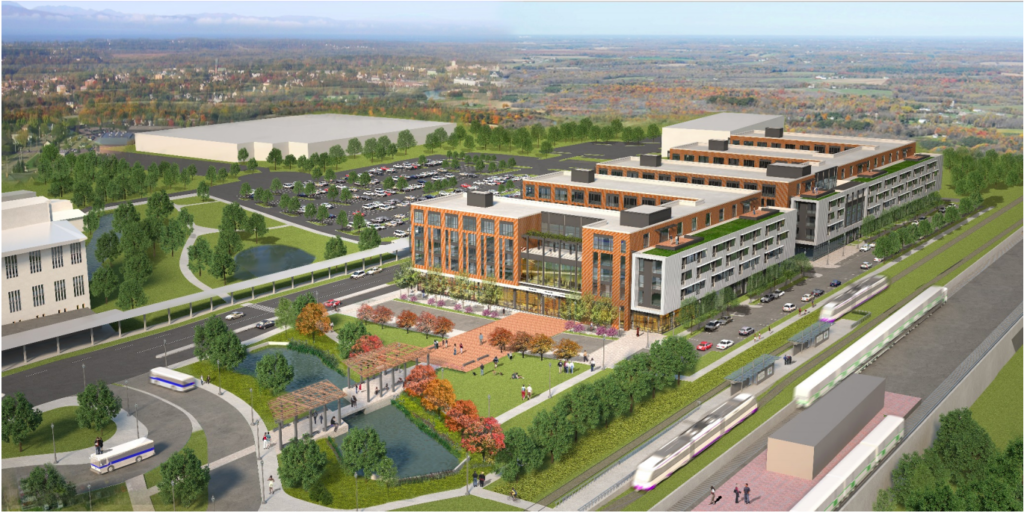
A rendering of development on the south side. Credit: WMATA.

College Park, Prince George’s
WMATA is planning a 5-story project at this station with more than 400 housing units.

A rendering of development at College Park. Credit: WMATA.

Capitol Heights, Prince George’s
WMATA would like to place a 6-story residential building with ground retail at its Capitol Heights station parking lot. This project was terminated in 2018 but WMATA staff asked for a new solicitation last year. KLNB is advertising the project’s retail component.

Deanwood, D.C.
In 2018, the WMATA board approved a joint development project to replace its Deanwood station parking lot with a mix of residential and retail and a garage. The project is not high-rise; rather, it envisions four-story buildings.

That’s about it. The project in D.C.’s Takoma neighborhood looks stalled as does the Greenbelt site in Prince George’s, which was once considered for the FBI. Amazon’s arrival in Northern Virginia could eventually stimulate development at Metro stations there but that seems quite a ways off.

Other than the Grosvenor-Strathmore site (which led to Bill 29-20) and New Carrollton (which might not have been viable without the relocation of the state’s housing agency), none of these projects has a high-rise component. That’s not an accident. Developers at Metro station sites have to deal with replacing existing parking (either with a garage or underground), station access issues, bus circulation issues and even possible amenities like park space. There is also WMATA’s time-consuming approval process on top of any local planning approvals. Developers of private sites don’t have to deal with these problems. Combine the construction costs of high rise as opposed to wood frame with the extra costs of building at WMATA sites and the economics of such projects get difficult, even with high rents and condo prices.

DC Urban Turf, a website that tracks residential development, lists hundreds of new residential projects that have been delivered, are under construction or are planned in the area. Many of them are high rises. High rises are being built in the region. They are just not being built, for the most part, on Metro stations.

So if high rise construction at Metro stations requires huge tax breaks to work, are the bill’s supporters right? Should Fivesquares and other developers get 15-year property tax exemptions? There are lots of other considerations to be discussed. Let’s do that in Part Three.

Share

Craig Rice: Follow the Rules to Open the Schools

By Adam Pagnucco.

In one of his patented straight talk moments, Council Member Craig Rice has implored residents to wear masks and heed social distancing requirements if they want schools to open for in-person instruction. Rice said today, “If we cannot control community spread, if we can’t get folks to do what they need to do, we are not going to open back our schools. So let me just be very clear. By folks refusing to do the things that we know are going to lower community spread and keep the community safe, it then in turn forces us to keep our schools closed.”

Amen, Council Member. Video of Rice’s remarks appears below.

Share

Jawando Fundraises Off Republican Attack

By Adam Pagnucco.

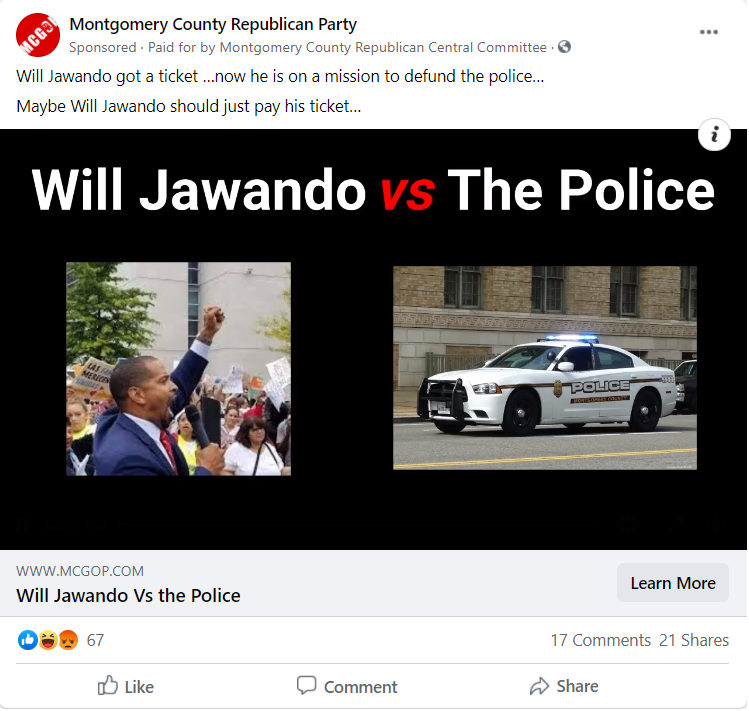
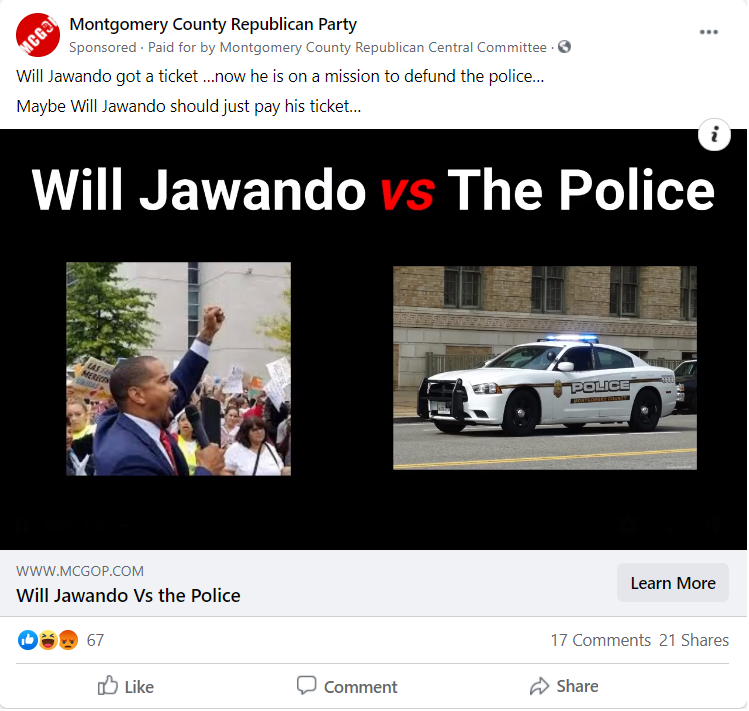
Council Member Will Jawando is raising money off an attack by the Montgomery County Republican Party on his work on police reform. He even borrowed our graphic of their Facebook ad without credit to Seventh State. (Pretty cheeky, Will!) Congratulations, Republicans – you just helped your least favorite council member raise some money. Jawando’s fundraising email appears below.


From: Will Jawando info@willjawando.com
Date: Mon, Sep 21, 2020
Subject: Maryland GOP Attacks, I need your help!

I need your help to fight back against GOP Attacks!

Dear ,

I’m writing to ask for your help.

The Maryland GOP is working overtime to incite President Trump’s right-wing base on Election Day — and they are using both my race and my efforts to reimagine public safety in our state’s largest jurisdiction as provocation.

Some of you know of the violent threats made on social media against me and my family. One Facebook post from a right-wing activist read: “God forbid you would be shot in the head while sitting in your car. One can only dream” and then, “We back blue.” This on the heels of an false advertisement published by the Republican Party to go after my efforts to reform policing.

This is just one example of how the GOP is targeting me — literally. They are doing that because I’ve succeeded in passing important police reform legislation in Montgomery County, and because targeting me right now helps them activate their base for the presidential election.

To be clear, I support the officers who put their lives on the line everyday. That is why I voted for their contract with the County, and why I believe they should not be on the front line for mental health crisis’ or student behavior in schools. We can honor the men and women who put on a uniform everyday while reimagining public safety and making changes when confronted with data showing disparities in policing.

Can you please make a donation today? We need allies like you if we are to stem this rising tide of racist hate. Your support will help us activate our own progressive base, and just as important, persuade undecided voters to stand up to the hate we see pouring out of the right wing.

I’m asking you for help because you have stood with me in the past. We are at a critical junction. To defeat our opponents, we must start in our local communities and our states — we must start at home. Please join me in this fight. Give today and take a stand against hate. Thank you.

Help me fight back against GOP Attacks!

Sincerely,

Will Jawando

Paid for by Will Jawando

Will Jawando
P.O. Box 10598
Silver Spring, MD 20914
United States

Share

Smart Growth or Corporate Welfare? Part One

By Adam Pagnucco.

For many years, MoCo has focused its land use and economic development policies on transit-oriented development. Since 2006, the county has adopted eight master plans centered on Metro stations, another four centered on Purple Line stations and one more centered on Corridor Cities Transitway stations. Another plan is in the works for Downtown Silver Spring.

The capstone for the Metro-based plans is development on top of the Metro stations themselves, which requires joint development agreements with WMATA. Placing the highest density on Metro stations, along with nearby parcels, enables the county to balance growth, transportation and environmental priorities in its march towards the future. For fifteen years, that’s what we have been told.

Now we are told that this approach won’t work without taxpayer subsidies.

The problem is that most, if not all, development on top of Metro stations is not proceeding. And that is because of economics. In order to be economically viable, Metro development projects must charge rents or condo prices sufficient to not only cover construction costs, financing and investor returns but also the unique costs associated with Metro station sites. The economics are particularly difficult with high rise projects, which have higher material and construction costs than wood-frame projects. And so the county council has proposed Bill 29-20, which would eliminate property taxes on Metro station development projects for 15 years and replace them with undefined payments in lieu of taxes to be set later.

In justifying the bill’s purpose, consider these remarks by Council Members Hans Riemer and Andrew Friedson, the lead sponsors of the bill, and Planning Board Chairman Casey Anderson at the council’s first work session.


Riemer
I want to say that this is a smart growth proposal. This is about making development feasible where decades of inactivity has demonstrated it is not feasible. If you look at Montgomery County and our Metro stations, you will almost universally see empty space on top of the Metro stations and despite efforts by WMATA over many years to support development at those stations, to solicit development on their property, there is very little that has happened. And there is very little that has happened recently, in the last ten years or so. Very little high rise, especially, and because of a shift in the market, I think which is driven by regional economic shifts and global economic shifts that have made the cost of high rise construction prohibitive except in the most high rent communities…

I think very broadly speaking, we have sought to channel all of our development, almost all of it, through a smart growth framework. We want to get housing that is high rise. We want to discourage sprawl. But the problem is we have not – the market isn’t producing the high rise that we have zoned for, that we want. And so the end result is we’re not getting much development. We’re not getting very much housing. We’re not even getting much commercial development.

Friedson
The idea that we’re forgoing revenue and that has a direct cost, that we’re leaving money on the table, we’re not leaving money on the table – the table doesn’t exist currently. That is the issue. There is no development, there is no investment. At best, the table is going somewhere else. It’s been shipped to another region of the country. It’s been shipped to another county. The whole point here is to create the opportunity. You know, the idea that we would be serious about transit-oriented development, that we would be serious about meeting our significant housing targets to address the housing crisis that we currently face but wouldn’t be willing to do anything about it is troubling. And we need a game changer. We need something to change the economic development path that we’re on, we need something to change the housing path that we’re on, that currently does not work. And I will say our housing situation, that is our version of a wall in Montgomery County. What we do with housing is a decision that we make on whether or not we want new residents here or not. That’s the local government version of whether we put up a literal or proverbial wall to say who can and who can’t live here, who we want and who we don’t want here.

Anderson
Will the development happen anyway? And I think the market is not just speaking, it’s screaming that the answer is no. Because you don’t have to take any particular real estate developer’s word for it, you can see what’s happening in the real world. It’s not just in Montgomery County, you can look at what market rents are at every Metro station in the region and you’ll see that there’s a few, particularly in Northern Virginia and in Bethesda, where rents can justify new high-rise construction there. Everywhere else, the answer is no, and that’s not just true of Grosvenor, or for that matter Forest Glen, as you mentioned, it’s also true of White Flint.


In considering these remarks, let’s remember who is saying them. It’s not County Executive Marc Elrich, who voted against numerous transit-oriented development master plans when he was on the council. It’s Casey Anderson, who has served on the Planning Board for nine years and chaired it for six; Hans Riemer, who has served on the council for ten years and is the current chair of its planning committee; and Andrew Friedson, who has emerged as the council’s principal champion of economic development during his first term in office. These are not development critics as Elrich has been. Anderson in particular, and Riemer to a lesser extent, are two of the architects of the county’s Metro-oriented land use policy and they are saying that it has failed.

They are also saying that the only way to rescue it is through what may ultimately become the biggest application of corporate tax breaks in the county’s history.

Are they right? We’ll discuss it in Part Two.

Share

Nine Districts Blasts Council on South Lake Elementary School

By Adam Pagnucco.

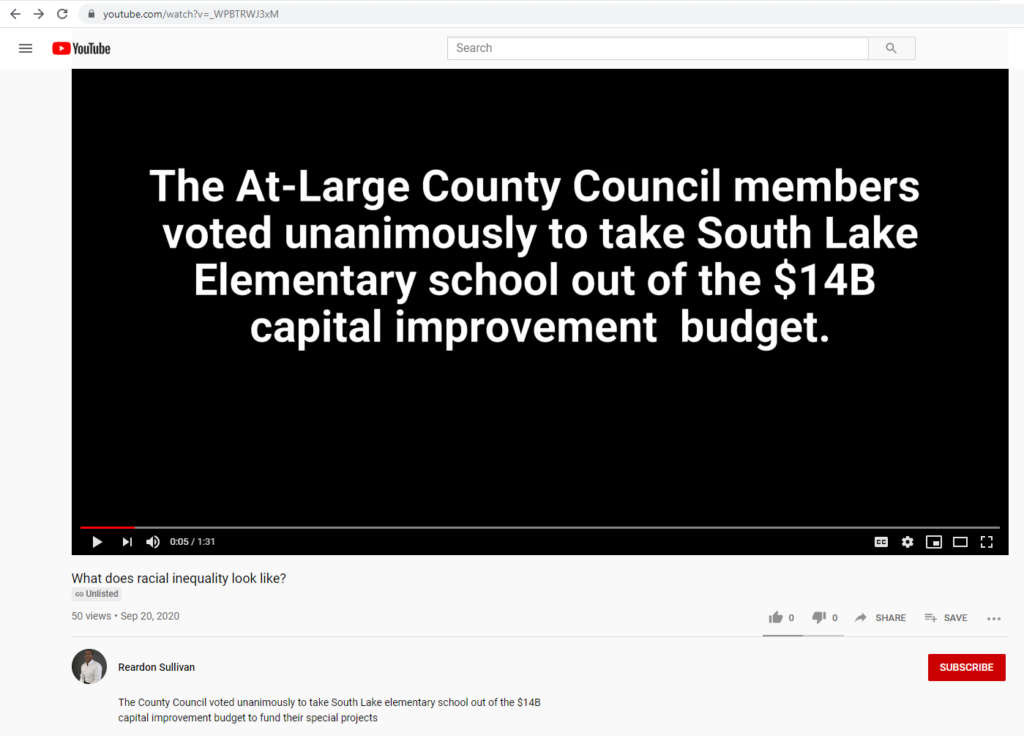
Nine Districts for MoCo, the group that put a charter amendment on the ballot converting the county council to a nine district structure, has released a video blasting the council for its decision to delay completion of a new building for South Lake Elementary School. The school, located in Gaithersburg, was the subject of a WTOP article describing heat and air conditioning problems, crowding and rodents running free inside the building. Community members have asked for a new school for years and MCPS has described the building’s problems as “insurmountable.” MCPS requested funding for a new building, which the council approved, but the council delayed completion by one year to September 2024 due to fiscal problems. The school board has since asked the council to restore the project’s original schedule but that won’t happen unless money can be found.

The video accurately notes that the school’s student body is overwhelmingly black and brown. However, its claim that the at-large council members “voted unanimously to take South Lake Elementary school out of the $14B capital improvement budget” is inaccurate. The council voted to delay the project, not delete it. It remains in the capital budget with a projected cost of $34.9 million. This is not the first time Nine Districts for MoCo has released a misleading video.

This claim is inaccurate.

The video was posted on YouTube by Reardon Sullivan, a member of the county Republican Party’s central committee. Republicans support the nine district group because they believe such a structure might lead to a Republican county council seat.

The video appears below.

Share

Poll Out on Ballot Questions

By Adam Pagnucco.

A poll is in the field on MoCo’s ballot questions, much of it focused on Question B (Robin Ficker’s charter amendment on property taxes). The sponsor of the poll is unknown. A source supplied this description of the poll questions asked in a recent call.


Tell me if you’re favorable, somewhat favorable, not favorable.

Montgomery County PTA
Marc Elrich
Robin Ficker
Montgomery County Dem Party
Ike Leggett
MCEA
Larry Hogan
David Blair
MCDL – county government employee association

Do I approve or disapprove of the job performance of the Montgomery County Council?

Issues of taxes

Would you say that taxes are too high, are just right or too low?

Trying to explain A, B, C, D.

How certain are you that you’ll vote for or against these measures? Very certain or uncertain?

Are you the type of person who votes for all the ballots, for the state level ballot or the local ballots?

I know the ballot question language can be confusing. What makes it less likely to change your vote?

Question B would prohibit county council from raising taxes
Question B is opposed by the county council
Question B was placed on the ballot by a petition organized by Robin Ficker
If the question is passed the only way to raise property taxes above the limit is through a majority vote on…?

Which statement comes closer to my own view:

Supporters say that the county council should not be able to increase property taxes. The county should stick to a budget and not drastically increase property taxes. Housing and living costs are already high in an expensive area.
Question B ties the hands of our government officials. The opponents say there are already checks in place to restrict county taxes from being raised. This measure would damage the county’s triple AAA bond rating and cause more money to be spent on infrastructure projects.

Reason to vote on Question B – they listed these statements and asked does this make you more likely to vote for B or less likely. Is that convincing, somewhat convincing or all convincing.

There is a broad coalition of labor, business and non-profit organizations that oppose Question B including MCEA and building capital area of realtors and Progressive Maryland and Washington Post editorial board.
The Maryland Democratic Party opposes question B.
If the county council loses control over public taxes they will just levy different taxes and fees when they want. This will just shift the burden on tax payers in a different way.
Montgomery County schools are the best in the region but this question will remove flexibility from leaders to fund our schools and infrastructure.
Threaten the county’s triple AAA bond rating that allows us to fund infrastructure projects. If this passes taxpayers will have to pay more for roads, bridges and public buildings.
Question B will tie the hands of county government and restrict their ability to deal with the health pandemic, the housing crisis and severe weather incidents.
Question B was put on the ballot by a Republican anti-government activist trying to cut local government and reduce government services.
We should give officials the flexibility to make decisions and then hold them accountable during elections. Question B would take away the ability of officials to do their jobs.

How certain are you on voting against or for Question B?

Do you think of yourself as a Republican, Democrat, independent?

Are you a strong Democrat or not strong? (only 2 options).

Thinking in political terms are you a liberal, moderate, or conservative?

What is the last year of schooling you completed?

Is anyone in your household of Latino descent?

Do you consider yourself to be white, black, Hispanic, Asian, Latino or something else?

Share

MoCo Medical Society Praises Gayles

By Adam Pagnucco.

The Montgomery County Medical Society has released the statement below praising county health officer Travis Gayles.

*****

FOR IMMEDIATE RELEASE September 18, 2020

MONTGOMERY COUNTY MEDICAL SOCIETY RECOGNIZES TRAVIS GAYLES, M.D., MONTGOMERY COUNTY (MARYLAND) HEALTH OFFICER, FOR HIS LEADERSHIP DURING COVID-19 PANDEMIC

Statement from Annette Pham, MD, FACS, President, MCMS

On behalf of the Executive Board of Montgomery County Medical Society, a professional association representing more than 1,600 physicians practicing in and/or living in Montgomery County, we wish to thank Travis Gayles, M.D., Montgomery County Health Officer and Chief of Public Health Services, for his exemplary leadership during the COVID-19 pandemic.

We commend Dr. Gayles for putting science first. Given the nature of the novel virus, his insistence on the use of scientific public and population health guidelines has been critical to ensuring the safety of Montgomery County residents. The reason that COVID-19 cases in Montgomery County have not been greater is due, in large part, to the aggressive public affairs and collaborative public health initiatives under his direction.

Sometimes these decisions have been unpopular; however, we commend Dr. Gayles for being a physician first using his medical knowledge and experience, strategic leadership, and passion for and dedication to our community’s health to tackle the challenges associated with COVID-19. His efforts have been professional, fair, and tireless. He is committed to the best interests of ALL Montgomery County residents.

The medical society has appreciated his collaboration with our organization to ensure physicians in our community have been kept informed throughout this crisis. We look forward to continuing collaborative efforts to also advocate for our patients as we head towards the next phase of recovery.

We are fortunate to have Dr. Gayles lead Montgomery County’s public health efforts. He is a critical asset to our county.

Share

MCM Labor Dispute Heats Up

By Adam Pagnucco.

Back in April, I wrote that a union representing production employees at MCM (Montgomery Community Media) had filed an unfair labor practice charge against MCM alleging failure to negotiate a new collective bargaining agreement in good faith. MCM is a non-profit that receives most of its funding from the county government to act as its cable access channel. As of FY21, the county is due to provide MCM $2.8 million. MCM’s collective bargaining agreement with NABET-CWA Local 31, which represents some (but not all) of its employees, expired on 6/30/18. MCM and the union have had discussions about a new agreement off and on since then.

As of this writing, a new agreement has not been reached. The union sent the email below to its members updating them on the status of negotiations. When reading it, bear in mind that management likely has a different point of view.


To: MCT/MCM NABET-CWA Members:
Dear Brothers and Sisters,
September 17, 2020

We would like to thank you for all of your hard work and diligence of pursuit during these trying times. Mostly however, your Union extends a huge congratulations for the incredible awards and accolades you have received for your ongoing work at MCT/MCM. It is with great pride that your Union wants to acknowledge all of you!

The Union understands the value of your contribution to MCT/MCM’s success. That is what fuels our negotiating committee, as we fight to gain better wages, benefits and working conditions for you. During these negotiations, we have faced an employer that does not acknowledge your hard work and dedication. To recap, the Contract expired on June 30, 2018, and CEO Nanette Hobson refused to bargain during the following 6 months. Your Union insisted on talks to present ideas, discuss issues, and hopefully put us on track for a “quick” settlement of decent terms once the Company was ready to bargain in January 2019.

When the Company sat down at the bargaining table, it sought to eliminate many of the benefits that you enjoyed in the collective bargaining agreement. The Union has spent the past 18 months fighting either to preserve those benefits or negotiate new provisions to protect all of you. The Union has gotten MCT/MCM to agree to a 3% wage increase for all full-time employees retroactive to July 1, 2019. The Union has gotten MCT/MCM to agree to a 3% lump sum payment for all part-time employees. The Union has further negotiated increases to the rate codes for part-time employees ranging from 6% to 35% depending upon the work being performed.

Here we are in September 2020, and the Company has presented us with another “Last, Best and Final” offer. To be very clear, we have been kind in our rendering of some older clauses with the hopes that the Company would respond in-kind with some substantial offers that acknowledge its respect for your continued hard work. We were wrong on that assumption!

There are only three issues that separate the parties:

First, the Company wants either to limit part-time employees’ participation in the Flex Plan to those who are currently participating in it or reduce its contribution to the Flex Plan from $10.00 per 8 hours worked to $5.00 per 16 hours worked. The former proposal is unacceptable because it would leave those part-time employees who are not participating in the Flex Plan with no other option for fringe benefits. The latter proposal actually discourages participation by making it harder for part-time employees to obtain coverage and access meaningful benefits. Your negotiating committee has repeatedly explained these issues to the Company, but it has not relented. The Union’s proposal is to maintain the Flex Plan, work on encouraging participation in the plan, and, if employees do not want the plan, then the parties can negotiate alternative arrangements in the future. The Company has rejected this proposal too.

Second, the Company wants to take playback operators out of the unit. It proposes eliminating a Playback Operator from the minimum/maximum wage scales for full-time employees (while acknowledging a Playback Supervisor will remain). Playback duties are bargaining unit work. The Union’s proposal keeps that work in the bargaining unit, but it at the same time provides greater flexibility to the Company as to which bargaining unit employees would perform that work. The Company refused that proposal as well.

Third, the final issue that is preventing a new agreement is the Company’s bad faith bargaining. MCT/MCM initially exploited the coronavirus pandemic by refusing to meet at all and then refusing to negotiate over economic matters. When the Union was finally able to force MCT/MCM back to the table, it tried to short-circuit the negotiations with ill-advised “Last, Best and Final offers.” MCT/MCM further tried to short-circuit the negotiations when CEO Hobson sent e-mails to you, mischaracterizing the Company’s last, best and final offers and encouraging you to ask your Union for a vote on proposals that the Company had not made at the time.

Throughout these two years of negotiations, the Union simply wanted to negotiate a new agreement that was fair and reasonable to everyone. The Union wanted an agreement that embodies the respect you deserve, as award- winning contributors to local, independent media. The Union wants an agreement that is fair to MCT/MCM, so that it can provide you with the employment that allows for you to continue winning awards and improving the quality of the media in Montgomery County.

On the other hand, MCT/MCM has not considered your needs as valuable employees. It refused for a long time to pay you properly. Now, it wants to limit or eliminate part-time employees’ access to fringe benefits, and it is seeking to do so during difficult times.

This has been a very frustrating time for the NABET-CWA negotiating team. We need your help! Wear RED whenever possible. Tell the Company you need to be appreciated! Union employees were slapped in the face in 2019 when every other employee at MCT/MCM got a pay raise.

This Company has received funding from the County budget. They have received special appropriations during COVID. Under the County “Services Contract” MCT/MCM receives almost double the salaries paid to those employees! Where does all the money go? Ask yourselves, then respond! Discuss this with management, but better yet… call and write to the County Councilmembers! They need to hear from you! This has continued too long!

The County Councilmembers emails are:

President, Sidney Katz – councilmember.Katz@montgomerycountymd.gov
Vice President, Tom Hucker councilmember.Hucker@montgomerycountymd.gov
Gabe Albornoz – councilmember.Albornoz@montgomerycountymd.gov
Andrew Friedson – councilmember.Friedson@montgomerycountymd.gov
Evan Glass – councilmember.Glass@montgomerycountymd.gov
Will Jawando – councilmember.Jawando@montgomerycountymd.gov
Craig Rice – councilmember.Rice@montgomerycountymd.gov
Nancy Navarro – councilmember.Navarro@montgomerycountymd.gov
Hans Riemer – councilmember.Riemer@montgomerycountymd.gov

In Solidarity,
MCT/MCM Negotiating Committee
/mw opeiu153afl-cio

Share

Maryland Politics Watch