Sitting Judges Get Temporary Restraining Order Against Pierre

By Adam Pagnucco.

Here’s something you don’t see every day in MoCo: a group of candidates obtaining a temporary restraining order against an opponent. As strange as that might be, the details are even stranger.

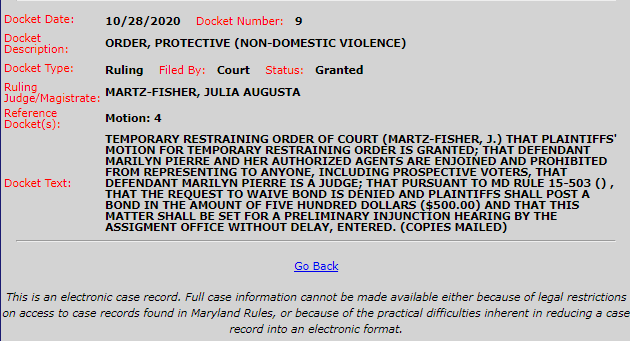
The incident that gave rise to the temporary restraining order occurred on Monday, October 26. According to a complaint filed in circuit court, sitting judge and candidate Bibi Berry and one of her volunteers encountered a volunteer for Marylin Pierre, who is running against the sitting judge slate, at the Silver Spring Civic Building. The civic building is an early voting location and Monday was the first day of early voting. Berry and her volunteer allegedly heard Pierre’s volunteer tell voters that Pierre was “the only progressive judge on the ballot.” Berry then claims to have corrected Pierre’s volunteer, telling voters (accurately) that Pierre is not a judge. According to the complaint, Pierre’s volunteer “continued to repeat the same phrase to prospective voters, ‘Ms. Pierre is the only progressive judge on the ballot’ louder and with greater conviction.” The sitting judges then filed for a temporary restraining order against Pierre’s campaign prohibiting her and her surrogates from referring to her as a judge. Judge Julia Augusta Martz-Fisher granted the temporary restraining order today.

This is the third strange incident involving Pierre that has been reported on Seventh State. The first occurred when Pierre tweeted that the defendants accused of killing George Floyd in Minnesota should be locked up with the burden of proof placed on them to show their innocence, a clear departure from basic criminal law. Pierre blamed the tweet on a volunteer. The second incident occurred when the former chair of the county Republican Party alleged that Pierre told GOP leaders in 2018 “she would be a ‘law and order’ judge who would be tough on bail.” Pierre is running as a progressive this year. Pierre admitted to attending GOP events and to contributing to the GOP but did not specifically address the allegations about what she said to party leaders.

Appearing below are the excerpt from the sitting judges’ online case file (accessible here) showing the issuance of the temporary restraining order as well as both the motion for temporary restraining order and the complaint filed by the sitting judges.

Share

Undervoting on School Board Races and Ballot Questions

By Adam Pagnucco.

This year has four hotly contested county ballot questions and at least one legitimately contested school board election. But here is something folks tend to forget: not everyone votes on these so-called “down ballot” races. And the question of who is not voting is almost as important as the question of who is.

In a presidential year, almost everyone who votes casts a vote for president. There are lots of other races at stake. This year, MoCo voters can also vote for Congress, judges, school board, two state ballot questions and four county ballot questions. However, there will inevitably be undervoting in many of these races. For the purpose of this post, the definition of “undervoting” is the percentage of people who cast a ballot but don’t vote in a particular contest. There is a lot of undervoting.

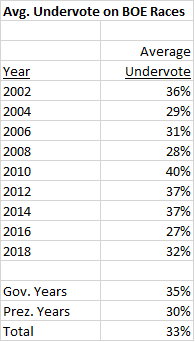
The table below shows undervoting in MoCo school board races since 2002. On average, one-third of people casting votes do not vote for school board.

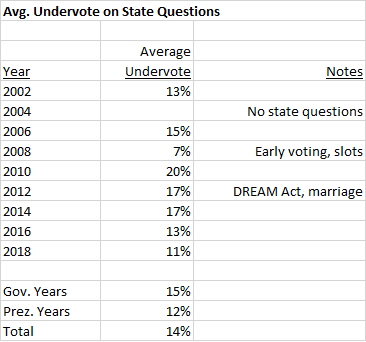
The table below shows undervoting in MoCo for state ballot questions since 2002. On average, one in seven people casting votes do not vote on state ballot questions.

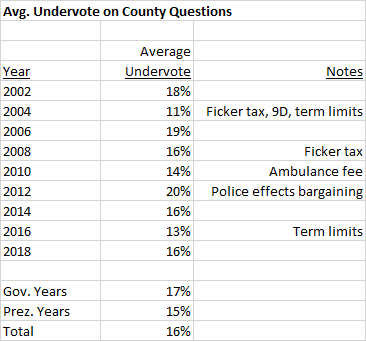
The table below shows undervoting in MoCo for county ballot questions since 2002. On average, one in six people casting votes do not vote on county ballot questions.

What determines undervoting? As shown in the tables above, undervoting seems to be a little less prevalent in presidential years, though not by much. Undervoting is much higher for school board races than ballot questions. That makes sense since – at least in some cases – voters can figure out how they feel about ballot questions from their language whereas school board candidates don’t have enough money to communicate directly with voters.

There is a little bit of evidence that clear and consequential ballot questions lead to less undervoting. County ballot question undervoting was lower than average in 2004 (when nine council districts and Ficker amendments on taxes and term limits were on the ballot) and in 2016 (when Ficker’s term limits amendment passed). State ballot question undervoting was about half the normal rate in 2008, when early voting and slots were on the ballot.

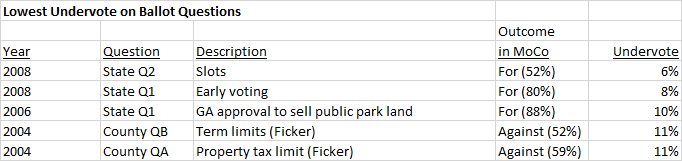
The table below shows the ballot questions with the lowest undervotes since 2002.

Four out of these five – slots, early voting, taxes and term limits – were big-deal questions. They were also relatively easy to understand for voters.

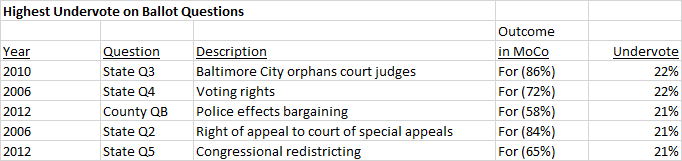
The table below shows the ballot questions with the highest undervotes since 2002.

There isn’t much of a pattern here. The police effects bargaining question in 2012 was the only question that was strongly contested.

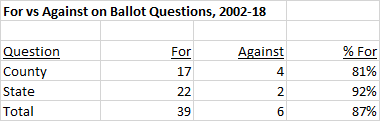
One more thing that will be of interest to all the groups promoting or advocating against specific ballot questions this year: most ballot questions pass. Since 2002, MoCo voters have voted in favor of 81% of county ballot questions and 92% of state ballot questions.

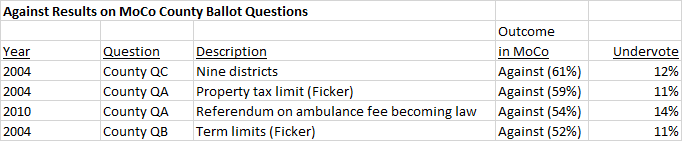
Here are the results for the four county ballot questions that have failed since 2002.

All four – term limits (2004), nine council districts (2004), property tax limits (2004) and the ambulance fee (2010) – were the targets of vigorous campaigns dedicated to killing them. All four saw lower than average undervoting.

There will certainly be undervoting this year and the stakes for the county, especially from the county ballot questions, are especially high. How will that affect the outcome?

Share

Non-Profits Come Out Against Question B

By Adam Pagnucco.

Non-profits have joined an expanding alliance against Robin Ficker’s anti-tax Question B that includes progressives, unions, business groups and all of MoCo’s county-level elected officials. The press release from Montgomery Neighbors Against Question B appears below.

*****

FOR IMMEDIATE RELEASE

Contact: Daniel Koroma
info@mocoagainstb.org

AREA’S TOP NONPROFIT ORGANIZATIONS JOIN OPPOSITION TO QUESTION B

From leading business groups to anti-hunger activists and local Democratic clubs, Montgomery County’s community leaders agree on one thing: Ficker’s Question B is a dangerous idea.

MONTGOMERY COUNTY, October 26, 2020 — The cross-county coalition that burst onto the Montgomery County political scene earlier this fall with a scathing ad aimed at Robin Ficker’s latest folly, Ballot Question B, now has a wide range of allies. The County’s diverse nonprofit community has joined the call to oppose Question B and released a public statement with over 25 nonprofit signons. Their message is one of strong public services, a strong local economy, and fiscal responsibility.

For Manna Food Center, a non-profit working to end hunger in Montgomery County, “Question B represents a real threat to our ability to provide expanded services effectively to a growing population of residents who find themselves vulnerable to hunger. Now is not the time to self-impose measures that would stunt the county’s ability to fund itself and Manna’s ability to provide services to communities when they need us most.”

Opposition to Question B is widespread across the Montgomery County non-profit community, with business groups uniting with labor, charitable organizations, and religious groups. “Nonprofits do their work in close partnership with County government.” said Lesley MacDonald, Executive Director of Nonprofit Montgomery. “Question B would severely restrict the County’s ability to support critical services. It would be harmful to the community, to nonprofits, and to those most in need.”

“The nonprofit organizations that help to tie Montgomery County’s social fabric together and provide vital services for an increasing number of our residents understand that supporting Question B would be a bad decision” said Hope Gleicher of Identity, a local non-profit that creates opportunities for Latino and other historically underserved youth. “B undermines the county’s future and unnecessarily risks our fiscal health while we try to battle a global pandemic. The organizations on the front lines of that battle understand what’s at stake and we’re proud to stand with them.”

The addition of such a wide range of area organizations to the effort against Ficker’ proposal strengthens the opposition message: whether for public services, COVID recovery, the local economy or the County’s coveted AAA bond rating, Question B is the worst possible idea for Montgomery County.

#

To see the full list of Nonprofits that have signed onto the letter against B, click here. You can also see the validator image of all organizations Against Question B here. For additional information, please contact Daniel Koroma at info@mocoagainstb.org.

Share

Hogan is Lying About Question 1

By Adam Pagnucco.

Governor Larry Hogan is hopping mad about Question 1, a statewide constitutional amendment on the ballot that would curtail some of his massive budget powers. That’s understandable – any politician (and most of the rest of us) would be upset about having any of our powers taken away. But Hogan’s critique of Question 1 has careened into the territory of outright lies and he deserves to be exposed.

Question 1 has its roots in a state budget crisis way back in 1915. In those days, the state government was considerably less professional than it is now. In Fiscal Year 1915, the state ran up a general fund deficit of $1.4 million. That was pretty bad considering that the state recorded revenues of just $12.1 million.

The crisis resulted in the incorporation of an executive budget system into the state’s constitution, which gives the governor enormous powers to set the operating budget. The General Assembly is prevented from adding to or rearranging the governor’s proposed operating budget under most circumstances. The legislature can cut certain items from the governor’s budget and also fence off money, designating it for use only under certain circumstances. The governor can release the money for those purposes or save it. Over the years, the General Assembly got around the restrictions by mandating future funding for some items through statute (especially education). But in an operating budget for an upcoming fiscal year, the governor – any governor – has awesome power which dwarfs the ability of the legislature to check it.

No other state gives such budgetary authority to its governor.

In the past, the governor and the General Assembly lived with each other by negotiating (to an extent) what would appear in the governor’s budget. But Hogan and the current General Assembly tend not to negotiate with each other all that nicely. Last spring, General Assembly Democrats got fed up and passed SB 1028, a constitutional amendment that would junk the executive budget system and balance budgetary power between the governor and the General Assembly. That is now Question 1 on this year’s ballot. Here is the exact language of Question 1.

Question 01

Constitutional Amendment
(Ch. 645 of the 2020 Legislative Session)
State Budget Process

The proposed amendment authorizes the General Assembly, in enacting a balanced budget bill for fiscal year 2024 and each fiscal year thereafter, to increase, diminish, or add items, provided that the General Assembly may not exceed the total proposed budget as submitted by the Governor.

(Amending Article II Section 17 and Article III Sections 14 and 52 of the Maryland Constitution)

Additionally, the bill creating Question 1 grants the governor authority to veto any line items added by the General Assembly to executive departments. Furthermore, the bill makes clear that the changes will take effect in Fiscal Year 2024, after Hogan has left office.

Hogan despises this constitutional amendment and set up a website to oppose it. The website says, “Question 1 would upend the Maryland constitution to give career politicians in the legislature unchecked power over the budget, denying governors the chance to hold them accountable and to protect taxpayers.”

Hogan also made this video in which he claimed that Question 1 would lead to higher taxes.

Here’s the lie: Question 1 does not give the General Assembly “unchecked power over the budget.” The very language of the amendment makes clear that the legislature “may not exceed the total proposed budget as submitted by the Governor.” That means the governor still gets to set a budget ceiling that the legislature cannot exceed. Furthermore, the bill gives the governor line item veto authority over appropriations for state departments. What the bill actually does is establish a balance of power between the governor and the General Assembly that resembles the arrangement in most other states.

If Hogan wants to make an honest argument against Question 1, he can claim that the current system has worked well enough over the past century and has prevented a recurrence of the kind of budget crisis that it was designed to stop. But it’s a lie to say that it will result in higher taxes when the governor still gets to set a budget ceiling.

Readers, please take this into account when voting on Question 1.

Share

MoCo Ballot Issue Committee Campaign Finances, October 18

By Adam Pagnucco.

The six committees formed to advocate for and against MoCo’s ballot questions have filed their final campaign finance reports before the general election, covering the period through October 18. Let’s see where the money is coming from.

First, a quick summary of the ballot questions.

Question A: Would freeze the property tax rate but allow a unanimous vote of the council to increase it. Authored by Council Member Andrew Friedson.
See Why Progressives Should Support the Friedson Amendment.

Question B: Would remove the ability of the county council to break the current charter limit on property taxes, thereby capping property tax revenue growth at the rate of inflation. Authored by Robin Ficker.

Question C: Would add 2 district seats to the county council, thereby establishing 7 district seats and 4 at-large seats. Authored by Council Member Evan Glass.
See MoCo Could Use More County Council Districts.

Question D: Would convert the current council’s 5 district seats and 4 at-large seats to 9 district seats. Authored by Nine District for MoCo.
See Don’t Abolish the At-Large County Council Seats, Nine Kings and Queens.

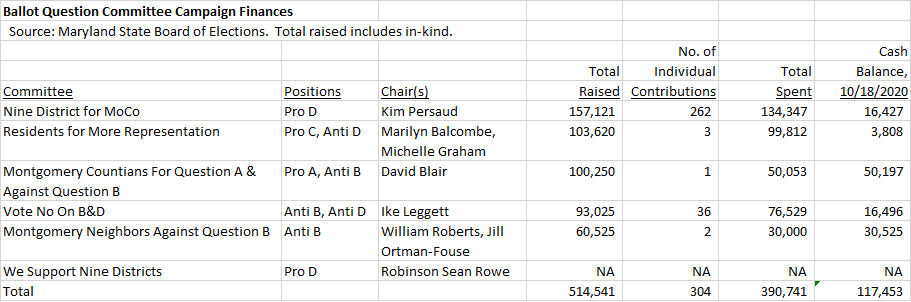
Here is a summary of finances for the committees for the entire cycle through October 18.

To understand why these flows of money are occurring, it’s useful to recall the genesis of these questions. This year’s ballot question fight was joined when two questions were placed on the ballot by petition: Robin Ficker’s anti-tax Question B and Nine Districts for MoCo’s Question D, which would eliminate council at-large seats and remake the council into 9 district seats. In response to those ballot questions, the county council put two of its own questions on the ballot to compete with them: Question A (a different tax limitation measure) and Question C (which would keep the at-large seats and add two district seats). It is believed by some that if two directly conflicting ballot questions pass, they will both get thrown out, though that is not 100% certain.

Once it became clear that both Ficker’s anti-tax question and the nine districts question were going to appear on the ballot, no fewer than four new ballot issue committees were created to stop one or both of them and/or to promote the council’s alternatives. In short order, many of the county’s power players took sides in an uncommon off-year ballot question war. The players’ positions are at least as interesting as the committees’ activities themselves.

Nine Districts for MoCo, the oldest of the committees, has by far the most individual contributors but 82% of its cash funding has come from the real estate industry. In its most recent report, MoCo GOP Central Committee Member Ann Hingston made 6 more in-kind contributions totaling $993, thereby providing more evidence of the links between Nine Districts and the county Republican Party. Nine Districts’ fundraising pace has slowed as they have collected just $154 since October 4.

The competing committees have rapidly closed the gap. Three groups have paid for mail: former County Executive Ike Leggett’s group opposing Questions B and D, former executive candidate David Blair’s group supporting Question A and opposing Question B and Residents for More Representation, a group supporting Question C and opposing Question D. These groups are also paying for websites and online advertising. But they got off to a late start while Nine Districts has been campaigning for more than a year.

Below are all the major players who have contributed at least $10,000 to one or a combination of these ballot issue committees.

David Blair – $165,000
Supports Questions A and C, opposes Questions B and D
Businessman and former executive candidate David Blair is the number one spender on ballot questions. He has contributed $65,000 to Legget’s group opposing Questions B and D, $50,000 to his own group supporting Question A and opposing Question B, and $50,000 to Residents for More Representation, which supports Question C and opposes Question D. Blair’s positions mirror the positions taken by the county Democratic Party. (Disclosure: I have done work for Blair’s non-profit but I am not involved in his ballot question activities.)

Charlie Nulsen – $123,500
Supports Questions A, C and D, opposes Question B
Nulsen is the president of Washington Property Company. On June 4, he contributed $50,000 to Nine Districts to help get Question D on the ballot. On October 13, he contributed $23,500 to Residents for More Representation to defeat Question D. Nulsen could have saved more than $70,000 and achieved the same outcome by simply doing nothing. He also contributed $50,000 to Blair’s group supporting Question A and opposing Question B.

Monte Gingery – $40,000
Supports Question D
The head of Gingery Development Group has made three contributions totaling $40,000 to Nine Districts.

Willco – $40,000
Supports Questions C and D
On August 5, this Potomac developer gave an in-kind contribution of $15,000 to Nine Districts which was used to pay Rowland Strategies (their campaign firm). On October 9, Willco gave $25,000 to Residents for More Representation, which is seeking to pass Question C and defeat Nine Districts. Folks, you can’t make it up.

MCGEO – $30,000
Supports Question A, Opposes Question B, Gave Contribution to Question D
The Municipal and County Government Employees Organization (MCGEO) has made a $20,000 contribution to Montgomery Neighbors Against Question B and a $10,000 in-kind contribution to Nine Districts. MCGEO President Gino Renne is the treasurer of Empower PAC, which gave another $5,000 to Montgomery Neighbors Against Question B.

MCEA – $20,000
Opposes Question B
The Montgomery County Education Association (MCEA) has contributed $20,000 to Montgomery Neighbors Against Question B.

UFCW Local 400 – $10,000
Opposes Question B
This grocery store union which shares a parent union with MCGEO gave $10,000 to Montgomery Neighbors Against Question B.

The Montgomery County Democratic Party recommends voting for Questions A and C and voting against Questions B and D. The Montgomery County Republican Party recommends the exact opposite. The Washington Post editorial board opposes all four ballot questions.

Share

School Board Campaign Finances, October 18

By Adam Pagnucco.

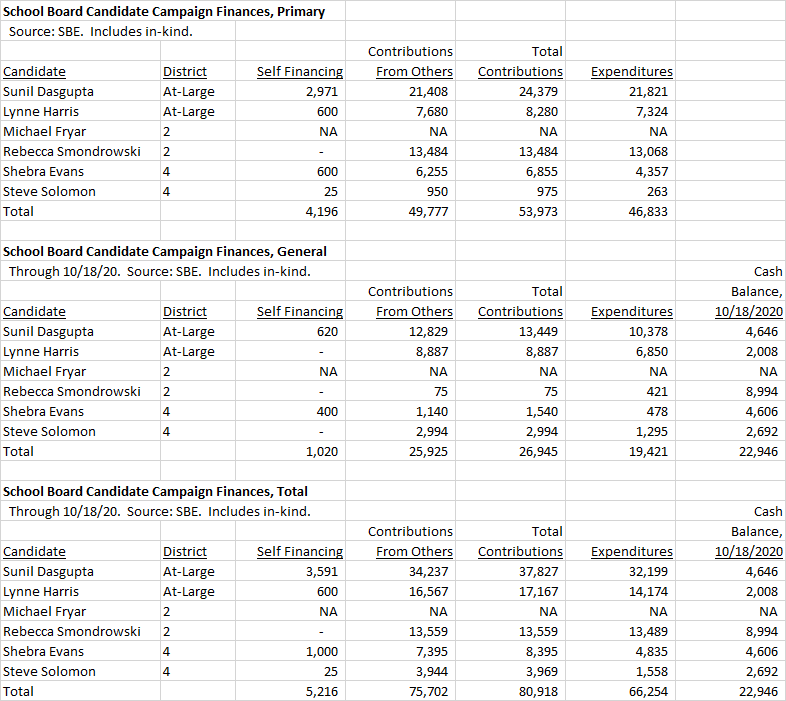
The school board candidates’ last campaign finance reports prior to the general election were submitted to the state on Friday. The table below shows money raised and spent for both the primary and the general.

There are a number of things I could point to here, such as Sunil Dasgupta’s financial edge over Lynne Harris (although that has declined in the general) and the fact that incumbents Rebecca Smondrowski and Shebra Evans don’t seem to be taking their challengers very seriously. (Smondrowski’s opponent, Michael Fryar, has raised no money but was still endorsed by the Washington Post. MCEA has not endorsed in that race.)

But the big story is what I wrote the last time I looked at these reports: these candidates are basically all broke. And that is particularly striking given the fact that at least a half-million people are probably going to vote in the general election this year. It’s impossible to reach that many people on a $20,000 budget (or less).

To MoCo’s state delegation: school board candidates desperately need public financing. Please introduce legislation enabling that to happen.

Share

Council Must Sustain Elrich’s Veto of Corporate Welfare

On a 7-2 vote, the Montgomery County Council approved a bill that would completely exempt real estate developments on WMATA property from property taxes for 15 years. Councilmembers Tom Hucker and Will Jawando voted against. The Council should sustain County Executive Marc Elrich’s veto of this corporate welfare masked as a social justice housing project.

This bill is such a bad idea that one hardly knows where to begin.

Proponents of transit endlessly sell the considerable funding required for it as the motor for development and smart growth that not only attracts jobs but increases land values and property tax revenues. We are told “if you build it, they will come.” Now, these same people tell us that they won’t come unless we “incentivize” (read: pay) them.

Even stranger, we are to pay these incentives to build high-priced apartments in desirable locations with very little extra affordable housing thrown in above normal requirements. I understand establishing enterprise zones with lower taxes in struggling neighborhoods, but Grosvenor-Strathmore and other Red Line stops don’t fit the bill.

Councilmember Andrew Friedson (D-1) has been quite aggressive in trying to sell Councilmember Hans Riemer’s bill:

None of the WMATA sites are being developed and developers with Joint Development Agreements are walking away all over the region, due to unique infrastructure requirements on these sites, high costs of high-rise construction, etc.

These sites currently collect ZERO property tax, generate ZERO housing, and provide virtually no public benefits aside from surface parking. I view that as an abject public failure, but respect anyone who prefers this status quo.

Multiple fiscal analyses have demonstrated both that high-rise projects don’t work without the incentive and that the Grosvenor project in particular would generate more revenue to the County in impact and income taxes than the property tax abatement (which the county wouldn’t otherwise receive without a project).

Councilmember Friedson argues we need to step up our corporate welfare game to compete when we shouldn’t even play this game. His argument also ignores that demand for homes in Frederick or Fairfax is based on other factors that far outweigh tax incentives linked to individual projects.

The uniqueness of the site argument fails to impress as somehow many buildings have been constructed around the whole region, indeed the whole country, around transit and difficult sites without the magic of tax incentives. (Manhattan exists!) I’m sure WMATA, developers and their supporters on the Council are happy to produce analyses showing otherwise, just as they always have in support of public spending on their agenda.

The incentives are a roundabout subsidy to WMATA. When we establish tax incentives the land becomes more valuable, so WMATA raises the price and recoups much of it. So it’s not even clear what share of this supposedly badly needed incentive the developers will see.

This tax giveaway also won’t increase the housing stock. When it’s built, Councilmembers Riemer and Friedson will point to it and say, “look what we did!” Except there will be another nearby project that didn’t happen because you’ve already pre-satisfied any demand with this one. Montgomery has plenty of land zoned for housing and buildings.

Councilmember Friedson also neglects to mention that the building will not have a zero cost to the county. Providing county services will cost money but Montgomery will receive a lot less than normal to cover those costs.

Andrew Friedson has been touted with much hope, including here, as the Council’s bright new economic light. If he wants to live up to this promise, he needs to shift his focus fast from this old-style ineffective developer welfare to more original ideas to attract commercial business to Montgomery.

The bill reflects Councilmember Hans Riemer’s long-term approach over several terms to housing, which has long dominated the Council. Unfortunately, it has had far more success in pleasing monied interests than it has accomplished in producing affordable housing. No doubt it also pleases David Blair’s developer-heavy crowd.

Councilmember Nancy Navarro has presented herself as second to none as a champion for social justice. She has stood up unflinchingly for often abused undocumented immigrants to the frequent dismay of their opponents around the State. Here, she argued that the Council needed to “be bold” and support this bill.

Except there is nothing remotely new, let alone bold, about giving a tax subsidy to developers. Speeding the production of high-priced apartments strikes me as the opposite of social justice.

I cannot help but wonder why this proudly progressive Council is focused on this legislation at this time when so many county residents are facing far more immediate and desperate problems. Even managing the day to day is still far from ordinary.

Charter Amendment A on Property Taxes

The crowning insult of this legislation is its juxtaposition with County Charter Amendment A. The short version is that the Council majority is now proposing to collect more in property taxes from ordinary residents even as it engages in this tax giveaway that has no valid economic or public purpose.

Charter Amendment A garners support from many because the current property tax system is not ideal for a variety of reasons (not the subject of this post). It effectively asks voters to loosen the very tight tax corset (it can only rise with the rate of inflation) so that the county can collect more if property values rise, as would likely happen now if the measure passes. It’s a tough ask at a time when many have seen incomes drop. One can argue that it is necessary when so many are in need.

But it is insupportable for the majority of the Montgomery County Council to offer a tax holiday to developers while increasing the take from ordinary citizens. It’s not progressive. It’s not liberal. It’s just bad economic policy wrapped in gaudy rhetoric that doesn’t stand up to scrutiny. It goes against this county’s good government traditions.

County Executive Elrich was right to veto this bad bill. The Council should vote to uphold his veto tomorrow.

Share

Reopening Plans – MCPS is Behind

Guest column by Lynne Harris, Candidate for Montgomery County Board of Education At-Large.

Reopening schools – safely – is critical. As an MCPS teacher, parent, a nurse and a public health expert, I have been closely following public health guidance, evolving science around COVID, and the work of school systems all around the world that have opened during the pandemic. I’m disappointed that MCPS lags so far behind almost every school district in Maryland. Twenty of our state’s 24 school districts have begun bringing some students back. To prevent irreversible learning and opportunity loss, we need a public health compliant, student-focused plan to start providing some level of in-person instruction to students.

It’s critically important to have a CDC-compliant plan now to bring small groups of students into our schools, periodically. Those most in need of in-person instruction include students vulnerable to learning loss, struggling students, young learners, students with special needs, and students in hands-on CTE programs like mine. That plan needs to ensure that MCPS and the County Health Department are in continuous collaboration, and have a well-thought out and well-communicated plan to move back and forth between fully virtual and hybrid instruction as Montgomery County’s COVID numbers change. Some say that’s hard, but school systems all over are doing that now.

SCHOOLS ARE ALREADY OPEN!

Planning to reopen doesn’t’ require re-inventing the wheel. We can look at how school systems around the nation and the world are educating the next generation face-to-face during a global pandemic. Six of the nation’s ten largest school systems – some with hundreds of thousands more students than MCPS – have reopened. It’s not that MCPS can’t devise a safe plan, it’s that MCPS hasn’t yet created one.

To see how this can work safely, look no further than our own schools. They’re already in use. MCPS for-profit learning pods and low-cost equity hubs are currently operating in more than 60 schools. Private schools in Montgomery County are open too – here’s an interesting piece from Education Week written by a MoCo middle school teacher teaching at one of them.

REOPENING SAFELY

Almost every school system that has reopened devised a hybrid plan, with a mix of in-person and virtual learning. Planning starts by sharing information with communities and providing a firm date for staff and families to opt in or out of in-person instruction. That data is essential for planning – once a school system knows which staff and students will participate only virtually, then it can make school-specific plans for hybrid instruction.

Most school systems have started by bringing in the most vulnerable learners and early learners (mentioned above) first. They are at highest risk for irreversible learning loss. And pragmatically, it’s easier to devise a plan for pre-K and elementary schools, where most students are together in a single classroom – than for middle and high schools where students typically change classes four to eight times daily.

In school districts where partial reopening is working:

Masks are mandatory.

Students and staff can opt for virtual only instruction.

Health screenings are routine, with firm guidelines. Some are completed online daily before students and staff enter the building. Anyone with a COVID-19 exposure must notify the school and self-quarantine. Contact-tracing is handled quickly with health officials. Anyone who feels unwell stays home.

Common spaces are marked for social distancing and equipped with supplies for hand hygiene.

Arrival and dismissal procedures minimize crowding, utilizing as many entrance/exits as feasible so students and staff enter and leave from the exit nearest their classroom.

Groups of students remain together (cohort) throughout the school day – eating lunch together, taking handwashing breaks together, going outside together.

Enhanced hygiene and cleaning protocols include restrictions on multiple use items in classrooms, socially distanced classroom arrangements, and frequent cleaning of high-touch surfaces.

One day per week, usually Wednesday, is virtual for everyone, allowing for deeper cleaning of spaces mid-week.

Staff, students and families know the plan for pivoting back and forth between hybrid and virtual instruction as community COVID numbers change, and understand how they will receive information about community COVID status and school operations.

MCPS’s work with our County Health Department should yield guidelines for safe operations and allow each of our 208 schools to create its own plan for space utilization. Every one of our schools is unique – in enrollment size, building size and layout, and the presence (or not) of special programs. All of those things matter in figuring out how to safely bring some students and staff back into classrooms, and how to safely and efficiently use school space and maintain social distancing.

FACTS VS. FEAR

I hear some people talk about MCPS reopening from a place of fear. That’s understandable – we’re living through a global pandemic. We need to temper fear and rhetoric with reality, knowledge and fact. Zero risk is impossible. Wherever people gather there is always the possibility for illness to spread. Think about it: have you traveled since March? Gone to a gathering of people that you don’t live with? Gone to the grocery store? Gone to a Farmers Market? If so, were conditions tightly controlled and health protocols rigidly observed? There’s always risk.

We have to look at creating a reopening plan through the lens of our purpose as a public school system. Our purpose is to educate students and support students and families. That means we have to look at what’s best for students, and the data is clear – virtual learning is NOT best for the majority of students. Some will suffer irreversible lifetime consequences if we can’t resume some level of in-person instruction.

MCPS is behind schools and learning hubs in our district, most of the systems in our state, and many across our nation and the world. Planning for reopening requires robust collaboration – and it needs to begin now. If none of us are seeing, hearing or learning about that planning, then MCPS is falling even further behind.

Share

Republican Del. Dan Cox Now Using QAnon Hashtags

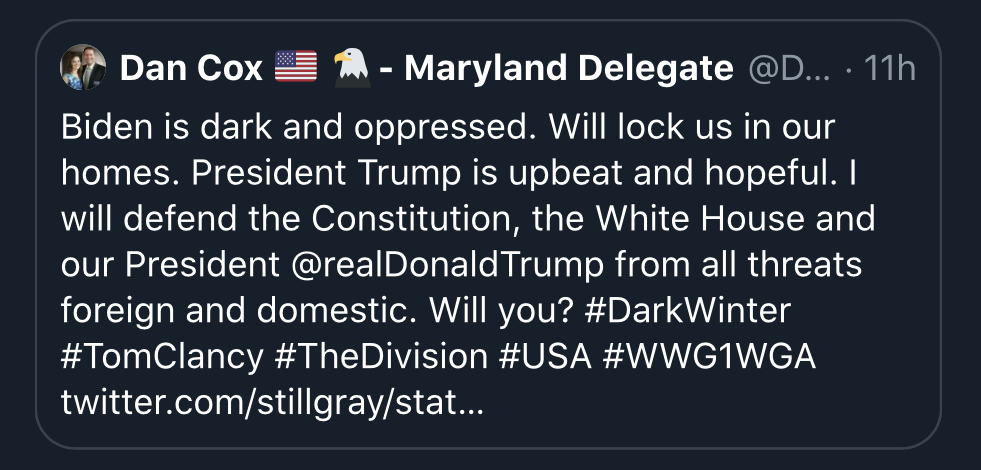
The hashtag #WWG1WGA, associated with the dangerous QAnon conspiracies, was used yesterday in a tweet by Maryland Del. Dan Cox (R-4, Frederick & Carroll). Apparently, the hashtag is short for the QAnon slogan of “where we go one, we go all.”

A member of the Maryland General Assembly is now associating himself with QAnon. Once again, the Maryland Republican Party faces a choice once again of normalizing the crazy and dangerous by joining or ignoring this, or facing it down.

I’d note the Senate Republican leadership recently swung right. Sen. Mike Hough, for example, who represents the same district, is enthusiastic for Trump and quit Washington football after decades because they dropped the name. But Gov. Larry Hogan’s brand is as a more sensible mainstream conservative. As leaders of their party, what will they do?

h/t Walter Olson (@walterolson).

Share

Nine Districts Shows What They’re All About

By Adam Pagnucco.

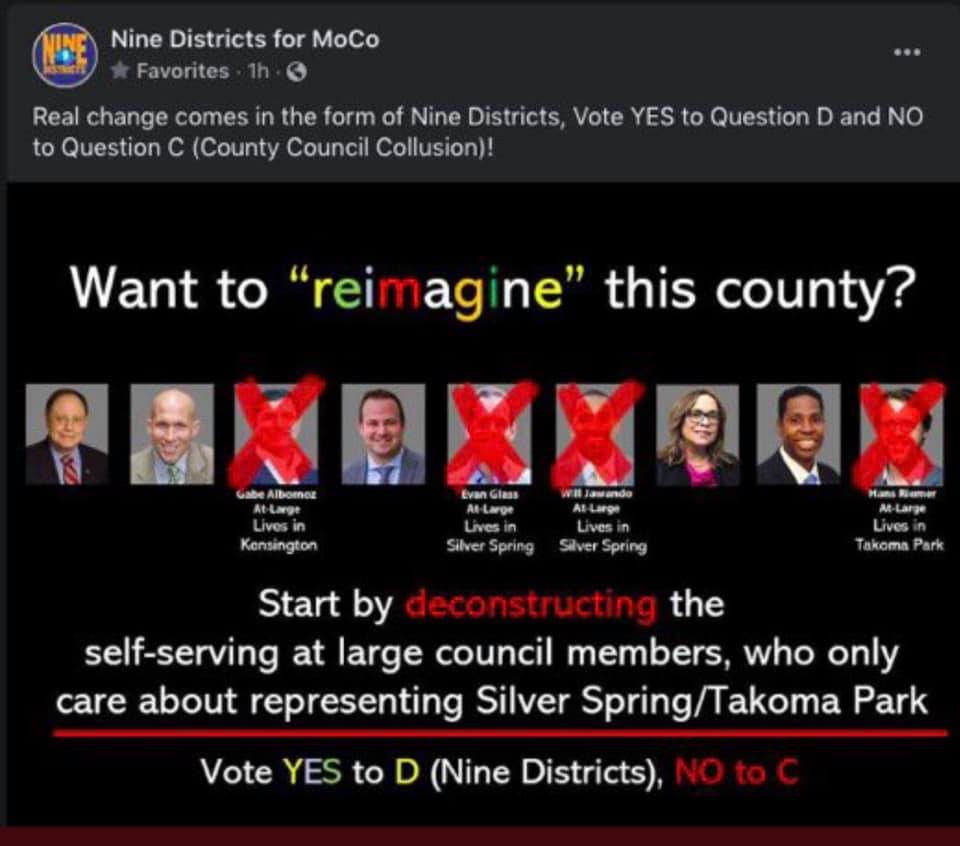
Nine Districts for MoCo, the group trying to abolish at-large seats on the county council, posted the following graphic last night.

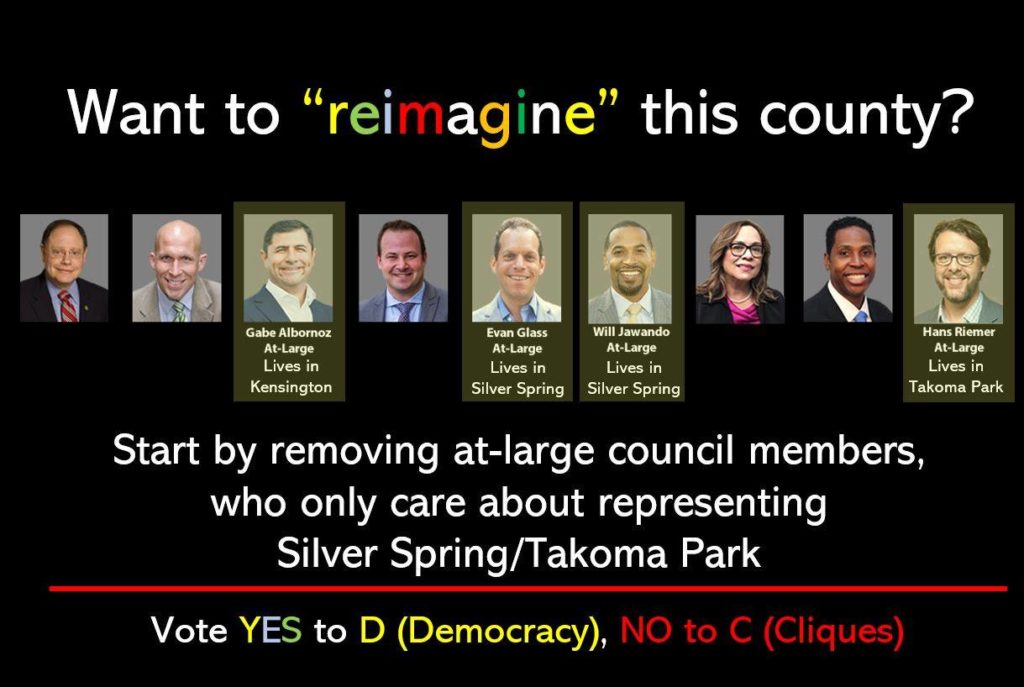
After getting pushback, the group deleted the image and posted a new graphic.

Readers, I leave it to you to determine whether this is legitimate political discourse in Montgomery County.

Share

Maryland Politics Watch