Once Again, MoCo’s Two Electorates

By Adam Pagnucco.

In November 2016, I wrote a three-part series called MoCo’s Two Electorates. (Here are the links to Part One, Part Two and Part Three.) I also wrote a piece titled “MoCo Revolts” in the wake of the term limits vote.

The combined thesis of those pieces are the following.

1. MoCo has two electorates: people who regularly vote in Democratic primaries and people who vote in general elections. Both electorates are important. Democratic primaries choose the county’s elected officials while general elections decide ballot questions and charter amendments.

2. There are roughly 40,000 Super Democrats in MoCo who vote in every primary. Relative to general election voters, they tend to be slightly more female, older, slightly higher income, slightly more likely to live in a single family home and more concentrated in downcounty. They are also slightly LESS diverse than general election voters.

3. Democrats comprise roughly 60% of general election voters with some variation by year. Republicans have outnumbered unaffiliated voters among the rest of actual voters though not by a lot. That means Republicans and unaffiliated voters can team up with a minority of Democrats to pass ballot questions.

4. On four straight meaningful local ballot questions since 2008, the general electorate took arguably the less progressive position in their votes. They voted in favor of Robin Ficker’s anti-tax charter amendment in 2008, against Ike Leggett’s ambulance fee in 2010, in favor of repealing some collective bargaining rights for police in 2012 and for term limits in 2016. This trend among the general electorate should not be comforting to the left. Term limits passed with a whopping 70% of the vote and only four precincts in the entire county voted against them.

Accordingly, these are the prophecies I made back then.

November 7, 2016: “Term limits is the issue of the day and will be decided soon enough. But a broader question looms. Given the differences between MoCo’s Two Electorates, what happens when elected officials cater to one of them at the heavy expense of the other? The recent large property tax hike, which was spread all across county government, was aimed at the priorities of liberal Democratic voters. It also became the core of the push for term limits which is aimed at the general electorate. This suggests a need for balance and restraint by those running the government. Because if one of the two electorates feels unheeded, either one has the tools to strike back – either by unseating incumbents or by shackling them with more ballot questions and charter amendments.”

November 11, 2016: “Opponents of term limits may be right about one thing – they may change the names of elected officials, but not the type of them. Democrats, often very liberal ones, will continue to be elected because of our closed primary system. But the combined message of the last four ballot questions imposes a hard choice on the elected officials of today and tomorrow. They can try to balance the interests of various constituencies across the political spectrum at the possible cost of losing the progressive support that influences Democratic primaries. Or they can stay the course and watch more moderate general election voters pass even more restrictive ballot questions, including perhaps the ultimate bane of progressivism – a hard tax cap.”

What has happened since then? First, let’s consider these two facts from the 2018 elections.

Geography: In the 2018 Democratic primary, the Democratic Crescent (a term I coined for the areas in and near the Beltway stretching from Takoma Park to Kensington and Bethesda) accounted for 34% of voter turnout while Upcounty accounted for 25%. In the 2018 general election, the Democratic Crescent accounted for 27% of voter turnout while Upcounty accounted for 31%. (The rest of the county accounted for 42% in each case.)

Diversity: Precincts that were majority white cast 60% of the votes in the 2018 Democratic primary and 58% of the votes in the 2018 general election. Precincts that were at least three-quarters white cast 22% of the votes in the Dem primary and 20% of the votes in the general. Precincts that were less than 40% white cast 24% of the votes in the Dem primary and 26% of the votes in the general. All of this suggests that the general electorate is slightly more diverse than MoCo’s Democratic primary electorate, which I also found in the 2014 data I examined years ago.

In other words, despite the substantial growth in voting in 2018, the differences between MoCo’s two electorates continued.

Two years later, ballot questions are THE local issue now. The county’s elected officials are up in arms about Ficker’s newest anti-tax charter amendment (which I predicted four years ago) and the nine districts charter amendment. Groups like Nine Districts for MoCo and former school board candidate Stephen Austin’s Facebook group did not exist in 2016, but they are playing in county politics now. Austin’s group has 8,500 members, bigger than any other online group devoted to MCPS. Nine Districts gathered more than 16,000 petition signatures for their charter amendment, of which 11,522 were found to be valid. Both groups direct their influence at the general electorate rather than just Democratic primary voters. Neither depends on the blessings of the Democratic Party but rather employs a combination of social media, press interest and (in Nine Districts’ case) developer money to get their points across. As for the Republican Party, it has found new life in promoting ballot questions like Ficker’s Question B and Nine Districts’ Question D.

Guess what? These kinds of things are here to stay. Regardless of what happens this year, don’t be surprised if more charter amendments appear on the ballot in 2022 and 2024 that arouse the ire of those in power. Tough beans for them because they are powerless to prevent it.

Have today’s county elected officials heeded the prophecies of 2016? For the most part, their agenda reflects the wishes of the progressive left – defunding the police, pursuing racial equity, cracking down on rent increases, resisting ICE and emphasizing transit over road construction. The one exception is that the county council (unlike the executive) has been resistant to tax hikes. Progressives sometimes complain that the county government doesn’t go far enough, but it does go in their direction. The problem is that other groups in the general electorate – Republicans, unaffiliated people and moderate to conservative Democrats – either don’t rank these priorities as highly as do progressives or in some cases might even oppose them. Mix that in with the county’s perceived anti-business reputation and geographically specific issues like school boundary lines and M-83 and many in the general electorate are not in the same place as the Super Democrats.

MoCo still has two electorates. One has the power to pick elected officials. The other can decide ballot questions that fundamentally change the structure of county government. We shall soon discover the depth of differences between them as well as their relative balance of power in controlling the county’s destiny.

Share

GOP Gov & Dem Assembly Leaders Join to Support Counting All Votes & Express Confidence in Elections

Earlier today, Republican Governor Larry Hogan joined with Democratic Speaker Adrienne Jones and Senate President Bill Ferguson to release this Public Service Announcement expressing firm support for counting all the votes and confidence in our state’s elections.

On the eve of Election Day, this bipartisan announcement is welcome leadership and the right message in these deeply divided times. As in all other states, Maryland’s count will not be fully complete on election night. Nevertheless, as leaders from both parties express, we will count all the votes and can have confidence in the final result.

That’s the right message around the country.

Share

Barr’s DOJ Will Monitor MoCo Election Along with Other Dem Areas.

The Civil Rights Division of the Department of Justice plans to send monitors to 44 jurisdictions “to monitor compliance with federal voting rights laws” on Election Day. Montgomery County, Maryland is one of them.

The 44 selected jurisdictions are almost exclusively ones that the Democrats expect to win in tomorrow’s presidential election. In North Carolina, for example, DOJ will monitor Democratic Wake (Raleigh) and Mecklenburg (Charlotte) but no other counties.

In Florida, the four out of the five counties are among the nine that Hillary Clinton managed to carry in the state. The fifth is Duval (Jacksonville), which she lost by just one point, has a large African-American population, and has been moving away from the Republicans–the 2018 Democratic gubernatorial candidate won by four even as he lost narrowly statewide.

Given the repeated attempts by the Republicans and the Trump campaign to limit access to the polls and to outright disfranchise voters, this seemingly far from accidental targeting of Democratic areas by Bill Barr’s extremely partisan Justice Department merits further investigation.

Here is the complete list of jurisdictions that DOJ plans to monitor:

  • Coconino County, Arizona;
  • Maricopa County, Arizona;
  • Navajo County, Arizona;
  • Los Angeles County, California;
  • Orange County, California;
  • Broward County, Florida;
  • Duval County, Florida;
  • Hillsborough County, Florida;
  • Miami-Dade County, Florida;
  • Orange County, Florida;
  • Palm Beach County, Florida;
  • Fulton County, Georgia;
  • Gwinnett County, Georgia;
  • City of Chicago, Illinois;
  • Cook County, Illinois;
  • Montgomery County, Maryland;
  • City of Boston, Massachusetts;
  • City of Lowell, Massachusetts;
  • City of Malden, Massachusetts;
  • City of Quincy, Massachusetts;
  • City of Springfield, Massachusetts;
  • City of Detroit, Michigan;
  • City of Eastpointe, Michigan;
  • City of Flint, Michigan;
  • City of Hamtramck, Michigan;
  • City of Highland Park, Michigan;
  • City of Jackson, Michigan;
  • Shelby Township, Michigan;
  • City of Minneapolis, Minnesota;
  • Bergen County, New Jersey;
  • Middlesex County, New Jersey;
  • Bernalillo County, New Mexico;
  • Mecklenburg County, North Carolina;
  • Wake County, North Carolina;
  • Cuyahoga County, Ohio;
  • Allegheny County, Pennsylvania;
  • Lehigh County, Pennsylvania;
  • Philadelphia County, Pennsylvania;
  • Richland County, South Carolina;
  • Harris County, Texas;
  • Waller County, Texas;
  • Fairfax County, Virginia;
  • Prince William County, Virginia; and
  • City of Milwaukee, Wisconsin.
Share

Keep Voting and Keep Calm

This is that short time every four years when political science professors become popular with the foreign media, which is how I found myself hanging out in the cold this morning in front of my polling place. Overhearing media interviews with voters entering and exiting the polls turned out to be more interesting than I expected.

One man in his late 20s gave what I think of as the standard small-d democratic answer, speaking about the importance of participating in the electoral process. Like many Americans, he preferred not to disclose his voter choice and to get back home to help take care of his kid.

The interviewers struck gold, however, when they managed to find the rare, outspoken Trump supporter in inner Montgomery County. A woman in her late 40s or early 50s, she very politely took time to explain why she preferred Trump to Biden.

Trump will “keep America as it is” while Biden wants to “change it.” Biden wants to make America “socialist.” The specific reason she cited for supporting Trump was his desire to keep out “illegal immigrants” and protect the border. She wanted to vote in person because she doesn’t trust the mail and is concerned that “the Democrats are going to steal the election” through mail ballots.

Put simply, this perfectly pleasant woman was in complete sync with the FOX and Trump narrative. It’s not something you see a lot of in my part of the world where Trump signs are literally nonexistent, and Biden will easily win over 80 percent of the vote. I suppose it’d be like watching someone explain their Biden vote in Carroll County.

The most unsettling part to me is the easy willingness to believe that somehow Biden can inexplicably steal the election by mail. So it remains important for leaders, officials and experts to keep providing accurate information to counter the deluge of misinformation about our democracy that the president and seems eager to spout. People who care about our democracy in both parties should participate, just like the Texas Republicans who are fighting efforts to disfranchise over 100,000 voters in Harris County.

Meanwhile, Democrats need to keep working to get out the vote in the few remaining hours of this election. Let’s also not buy into the panic over counting the votes. America has done this many times before, so it’s not like it’s a mystery. Pandemic or no pandemic, our officials are well prepared to do it again.

The doubt sown over this very question by President Trump as well as his willingness to peacefully transfer power is what fills many Americans with dread rather than hope as we approach election night. It’s what makes this election year so abnormal.

But by far the best response that Americans can provide is to keep streaming to the polls until they close and then to keep calm while we await the complete count. For a variety of reasons, some states may start out red or blue and then go the other way. It is not a stolen election if Florida starts the night as blue (early voters) and then trends red (election day voters). Nor is it stolen if Pennsylvania is red on election night but then mail ballots turn it blue. All votes are equal.

We, the People, need to show respect for our democratic process even if the president does not and goes ahead with his publicly stated plan to declare victory prematurely. I realize that the repugnance of these sorts of actions amplified by social media encourages the opposite. Just remember that we all lose if those boards in front of stores in downtowns across the country turn out to have been necessary.

Share

Who Has the Edge in the At-Large School Board Race?

By Adam Pagnucco.

This year saw one of the most contentious school board primaries in recent county history. With incumbent at-large school board member Jeanette Dixon announcing her retirement, a 13-member field filled social media and press accounts in their quest to succeed her. Perhaps the foremost issue was MCPS’s boundary study, which was both supported and opposed by numerous candidates. The primary’s survivors are former PTA president and MCPS teacher Lynne Harris and Universities at Shady Grove professor Sunil Dasgupta, both boundary study supporters. Now they are facing off in a general election that will reach its conclusion next week.

Who is going to win, Harris or Dasgupta?

Here is what we know. Harris has been endorsed by the Washington Post and is supported by a large number of PTA activists, including her campaign manager, Laura Stewart. Dasgupta has been endorsed by MCEA, wielder of the mighty Apple Ballot, as well as SEIU Local 500, Casa in Action and Progressive Maryland. His campaign manager is MCPS teacher Chris Wilhelm, who ran a strong campaign for county council at-large two years ago. (Wilhelm and Stewart, besides being the campaign managers, are both well-qualified to be school board candidates themselves!) Dasgupta has outraised Harris but neither has the money to effectively reach a general electorate which will probably have a half million voters. The campaign seems devoid of the rancor that characterized the primary although some teachers were upset with Harris’s remarks criticizing MCEA over the issue of school reopening.

Both candidates have written guest blogs on Seventh State. Dasgupta wrote Distance Learning May be Plan C, but it is the Best Option Right Now on July 17 and Changing the Reopening Timeline: a Recipe for Confusion and Anxiety on September 28. Harris wrote Reopening Plans – MCPS is Behind on October 25. All three posts attracted significant numbers of readers.

At first glance, both Harris and Dasgupta seem to have plausible chances to win. But this is Seventh State, so let’s not stop there. On to the spreadsheet!

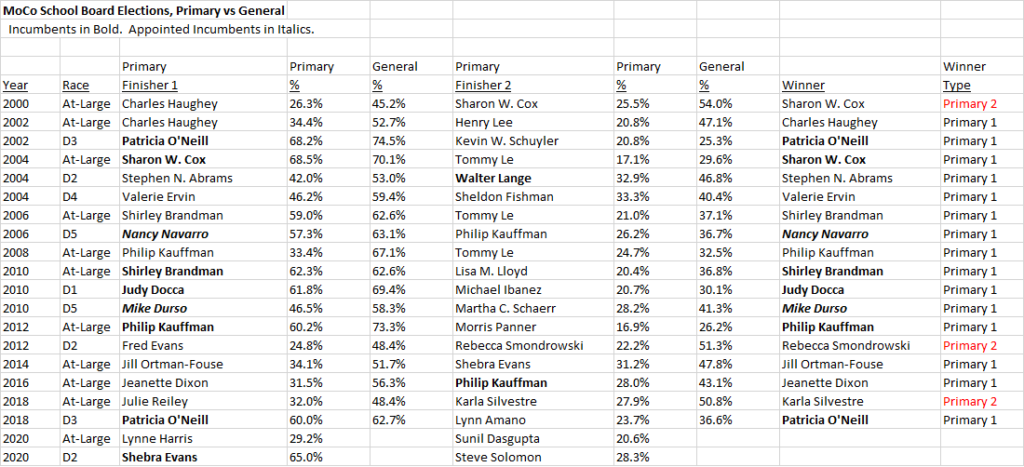
Let’s look back at the last twenty years of school board races. The table below examines the frequency with which candidates who finish first in a primary go on to win the general election. (Races in which there are two or fewer candidates don’t have primaries but rather advance directly to a general election.) Incumbents appear in bold, with appointed incumbents also appearing in italics.

In the last 18 school board races with both primaries and generals, the top finisher in the primary went on to win the general 15 times. That’s good news for Harris, who finished first in the primary this year. But let’s not declare the race over yet. The three cases in which the top primary finisher did not win have four things in common.

The election had an open seat.
That’s the case this year as Harris and Dasgupta are vying to replace a retiring incumbent.

The top finisher in the primary received a low percentage of the total vote.
In the 2000 at-large race, Charles Haughey finished first in the primary with 26% of the vote. In the 2012 district 2 race, Fred Evans finished first in the primary with 25% of the vote. In the 2018 at-large race, Julie Reiley finished first in the primary with 32% of the vote. All three would go on to lose the general. Harris’s percentage in the primary, 29%, is in the same ballpark as these other candidates.

The second finisher in the primary had either the Post or the Apple Ballot.
In the 2000 at-large race, Sharon Cox was endorsed by the Post. In the 2012 district 2 race, Rebecca Smondrowski was endorsed by the Post. In the 2018 at-large race, Karla Silvestre had the Apple Ballot. All three came back from second-place finishes in the primary to win the general. As noted above, Dasgupta has the Apple.

The difference between the top and second finishers in the primary was five points or less.
In 2000, Cox trailed Haughey by 1.8 points in the primary. In 2012, Smondrowski trailed Evans by 2.6 points. In 2018, Silvestre trailed Reiley by 4.1 points. All three came back to win the general. Harris led Dasgupta in this year’s primary by 8.6 points. That’s a bigger margin than the other three races discussed here.

And so, Dasgupta meets three of the four conditions under which second place primary finishers won school board general elections over the last 20 years. Only the margin by which Harris finished first in the primary augurs against him.

So what do you think, readers? Does Harris have the edge because she won the primary by almost 9 points? Or can Dasgupta come back to win?

Share

Crapshoot

By Adam Pagnucco.

At the national level, the big questions are who will control the presidency and the Congress. At the county level, the big question is which (if any) of four consequential charter amendments on the ballot will pass. This is an all-consuming question for most of the county’s power players.

What is going to happen?

First, a quick summary of this year’s ballot questions.

Question A: Would freeze the property tax rate but allow a unanimous vote of the council to increase it. Authored by Council Member Andrew Friedson.
See Why Progressives Should Support the Friedson Amendment.

Question B: Would remove the ability of the county council to break the current charter limit on property taxes, thereby capping property tax revenue growth at the rate of inflation. Authored by Robin Ficker.

Question C: Would add 2 district seats to the county council, thereby establishing 7 district seats and 4 at-large seats. Authored by Council Member Evan Glass.
See MoCo Could Use More County Council Districts.

Question D: Would convert the current council’s 5 district seats and 4 at-large seats to 9 district seats. Authored by Nine District for MoCo.
See Don’t Abolish the At-Large County Council Seats, Nine Kings and Queens.

Now to some history. The last time the county was embroiled in a ballot question battle this sweeping was in 2004. In that year, three charter amendments were petitioned to the ballot:

Question A: An anti-tax charter amendment by Robin Ficker removing the ability of the council to exceed the charter limit on property taxes. This amendment was similar to this year’s Question B.

Question B: A term limits amendment by Ficker that was similar to the amendment passed by voters in 2016.

Question C: An amendment to create nine council districts that was identical to this year’s Question D.

At that time, a coalition of business, labor, progressives and elected officials assembled to oppose all of the questions. The group had a simple name: the Vote No Coalition. The Post editorial board also urged a no vote on all three. In the end, the tax cap amendment failed by 59-41%, term limits failed by 52-48% and nine districts failed by 61-39%.

This year, the message isn’t simple because – unlike 2004 – the council placed competing amendments on the ballot. The message from most of the council and many of their supporters is vote for A and C, vote against B and D. The message from many opponents is vote for B and D, vote against A and C.

How many ordinary voters are going to keep track of the alphabet soup? At least the Post has stayed consistent with its message of 16 years ago, urging a no vote on everything.

Another difference between today and 2004 is that the groups are more fractured now. In 2004, labor was a powerful force in the Vote No Coalition. This year, three unions – MCGEO, the fire fighters and the police – gave thousands of dollars of in-kind contributions to Nine Districts for MoCo. (MCGEO now insists that they don’t support nine districts.) Developers, a major source of campaign funds in MoCo, are all over the place. The only real commonality with 2004 is that virtually every category of player is united against Robin Ficker’s anti-tax Question B, which has no ballot issue committee advocating on its behalf. Otherwise, the proliferation of competing committees and genuine differences of opinion, especially on council structure, make this year much more complicated than 2004.

In analyzing the questions’ chances of success, let’s first consider the electorate. It’s a presidential general election so the electorate is going to be huge. Four years ago, 483,429 MoCo residents voted in the general. This year, that number will probably be more than 500,000. A huge majority of them are voting primarily for president. A huge majority of them know little or nothing about county tax policy or the structure of the county council. No group has the resources to communicate with all of them.

It’s a crapshoot, folks.

Aggravating all of this is the complicated nature of the questions themselves. Question A, for example, is 148 words long and reads like it was drafted by a lawyer or a tax accountant. Do most voters have strong opinions on whether capping a tax rate or an increase in total receipts is an inherently better approach? As for the council questions, do most voters have strong opinions on which legislative structures are better? Politicians and advocates have strong opinions on all of the above but they won’t be deciding the outcome. A half million voters who know little or nothing about any of this will.

Despite all of the activities by the ballot issue committees, the two things most likely to be seen by voters are the ballot language itself and the recommendations of the county Democratic Party, which were mailed to all households with at least one Democrat in them. Question D’s ballot language, which tells voters it will reduce the number of council members they can vote for from five to one, is a huge problem for nine districts supporters and may have played a part in killing nine districts in 2004. As for the Democrats’ recommendations (supporting A and C, opposing B and D), it’s natural for Democrats – who historically comprise a big majority of MoCo general election voters – to seek guidance from their party on questions with which they aren’t familiar. Here on Seventh State, this post on the Democrats’ position was the runaway most-read post in October. Then again, the Democratic Party opposed term limits four years ago and it was passed with 70% of the vote anyway.

Finally, what happens if conflicting questions pass? That outcome can’t be dismissed, especially if voters have problems even understanding the questions. Since 2002, MoCo voters have approved 81% of all county questions that have appeared on the ballot. A state attorney general opinion from 2002 speculates that courts will reject directly conflicting questions passed by voters, although the opinion states, “The Courts in Maryland have not addressed the issue of which of two conflicting charter amendments would prevail if both received a majority vote in an election.” It’s not clear that the courts have resolved this question since then. So what happens if both A and B pass, or if both C and D pass? Will the courts reject both or impose whichever of them gets more votes?

Again, it’s a crapshoot.

Regardless of what passes and what doesn’t, we all have to ask ourselves this.

Is a crapshoot any way to run a government?

Share

Explaining Question A and Why I Voted No. (Definitely Vote No on Question B.)

How Property Taxes Work in Montgomery

Under current law, Montgomery County may only collect the same total amount in property taxes across the county as the previous year – also known as the constant yield tax rate –adjusted for inflation. So if the County collected $100,000,000 in property taxes last year and inflation is 3%, it may collect $103,000,000 this year. The only exception is if the County Council votes unanimously to raise property taxes.

This legal limit forces the county to adjust the tax rate based on changes in total value of assessed property in the tax. If the county’s tax base increases by 10% due to increases in real property values, the County treasury does not because the County must adjust the property tax rate downward, so it collects no more than last year adjusted for inflation. The county can also adjust rates upward if needed to collect the permitted amount.

Question A changes that system. It would cap property tax rates instead of receipts. Montgomery would see great increases in the amount of property tax collected when property tax values grow without changing the rate because they would no longer need to adjust the rate downward so they don’t collect more money.

Councilmembers will claim that they did not increase property taxes because they left the rate unchanged, but the County will collect a lot more. By keeping the focus on the rate rather than amount collected, the county can even nominally reduce the rate and claim that they reduced property taxes even as they go up in real terms and the county collects more than previously.

How Question A Raises Property Taxes

Councilmember Andrew Friedson, the sponsor of the amendment, argues that residents will benefit when housing values go down. However, the Council can vote to increase the rate to collect as much as the previous year as under the current system, just like the 8.7% tax increase that they adopted in 2017. There seems little doubt that they would do this if needed to avoid substantial cuts in spending.

In times when property values rise quickly, this can add up fast, Property taxes increases are limited to 10% a year but this is far above inflation and add up very quickly. If you pay $5000 in property taxes now, you would pay $6655 if you had the maximum increase each year for three years. The key caveat, of course, is that it all depends on how your property values change. But the amendment has no limit on the rate of growth in property taxes.

Confusing Wording

I’m not thrilled that the wording of this charter amendment focuses on limiting rates, and thus gives a rather deceptive impression that it limits, rather than increases, property taxes. (Some proponents argue that it doesn’t but since the unquestionable purpose is to allow the county to reap more revenue, it seems a fair characterization.)

Timing and Impact During an Economic Crisis

Normally, in an economic crisis, it’s not unusual to see housing values fall. But many in Montgomery have paradoxically seen their housing values rise because the crisis is due to COVID and more people are seeking larger spaces with some attached outdoor space. No one knows the future, but this would result in higher property taxes with the next set of assessments.

Many property owners in the county have seen salaries and benefits cut sharply due to the shutdown and economic crisis. Federal government workers haven’t seen pay cuts, but they haven’t had a decent pay raise in years. That’s true of many people.

As a result, a lot of people are ill-positioned to pay a property tax increase even though they may well receive one as a result of this charter amendment the next time that their properties are assessed.

Higher Taxes for Residents, Lower Taxes for Favored Developers

For me, the final straw is that the county council overrode the county executive’s veto of a huge dollop of corporate welfare for developers in the form of 15-year tax breaks (!) by 7-2 the other day. While I realize that opponents as well as the executive support Question A, and I am grateful for their votes and outspokenness on the issue, the Council seems far too inclined to continue down this path after the election. If they can afford giving tax cuts to developers to build high-priced apartments, I don’t see why they need to raise mine.

We Need Property Tax Reform, This Isn’t It

There are unquestionably problems with the county tax system. The three-year assessment cycle creates some odd quirks. Additionally, the current limit doesn’t take into account a growing population as well as other needs. In short, the budget corset is too tight. The unanimity requirement further limits the authority of our representatives too much, even if the voters passed it. But this isn’t the right way to do it, or the time, so I voted no.

But Others See It Differently

Adam outlined previously why some view this property tax increase as a good idea. Even leaving aside one’s desire to fund progressive policies, as I mentioned in the previous section, the current system does not provide sufficient funding with increases over time because it doesn’t into account factors like population growth and other needs. So I can see how other people might see this differently.

I mention this because, like much in politics, I see this as an issue on which reasonable people can disagree. Much of the rhetoric surrounding the ballot questions, even the form of the county council, has been getting more and more vehement on social media. Since we’re in a moment that is already overheated on steroids (now there’s a mixed metaphor!), it seems worth a mention that we’ll manage whatever the outcome of this ballot question.

Question B

Vote No. This is Robin Ficker’s latest very bad idea that would make current problems with the property tax system worse.

Share

Pierre Responds to Sitting Judges

By Adam Pagnucco.

Yesterday, the sitting judges slate filed for and were granted a temporary restraining order against the campaign of their opponent, Marylin Pierre, after they alleged that one of her volunteers inaccurately told voters that she was a judge. Pierre sent us the following response.

*****

Mr. Pagnucco,

Thank you for the opportunity to respond to the allegation.

Let me be clear, I have never referred to myself as an incumbent judge at any time during this campaign or during my previous campaign. I am proudly a candidate for Circuit Court judge in Montgomery County and have endeavored to conduct this campaign with the highest standards of professionalism and civility appropriate to the office.

Instead of engaging voters on the issues that I have raised during this campaign, my opponents have resorted to uncivil personal attacks and frivolous legal intimidation tactics to try and win the race. This allegation and their social media and television ads seek to damage my reputation and call into question my professional experience and service to the bar and our community.

The other candidates made a choice. They could have reached out to my campaign to let us know a volunteer misspoke. Instead, they are using litigation to harass & intimidate while wasting taxpayer money.

Montgomery County deserves judges who will do what is best for our community, use the taxpayer’s resources wisely, and show dignity and respect for all.

While my opponents continually attempt to smear me and my 30 years of experience, I know who I am. I am a dedicated lawyer, a former military police officer in the United States Army, a former chair of the Montgomery County Criminal Justice Coordinating Commission, a winner of the Leadership in Law Award, a three-time winner of Maryland’s Top100 Women Award, and a winner of numerous other community service and pro bono awards.

I am the only candidate endorsed by Progressive Maryland, Progressive Neighbors, Progressive Legacy, NARAL Pro-Choice Maryland PAC, the Association of Black Democrats of Montgomery County, Our Revolution Maryland, Our Revolution MoCo, MoCo Students for Change, the Montgomery County Green Party (MD), and Mayor Jeffrey Slavin.

I am a progressive and compassionate candidate for judge.

Share

The County is Not Taking its Budget Crisis Seriously

By Adam Pagnucco.

As I have previously written, MoCo government is in the throes of a dire budget crisis that rivals the near-death experience it suffered during the Great Recession. The county is looking at an estimated revenue shortfall of $522 million from FY20 through FY22. In response, the county executive announced back in March that he had “already instituted a hiring and procurement freeze for all programs not engaged in direct response to COVID-19.” The idea was to clamp down on all but the most necessary types of spending to weather the county’s pandemic-fueled budget downturn.

Nothing has improved since then. However, it’s apparent that the hiring freeze is over.

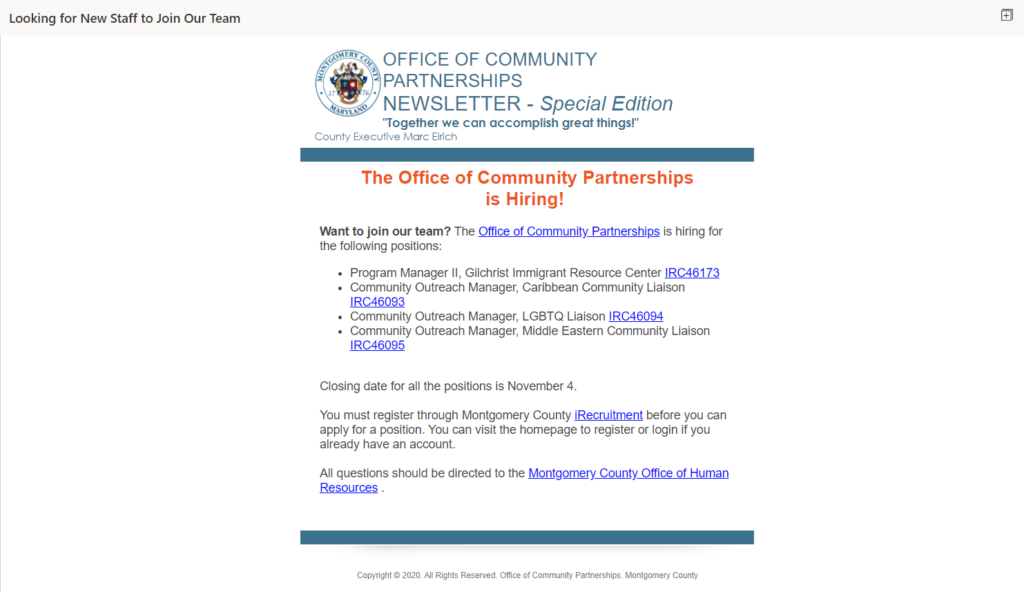
Today, I received this notice from the county’s Office of Community Partnerships that they are hiring for three community outreach positions and a program manager position.

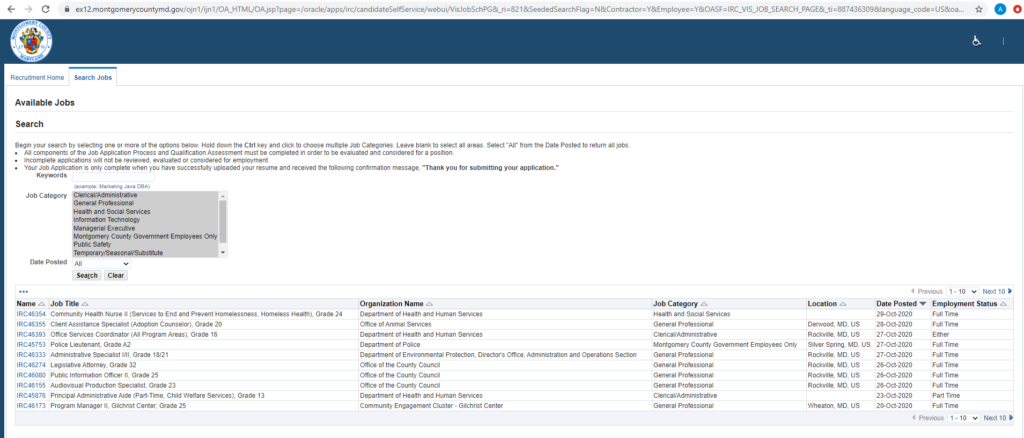
That’s not all. The county’s online hiring system shows 43 open positions for which the county is soliciting applications, of which 22 were posted this month and 9 were posted in the last week. These positions include an adoption counselor in the Office of Animal Services, an administrative specialist in the environmental protection director’s office, a manager in the retirement plan office, a policy analyst in the budget office, a warehouse position at the liquor monopoly and three positions at the county council. It’s hard to argue that any of these positions are “engaged in direct response to COVID-19.”

So let’s add this all up. The county is facing hundreds of millions of dollars in revenue losses. Nevertheless, it has committed to open-ended COVID pay that could total $100 million over the course of the year, is spending freely from reserves and passed a cream puff savings plan full of paper “savings” from lapsed positions. The county can’t stick to its previously announced hiring freeze and is even hinting at another raid on retiree health care money. The county’s fiscal strategy, such as it is, is to pray for a federal bailout.

Maybe the county will get a bailout after all. If the feds don’t do it, will taxpayers be asked to do it next spring?

Share

Maryland Politics Watch