Scandal: County Employees Got COVID Pay They Were Not Entitled to Get

By Adam Pagnucco.

MoCo Inspector General Megan Davey Limarzi, who previously uncovered an overtime scam in the fire department, has done it again. She has issued a new report detailing COVID emergency payments to employees of the Department of Permitting Services (DPS) who were not entitled to receive them under county policy. Moreover, she hints that this may be happening in other departments too. The whole thing is a massive scandal due to – at the very least – poor management in county government.

COVID emergency pay was set in three collective bargaining agreements with the police, the fire fighters and MCGEO in early April. Two categories of emergency pay were established:

Front facing onsite: work that cannot be performed by telework, involves physical interaction with the public, and cannot be performed with appropriate social distancing. This work would receive an additional $10 per hour.

Back office onsite: work that cannot be performed by telework and does not involve regular physical interaction with the public. This work would receive an additional $3 per hour.

Work performed through telework was ineligible for emergency pay.

In May, the Office of Inspector General (OIG) received complaints that DPS was allowing inspectors to receive front facing emergency pay ($10 per hour) for work performed at home. The complaints alleged that employees were “defrauding the system” and “taking advantage of undeserved hazard pay.”

That’s exactly what the OIG found was occurring in four out of five DPS divisions. The OIG wrote:

Our investigation uncovered that DPS management enacted a COVID differential pay policy that was contrary to the Administration’s policy, resulting in overpayment of front facing COVID differential pay to DPS inspectors from approximately March 29 to August 29, 2020. We also found that DPS inspection data on its website, the Data Montgomery website, and in internal records is incomplete and not entirely accurate.

The reason for the overpayments was that work performed remotely was allowed to be paid an extra $10 per hour as if it had been performed in physical interaction with the public. That violated county policy, which held that each hour of work had to be evaluated separately to determine whether it was eligible for an extra $10 per hour (front facing), $3 per hour (back office) or nothing (telework). The violation occurred because DPS management allowed it. The OIG wrote:

The former Acting DPS Director and the four Division Chiefs stated that collectively they decided to allow inspectors to claim front facing differential for their entire workday rather than ‘nickel and dime’ them by asking that they account for individual hours.

Notably, Fire Prevention and Code Enforcement inspectors correctly followed County policy and did not claim front facing differential for their entire workday. The Division Chief told us that he did not know that the former Acting Director interpreted the policy differently. He also did not know that the other divisions were allowing their inspectors to claim all their workhours as qualifying for front facing differential.

The OIG could not figure out how much of the emergency pay was ineligible under county policy. That’s because “we were not able to obtain accurate information on the number of inspections conducted by DPS inspectors, how inspections were conducted, and their duration.” The OIG did note that when DPS finally adjusted its policy to match county policy, front facing differential hours claimed fell by 27% and the number of DPS employees claiming 80 hours of front facing pay per pay period fell by 90%.

Finally, the OIG made this ominous statement. “Additionally, we found that other County departments may also be misapplying the COVID differential pay policy and possibly paying undeserving employees COVID differential pay.” The report does not present evidence to back this up but one senses that this may ultimately be only the beginning of a much larger investigation.

The OIG recommended that the executive branch review DPS and all other county departments to ensure that COVID pay was being administered in compliance with county policy. The OIG also recommended that the county not use CARES Act money or apply for FEMA reimbursements for COVID emergency pay until all payments had been verified as complying with county policy. Chief Administrative Officer Rich Madaleno replied that county departments would review the pay and follow the collective bargaining agreements and regulations which established the pay. He also said that the county would “make all appropriate adjustments” to any FEMA reimbursement requests or uses of CARES Act money.

So let’s review this astonishing report. Top management in one of the county’s most important departments was willing to disobey county policy and overcharge taxpayers rather than have work hours properly reported. Management also lacked complete or accurate records on the actual work performed by its employees. The county’s budget monitoring processes failed to catch this and it would probably still be going on if it weren’t for the OIG. The county’s ability to seek FEMA reimbursements for this pay could be endangered. (Let’s remember that the total amount of COVID emergency pay is projected to be $100 million over the course of a calendar year and currently has no fixed end date.) And the county’s response is not “heads are going to roll and we will get our money back,” but rather that they will follow regulations and collective bargaining agreements.

Who knows what will happen now, but here’s a prediction: the county council’s review of this report is going to be must-see TV. A preview appears below.

Share

Watching the Vote Counts: A Lesson from Maryland

By Adam Pagnucco.

Just like me, I bet you’re eagerly watching the presidential vote counts in states like Arizona, Georgia, Nevada and Pennsylvania. Here’s a bit of info from Maryland that might help you digest what you’re seeing.

Press coverage of those states emphasizes voting by county. If certain big counties (like Philadelphia in Pennsylvania, Clark in Nevada, Fulton in Georgia and so on) are both heavily Democratic and have counted below average percentages of their votes, that is obviously going to impact the overall state leads. But there’s another thing to consider: voting mode. Democratic Party leaders told their people to vote by mail and vote early. Republican Party leaders told their people to avoid mail and vote in person. That has apparently had some impact in how members of each party chose to vote.

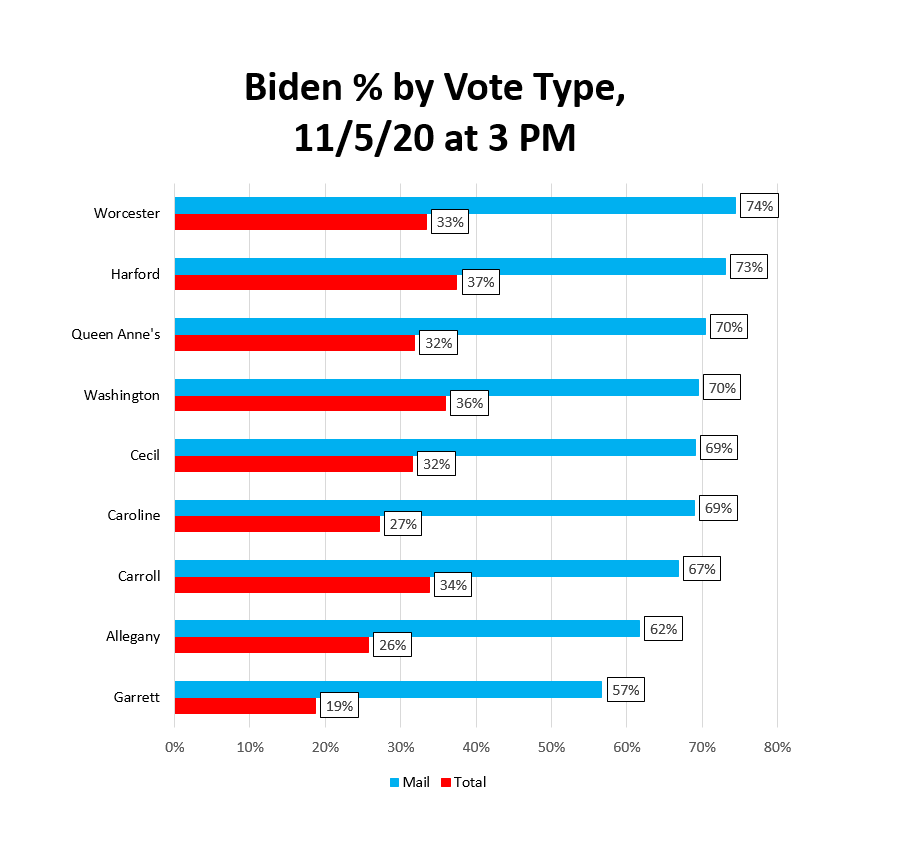
The chart below shows former Vice-President Joe Biden’s vote percentages in nine Maryland counties as of this writing (3 PM on November 5): Allegany, Caroline, Carroll, Cecil, Garrett, Harford, Queen Anne’s, Washington and Worcester. The data comes from the State Board of Elections. All of these counties gave at least 60% of their total votes so far to President Donald Trump. They are arguably the most conservative counties in the state. The red bars in the chart show Biden’s percentage of the total votes. The blue bars show Biden’s percentage of the mail votes.

In every one of these counties, Biden received less than 40% of total votes tabulated so far. However, in every one of these counties, Biden received a majority of mail votes. In seven of the nine counties, Biden received at least two-thirds of mail votes despite losing by double digits overall to Trump.

A strong caveat: this is Maryland, not Arizona, Georgia, Nevada or Pennsylvania. But these are also rather conservative places in Maryland, places where Democrats at all levels usually lose. The implication here is that voting mode may matter as much as vote count percentages by county. If a disproportionate share of the outstanding votes in Arizona, Georgia, Nevada and Pennsylvania are mail votes, Biden may have an advantage as those votes come in even if they come from red counties.

Let’s see how much that matters in the hours ahead.

Share

MoCo Ballot Groups Declare Victory

By Adam Pagnucco.

The four ballot issue committees who worked on behalf of Questions A and C and against Questions B and D have issued a joint victory statement. The committees and their affiliated organizations had different focuses on the questions but still coordinated their activities when possible. Their statement is reprinted below.

*****

FOR IMMEDIATE RELEASE

MONTGOMERY COUNTY BALLOT COMMITTEES CELEBRATE SUCCESS AT THE BALLOT BOX

Broad coalition of religious, business, labor, and community groups thanks all the members and partners who worked tirelessly to protect the future of Montgomery County.

MONTGOMERY COUNTY, November 5, 2020 — With a shared vision of a better Montgomery County that works for everyone, we successfully took our message to voters about the County ballot questions. Every vote counts and, as our County’s dedicated election workers complete the count, we take a moment to acknowledge the power of our community working together.

In a time when our country is so divided, Montgomery County showed how broad and diverse coalitions can work side by side to address tough issues. Whether it is tax policy or representation, the politics of lifting people up is more powerful than tearing people down. When we believe changes are needed, we are capable of coming together as a community to make it happen. We are confident in the opportunity ahead to build a better and stronger future for all Montgomery County residents.

Signed,

Montgomery Neighbors Against Question B
Press Contact: Daniel Koroma

Montgomery Countians For A & Against B
Press Contact: Scott Goldberg

Residents for More Representation
Press Contact: Marilyn Balcombe

Vote No on B&D
Press Contact: Susan Heltemes

Ballot committee coalition members:
● Baltimore-Washington Laborers’ District Council, LiUNA
● CASA
● CERG 2.0
● Greater Capital Area Association of Realtors(R)
● Jews United for Justice
● LGBTQ Democrats of Montgomery County
● MCGEO – UFCW Local 1994
● MoCoWoMen
● Montgomery Countryside Alliance
● Montgomery County Chamber of Commerce
● Montgomery County Council of PTAs
● Montgomery County Democratic Central Committee
● Montgomery County Democratic Socialists of America
● Montgomery County Education Association
● Montgomery County Hispanic Chamber of Commerce
● Montgomery County Women’s Democratic Club
● Montgomery County Young Democrats
● Nonprofit Montgomery
● Progressive Maryland
● SEIU Local 500
● Sierra Club
● Takoma Park Mobilization
● The Association of Black Democrats of Montgomery County
● and many other organizations, county leaders, and engaged residents!

#

Share

Moody’s: Passage of Question A is a “Credit Positive”

By Adam Pagnucco.

Moody’s Investors Service, one of the three major Wall Street bond rating agencies, has released an issuer comment characterizing the passage of Question A as a “credit positive” for Montgomery County. The comment is reprinted below.

*****

Montgomery (County of) MD

Voters amend limits to property tax revenue collections, a credit positive

On November 3, voters in Montgomery County (Aaa stable) approved a charter amendment on property tax limitations which enables the county to raise property tax rates without revenue constraints, a credit positive.

The approved measure (Question A) replaces the existing limit and enables a unanimous vote by County Council to adopt a tax rate on real property that can exceed the rate from the previous year. The amendment is credit positive for county operations because property tax revenue is not subject to any restrictions based on inflation, and revenue growth can be captured through tax base expansion in addition to any approved rate increases. The county’s previous charter limit, a self-imposed tax cap that was enacted in 1990, limited property tax revenue growth to the rate of inflation (CPI index) and an amount based on new construction.

A second charter amendment on the ballot (Question B) was rejected, which aimed to remove the county’s ability to increase revenue above inflation. The failure of the measure is also positive because it enables the county to retain flexibility to increase this revenue source when needed to balance the budget, particularly as its income tax rate is already levied at the maximum state cap of 3.2%. Montgomery County is just one of five counties in Maryland with a charter amendment limiting property tax revenue increases, and the ability to adjust the tax rate accordingly is important, particularly as most of the county’s debt is secured by its limited ad valorem tax and full faith and credit pledge.

Income taxes are the county’s primary general fund revenue source (43.5% of total fiscal 2019 revenue), followed by property taxes (36.6%) and other local taxes (7.8%).

The county demonstrated willingness to override its prior charter limit in May 2016 when it approved a 9.9% increase in property tax revenue to support rising debt service and insurance costs, as well as an increase in the Maintenance of Effort (MOE) for K-12 schools and the community college, mandated by the State of Maryland (Aaa stable). Without the increase, the county faced a $178 million budget gap in fiscal 2017 (ended June 30, 2017).

Share

MoCo’s Bad Bailout Bet

By Adam Pagnucco.

There are a lot of reasons to pay attention to the races for president and Congress: social justice, climate change, the pandemic, the economy, the fate of planet Earth… you get the idea. Here’s one more reason. If you’re a MoCo taxpayer, the fiscal fate of your county government might depend on what happens in Washington. And right now, that fate is not looking great.

Here’s why: since the summer, MoCo has been praying for a federal bailout. The reasons include:

1. The county is facing a revenue shortfall currently estimated at $192 million in this fiscal year and more than a billion dollars over the next six years.

2. In July, the county passed a nothing-burger savings plan that relied to a great extent on lapses rather than actual cuts.

3. From January through mid-September, the county council spent $28 million out of reserves.

4. The county executive has entered into open-ended agreements with county employee unions to give them emergency pay which could total $100 million over the course of a year. (Employees at MCPS, the college and park and planning are not covered by these agreements.) MoCo’s emergency pay is far more generous than offered by any other jurisdiction in the region.

5. Counting both appropriations and placeholders, the county’s share of federal CARES Act money is already spoken for.

6. The county’s own emergency management director has expressed skepticism in public that FEMA will reimburse the county for a meaningful share of its COVID expenses.

7. The county has ended its hiring freeze and is filling positions across many different departments, including ones not directly related to the pandemic emergency.

But who needs fiscal discipline when a blue wave sweeps over Washington, giving the Democrats total control of the federal government? And then they can solve all of MoCo’s financial problems with the biggest state and local government aid package in U.S. history. Right?

Wrong.

As anyone not hiding on Mars has noticed, the federal elections have not gone as planned for Democrats. Three scenarios seem plausible, all with troubling consequences for MoCo.

President Donald Trump wins reelection.
This is obviously awful for many reasons. One of them is that Vice-President Mike Pence can break ties in the U.S. Senate, giving GOP Senate Majority Leader Mitch McConnell extra latitude in his chamber.

Former Vice-President Joe Biden defeats Trump but Republicans hold control of the Senate.
This is better than a second Trump term but let’s remember that McConnell once said he would prefer that state and local governments go bankrupt rather than get more federal aid. Additionally, the last thing McConnell would want is to give Biden a big win with tons of federal money for blue localities like MoCo.

Biden wins and Democrats get razor-thin control of the Senate.
Even if Democrats win the Senate, McConnell could use the filibuster to block or reduce more federal aid. Would Democrats repeal the legislative filibuster with control of the Senate hanging on a vote or two?

Clearly, a huge bailout for MoCo is far from a sure thing under any of these scenarios. It’s also not helpful that the Democratic majority in the U.S. House could be the smallest held by either party in 20 years.

MoCo’s bailout bet was always a bad one. At the very least, a bit of restraint was in order. But we are now one-third of the way into the current fiscal year and any budget adjustments made now will be more severe than if they were put into effect months ago. The mess is getting harder to clean up, not easier.

Is anyone going to bring order to the budget or are we headed for another tax hike?

Share

How Many More Votes Will be Counted?

By Adam Pagnucco.

As of right now, here is the status of key election results in MoCo.

School Board At-Large: Lynne Harris 53%, Sunil Dasgupta 46%

School Board District 2: Rebecca Smondrowski 60%, Michael Fryar 39%

School Board District 4: Shebra Evans 66%, Steve Solomon 33%

Circuit Court Judge: Bibi Berry 23%, David Boynton 21%, Michael McAuliffe 21%, Christopher Fogleman 20%, Marylin Pierre 14%

Question A (Authored by Council Member Andrew Friedson, freezes property tax rate with unanimous council vote required to exceed): For 62%, Against 38%

Question B (Authored by Robin Ficker, would limit property tax receipt growth to rate of inflation and remove council’s ability to exceed): For 42%, Against 58%

Question C (Authored by Council Member Evan Glass, changes county council structure to 4 at-large seats and 7 district seats): For 61%, Against 39%

Question D (Authored by Nine Districts for MoCo, changes county council structure to 9 district seats): For 42%, Against 58%

You can see the latest results here for school board and judicial races and here for ballot questions.

But all of this is subject to a HUGE caveat: not all the votes have been counted. How many more remain?

Three batches have yet to be counted. First are the remaining election day votes. As of right now, only 3 of 40 election day vote centers in the county have reported 80% or more of their results. At this moment, 6,474 election day votes have been cast for president. That suggests tens of thousands of votes more could come in.

Second are the remaining mail votes. According to the State Board of Elections, MoCo voters requested 378,327 mail ballots. At this moment, 177,628 mail votes have been cast for president. This suggests that roughly 200,000 mail votes are out there. Not all of them will ultimately result in tabulated votes but it’s still a lot.

Third are provisional ballots. How many are out there is not known right now. However, this will be by far the smallest of these three categories and they will make a difference only in tight races.

So let’s put it all together. At this moment, 312,452 total votes for president have been tabulated. (I don’t have an official turnout number, but since the presidential race has the least undervoting, this figure is probably reasonably close to turnout so far.) This suggests – VERY roughly – that 55-60% of the votes have been counted, with the vast majority of outstanding votes coming from mail ballots.

What does that mean for the results above? To determine that, we need to examine how different the election day votes and the mail votes were from the total votes tabulated so far since those two categories are where most of the remaining votes are coming from. And of those two categories, mail votes will be far larger than election day votes.

President

MoCo’s votes for president (as well as Congress) are not in doubt but the differential results by voting mode are suggestive of a pattern affecting other races. Former Vice-President Joe Biden has received 79% of total votes as of this moment. However, he has received 51% of election day votes, 65% of early votes and 90% of mail votes. That illustrates a strong partisan pattern associated with voting, with election day votes most friendly to Republicans and mail votes most friendly to Democrats. Keep that in mind as you proceed to the races below.

Circuit Court Judges

Challenger Marylin Pierre has so far received 14% of early votes, 14% of election day votes, 15% of mail votes and 14% of total votes. Each of the incumbent judges cleared 20% on all of these voting modes. This is a non-partisan race so the partisan pattern noted above has minimal effect here. With little reason to believe that the next batch of mail votes will be different than the mail votes already tabulated, it’s hard to see Pierre pulling ahead.

School Board

The district races are blowouts. Let’s look at the at-large race between Lynne Harris and Sunil Dasgupta. Harris has so far received 53% of early votes, 60% of election day votes, 53% of mail votes and 53% of total votes. These are not big leads but they are fairly consistent. For Dasgupta to pull ahead, he would need to pull at least 55% of the outstanding votes yet to be counted, more than flipping the outcome of the existing votes. Unless the next batch of votes – especially mail – is somehow fundamentally different from what has already been cast, it’s hard to see that happening.

Ballot Questions

There are two things to note here. First, none of these results are close at this moment. Second, while these are technically non-partisan, the Democratic Party and the Republican Party endorsed in opposite directions and both sides worked hard to make their views known. The partisan split seen in the presidential election had an impact on the ballot question results.

First, let’s look at election day voting. Judging by the presidential race, this was the most favorable voting mode for the GOP. Here is how election day voting (so far!) compares to total voting (again, so far).

Question A For Votes: Election day 51%, total 62%
Question B For Votes: Election day 60%, total 42%
Question C For Votes: Election day 52%, total 61%
Question D For Votes: Election day 60%, total 42%

This looks like good news for supporters of Question B (Robin Ficker’s anti-tax question) and Question D (nine districts). After all, there are probably tens of thousands of election day votes yet to be counted.

However, the big majority of outstanding votes are mail ballots. Joe Biden received 90% of mail ballot votes tabulated so far, a sign that Democrats dominated this voting mode. Here is what the mail votes (so far) look like.

Question A For Votes: Mail 68%, total 62%
Question B For Votes: Mail 34%, total 42%
Question C For Votes: Mail 65%, total 61%
Question D For Votes: Mail 33%, total 42%

The mail votes uphold the winning margins of Questions A and C and depress the results for Questions B and D. That’s not a surprise if 1. Democrats voted disproportionately by mail and 2. Democrats stuck with their party’s position on the ballot questions. Indeed, we know here at Seventh State that this post on the Democrats’ statement on the ballot questions got huge site traffic.

As a matter of fact, one could even go so far as to say that once the ballot questions turned partisan, it may have been the beginning of the end.

Plenty of votes remain to be counted so let’s respect that. We may know a lot more by the weekend.

Share

Pierre Trailing in Challenge to Incumbent Judges

Based on the report run just after midnight, progressive challenger Marylin Pierre is trailing in her bid to unseat one of the four incumbent judges.

These are incomplete results but they show Pierre with a substantial deficit of over 50,000 votes behind Christopher Fogleman in fourth place.

Note that the number of under votes, the people who cast ballots but chose not to vote in the contest, is far higher than the number of votes received by an of the judicial candidates. There are no partisan cues and most people don’t know the candidates.

Pierre has run a spirited challenge, winning a slot in the general election by defeating one of the incumbents in the Democratic primary. She won some noted endorsements, including one from Prince George’s State’s Attorney Aisha Braveboy the other day.

At the same time, Pierre’s campaign made several missteps. Previously, the progressive-backed candidate had donated to Republicans. Her twitter account suggested wrongly that burden of proof was on accused police in the George Floyd case to show that they are not guilty. Pierre blamed the misstep on a volunteer who failed to follow guidelines in managing the Twitter account.

The incumbent judges proved ready to capitalize aggressively on these errors, even to the point of getting a restraining order against Pierre for a campaign volunteer who inaccurately portrayed her as Judge Pierre. These problems combined with a very different electorate that of the Democratic Primary appear to have left Pierre short last night with the incumbent slate of four judges returning to the bench in Montgomery.

Share

Early Results on MoCo Races

By Adam Pagnucco.

The first batch of votes on MoCo races has been reported. This is VERY early and VERY incomplete. So far, the reports include only early votes and less than half the mail ballots requested by MoCo voters with no election day votes tabulated. All of that means these races are FAR from decided, folks!

All of that said, here are the earliest results. Bear in mind that the final percentages are going to be different, but how different they will be cannot yet be said.

School Board At-Large: Lynne Harris 53%, Sunil Dasgupta 46%

School Board District 2: Rebecca Smondrowski 60%, Michael Fryar 39%

School Board District 4: Shebra Evans 67%, Steve Solomon 33%

Question A (Authored by Council Member Andrew Friedson, freezes property tax rate with unanimous council vote required to exceed): For 63%, Against 37%

Question B (Authored by Robin Ficker, would limit property tax receipt growth to rate of inflation and remove council’s ability to exceed): For 41%, Against 59%

Question C (Authored by Council Member Evan Glass, changes county council structure to 4 at-large seats and 7 district seats): For 62%, Against 38%

Question D (Authored by Nine Districts for MoCo, changes county council structure to 9 district seats): For 41%, Against 59%

It is probably not a coincidence that these results mirror the recommendations of the county’s Democratic Party, but the results are far from final.

At some point tonight, the election day votes should be added in. You can refresh them here for school board races and here for ballot questions.

Share

Klacik’s Vanity Project

Republican Kim Klacik sure garnered a lot of attention and money for her longshot bid to unseat Kweisi Mfume in the Seventh Congressional District. But she has been far more focused on building her national brand than on Baltimore.

Klacik may have become the first congressional challenger in history to refuse free local TV time when she wouldn’t sit down for a standard candidate profile interview with WBAL at the end of October. As WBAL reported:

Klacik declined an invitation to sit down with 11 News for this election series. A spokesman said Klacik would agree to a live TV interview or nothing.

Klacik doesn’t live in the Seventh District. As she notes, it’s not a legal requirement, and says she’ll move if she wins. Klacik has spent an unusual amount of time outside the district for someone claiming to have a genuine interest in winning it. Klacik traveled to Arizona to take part in rallies with President Trump and Donald Trump, Jr. — not the usual stomping grounds for voters in the Seventh District (at least of Maryland).

Republican blogger Brian Griffiths and I rarely agree on anything political. Seems like he got this one dead right though:

Kim Klacik doesn’t actually give a damn about winning the election. Kim Klacik doesn’t give a damn about the Baltimore County Republican Central Committee, of which she ostensibly remains a member. She doesn’t give a damn about the Maryland Republican Party or even the city of Baltimore. All she cares about is continue to parlay her unearned fame into continued speaking fees and media appearances. Hey, she wouldn’t be the first internet celebrity Republican to follow the money. But for Kim Klacik to do it now, mere days before her election, is an insult of the highest order and she is making a fool out of everybody who has ever supported her or gave her money.

Generally, it’s great for any community to have strong choices and to be courted by both parties. But that’s not what Klacik’s campaign has been about. Maryland voters of all political stripes ought to remember that when she launches her next vanity project.

Share

Top Seventh State Stories, October 2020

By Adam Pagnucco.

These were the top stories on Seventh State in October ranked by page views.

1. MoCo Democrats Issue Statement on Ballot Questions
2. Sitting Judges Get Temporary Restraining Order Against Pierre
3. Harris Blasts MCEA Over School Reopening
4. Progressive-Backed Judge Candidate Courted, Donated to Republicans
5. Teachers Respond to Lynne Harris
6. Elrich Vetoes WMATA Property Tax Bill
7. State Audit: Thousands of MoCo Homeowners Overcharged on Property Taxes
8. Reopening Plans – MCPS is Behind
9. Why Montgomery County Ballot Questions B and D Are Truly Bad Ideas You Should Vote Against
10. Ballot Question Committee Scorecard

The number one post by far was MoCo Democrats Issue Statement on Ballot Questions. In fact, that post was one of the most well-read in the history of Seventh State. Most folks who saw it probably found it through Google – and that’s a meaningful piece of intelligence. If people are googling terms like Montgomery Democrats and ballot questions, then not only are they finding content here, they may find similar content at Bethesda Beat, the Democratic Central Committee’s website, the various ballot issue websites and elsewhere. This means that MoCo voters want to know what the county Democrats think about the ballot questions. That’s good news for supporters of Questions A and C and not such good news for supporters of Questions B and D.

The two posts about circuit court judge candidate Marylin Pierre and her opponents, the sitting judges, are being aggressively circulated on social media. This is the fiercest MoCo judicial race in a loooooong time. Can Pierre break through?

One story that was big with readers and off the radar of politicians was State Audit: Thousands of MoCo Homeowners Overcharged on Property Taxes. It’s a massive scandal that state math errors resulted in overcharging of property taxes for thousands of MoCo homeowners and that the state is refusing to offer refunds. In addition to Seventh State, Fox 5 and WMAR (ABC) Baltimore covered it. As far as I know, no state or county politician has made a public statement about this. Maybe I will ask them!

Share

Maryland Politics Watch