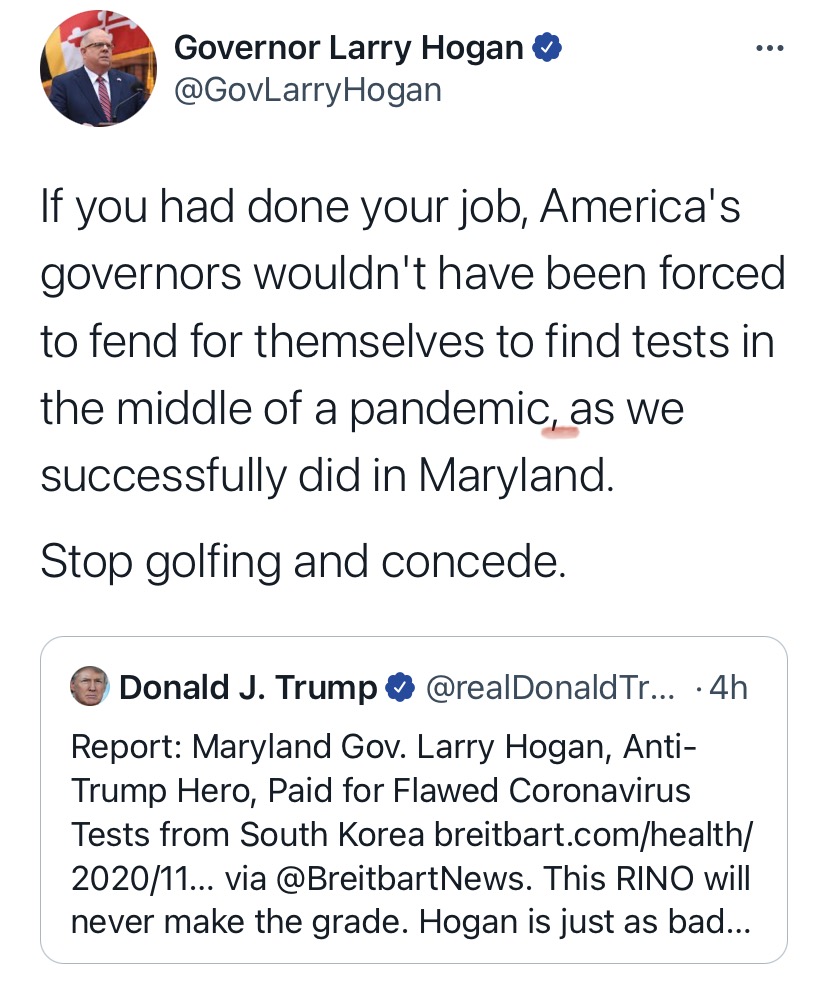
Gov. Larry Hogan is having a very bad press week as the media finally focuses on the well known fact that the COVID tests from South Korea were overpriced duds and that he has continued to pretend that they were a success long after it was clear that they weren’t.
But Gov. Hogan is absolutely 100% right on the money when he says that the federal government left the states completely at sea. After denial of the pandemic was no longer possible, President Trump repeatedly and publicly told the states that they were on their own. So Gov. Hogan may have failed in this instance, but why on earth did the president and the federal government leave him to scramble for tests and other supplies?
Gov. Hogan was among the first Republicans to do the utterly normal and congratulate President-Elect Biden. He hadn’t gone beyond that to show leadership in demanding that Trump concede or point out that his behavior was that of an undemocratic sore loser. Looks like the President’s attack has just goaded him into precisely just that.
It turns out that President Trump isn’t the only one who doesn’t take well to public slams and knows how to punch back twice as hard.
In a little-noticed executive order, County Executive Marc Elrich has indefinitely prolonged the time taken by the county government to respond to Maryland Public Information Act (MPIA) requests. Under the order, MPIA requestors may have to wait until after the pandemic emergency is over before the county will answer their requests.
The MPIA is a state law that is a counterpart to the federal Freedom of Information Act. Under the MPIA, individuals may request records in the custody of state and local governments subject to a number of exceptions. The time taken by governments to respond to requests is described by the state’s MPIA manual:
Under GP § 4-203(b)(1), if a custodian determines that a record is responsive to a request and open to inspection, the custodian must produce the record “immediately” after receipt of the written request. An additional reasonable period “not to exceed 30 days” is available only where the additional period of time is required to retrieve the records and assess their status under the PIA. A custodian should not, however, wait the full 30 days to allow or deny access to a record if that amount of time is not needed to respond.
That may not be the case anymore in Montgomery County for the foreseeable future.
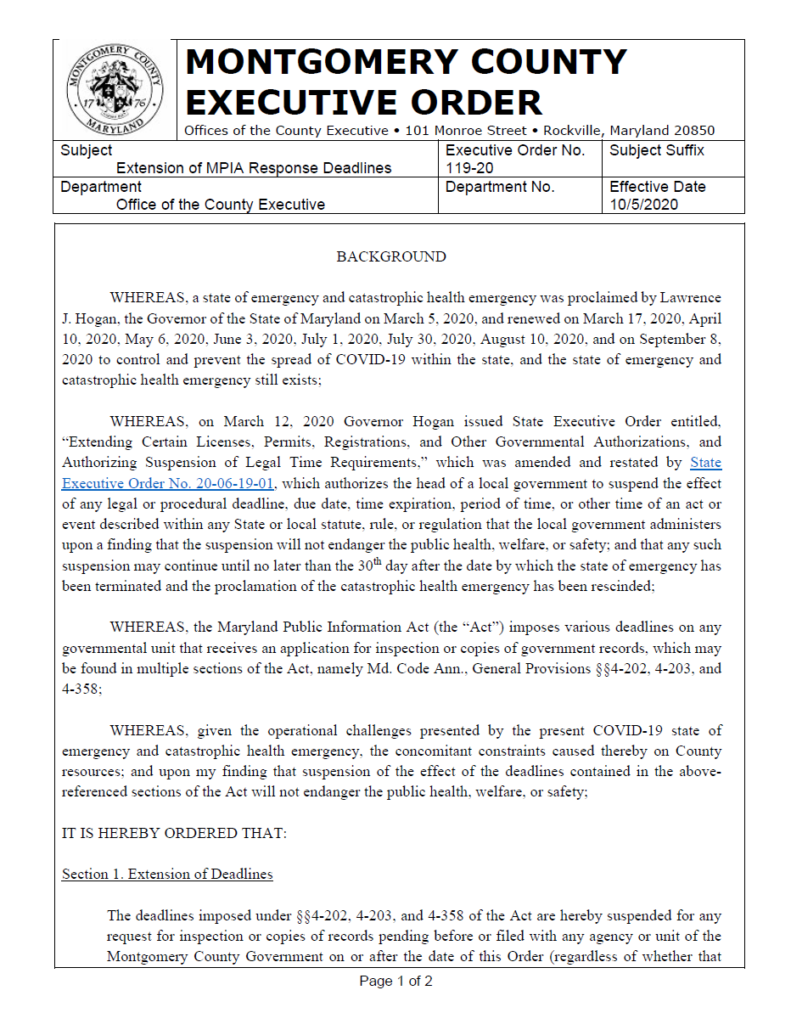
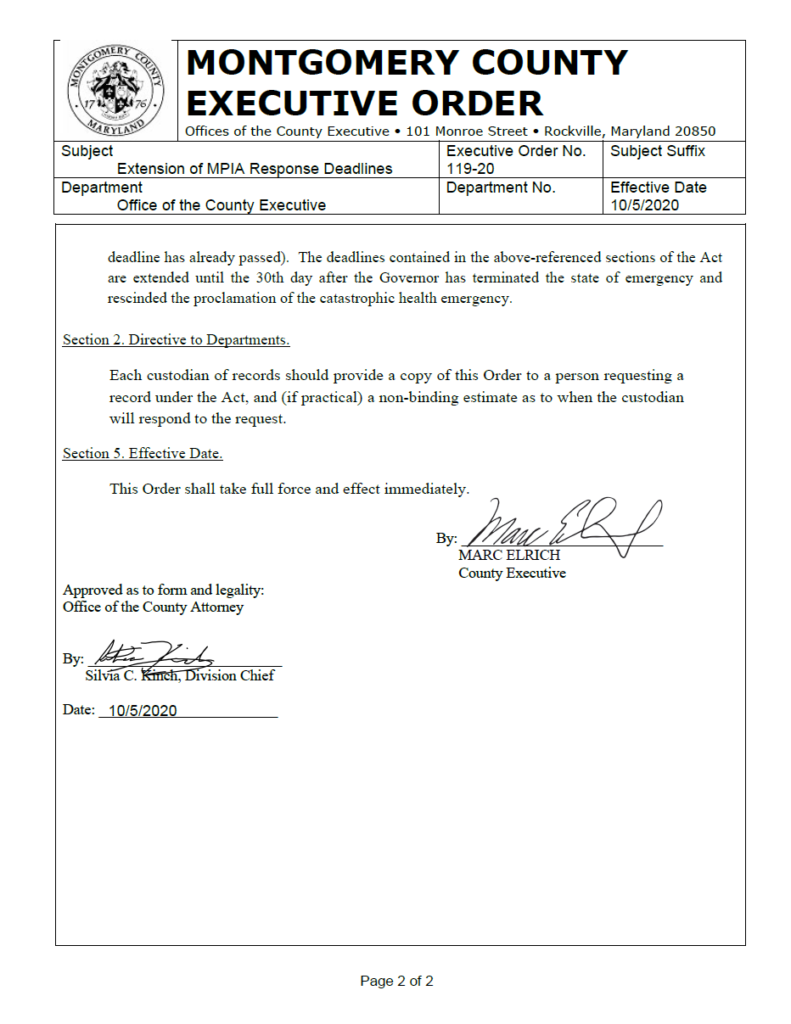
On October 5, County Executive Marc Elrich issued Executive Order 119-20 on the subject of “Extension of MPIA Response Deadlines.” The order’s text states:
Section 1. Extension of Deadlines
The deadlines imposed under §§4-202, 4-203, and 4-358 of the Act are hereby suspended for any request for inspection or copies of records pending before or filed with any agency or unit of the Montgomery County Government on or after the date of this Order (regardless of whether that deadline has already passed). The deadlines contained in the above-referenced sections of the Act are extended until the 30th day after the Governor has terminated the state of emergency and rescinded the proclamation of the catastrophic health emergency.
Section 2. Directive to Departments.
Each custodian of records should provide a copy of this Order to a person requesting a record under the Act, and (if practical) a non-binding estimate as to when the custodian will respond to the request.
Section 5. Effective Date.
This Order shall take full force and effect immediately.
No one knows when the state of emergency will end. This executive order could conceivably postpone MPIA responses by a year or more. This is an unprecedented act by Montgomery County Government. Additionally, the reference to “any agency or unit” of the county government raises the question of whether it applies to MCPS, Park and Planning, Montgomery College and other affiliated entities.
County governments normally do not have the option of overturning state law, but Elrich cites an executive order by Governor Larry Hogan as his source of authority. That executive order says in part:
The head of each unit of State or local government may, upon a finding that the suspension will not endanger the public health, welfare, or safety, and after notification to the Governor, suspend the effect of any legal or procedural deadline, due date, time of default, time expiration, period of time, or other time of an act or event described within any State or local statute, rule, or regulation that it administers. The unit head shall provide reasonable public notice of any such suspension.
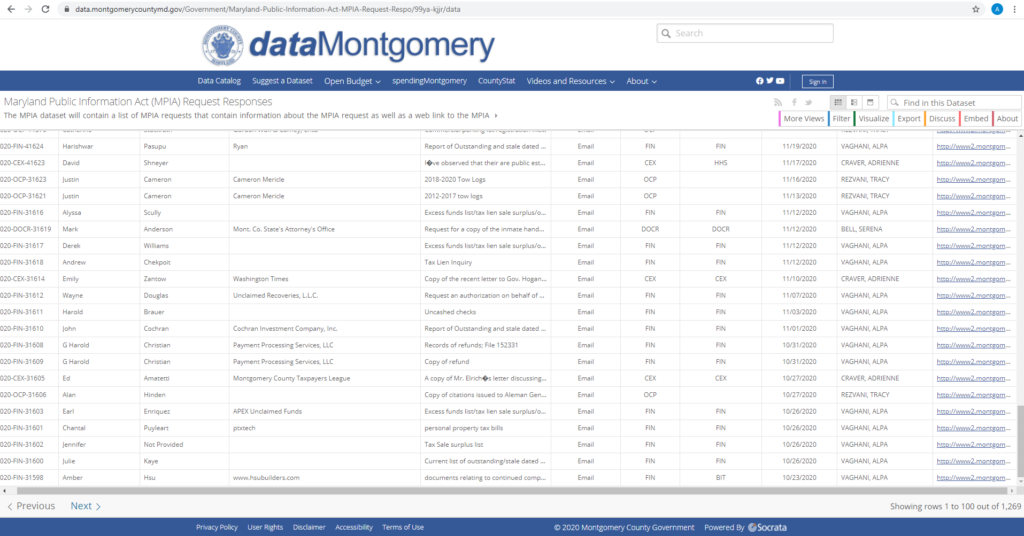
Elrich issued his executive order on October 5, when it took “full force and effect immediately.” Now here is an odd thing. According to the county’s MPIA response database, the county has answered 36 MPIA requests since October 5 as of this writing. This raises a number of questions. Do some county departments know of the executive order but not others? Or is there an interpretation of Elrich’s executive order that permits departments to decide whether to answer a request immediately or postpone it? Any disparate treatment of MPIA requests depending on their nature would be deeply troubling.
This screenshot of the county’s MPIA response database shows that it has continued to answer at least some requests since October 5.
Folks, I have been writing about state and county politics since 2006. I have used the MPIA countless times to obtain information of public interest, including information that would normally not be released by the authorities. The MPIA is among the most important tools available to residents to hold their government accountable. Indefinitely postponing answers to MPIA requests accomplishes nothing other than to allow county officials to behave as they will in the dead of night.
I respectfully ask the county council to summon representatives of the executive branch to justify this executive order in a public session.
by David Lublin (with a little help and inspiration from a friend)
This is like the world’s longest bad break-up. Will they get back together, or won’t they? And if so, will it last? And if not, looks like they’re gonna put themselves back out there on Match.com (P3 edition) and hope for the best.
It’s like the State is the boyfriend not getting the message when told “It’s not you, it’s me.” In this case, it may really be the “me” because my understanding is that companies like Fluor in the Purple Line Transit Partnership no longer want to be in this sort of business. Put another way, they just aren’t that into us anymore.
The problem for the State is that the breakup comes with a payout of $367 million — a little more than the usual foregone when you made the wise decision not to request that VHS tape or DVD back. Where is the State supposed to find this money? Is the new concessionaire supposed to pay it as part of taking over the contract?
Then there is still the little matter of the extra $1 billion and rising in costs. I have no idea how much Fluor and the other companies are willing to pay to make the State go away. I’d observe, however, that (1) the State needs this finished way more desperately (it’s a political imperative, if nothing else) than they do, and (2) you can hire an awful lot of lawyers for just a fraction of that to fight over that big a chunk of change.
In short, it looks likely we’ll be on the hook for it. The State has the fantasy that this somehow won’t reduce the State’s borrowing capacity because the new concessionaire (P3 partner) will borrow the money. But we’ll have to pay it back over time and the bond rating agencies have made clear that they will unsurprisingly regard this government financial obligation as such in evaluating our AAA bond rating.
The financial distress resulting from this project is just getting started. It could hardly come at a worse time.
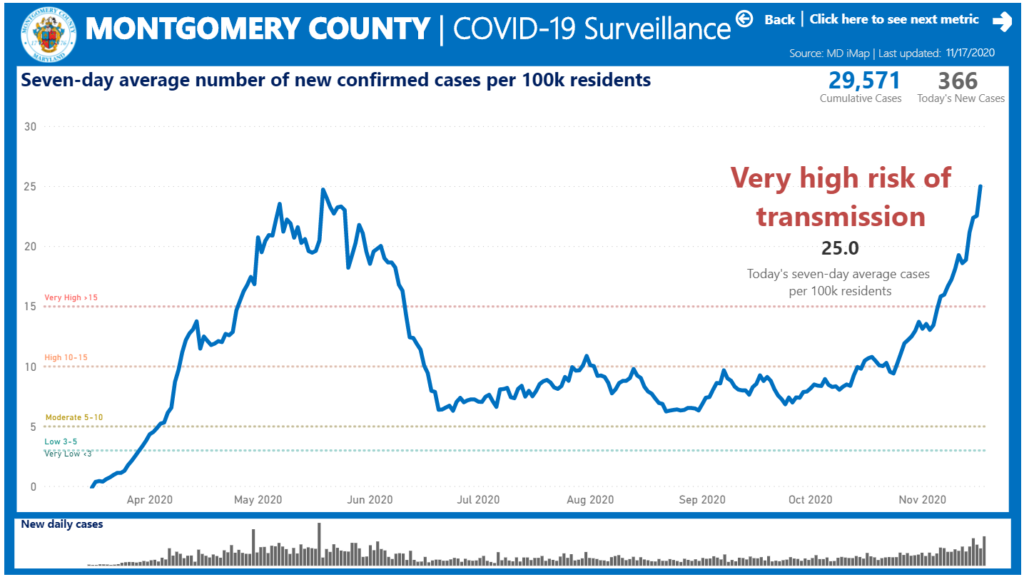
Yesterday, MoCo hit a new peak in its 7-day average of new COVID cases, a key statistic guiding the county’s pandemic response. On November 17, the county hit a 7-day average of 25.0 cases per 100,000 residents. That was higher than the previous peak of 24.7 on May 19, when the county’s lockdown measures were more severe than they are today. The graph below appeared on MoCo’s COVID dashboard yesterday.
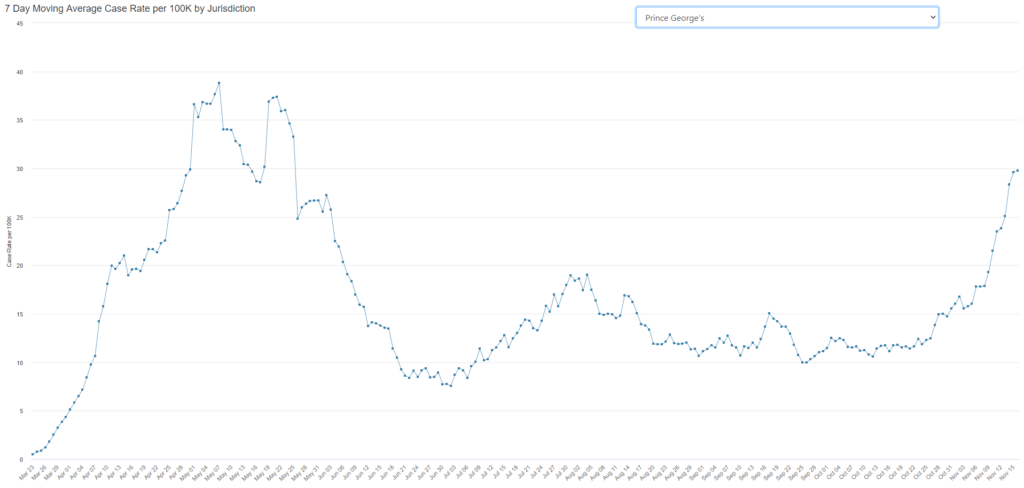
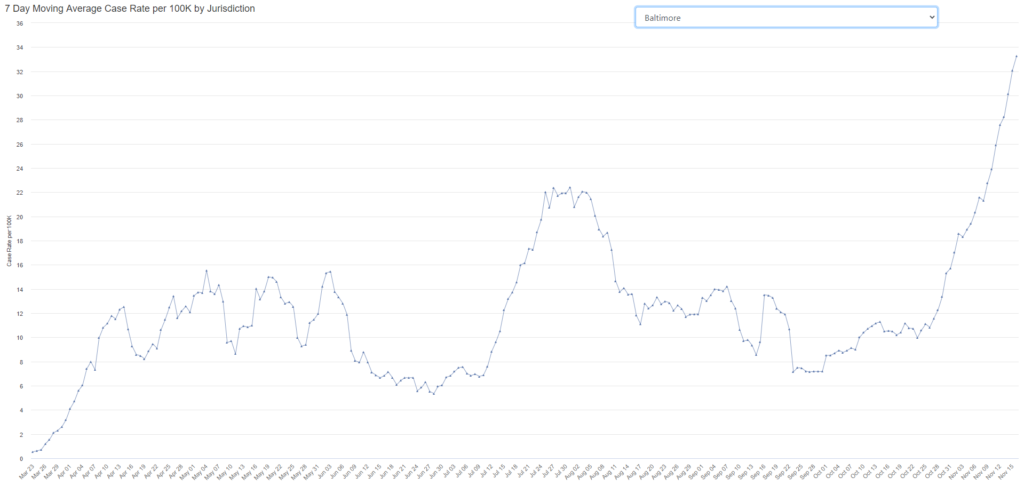
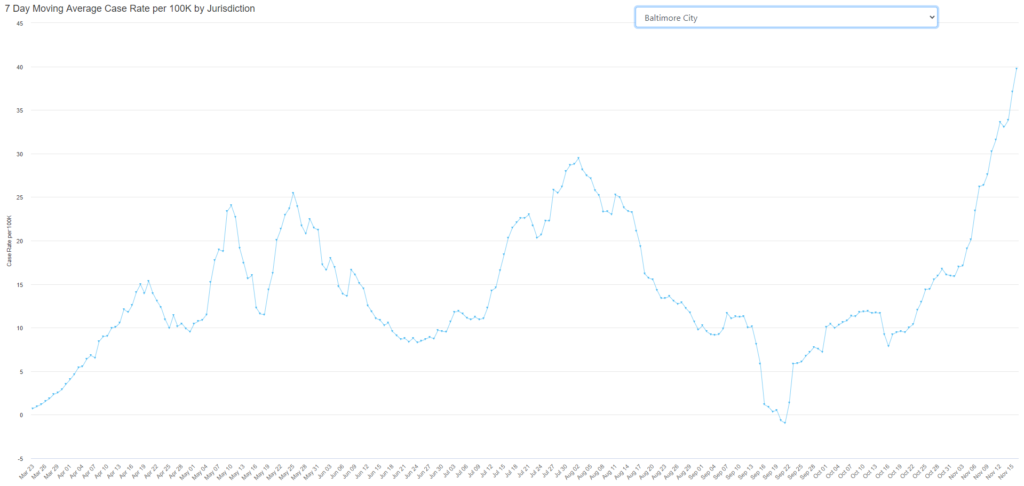
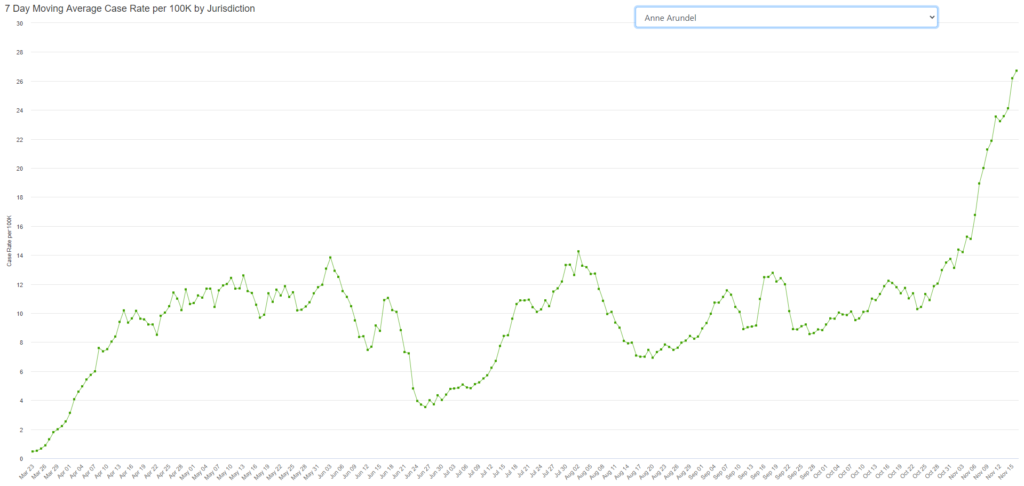
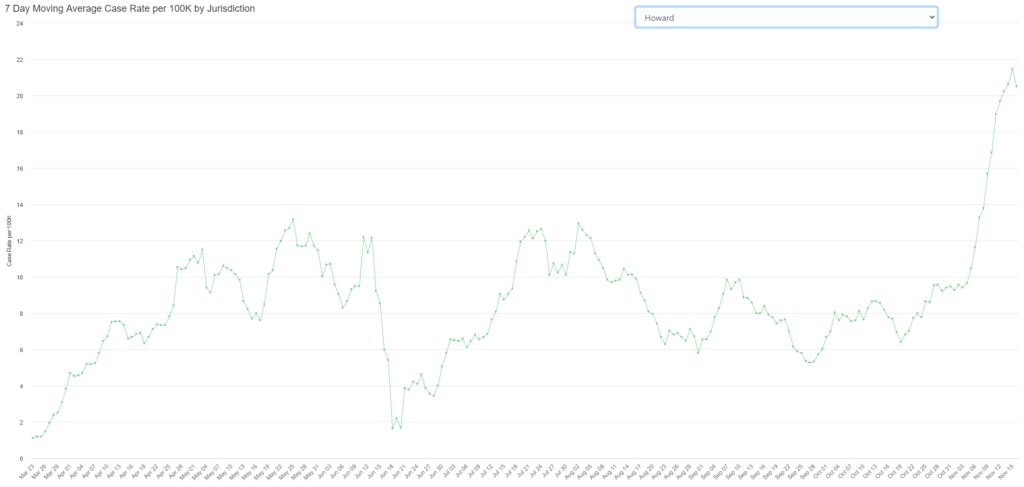
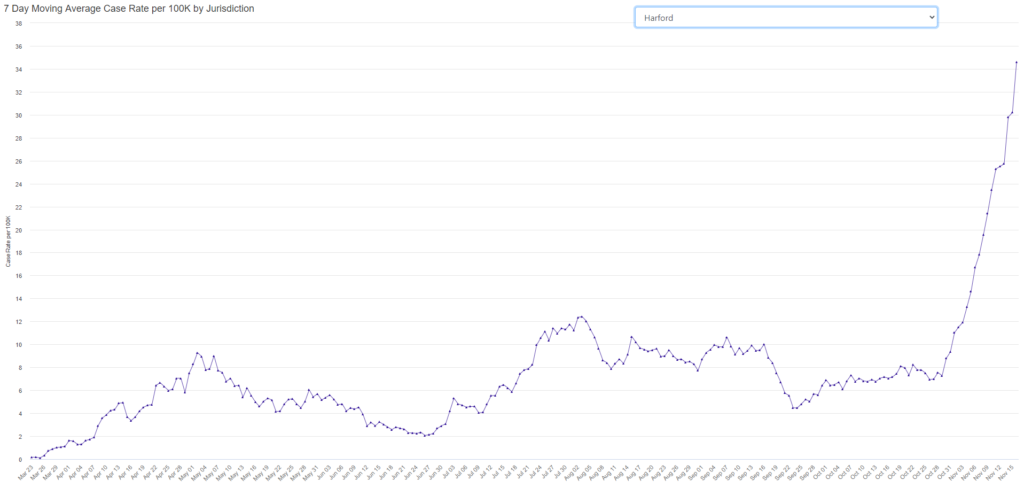
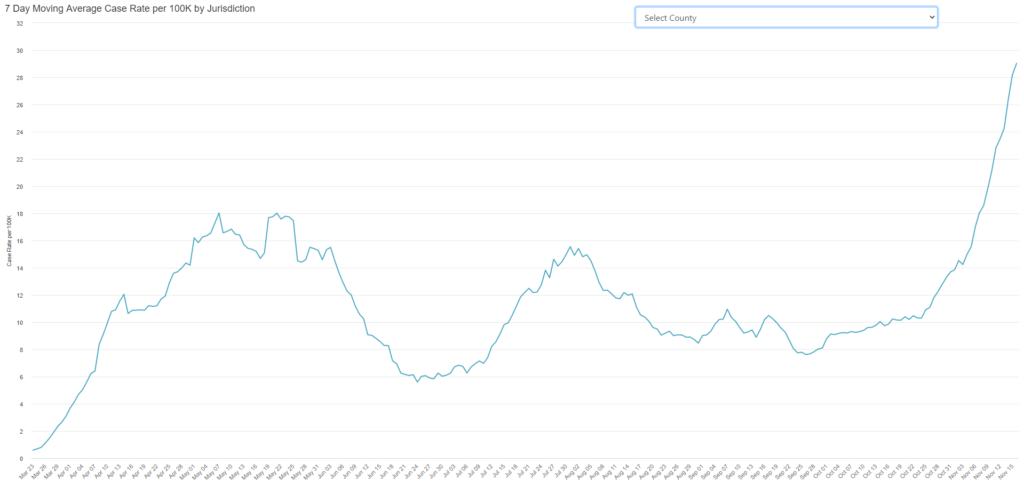
MoCo is not alone. Most major jurisdictions in the state have recently hit new peaks for COVID cases. The charts below from the state’s COVID dashboard show 7-day averages of case rates for each of the other Maryland jurisdictions with more than 250,000 residents.
Prince George’s: On November 16, Prince George’s County’s 7-day case rate was 29.8, lower than the previous peak of 38.85 on May 7.
Baltimore County: On November 16, Baltimore County’s 7-day case rate was 33.26, higher than the previous peak of 22.41 on July 31.
Baltimore City: On November 16, Baltimore City’s 7-day case rate was 39.76, higher than the previous peak of 29.46 on August 2.
Anne Arundel: On November 16, Anne Arundel County’s 7-day case rate was 26.71, higher than the previous peak of 14.26 on August 2.
Howard: On November 16, Howard County’s 7-day case rate was 20.48, higher than the previous peak of 13.16 on May 25.
Frederick: On November 16, Frederick County’s 7-day case rate was 22.29, higher than the previous peak of 15.96 on April 14.
Harford: On November 16, Harford County’s 7-day case rate was 34.62, higher than the previous peak of 12.42 on August 3.
Finally, the chart below shows the statewide COVID case rate in Maryland. On November 16, the state’s 7-day case rate was 29.03, higher than the previous peak of 18.03 on May 7.
On November 16, the highest 7-day case rates per 100,000 residents in the state were in Allegany County (110.57), Garrett County (60.56) and Washington County (41.42).
These trends are alarming health officers, county leaders and health care providers all over Maryland. Expect swift and draconian measures from state and local governments to bring these soaring case rates under control.
We already know that the Purple Line is going to be massively delayed and way over budget. The Montgomery County Council inadvertently revealed just before the election that it also won’t bring the promised economic or housing benefits.
The Council voted 7-2 to heap new tax incentives on developers in order to make project happen around Grosvenor-Strathmore and other Red Line Metro stations in the County. Metro carries more passengers than the Purple Line and Grosvenor-Strathmore is a desirable location for development, as are several other Red Line locations.
If we need to give developers gobs of money to make development happen at these locations, the same will surely be true at Purple Line stations. Yet the Purple Line wasn’t sold that way. Land has been upzoned around all the Purple Line stations and we were told that development would follow.
No one mentioned the need for massive subsidies once the Purple Line was built. On the contrary, we were promised that development around these stations would help fill the county’s coffers even as it produced more housing and economic development around the stations. Turns out that’s not the case.
The only place where development is planned or underway is at Chevy Chase Lake. Unfortunately, this appears to be the only place where the economics make sense. We’ve paid literally billions to subsidize one economic development. The lobbying by the Chevy Chase Land Company paid off. For them.
So add the cost of huge development subsidies to the Purple Line tab.
The major advocates of the Purple Line have a lot to explain, but perhaps at the top of the list among the current county leadership are County Councilmember Hans Riemer and Planning Board Chair Casey Anderson. Hans Riemer was a former leader of Purple Line Now before joining the Council and has continued to advocate relentlessly for the project, as has his good friend, Casey Anderson, on the Planning Board.
Both present themselves as certain of the solutions to the region’s transit and housing problems. Even ignoring the out-of-control costs and massive delays, and I don’t know why we should, they heavily touted the housing and economic development benefits of the Purple Line. Neither Riemer nor Anderson ever explained that we would need to heap subsidies on top of the transit costs to make the housing and economic benefits happen.
Though they are far from alone in needing to shoulder blame, rather than being an economic cash cow, the Purple Line has now metastasized into the monorail episode from the Simpsons. Only it’s a lot less funny to be living it.
With COVID-19 transmission approaching its highest levels since the spring, will MCPS actually reopen?
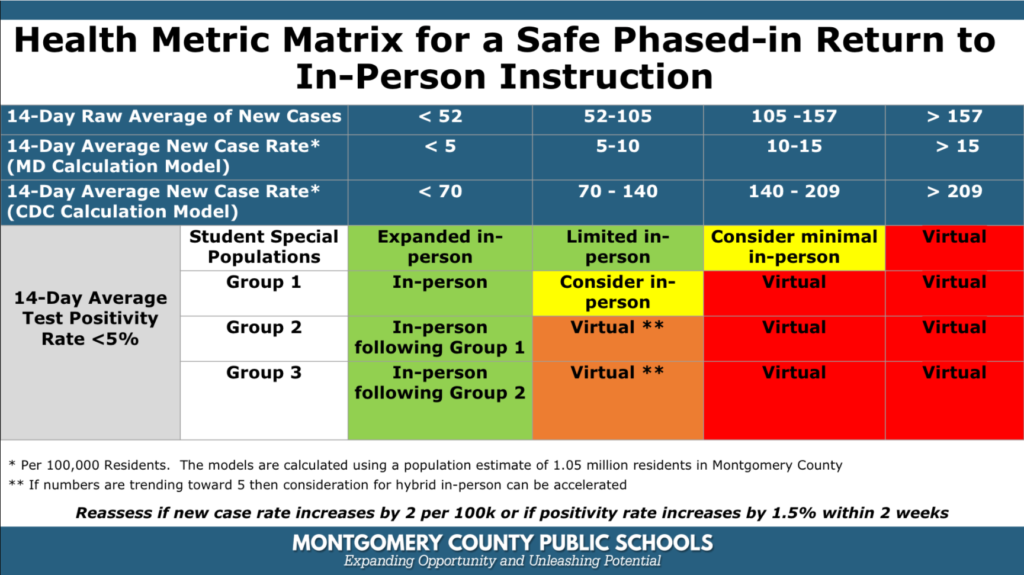
To answer that question, let’s consult MCPS’s own health metrics. For the purpose of determining which students will return and when, MCPS has broken them up into four groups in order of in-person instructional need.
Student special populations, including special education students and other students with special needs Group 1: Kindergarten; grades 1, 6 and 9; career and technical education (CTE) students Group 2: Pre-kindergarten and grades 2, 3, 7 and 10 Group 3: Grades 4, 5, 8, 11 and 12
The phase-in timing for each of these groups depends on average new COVID-19 case rates. The higher the case rates, the slower the phase-in of return. At an average rate of 15 or more new cases per 100,000 residents over a 14-day period, all groups would be taught virtually. For rates between 10 and 15, “minimal in-person” learning would be considered for special population students but would be virtual for all other groups. For rates between 5 and 10, limited in-person learning would be provided for special population students, minimal in-person learning would be considered for group 1 and other students would receive virtual learning.
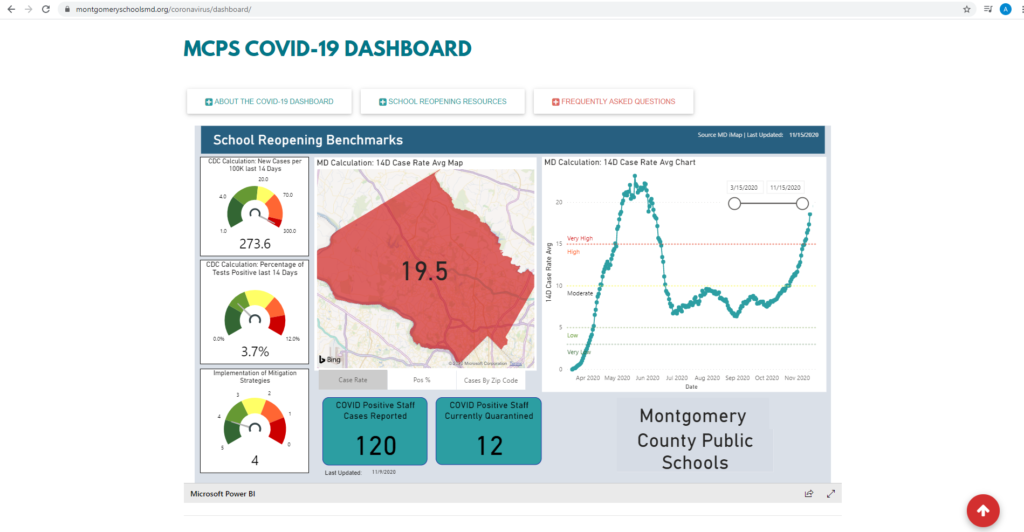
So what does this mean given MoCo’s case rates? First, according to MCPS’s dashboard, the 14-day average case rate has never been below 5 since the virus came to MoCo in March. That means according to MCPS’s metrics, most students would never have been eligible for in-person learning since the pandemic began. For the period of May through mid-June and beginning in the second week of November, no students at all would have been in virtual learning. The school system’s dashboard, along with other metrics maintained by the county and state, now shows COVID case rates spiking to the highest levels seen in months. MCPS’s average 14-day case rate of 19.5 on November 15 is the highest rate since June 6. Under such conditions, MCPS’s metrics would keep all students in virtual learning.
Another issue is that MCPS’s reopening plan contains substantial costs, including health screenings, capacity limits (including on buses), personal protective equipment, training, air quality mitigation and recruitment. MCPS Superintendent Jack Smith has said the district will “absolutely have to hire more people” to implement a hybrid model combining virtual and in-person learning. MCPS has not released a reopening cost estimate as of this writing, but it’s conceivable that it could go into the tens of millions of dollars. If MCPS needs assistance from the county, it could be out of luck given that the county’s federal grant money is almost all spent or spoken for and the county’s emergency pay program has blown an 8-digit hole in its budget.
Finally, Maryland school districts that have reopened have faced tough going. Carroll County faced a shortage of hundreds of teachers when it reopened at the end of September. Allegany, Dorchester, Harford and Somerset counties all reopened and then later closed due to COVID spikes. Last week, Maryland Matters reported, “About half of local school districts reversed plans to return to in-person learning.” This is all a dire warning to any school district thinking of reopening in the current conditions of COVID spread.
All of the above together suggests that MCPS will proceed with reopening only if MoCo sees a miracle reduction in COVID cases or if MCPS liberalizes its health metrics. Neither seems likely as the pandemic continues.
Maryland Governor Larry Hogan has provided a refreshing bit of sanity and leadership by refusing to join the chorus of his fellow Republicans claiming that Democrats stole the presidential election and congratulating President-Elect Joe Biden.
Unfortunately, Maryland Republicans are not following his lead. As the Washington Post reported, U.S. House Rep. Andy Harris (R-1) is propagating unsubstantiated allegations:
Secret unobserved vote counting in the swing states means that we will have to wait until a court unravels what really went on. When that thorough investigation is over, and we know that only legal votes have been counted then we will know who the real winner is – and then and only then we need to move on.
All of Trump’s claims regarding observers have been dismissed around the country. Just a reminder of what happened in the Philadelphia case:
during a hearing for a federal version of that suit on Thursday, Judge Paul Diamond of the U.S. District Court for the Eastern District of Pennsylvania pressed a lawyer for Mr. Trump on whether the campaign’s observers did, in fact, have access to the facility. The lawyer said, grudgingly, that there were “a nonzero number” of people in the room.
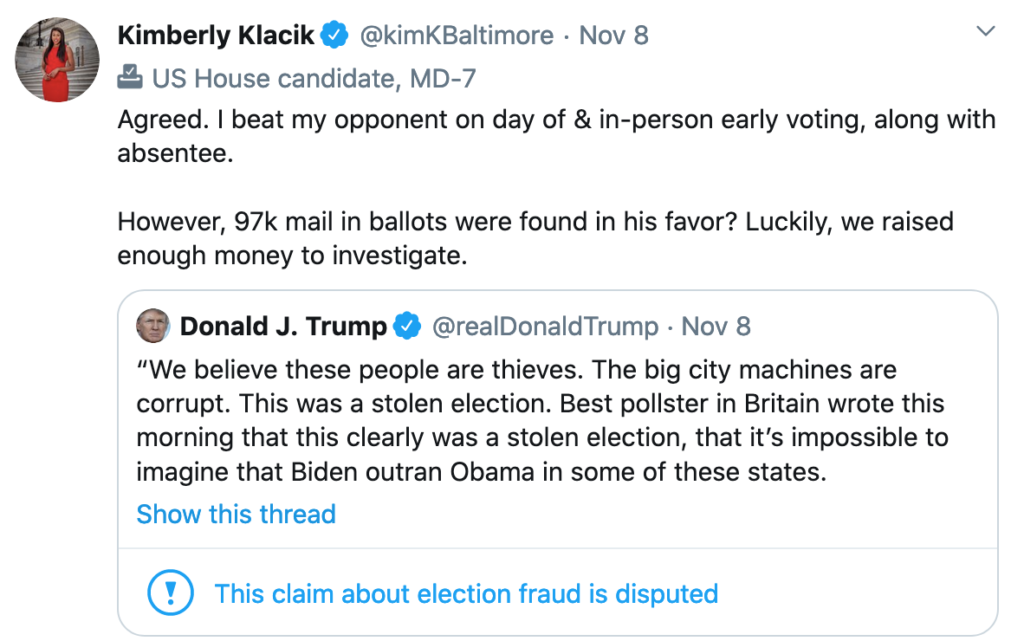
There is voter fraud whether people want to admit it or not. Just so you know, there are people looking into my race as well, and as soon as I have information, I’ll share that.
More on Twitter:
Yes, Kim Klacik is alleging that people were stealing votes for Kweisi Mfume in her race. She’s also claiming that people are looking into it, which sounds equally fanciful. I bet the gumshoes on Where in the World is Carmen Sandiego? were more active. Mfume beat Klacik by over 130,000 votes or 43% in this heavily Democratic district.
Meanwhile, as I look around Twitter and Facebook pages of Republican members of the General Assembly, I keep coming up empty in my search for someone who echoes the Governor’s thoughts in congratulating President-Elect Biden. (Hope springs eternal, let me know if I missed someone.) I found plenty who touted Republican gains–funny how there was never any fraud mentioned in those elections.
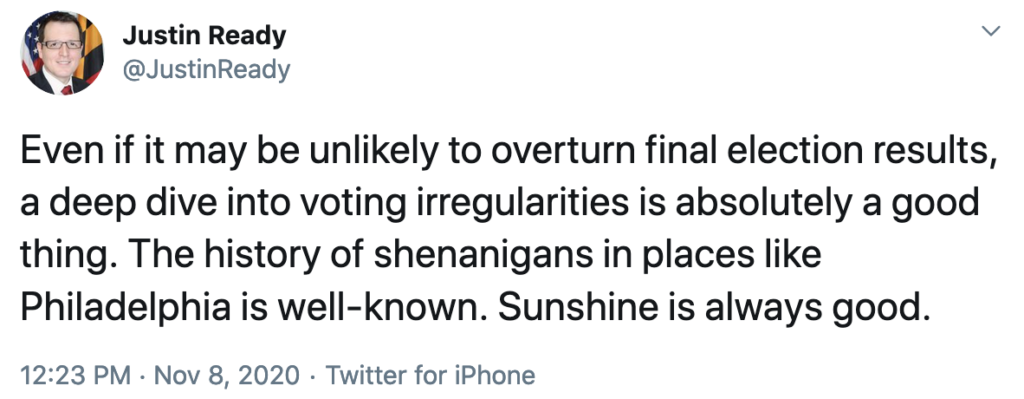
Del. Justin Ready impugned Philadelphia elections without any basis even though he admits it probably won’t change the outcome:
Except there is no evidence of any “irregularities” or “shenanigans” beyond the deep abnormality of the failure to concede the election and invented claims of a stolen election designed to delegitimize the President-Elect and our democracy.
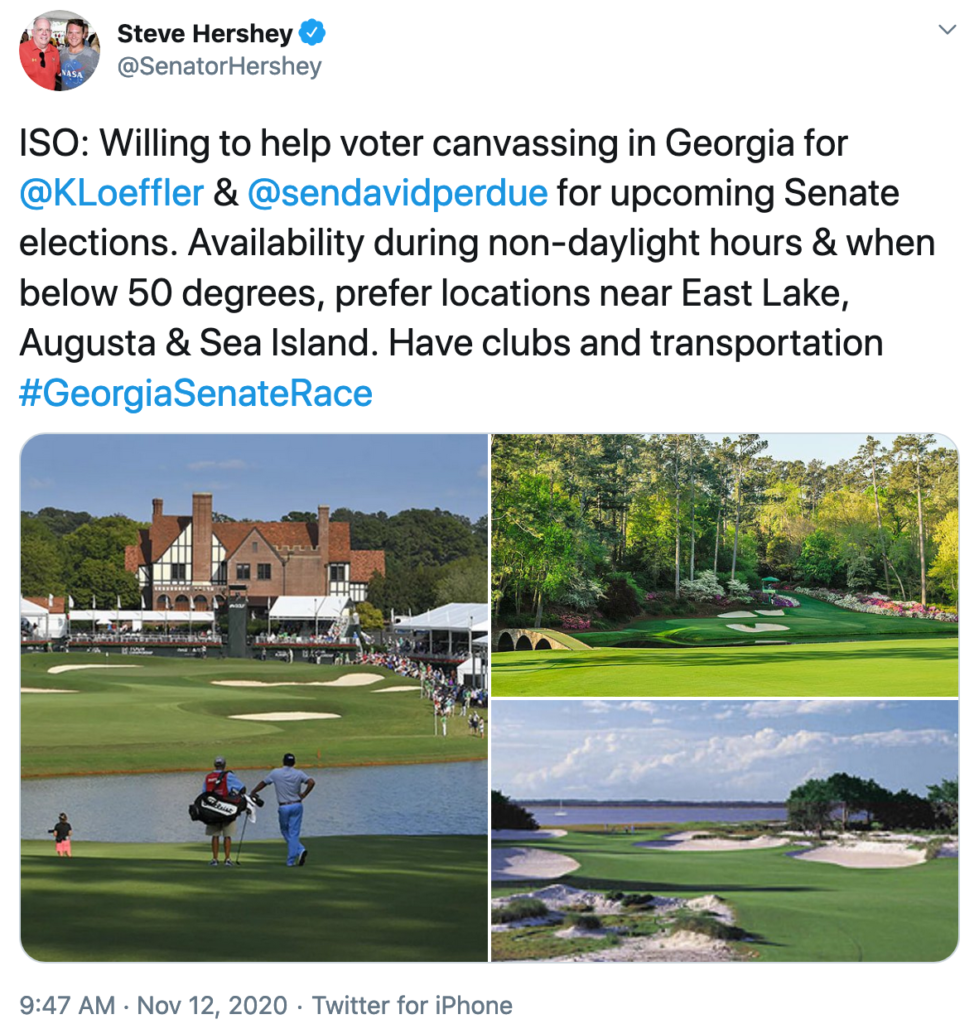
Sen. Steve Hershey is looking to help elect the two Republicans to the U.S. Senate in Georgia–the same two with corrupt stock trades who have now demanded the resignation of Georgia’s Republican Secretary of State at Trump’s behest because he ran an election in which Trump lost.
Though Hershey is clearly more interested in golfing:
Once again, the county council has expressed its displeasure at the administration of County Executive Marc Elrich. And once again, executive branch officials were invited to a Zoom thrashing that was less pleasant than most root canals. Chief Administrative Officer Rich Madaleno plays more defense now than beloved former Washington Capitals goalie Braden Holtby.
Right or wrong, this is turning into a regular thing.
One of the more troublesome revelations from the inspector general’s report was that managers at the Department of Permitting Services deliberately violated county policy in handing out undeserved COVID pay to employees. Madaleno’s first response in the Washington Post was to characterize it as an “unfortunate mistake.” He walked that back in discussion with the council, but then his deputy chief administrative officer and the current permitting services director both told the council that it was a mistake. It was not. The inspector general said that the managers who awarded the extra pay “decided to allow inspectors to claim front facing differential for their entire workday rather than ‘nickel and dime’ them by asking that they account for individual hours.” This was not a mistake. It was insubordination.
Council Member Andrew Friedson lays out remedies for the conduct found in the inspector general’s report.
Several council members called for an independent investigation, but if the administration continues to believe that this was a mistake rather than insubordination, whether accountability occurs is an open question. Other managers are watching. So are employees who may be thinking of calling the inspector general because of issues going on in their departments. If no one is held to account, why bother?
There is more. The COVID pay program has expended tens of millions of dollars with no end in sight. The council has allowed this to fester for months while it has drained the county’s beleaguered budget. The executive branch has claimed that FEMA will reimburse it for most of this money, but the inspector general has questioned that and so has the county’s own emergency management director.
County spending is within the purview of the county council. If the council is dissatisfied with the executive branch’s management of it, the council must step in. The council may not be able to do much about money that has already been spent, but it can pass legislation governing it in the future. Such legislation should define emergency pay, specify who gets it and who does not, set its levels, specify the conditions under which it is paid, establish an approval process, establish a fixed duration with a possible extension process and mandate regular reporting. If county managers refuse to obey their chief administrative officer, let’s see if they will refuse to obey county law. More than that, let’s see if county leaders can reestablish respect for taxpayer funds rather than allowing them to be treated as “other people’s money.”
Complain all you want about this, council members. But in the end, if you think it’s a problem, you must fix it. Or own it.
Council Member Andrew “Real Deal” Friedson Friedson authored Question A, which liberalized the county’s property tax system to allow receipts to increase with assessments. Wall Street applauded its passage. Even progressives, who don’t love Friedson but owe him big-time for opening up the county’s revenue stream, have to admit that his Question A was the real deal.
Council Member Evan Glass Glass authored Question C, which added two district council seats and defeated the nine district Question D. Lots of wannabe politicians are going to look at running for the new seats. Every single one of them should kiss Glass’s ring and write a max-out check to his campaign account.
County Democratic Party It’s not a coincidence that MoCo voters adopted the positions of the county Democratic Party on all four ballot questions. With partisan sentiments running high and information on the questions running low, MoCo Democrats went along with their party and dominated the election.
David Blair Blair was the number one contributor to the four ballot issue committees that passed Questions A and C and defeated Questions B and D. By himself, Blair accounted for nearly half the money they raised. Whatever Blair decides to do heading into the next election, he can claim to have done as much to pass the county Democrats’ positions on the ballot questions as anyone. (Disclosure: I have done work for Blair’s non-profit but I was not involved in his ballot question activities.)
Ike Leggett The former county executive was key in leading the fight against Robin Ficker’s anti-tax Question B and the nine county council district Question D. Thousands of MoCo voters still like, respect and trust Ike Leggett.
Jews United for Justice While not having the money and manpower of many other groups who played on the questions, Jews United for Justice played a key role in convening the coalition that ultimately won. They have gained a lot of respect from many influencers in MoCo politics.
Facebook Lord knows how much money they made from all the ballot question ads!
Losers
Robin Ficker At the beginning of 2020, MoCo had one of the most restrictive property tax charter limits of any county in Maryland. For many years, Ficker was looking to make it even tighter and petitioned Question B to the ballot to convert it into a near-lock on revenues. But his charter amendment provoked Friedson to write Question A, which ultimately passed while Question B failed and will raise much more money than the current system over time. Instead of tightening the current system, the result is a more liberal system that will achieve the opposite of what Ficker wanted – more revenue for the county. This was one of the biggest backfires in all of MoCo political history.
Republicans The county’s Republican Party did everything they could to pass Ficker’s anti-tax Question B and the nine county council district Question D. In particular, they gave both cash and in-kind contributions to Nine Districts and even raised money for the group on their website. In doing so, the GOP provoked a fierce partisan backlash as the county Democrats rose up to take the opposite positions on the ballot questions and most Democratic-leaning groups combined forces to support them. With President Donald Trump apparently defeated, Governor Larry Hogan leaving office in two years and little prospect of success in MoCo awaiting them, where does the county’s Republican Party go from here?
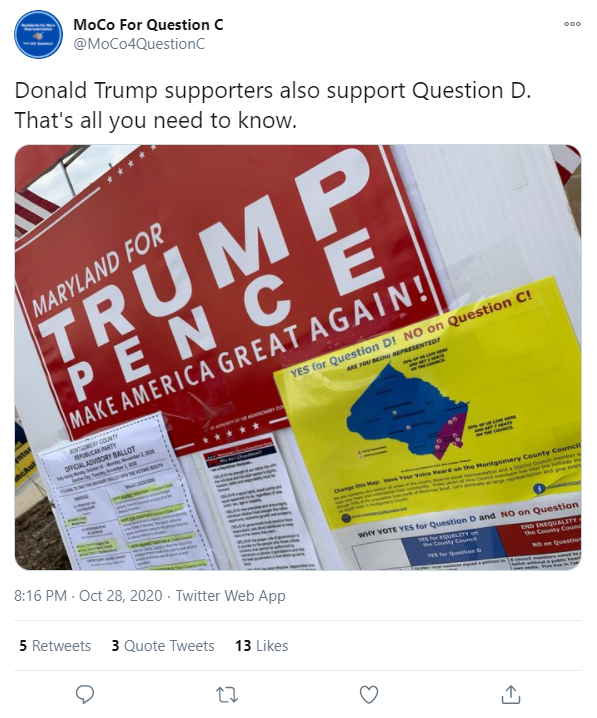
This tweet by MoCo for Question C from a voting location explains all you need to know about why Question D failed.
Political Outsiders It wasn’t just Republicans who supported the failed Questions B and D; a range of political outsiders supported them too. What they witnessed was a mammoth effort by the Democratic Party, Democratic elected officials and (mostly) progressive interest groups to thwart them. Even the county chamber of commerce and the realtors lined up against them. Whether or not it’s true, this is bound to provoke more talk of a “MoCo Machine.” Machine or not, outsiders have to be wondering how to win when establishment forces combine against them.
Push
MCGEO, Fire Fighters and Police Unions These three unions are frustrated. They have not been treated the way they expected by the administration of County Executive Marc Elrich and they are also upset with the county council for abrogating their contracts (among other things). They wanted to show that they could impose consequences for messing with them and that was one reason why all three made thousands of dollars of in-kind contributions to Nine Districts. On the negative side, the nine districts Question D failed. On the positive side, the passage of Friedson’s Question A will result in a flow of more dollars into the county budget over time, a win for their members. So it’s a push. On to the next election.
Council calls for immediate Executive action to stop improper differential pay and an independent investigation across Montgomery County Government
ROCKVILLE, Md., Nov. 6, 2020—Today the Office of the Inspector General issued a Report of Investigation revealing that Department of Permitting Services inspectors improperly received COVID-19 differential pay. The Council will have an oversight meeting about this issue on Tuesday, Nov. 10 with Inspector General Megan Limarzi and Chief Administrative Officer Rich Madaleno. The Council made the following statement about the report.
The Council is outraged by the differential pay issues identified in the Department of Permitting Services by the Office of the Inspector General. We are calling for an independent investigation across all Montgomery County Government departments and immediate action by County Executive Elrich to stop improper differential pay. Every dollar that was improperly paid needs to be recovered immediately, and those who committed these egregious acts must be held accountable.
The Council thanks those who reported their concerns to the Office of the Inspector General. We also appreciate the ongoing diligent work of Inspector General Limarzi and her team to provide objective oversight and protect the integrity of county government operations and programs. The Council will continue to take legislative and budget action to empower the Office of the Inspector General with the resources needed to protect our taxpayers.