Methodology Note: Precinct Analysis

By Adam Pagnucco.

In coming days, I’ll be crunching precinct-level results from the 2020 general election. This post summarizes the methodological choices I made and I’ll refer back to it in the future.

General election precinct results for candidate races and ballot questions are available here for every county in Maryland. In prior years, precinct results were available only for election day voting. For this year’s general election (but not the primary), they are available for all voting modes. That’s an improvement but it means that precinct results for this year aren’t strictly comparable to earlier years.

This year, Montgomery County has 258 precincts. Three of them are “ghost precincts,” which do not report results because no people live in them. If you see the number of precincts alternatively represented as 258 or 255, the three ghost precincts are the reason. Don’t worry about it because vote tallies are unaffected.

All precincts are assigned to congressional, state legislative and council districts. Their town designation is determined by the location of the voting place. This gets a little blurry at times as folks from one town can have a voting place in another, but this shouldn’t have a huge impact on geographic results.

The Democratic Crescent, a term I used two years ago to identify regularly voting downcounty Democrats, includes precincts in Bethesda, Cabin John, Chevy Chase, Kensington, Takoma Park and Silver Spring inside the Beltway. Upcounty includes precincts in Brookeville, Clarksburg, Damascus, Dickerson, Gaithersburg, Germantown, Laytonsville, Montgomery Village, Olney, Poolesville, Sandy Spring and Washington Grove. Residents of smaller nearby communities vote in these precincts, including people who live in Ashton, Barnesville, Beallsville, Boyds and Goshen. Wheaton includes zip code 20902. Glenmont/Norbeck includes zip code 20906, except for Leisure World, which is tracked separately. Silver Spring East County includes all other Silver Spring precincts outside the Beltway and located in zip codes 20901, 20903, 20904 and 20905.

I may refer to how precincts voted for term limits in 2016. Term limits voting is correlated both with partisan turnout and certain other voting behavior this year.

I included estimates of average household income by zip code from the Census Bureau for the five-year period of 2014-2018. I wish I had recent estimates by precinct but that will hopefully be released with the next batch of decennial census data.

Finally, I took a shot at demographics by precinct. This was a huge and imprecise exercise. Using 2010 census data, I matched census blocks to precincts. This is challenging because the two frequently don’t match exactly and precinct definitions have changed over the years. After a great deal of work, I was able to generate rough estimates of percentage Asian, Black, Latino and white for each precinct’s population and use them to gauge crude patterns of voting associated with race. I can’t stress how rough and dated this is and I look forward to getting updated 2020 census data to plug in.

That’s about it. We’ll start digging into data soon!

Share

Klacik Didn’t File Required Financial Disclosure

Like Members of the U.S. House, congressional candidates are required to file financial disclosure forms. Kim Klacik, who made quite a splash as the Republican sacrificial lamb against Rep. Kweisi Mfume, never filed one according to the Clerk of the U.S. House of Representatives.

According to the Clerk’s office:

Financial Disclosure Reports include information about the source, type, amount, or value of the incomes of Members, officers, certain employees of the U.S. House of Representatives and related offices, and candidates for the U.S. House of Representatives.

These reports are filed with the Clerk of the House as required by Title I of the Ethics in Government Act of 1978, as amended. 5 U.S.C. app. § 101 et seq.

Klacik touts herself as a “Republican strategist” and the founder of a nonprofit, Potential Me, but her sources of income remain unknown and vague. Her failure to file the legally required report tends to confirm the impression that she intends to remain in the limelight and earn a living based on her failed campaign.

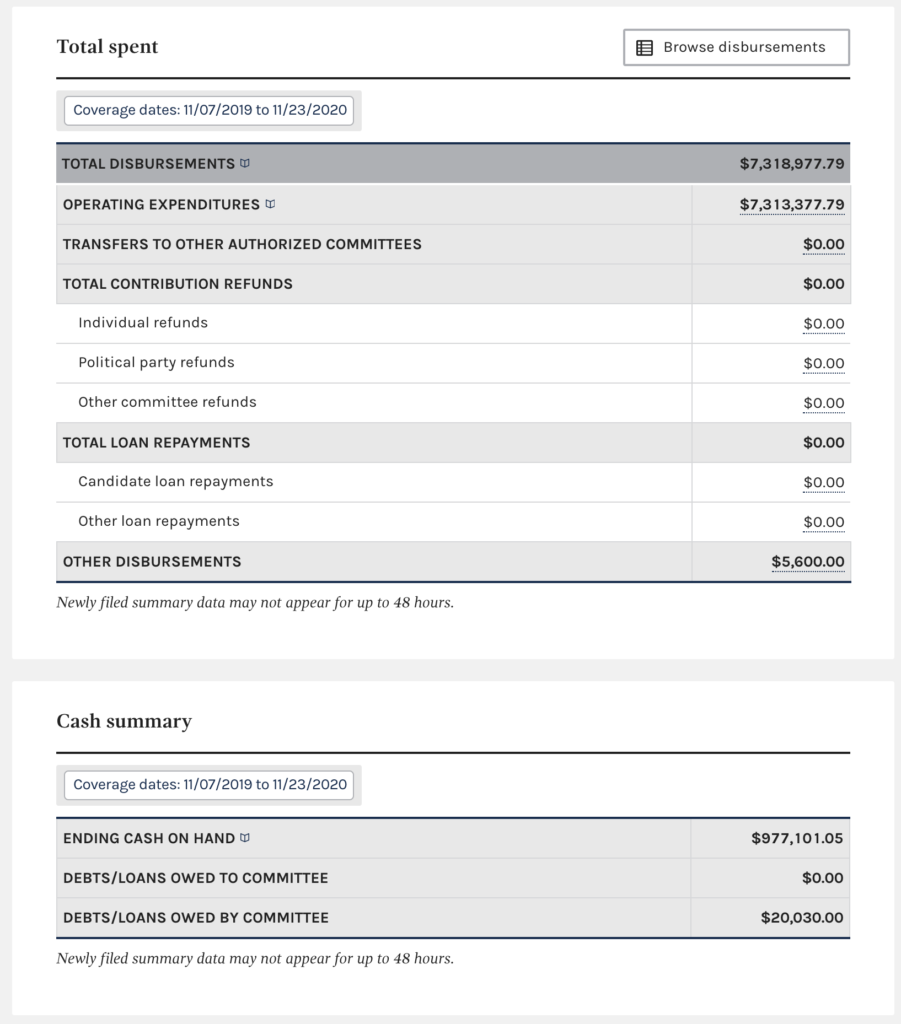
Campaign finance watchdogs will also want to watch carefully where the nearly $1 million in unspent funds in her campaign account goes. Unusually for a serious congressional challenger, not all of her impressive fundraising went to the campaign.

Share

Follow the Money

By Adam Pagnucco.

To understand the growing strains on MoCo’s pandemic-stricken budget, it helps to follow the money. Here is an example.

Follow This Money

Last spring, the county council voted down compensation increases contained in the collective bargaining agreements negotiated by County Executive Marc Elrich with the three county employee unions: MCGEO, the fire fighters and the police. The increases totaled $22 million in the current fiscal year and $29 million annually thereafter. This was the sixth time that the county trimmed or eliminated raises for employees in the last eleven fiscal years. (The county zeroed out raises in FY11, 12, 13 and 21 and reduced collectively bargained raises in FY17 and 20.)

At around the same time, the executive granted the three unions indefinite COVID pay without seeking the consent of the council. There is no question that workers exposed to hazardous conditions deserve extra compensation. The issues are that the executive’s COVID pay far exceeds what any other government in the region (and maybe the entire nation) has granted and that it has no fixed end date. The cost of this pay is $4 million a pay period or roughly $100 million a year, more than three times the compensation increases contained in the now-abrogated contracts. Employees of the college, school district and park and planning are not getting the money. It must be noted that the president of the largest county union said two years ago, “Marc Elrich won the primary thanks to our shoe leather.” Subsequently, the inspector general found that workers were getting pay to which they were not entitled in at least one county department.

No county leaders argue that employees should get zero emergency pay. Instead, the problem now is that the county has little clue how to pay for it even as its budget has been crippled by the COVID recession. Originally, the extra pay was supposed to be mostly reimbursed by FEMA, but the county’s emergency management director called that into question in October. The emergency pay liability grows every day and the need to pay it off grows more desperate.

Now Follow This Money

The county received a $183 million allocation of federal CARES Act money last spring to help it pay for COVID expenses, including aid for pandemic-stricken residents and businesses. But there’s a catch: if the county doesn’t use the federal money for eligible purposes by December 30, it forfeits it. In October, the county council went nuclear upon finding out that the executive branch was slow to spend the federal money it had appropriated for various assistance programs, including aid for rent, food security, child care and more. Administration representatives said that they were trying to prevent fraud and waste and dealing with frustrating FEMA paperwork requirements.

Now it turns out that the money won’t all be spent by December 30. Council staff wrote last week:

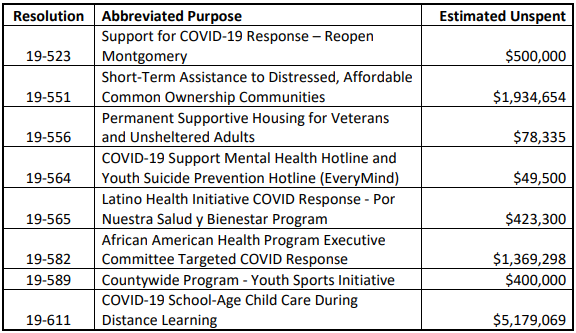
CRF [Coronavirus Relief Fund] monies received by Montgomery County must be spent on costs incurred on or before December 30, 2020. Since March 2020, the County Council has enacted special appropriations to help Montgomery County residents and businesses endure the pandemic and its effects. Due to the restrictions on spending imposed by Congress, the Administration expects that $9,934,156 in CRF dollars will be unspent based on current spending patterns and demands. The list below details the special appropriations where funds will likely go unspent.

The table below shows the $9.9 million in unspent federal money by assistance program. The three biggest programs are child care, assistance to distressed common ownership communities and African American health care.

So it appears that families needing child care, residents of distressed common ownership communities and African Americans needing health care may not be getting the federal grant money the council allocated to them. (They might not be completely out of pocket as the executive has recommended the use of county reserves to help.) That said, the $9.9 million in federal grant money still needs to be used by December 30 or forfeited. What’s the administration’s plan for that?

The executive branch sent the council a resolution that says essentially: trust us. The resolution suggests a number of alternate uses for the federal grant money and then says this:

If any of the $9,934,156 is unable to be spent on the Council priority uses identified above in advance of the deadline established by Congress, these funds may also be used for any eligible expense previously authorized by the Council by Resolution 19-498.

And what does Resolution 19-498 authorize? Lots of things, including this:

Payroll expenses for public safety, public health, health care, human services, and similar employees whose services are substantially dedicated to mitigating or responding to the COVID-19 public health emergency, including any pay differential provided to employees responding to the public health crisis. [Bold added for emphasis]

Last Tuesday, the council approved the executive’s resolution to allow a potential transfer on an 8-1 vote with only Council Member Andrew Friedson dissenting.

And so federal grant money set aside by the council for families needing child care, residents of distressed common ownership communities and African Americans needing health care is now subject to diversion to pay off part of the soaring emergency pay liability created by the executive. But even if that happens, it’s not the end of the story. There is only $9.9 million in unspent federal money in play here whereas the total emergency pay liability accounts for $4 million a pay period, or $100 million a year. A reallocation would buy the county about five weeks of time. After that, the liability resumes spraying red ink.

What will happen next as the day of reckoning draws near?

Share

Dorfman Out at Liquor Monopoly

By Adam Pagnucco.

According to a mass email sent by Deputy Chief Administrative Officer Fariba Kassiri, Alcohol Beverage Services (ABS) Director Bob Dorfman is leaving his position effective today. The email is reprinted below.

*****

Subject Line: Bob Dorfman/Acting ABS Director

From: Kassiri, Fariba
Sent: Monday, December 14 2020
To: #ABS All
Cc: #MCG.Department and Office Directors; #MCG.SeniorEAAContacts; #MCG.Legislative Branch Directors

ABS Employees,

Effective today, Bob Dorfman will be moving on from his position as Director of Alcohol Beverage Services. On behalf of the County Executive, I want to thank Bob for his 4 years of service to Montgomery County Government and acknowledge his significant accomplishments during that time. ABS would not be the success it is today without his leadership and vision. I thank him for his many contributions and wish him well in his future endeavors.

Kathie Durbin will be Acting ABS Director until a permanent director is appointed.

*****

It’s difficult to describe just how badly the liquor monopoly was doing when Dorfman, a former Mariott executive, was hired to run it four years ago. The monopoly had suffered critical delivery outages in the week between Christmas and New Year’s two years in a row. It was riddled with crime and abuse, with employees skimming booze and selling it for cash, driving drunk in county trucks and running the warehouse with sticky notes. Licensees were so upset at the monopoly’s failures, especially with regards to special orders, that Delegate Bill Frick (D-16) introduced a bill to allow county voters to end it. (I organized a coalition to support Frick’s bill.)

Dorfman’s success was to do what prior leaders had promised to do for years: run the organization like a business. Even some of the monopoly’s harshest critics conceded that, under Dorfman, the department’s delivery accuracy and service improved. Special orders were still an issue but there were no more week-long outages during holiday periods. Dorfman’s performance was good enough that pressure to abolish the monopoly eased off, at least for a little while. One caveat: Dorfman’s pursuit of the bottom line was great for the monopoly but not always for licensees. He instituted a new bottle fee for licensees at county liquor stores and blocked reform passed by the General Assembly to allow private stores to sell spirits.

Dorfman was also an aggressive defender of his organization, going after both Council Member Hans Riemer and Seventh State founder David Lublin in public. When Riemer found out that county liquor stores were losing money and suggested shutting them down, Dorfman called him “ill informed” and said he “obviously doesn’t care much” about county employees. No other department head has said such things about a sitting Council Member in recent memory!

Departing department directors often take extended departures, with their last days scheduled for weeks or months after their announcements. That’s not the case with Dorfman, who is out effective today. That makes me wonder whether he is leaving on good terms with the administration. In any case, his example offers a lesson: if the county wants the liquor monopoly to perform like a business, it has to hire someone to run it who knows how to run a business. Dorfman was that guy. We shall see if County Executive Marc Elrich heeds that lesson when hiring Dorfman’s successor.

Share

Trump vs Hogan: Votes by MoCo Town

By Adam Pagnucco.

In what amounts to an early Christmas for this number cruncher, the State Board of Elections has released precinct voting data for candidate races and ballot questions. We are going to have a lot more of this in coming days, but here is a very quick cut comparing outgoing (yes, outgoing) President Donald Trump with Governor Larry Hogan.

In the 2020 general election, Trump received 19% of the vote in MoCo. In the 2018 general election, Hogan received 44% of the vote in MoCo, probably the highest percentage for a Republican in a MoCo gubernatorial general since Spiro Agnew won the county in 1966.

In comparing the two, there are two caveats. First, the electorate in the 2020 general election (more than 517,000 voters in MoCo) was bigger than the electorate in the 2018 general election (413,137). That means these are different groups of voters, although the Democratic percentage of the electorate in 2020 (64%) is about the same as in 2018 (65%). (The state has not released official turnout numbers yet for 2020, making these numbers approximate.)

Second, 2020 precinct level data includes all voting modes whereas 2018 included election day votes only. Election day votes accounted for 61% of all MoCo votes cast in the 2018 general election, and the Democratic percentage of the electorate (61%) was lower than the Democratic percentage of other voting modes (71%). That skews the 2018 precinct results in Hogan’s favor a bit. Hogan won 47% of MoCo’s election day votes whereas he won 44% of MoCo’s general election votes overall.

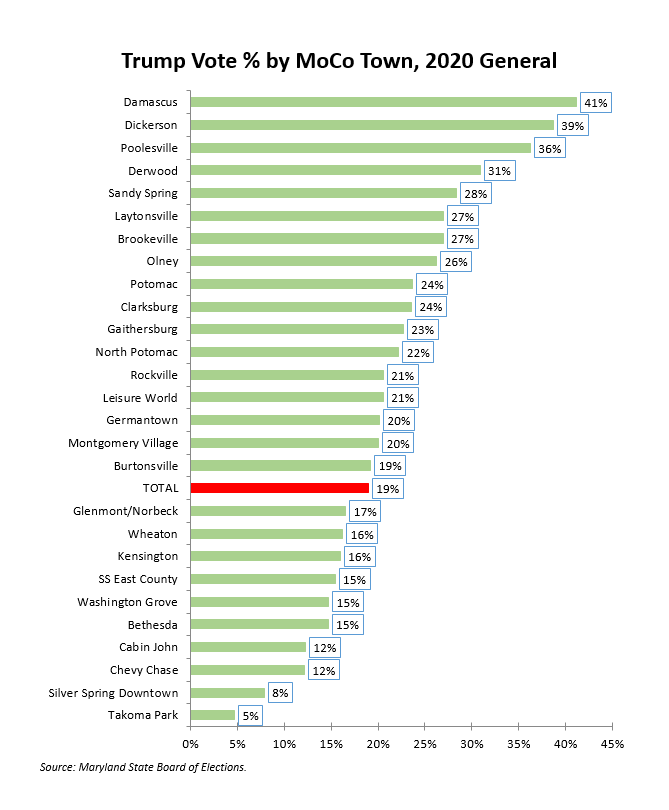
All of the above said, the chart below shows Trump’s vote percentage by MoCo town in the 2020 general election.

These results are predictable. Trump only won one precinct out of MoCo’s 258 precincts: 12-1 in Damascus, where he tallied 962 votes vs Joe Biden’s 926. Trump did particularly badly in the Democratic Crescent, pulling in the teens and single digits there.

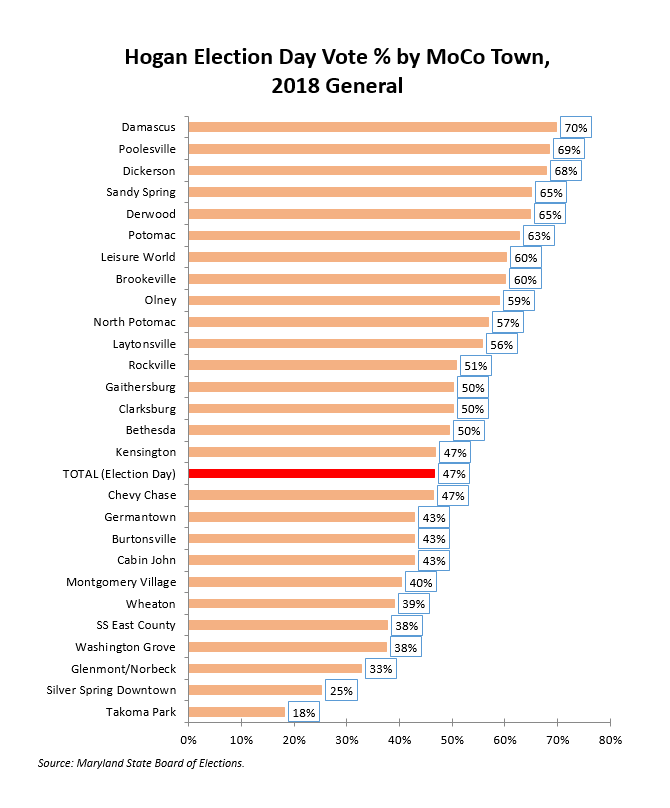
The chart below shows Hogan’s election day vote percentage by MoCo town in the 2018 general election.

In terms of election day votes only, Hogan won many areas in MoCo. Even if other voting modes were included, Hogan probably won in Brookeville, Damascus, Derwood, Dickerson, Laytonsville, Leisure World, North Potomac, Olney, Poolesville, Potomac and Sandy Spring. Hogan’s overall loss in MoCo was due to lopsided defeats in Silver Spring and Takoma Park, not to geographically broad unpopularity.

This goes to show that a fiscally conservative, socially agnostic and politically strategic Republican can get a lot of votes here, especially in upcounty. But Trumpism is a huge loser in MoCo.

Share

MCEA to School Board: Reopening Should be Safe

By Adam Pagnucco.

In a letter written to the school board today, Montgomery County Education Association (MCEA) President Chris Lloyd called for a number of measures to ensure that any reopening of schools would be as safe as possible.  Among those measures are the installation of effective air handling systems in every classroom, a health and safety committee at every school, strict social distancing, personal protective equipment and a choice of work location for educators.

Lloyd’s letter is reprinted below.

*****

December 11, 2020

Sent Via Email

Office of the Board of Education
Montgomery County Public Schools
Carver Educational Services Center
850 Hungerford Drive, Room 123
Rockville, Maryland 20850

Dear President Wolff and Members of the Board of Education,

I write to you today on behalf of the Montgomery County Education Association in relation to the Tuesday, December 15, 2020 Board of Education meeting, and the discussion/action around the return to physical workspaces.

We affirm the value of in-person learning, in support of the needs of our young scholars and their academic and social-emotional well-being. We call upon you to demand that our state and county leaders make the required investments in physical workspaces and institute policies to curb the significant community spread of this virus.

All of us need to be advocating for policies and funding needed for the safe schools our communities deserve. There is a fierce urgency in this work, so that we can return to schools as soon as possible. It is incumbent on policy makers to prioritize public education and the safety of adults and children in our care, not through proclamation, but through investment and policies.

We want to return to school safely and soon, and we can do this by stopping the rampant community spread, and by simultaneously providing proper health and safety protocols at the worksite. Acting immediately on these two items will allow our schools to thrive.

We have the knowledge and understanding of how to stop community spread. We’ve seen countries such as Australia institute polices that not only bent the curve of transmission but caused a precipitous and effective drop in cases and deaths, which allowed for safety in a community and its schools. Stopping the rampant community spread in our community is a matter of public policy and will, and it can be done if we decide to do so.

We have the knowledge, understanding and the resources to make workplaces safe. The Silver Diner in Rockville safely uses UV light in its air handling to eradicate the virus, and transmission there is significantly lower than average. Other worksites such as grocery stores have installed plexiglass barriers, used face masks and face shields, while simultaneously and significantly increasing the air exchange rate and air filtration in their buildings, aggressively moving air up and out of the building. These are examples of ways critical and essential businesses are seeking to eradicate the virus in their buildings. For one of the wealthiest counties in the nation, with $184 million in CARES Act funding, there is an obligation to act in this way in our public buildings.

We believe schools are essential, and therefore deserve essential funding to make the buildings and the inhabitants safe. Instituting a paycheck protection program for county businesses will allow us to stop the spread, and to open up the most important buildings for our children – our schools. By prioritizing schools and protecting our most vulnerable workers, we can both control the virus, keep our economy strong, and invite students back into buildings.

We call on the immediate funding and installation of effective air handling systems in each classroom, that provide for necessary air transfer, filtration and virus eradication.

We call for a laser focus on instruction, that educators can teach either online or in buildings, so that we can meet the needs of young scholars in our care and focus our efforts either in-person or online.

We call for Health and Safety Committees at each school, to look after the physical and emotional security of our students.

We call for every inhabited space in our schools to have the safety we’ve come to know and expect, and just like other emergencies, for educators to have the ability to remove themselves and their students from life-threatening situations.

We call for strict social distancing measures and needed PPE so that we can protect our children, families and staff.

We call for the choice of work location for educators, either remote or in-person, so that we can meet the needs of our teachers, and all of the children in their care.

All of this is possible with action now, so that we can bend the pandemic curve and have our buildings safe for occupancy. It will require funding and policies that make clear the top priority of this community is its schools and other people’s children. Fierce urgency and moral courage demands nothing less.

We alone cannot make our schools safe. We alone cannot stop the rampant spread of the virus. But we can lead the efforts to make this happen. It took weeks, and not months, for other countries with strict policies to bring the spread of the virus under control. It took investment by a community to make workplaces safe. We should do the same, demand the same, and then return to school safely and soon after executing such policies and infrastructure investments.

Sincerely,

Christopher Lloyd, NBCT

President, MCEA

Share

Come On Now

By Adam Pagnucco.

MoCo is about to embark on one of its most important tasks of the decade: redrawing county council districts. The county’s charter mandates redistricting every ten years in line with the release of new U.S. Census data. The charter also states that the council must pick a redistricting commission to recommend new boundary lines (although the council retains the final say). The current redistricting will be particularly intense given the recent passage of Question C, which expanded the number of districts from five to seven.

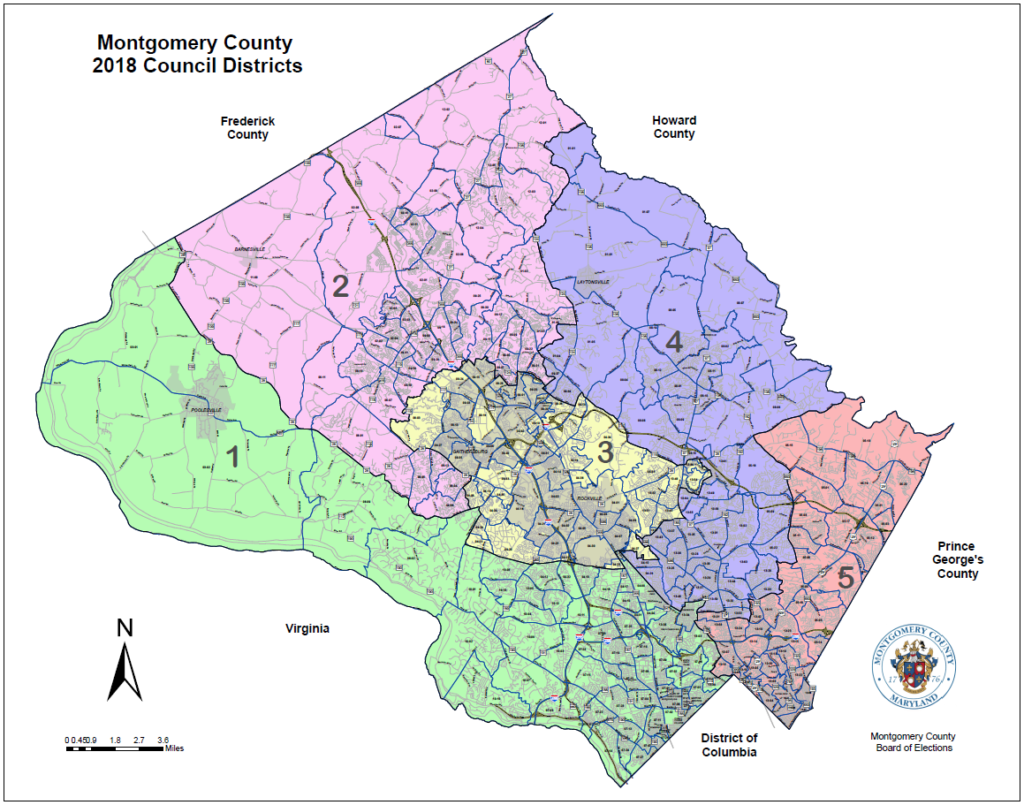
MoCo’s current county council districts.

More than 100 people applied to be on the 11-member redistricting commission and 32 were scheduled for interviews. The interviewed applicants include:

1. Two former elected officials, including one who used to be a council member and has run for two different offices in the last five years.

2. Five other former candidates for office, including one who has run for office seven times since 2009. Three of these former candidates have run at least once since 2018.

3. Two political consultants, one of whom has worked for MoCo politicians, including sitting council members.

4. Two spouses of sitting municipal elected officials. Both of these officials unsuccessfully ran for higher office before being elected to their current positions. One of the spouses also ran for office, including for council in 2017-18.

5. A sibling of a 2018 council candidate who has managed multiple local political campaigns.

These are not bad people. To the contrary, most – if not all – of them have done good things and can serve the county well in other roles. But the redistricting commission is a critical body that will play a key role in designing council districts for the next decade. The importance of this exercise to county residents cannot be overstated. The public interest should be the sole determinant of redistricting. Given the fact that the public is watching how this plays out:

It would be wise to avoid the appearance of a candidate designing his or her own district for a future run.

It would be wise to avoid the appearance of a political operative designing a district for a client.

It would be wise to avoid the appearance of a commission member designing a district for a family member.

Redistricting is an official and supremely important act of county government but it’s also a very sensitive one. Many people are jaded about “gerrymandering” and the county just had an all-out ballot war over the appropriate number of council districts. I can’t count how many times I have seen the word “machine” used to describe the county’s politics this year. In this climate, it won’t take much to get people to believe the worst about redistricting, and given the recent popularity of charter amendments, who knows how far such sentiment could go.

There are plenty of qualified applicants who could do a good job and don’t have any of the above issues. Come on now, council members! Please consider them when choosing who serves on the redistricting commission.

Share

Council Overrides Veto, Attacks Elrich, Cuts Revenue for School Buildings

The Montgomery County Council unanimously overrode County Executive Marc Elrich’s veto of their bill to lower impact taxes on development in wide areas around public transit.

The press releases title sets the tone with the strange claim that the override reaffirms the Council’s “commitment to investing in Montgomery County’s future.” Except that by reducing the impact taxes collected, the county will now have less money to invest in school buildings and other capital projects.

It’s a commitment to disinvesting in public infrastructure. The language is especially telling because Democrats normally tout public spending as investment, but they’ve adopted Republican-style talking points on cutting taxes. Knowing this is the case, the press release is at pains to hide just how much they’ve reduced taxes on developers. It just says that the new tax rate will “more accurately” reflect the actual cost of school facilities.

The individual comments are little better. Sponsor Hans Riemer attacks Elrich because that is what he does. He also lauds the policy as “balanc[ing] the competing needs to address school enrollment” and “make our transportation system safer.” Except lowering impact taxes that help build new school buildings hurts rather than helps schools. I imagine this also reflects Hans’s magical thinking that everyone wants to live near transit but that they won’t have many kids—somehow families with kids don’t need housing too.

Councilmember Nancy Navarro refers to this legislation as “bold” which is the same word she used previously for lauding her support for the last tax cut on devleopers.

Overclaiming that this will lead to more “affordable housing” and “environmental sustainability,” Councilmember Andrew Friedson says the bill makes the county “more attractive to new businesses.” Once again, he conflates development with business as the Council continues to do nothing to attract the non-development related business it needs.

There is no requirement for more affordable housing as a share of new development. Impact taxes have little impact on the overall cost relative to demand and land prices, so the major impact will not be a blossoming of housing or a reduction in its price, but further losses to the county treasury to build schools.

All of Hans Riemer’s many other like-minded bills have similarly failed to do much to bring affordable housing to the county. This one won’t either. It might, however, result in more campaign contributions from developers to the incumbent councilmembers and their allies.

Evan Glass touts how hard the Council worked on the new policy—they did spend a lot of time on it—and that it reflects the Council’s commitment to “inclusivity and diversity.” No doubt the Council believes that to be true. But progressive verbiage doesn’t alter the hard fact that, directly at odds with this claim, the county will deepen the already acute shortfall in funds for public school buildings to serve its diverse student population.

“Council Assures More Portables in MCPS’s Future” would have been a good alternative title for the press release.

Share

Jawando Calls for a Tax Hike

By Adam Pagnucco.

This morning, the county council and representatives of the executive branch discussed the county’s abysmal new fiscal plan, which raises the prospect of cuts to county government (excluding MCPS and Montgomery College) of up to 12% next year. That attracted many comments from the council as one might imagine. Council Member Will Jawando was the only one to call for a tax hike to prevent draconian cuts. His comments (which can be seen on county video) are transcribed below.

*****

Thank you, Mr. President and thank you to Mr. Madaleno [the county’s chief administrative officer] and Mr. Coveyou [the county’s finance director] and acting director [Jennifer] Bryant [the county’s acting budget director]. Excited to confirm that shortly. And to all the staff.

A couple things I just wanted to note. I think Council Member [Evan] Glass said something that’s really important I want to underscore and I agree with, that our focus needs to be on maintaining services for those who need it the most, and Director Bryant, you said this as well, and I think everyone agrees with that. But I also want to make sure that we are also looking at how we’re going to come out of this crisis. And we are in the unenviable position of having to both manage our fiscal situation, deal with the multiple pandemics – health, social, economic – and try to make sure that we don’t exacerbate inequality and we plan for the recovery at the same time.

And that’s not easy, right? We’re dealing with that, as is the nation, as is the world. But I think we are in a better position than most to try to make those plans. And I want to urge us to do a couple of things as we’re thinking about that, so as Mr. Madaleno, as you’re coming back in January with your team. We have reserves for a reason. So we should use them. If we’re not going to use them now, I don’t know when you would use them. I’ve said this since the beginning. And we have been using them on special appropriations and we have been seeking reimbursement.

Jawando speaks in open session today.

But I think to – as we’re looking at, there’s been a lot of talk of savings plans. We cannot cut critical services to those in need that are going to exacerbate income inequality. And if those decisions are being made or are on the chopping block, we have to use reserves.

The other thing is we have to consider how we’re going to raise additional revenues. This has been one of the most unequal pandemics and recessions that we’ve ever seen. There was a report out in October that billionaires increased their net worth by $637 billion through October during the pandemic. And obviously those numbers are smaller for millionaires. But equal growth. While at the same time, you see more than 40 million Americans applying for unemployment insurance. My office has helped hundreds, I know other colleagues have. So this recovery, this pandemic has not been equal. And Montgomery County is a perfect example of that. We have – we are in the wealthiest county in the wealthiest state with the most millionaires per capita in the country. And so as a state and as a county, some who have done well, and I’m happy that that’s the case – we’re going to do have to do more for our residents. So before we discuss any cuts to services that are in need that are going to exacerbate inequality, we’re going to need to look at these types of options.

I’m glad that we included in the statement we sent to Annapolis asking for the authority to levy a progressive tax bracket on the income tax. We need to do that. I’ve said it before. If we were to increase the top bracket from 3.2 to 3.5 percent on just millionaires in the county, you’d bring in over $90 million in revenue a year. I’m not saying that’s the specific proposal we need to do, but we certainly need to be talking about those things in the context of this larger picture. And I just want to say that because it hasn’t been said. So I look forward to reviewing the details. I appreciate the sobering picture and look forward to working through this with you and our colleagues.

Thank you, Mr. President.

Share

Maryland Politics Watch