Live Tweeting Tonight’s District 1 Debate

Tonight, I plan to live tweet tonight’s tonight’s debate between the nine (!) candidates for the Montgomery County Council District 1 seat.  The debate s being held at 7pm at the 4H Center on Connecticut Ave. in Chevy Chase. You can follow along @theseventhstate.

There are nine (!) candidates for the seat:

Richard Banach (R)
Bill Cook (D)
Pete Fosselman (D)
Andrew Friedson (D)
Ana Sol Guttierez (D)
Jim McGee (D)
Reggie Oldak (D)
Dalbin Osorio (D)
Meredith Wellington (D)

Share

Public Financing Geography, Part Three

By Adam Pagnucco.

It’s time to start looking at the geography of in-county contributions for the thirteen candidates who have so far qualified for public matching funds: County Executive candidates Marc Elrich, Rose Krasnow and George Leventhal and Council At-Large candidates Gabe Albornoz, Bill Conway, Hoan Dang, Evan Glass, Seth Grimes, Will Jawando, Danielle Meitiv, Hans Riemer, Mohammad Siddique and Chris Wilhelm.  While all participate in the same system, there are immense differences between them in where they are raising money.

First, an overview.

Long-time Council Members Marc Elrich and George Leventhal lead in public financing fundraising.  But former Rockville Mayor and Planning Department staffer Rose Krasnow is closing on them.  Krasnow qualified for matching funds in 109 days, far faster than Elrich (209 days) and Leventhal (278 days).  All three lead the Council At-Large candidates in total raised primarily because of the higher public matching rate for Executive candidates.  Riemer, Conway and Glass lead the council candidates while Meitiv, Siddique and Grimes trail.  The fact that some candidates last reported two months ago while others reported within the last few weeks will affect this data somewhat.  Including the traditionally funded candidates, Roger Berliner so far leads the Executive candidates while Delegate Charles Barkley is one of the Council At-Large leaders and Ashwani Jain is competitive.

Here’s an important thing to note about public financing: it’s not just about money.  It’s also a cornerstone for a field program.  The same folks who show up at campaign events and bring small checks are the people who can be tapped for neighbor-to-neighbor letters, canvassing, phone banking, lit drops and poll coverage.  The total amount raised is a useful proxy for the number of ardent supporters, so money raised in a local area may be a possible, partial precursor to actual electoral performance.

Now to the three Executive candidates.

Marc Elrich

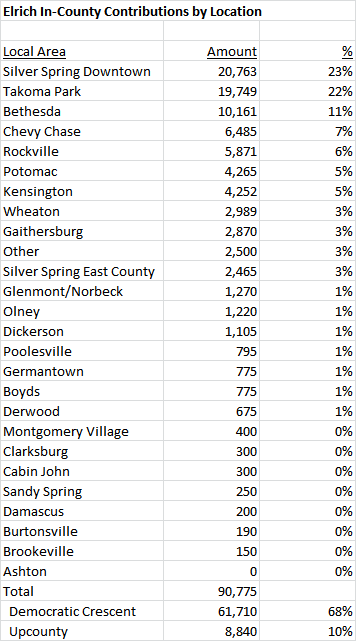
Elrich is the number one fundraiser in Downtown Silver Spring, Olney and Takoma Park, the latter by a mile.  His contributions have been heavily concentrated in the Democratic Crescent, which accounts for 53% of all in-county contributions and 68% of in-county contributions to Elrich.  This resembles the Downcounty support for Jamie Raskin in his 2016 race for Congress.  That distribution along with Elrich’s number one finish in the last two at-large elections and his many progressive endorsements makes him the front runner in the eyes of most observers.

George Leventhal

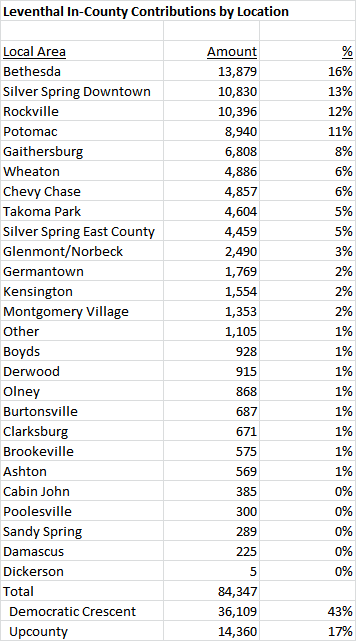
Leventhal, a former Chair of the county Democratic Party, has leveraged his more than twenty years in county politics to assemble the most geographically diverse contribution distribution of the Executive candidates.  He is the number one fundraiser in Bethesda, Gaithersburg, Germantown and Montgomery Village.  Leventhal leads Elrich in Upcounty but trails him by a lot in the Democratic Crescent.  Can Leventhal pull enough votes from Midcounty and Upcounty to overwhelm Elrich’s strength in Silver Spring and Takoma Park and break through?

Rose Krasnow

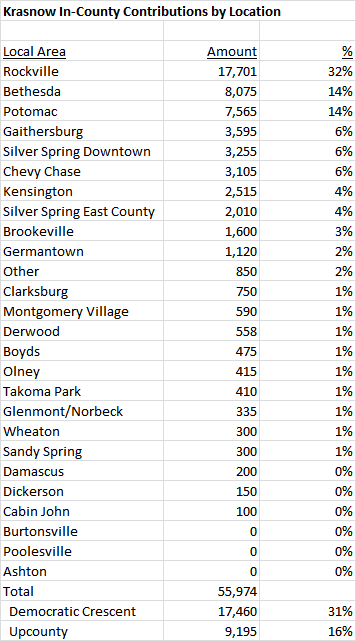
Krasnow was an elected official in Rockville between 1991 and 2001 and she is crushing both Elrich and Leventhal in money raised from the city.  On the other hand, she trails them badly in the Democratic Crescent.  Krasnow is off to a fast start in public financing but she needs more exposure in Downcounty areas like Downtown Silver Spring, Bethesda and Chevy Chase.  Elrich and Leventhal have been working those places for years and time is getting short.

Next, we will start looking at the Council At-Large candidates.

Disclosure: the author is a publicly-listed supporter of Berliner for Executive.

Share

Public Financing Geography, Part Two

By Adam Pagnucco.

As we stated in Part One, we have examined nearly 9,000 records of contributions to thirteen countywide candidates in the public financing system who have qualified for matching funds: County Executive candidates Marc Elrich, Rose Krasnow and George Leventhal and Council At-Large candidates Gabe Albornoz, Bill Conway, Hoan Dang, Evan Glass, Seth Grimes, Will Jawando, Danielle Meitiv, Hans Riemer, Mohammad Siddique and Chris Wilhelm.  Today we begin to answer the question of where individual contributions in the public financing system are coming from.

First, let’s tally the aggregate sums collected by all thirteen candidates.

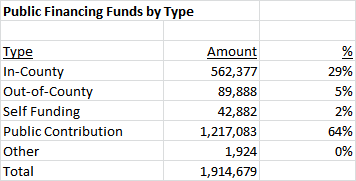
The largest source of money in the public system is public matching funds, which outnumbers private contributions by more than two to one.  But that understates the magnitude of matching funds because the contribution records do not include public funds requested but not yet disbursed.  We will examine that issue when we begin discussing individual candidates in Part Three.  One note: while candidates may not take corporate contributions, their accounts may accept vendor refunds, deposit returns and bank interest.  That accounts for the tiny amount in the “other” category.

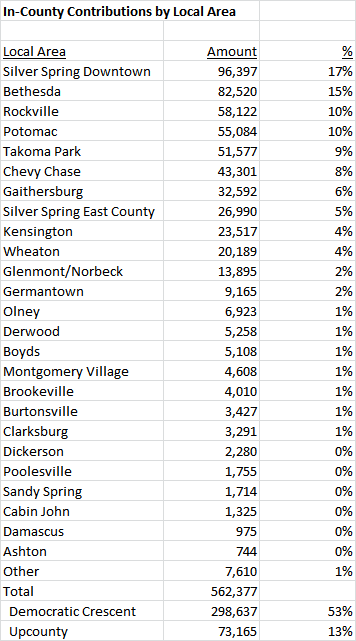
Now let’s look at in-county contributions by local area.

Urban centers that are also Democratic strongholds tend to dominate here, especially Downtown Silver Spring and Bethesda.  We have previously identified an area we call “the Democratic Crescent” including Takoma Park, Downtown Silver Spring, Kensington, Chevy Chase, Bethesda and Cabin John that accounts for 23% of the county’s population, 29% of its registered Democrats and 37% of its Super Democrats (those who voted in each of the last three mid-term primaries).  That area accounts for 53% of in-county contributions in the public financing system.

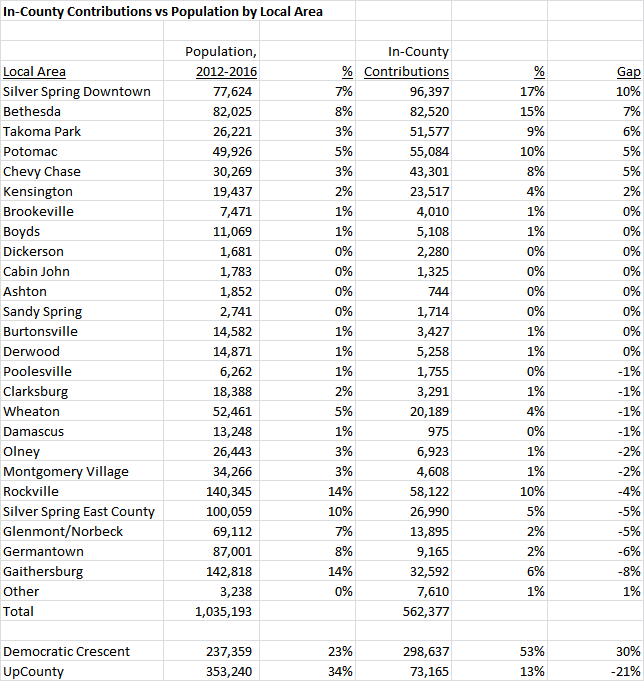
Below we compare in-county contributions to population by local area.

Relative to their population, Downtown Silver Spring, Bethesda, Takoma Park, Potomac and Chevy Chase are over-represented in terms of in-county contributions.  Gaithersburg, Germantown, Glenmont-Norbeck (zip code 20906) and Silver Spring East County (zip codes 20903, 20904 and 20905) are under-represented.  The Democratic Crescent accounts for 23% of the county’s population but 53% of in-county contributions.  Upcounty, an area we define as including Ashton, Boyds, Brookeville, Clarksburg, Damascus, Dickerson, Gaithersburg, Germantown, Montgomery Village, Olney, Poolesville and Sandy Spring, accounts for 34% of the county’s population but just 13% of in-county contributions.

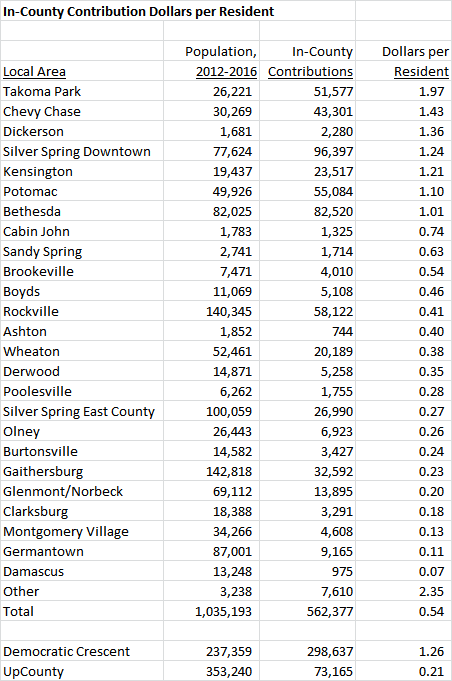
Here’s another way to look at the same data: in-county contribution dollars per resident.

Seven communities contributed one dollar or more per resident to publicly financed candidates: Takoma Park, Chevy Chase, Dickerson, Downtown Silver Spring, Kensington, Potomac and Bethesda.  Except for Dickerson and Potomac, all of these areas are in the Democratic Crescent.  Seven communities contributed less than 25 cents per resident: Burtonsville, Gaithersburg, Glenmont-Norbeck, Clarksburg, Montgomery Village, Germantown and Damascus.  The average contribution per resident in the Democratic Crescent was $1.26.  In Upcounty, it was 21 cents.

Finally, we compare in-county contributions to the distribution of Super Democrats.

The distribution of in-county contributions is a much closer match for Super Democrats than for the broader population.  But Super Dem-intensive areas are even more influential among contributors.  The Democratic Crescent accounts for 37% of Super Dems and 53% of in-county contributions.  Upcounty accounts for 20% of Super Dems and 13% of in-county contributions.  Downtown Silver Spring and Takoma Park are over-represented here even when factoring in how many Super Dems they have, while Glenmont-Norbeck, Silver Spring East County and Rockville are under-represented.

The bottom line is that public financing is amplifying the influence of heavily Democratic Downcounty areas above and beyond patterns of residency and voting.  That influence comes at the expense of Upcounty areas like Gaithersburg, Germantown, Clarksburg, Damascus and the smaller communities close to the Frederick and Howard County borders.  If corporate money and PAC money are thought to have outsize impacts on the actions of county government in the traditional system, then one wonders if the Downcounty dominance that some Upcounty residents complain about will be even more pronounced due to public financing.

In Part Three, we will begin examining specific candidates.

Share

Teachers Make New State Legislative Endorsements

By Adam Pagnucco.

The Montgomery County Education Association (MCEA) has made a new round of endorsements in state legislative races, conferring the influential Apple Ballot on the following House candidates.

District 15: Kevin Mack

District 17: Kumar Barve, Julie Palakovich Carr, Julian Haffner

District 18: Jared Solomon

District 19: Marlin Jenkins, Vaughn Stewart

District 20: Darian Unger

District 39: Gabriel Acevero

Combining these endorsements with those previously announced, the teachers are now supporting non-incumbents Mack, Palakovich Carr, Haffner, Solomon, Jenkins, Stewart, Unger, Acevero and District 16 House candidate Samir Paul (who is an MCPS teacher) along with all the state-level incumbents running for reelection except for Delegates Jim Gilchrist (D-17) and Marice Morales (D-19).  At the county level, the union has endorsed Ana Sol Gutierrez in Council District 1, Ben Shnider in Council District 3 and Brandy Brooks, Will Jawando and Chris Wilhelm (another MCPS teacher) for Council At-Large while postponing action on most county incumbents.

We find it interesting that Gilchrist (who the teachers endorsed in 2010 and 2014) and Morales (who was not endorsed in her first race last time) were the only two incumbents running for reelection who were not supported.  Also, the teachers have left one vacant slot in the strongly contested District 18 House race that may or may not be filled and chose not to support Board of Education Member Rebecca Smondrowski, who is running for Delegate in District 17.  Depending on what is said about those issues, we may have further comment soon.

Share

Precinct Power! Renewing the Democratic Party in Communities Across MoCo

By George Neighbors.

From the Commander-in-Tweet’s public policy pronouncements in Washington to blocking dissent on Facebook in Annapolis to the NRA’s endorsements of the duo, there’s a lot of unhappiness with the current US President and Maryland’s Governor.

Angry and teary eyed emojis don’t change public policy, and they sure don’t alone change who’s in power.  We need to move beyond social media rants and listserve brawls. We need to engage our neighbors. We need to build and bridge community with our neighbors to take action.

Personally, in April of last year I decided to raise my hand and step back in to the political arena. With encouragement and a little arm twisting by friends, I signed up to be a ​Precinct ​Leader​ for the Democratic Party​.  Now I’m the face and connective tissue of the Democratic Party to my neighbors.

Most Seventh State readers will know what a ​”Precinct​”​ is and what a ​”​Precinct Leader​”​ does, but I ask that you indulge me as part of what I’m trying to do to open up the opportunities and break down the barriers within the Democratic Party.

Precincts are the most local part of the Democratic Party. Each community is made up of voters in a community with a common voting location, aka polling place. These polling place communities are “Precincts.”​ In Montgomery County alone, we have 255 Precincts​!​ Each ​Precinct has a leader (or two) who is responsible for reaching out, engaging, educating and mobilizing voters and would-be voters in her​/his​ community.

Precinct officials and volunteers gather at the party’s precinct organization meeting on March 10.
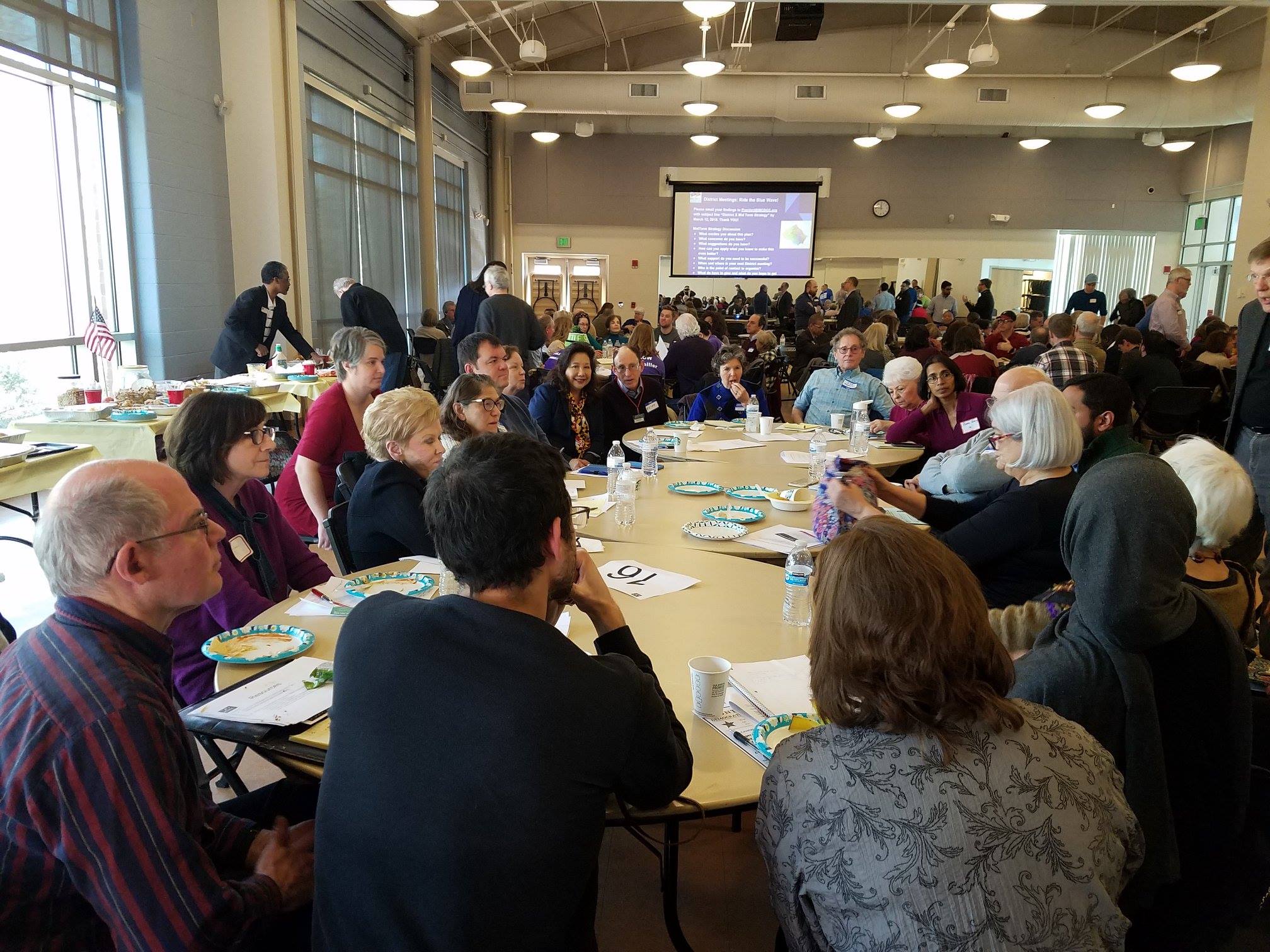
Because I’m relatively new to the inner workings of the Democratic Party, and I have an  organizational development background, and I kept asking a LOT of questions, I was asked to co-chair the Precinct Organization of the Montgomery County Democratic Party in August. You know the drill… you keep asking questions, you’re put in charge.

The Co-Chairs’ role is to empower, engage, mobilize, communicate, recruit and retain across all 255 Precincts – and ​engage with our 500+ leaders!

What I’ve learned is that we have many amazing people who have been doing the ​Precinct ​work of the Democratic Party for a long time: 20+ years! And we have a lot of new people, like me, who are keen to engage, and make a difference.

I’ve been asked, “What are we doing differently with the Party?” I tell people that we’re renewing the Precinct Organization. We’re refocusing on Precinct Power.

Renewing means prioritizing resources​​,​ training, mobilization, outreach, communication, and appreciation to recruit and retain great ​Precinct Leaders. Renewing also means we have to do things a little differently.

Renewal goal number one is to be strategic and intentional about our voter turnout strategy. We aim to increase Montgomery County Democratic midterm general election voter turnout by 15 percentage points, from the 45% in 2014 to 60% in 2018. We have a plan.

Renewal goal number two is to empower Precinct Leaders. We’re gathering the Precinct Leaders from across the County together every few months to discuss the strategy of the Party, evolve their role beyond Election Day to engage with their communities throughout the year, and build the infrastructure at the State District level so that we can inspire people across the County, coordinate across the Districts, and engage in each Precinct community.

Renewal goal number three is to mobilize the Precincts. Beginning last summer and continuing through the fall and winter, we engaged Precinct Leaders in canvassing to learn what Democrats think. ​”​Canvassing​”​ means you go door-knocking  to reach and talk with​ people. ​It’s proven to be the best way to reach voters and get ​them engaged.

These canvasses were not asking the voters to donate or vote. Rather, these were “listening canvasses” to have voters share their thoughts. During these conversations ​we listened and helped connect neighbors with their elected Democratic officials to address issues ranging from a broken street light to an erroneous utility bill to navigating healthcare.

The canvasses also provided an opportunity to train our Precinct Leaders in canvassing and outreach. It was about making a personal connection with voters. Bringing the Democratic Party to them!

​Renewal goal number four is to activate each Precinct. To help grow the Precinct Organization, ​I’ve spent the past six months ​speaking to clubs and organizations across the ​County about the ​Precinct ​Organization, and how people can get involved.

Many Precincts could use new blood to assist current Precinct Leaders, and many other Precincts are in need of new leadership either because of an absence or because someone is ready to step aside.​

We also need to engage new voters and immigrants as well. Having people who look, live and speak like they do, is the beauty of the Precinct Organization, i.e., neighbors talking to neighbors.

So now comes the pi​tch… With the June primary counting down, and the general election in November, we need to organize. We need to mobilize. We need to engage. We need voters to turn out. We need voters to vote.

We also need ​Precinct ​Leaders. We need bilingual leaders. We need new leaders. We need leaders who represent their community. We need leaders up county, down county, east county, west county and mid county. Opportunities abound to do something that matters. Together we can build stronger and engaged communities.

I’m asking all Democrats reading this to do four things.

​1. Go to the ​Precinct ​Organization map on the Montgomery County Democratic Party website and look up your ​Precinct.

​2. If you have a ​Precinct Leader, reach out to say ‘thank you.’ Then offer your help to knock on doors, call, enter data, host a meet and greet, etc.​ (Please email Precinct@MCDCC.org if s/he does not get back to you.)​

​3. ​If you looked up​ your Precinct​ and you don’t have a Precinct Leader, ​YOU can apply to be a Precinct Leader​ with this application!​ You can also email my cochair Mumin Barre and me at Precinct@MCDCC.org to set a time to talk about it and answer your questions.

​4. ​Please share this story with as many people as you can ​via email, social media, ​and ​word-of-mouth. We need engaged and empowered Precinct Leaders, who are building and bridging communities, to take back the governorship.

I’m committed to making sure that no one come June or November wonders how they can get involved and engaged… how they can build stronger and engaged communities… how they can make a difference.

As we ​renew our Precinct Power, we need everyone- new and lifelong Democrats- to help build the Democratic Party, listen to residents, and reach voters to make a difference in their lives and our community.

George Neighbors is the Democratic Party Precinct Vice Chair of Precinct 13-21​, Co-Chair of the Montgomery County Democratic Party’s Precinct Organization, and the male District 20 Candidate for the Montgomery County Democratic Party’s Central Committee in the June 26 Democratic Primary.

Share

Public Financing Geography, Part One

By Adam Pagnucco.

This year’s election cycle is the first one in which public financing is being used in MoCo’s county-level races.  That is one of many reasons why this election is historic in nature.  So far, we know the following things about public financing: it is heavily used (especially in the Council At-Large race), it is administratively challenging, it requires a long time to raise money, it is less costly than first thought and while it creates opportunities for new candidates, it confers huge benefits on incumbents.  Also, as predicted, the system reduces the influence of corporate interests and PACs.  But who is stepping into that vacuum?

This week, we will explore where contributions to publicly financed candidates come from.  Participation in the system is optional; candidates can stay in the traditional system and many of them have done so.  Candidates in the public system may only accept contributions from individuals up to $150.  They cannot take money from corporate entities or PACs and must limit self-financing to $12,000.  Contributions from in-county residents are matched by the county on a sliding scale.  For Executive candidates, a $150 in-county contribution gets a county match of $600.  For council candidates, a $150 in-county contribution gets a county match of $450.  Candidates must meet thresholds of in-county money raised and numbers of in-county contributors to qualify for matching funds and are subject to caps of public fund receipts.  And if a candidate applies for matching funds and does not meet the thresholds, that person can be ruled ineligible for matching funds.

To examine the origins of contributions in public financing, we accumulated the contribution records of thirteen candidates who have qualified for matching funds: County Executive candidates Marc Elrich, Rose Krasnow and George Leventhal and Council At-Large candidates Gabe Albornoz, Bill Conway, Hoan Dang, Evan Glass, Seth Grimes, Will Jawando, Danielle Meitiv, Hans Riemer, Mohammad Siddique and Chris Wilhelm.  We did not include contributions to district-level candidates like Sidney Katz, Nancy Navarro and Reggie Oldak because their receipts will inevitably be skewed to their districts, thereby introducing a geographic bias into the data.  We also did not include contributions to non-qualifiers because they may not ultimately receive matching funds.  One important consideration with examining these accounts is that not all of them have last filed on the same dates.  While some were current as of the last regular report in January, others have filed as recently as last week.  That’s because once a candidate qualifies for matching funds, they can apply for new distributions at any time through fifteen days after the general election.  One important constraint for late starters: candidates in the system must qualify for matching funds by 45 days before the primary.  Since the date of this year’s primary is June 26, that means the qualifying period ends on May 12.

This analysis involved an examination of nearly 9,000 records.  We asked two sets of questions.  First, where are in-county contributions eligible for matching funds coming from and how do they compare with both the population and regular Democratic voters?  Second, what are the differences in contribution geography between participating candidates?  Those differences contain illuminating clues to the appeal and strategy of the candidates which could ultimately decide the election.

We will begin unveiling our results in Part Two.

Share

MoCo Endorsements: March 9, 2018

By Adam Pagnucco.

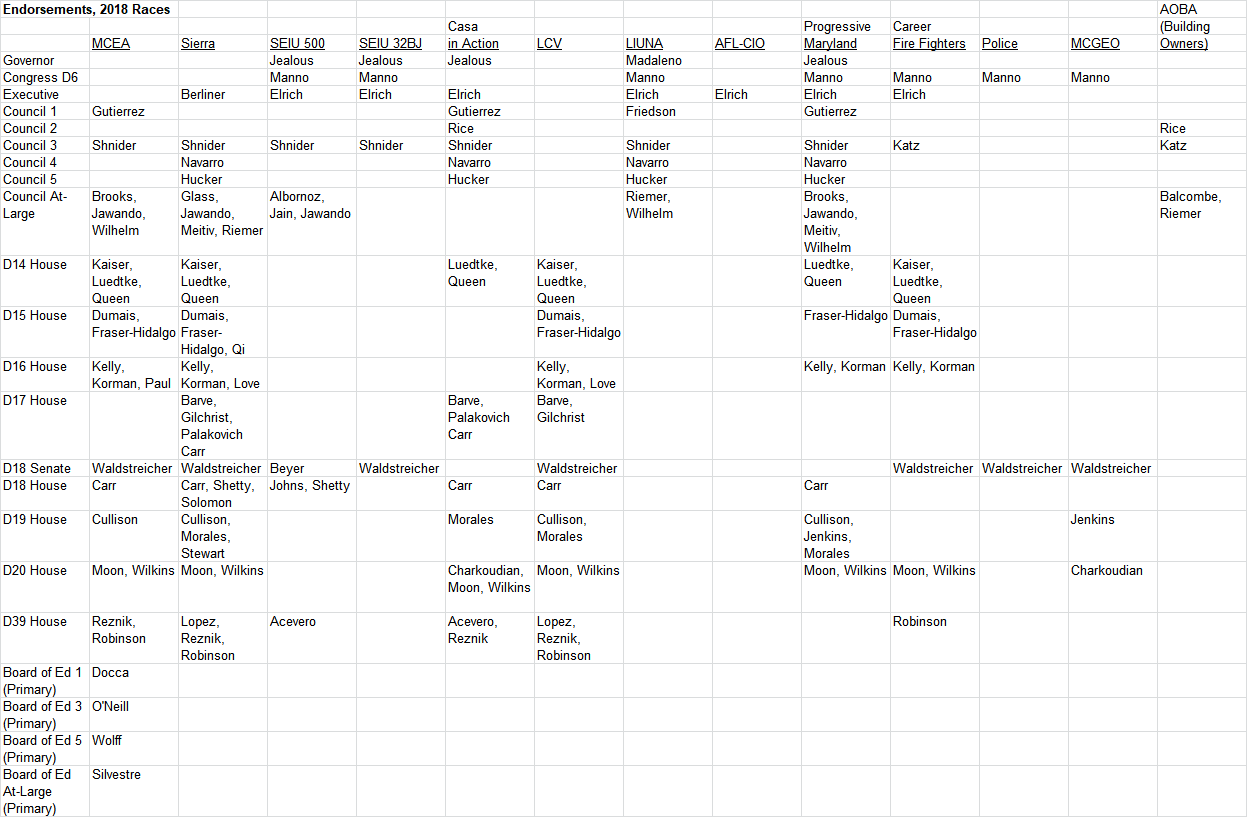
We have entered the thick of endorsement season and a big one just came out: a partial decision by MCEA, holder of the mighty Apple Ballot.  We have updated our institutional endorsement matrix and offer some comments below.

First, a note.  Many of the listed endorsing organizations have not finished their processes and may be announcing more decisions in the future.  Other important organizations (like the Washington Post, the Realtors and the Volunteer Fire Fighters) have not endorsed yet at all.  So this list is a work in progress.

That said, here are a few impressions.

Senator Roger Manno, who might be the most pro-union member of the entire General Assembly, is sweeping labor endorsements in his run for Congress District 6.  How far will that take him against Delegate Aruna Miller and Total Wine co-owner David Trone?

Council Member Marc Elrich, who is running for Executive, has put together an impressive string of progressive endorsements and he will be getting more of them.  He is definitely the favored Executive candidate of the left.

Ben Shnider, who is challenging District 3 County Council candidate Sidney Katz, has also become a darling of the left.  Will that be enough to take out Katz, who has been the most prominent politician in Gaithersburg for decades?  We will have an opinion on that in the near future.

Will Jawando, who is running for Council At-Large, has had a great six weeks.  He is the only non-incumbent who has assembled four influential institutional endorsements, including the Apple.  (Chris Wilhelm has three and Danielle Meitiv and Brandy Brooks have two each.)  Combine that with Jawando’s fundraising success, electoral experience and natural charisma and he is looking strong right now.

The good news for Delegate Jeff Waldstreicher, who is running for the District 18 Senate seat being vacated by Rich Madaleno, is that he is dominating the institutional endorsements over Dana Beyer and Michelle Carhart.  The bad news is that his dispute with House candidate Helga Luest is escalating.  Women are 60% of MoCo Democrats and this is a particularly bad cycle to run afoul of them.

While MCEA has made some county-level endorsements, it has postponed its decision on the incumbents (except for Sidney Katz).  The teachers are unhappy with recent MCPS budget decisions made by the County Council, especially with the breaking of their collective bargaining agreement two years ago.  With Ike Leggett’s recommended budget coming next week, we will learn more about what might happen to MCPS this year and that will affect the union’s thinking.  The remaining non-incumbents in the Council At-Large race will be paying rapt attention!

Speaking of the At-Large race, we wrote last April that the sole incumbent running, Hans Riemer, was going to be reelected.  We still believe that will happen and so do most of the folks running in his race.  But what happens if he is passed over by both the Apple Ballot and the Post?  The Apple is skeptical of council incumbents right now.  As for the Post, the newspaper endorsed Riemer in the 2014 primary in part because it said challenger Beth Daly was “dead wrong.”  But it dumped Riemer for a no-name Republican in the general election, saying he was “a first-termer with modest achievements.”  The Post has a lot more options in the 2018 At-Large field than it did last time.  Then throw in the facts that there are a lot of good folks in the At-Large race and Riemer’s name will be appearing near the end of a VERY long ballot.  If Riemer loses both the Apple and the Post and the hungry field of non-incumbents continues to impress, is he still a lock to win?  (Disclosure: your author used to work for Riemer.)

That’s it for now.  We’ll have more when the next wave of endorsements comes in!

Share

When They Go Low

District 18 Delegate Candidate Helga Luest’s statement that Del. Jeff Waldstreicher tried to lure her into the Senate race in order to aid his own move from the House of Delegates to the Senate has become quite the contretemps in District 18.

Jeff Waldstreicher’s Denial

After evading questions from me and refusing to comment on the record, Jeff finally issued this statement to Andrew Metcalf over at Bethesda Beat:

These claims are false, defamatory, and born of actual malice,” Waldstreicher, who has served as a delegate since 2007, said in the statement. “When they go low, I go high—standing up for our community’s progressive values, leading the fight for $15 minimum wage, investing in our schools and resisting the Trump administration at every turn.

Jeff ought to be a near lock for this seat. He’s a three-term delegate and has consistently garnered more votes than his opponent, regular state legislative candidate Dana Beyer, as Adam Pagnucco has pointed out. He hasn’t strongly alienated any constituencies, which should make it hard for her to gain traction.

But he seems to be doing his level best to turn this into a competitive race. Even leaving aside Helga’s claims, his public statement sounds like what Melania would say if she was a red-headed attorney.

Rather than issuing a standard denial or explaining the situation, it looks like Jeff is thinking like an attorney who has managed to turn Michelle Obama’s inspiring words into political pablum. Moreover, when an attorney uses legalistic words like “defamatory” and “actual malice,” it look like he’s hinting at a lawsuit in an effort to get Helga to stop talking.

That’s not going to happen.

It never looks good when the optics are of a politician trying to silence someone. In the current climate, a male candidate trying to get a female candidate to stop talking looks even worse. Of course, if he did file a lawsuit that would really torch his political ambition.

Jeff’s evasiveness and efforts to kill the story also haven’t helped. Jeff’s silence and avoidance of comment on any remotely controversial issue at last Sunday’s debate–he literally did not speak for the first 75 minutes–also reinforce the perception of an overly political approach.

#metoo?

Dana Bayer felt “it was demeaning” that Jeff suggested she run on a slate with him for delegate instead of competing for the Senate seat. That, however, seems like normal politics and a good offer.

On the other hand, an effort by Jeff to get Helga to run for the Senate to help him out, would appear much more manipulative and skeezy. Voters might well judge it less kindly, though I’m not sure if they will know or care.

Dana Beyer tried to push the narrative, which is also how Helga sees it, of criticizing Jeff’s alleged behavior in light of #metoo:

I trust her and believe the story.

I find it disturbing that Jeff would so crassly ask anyone to sacrifice themselves for his sake, let alone a woman. As if her commitment to public service was inconsequential, and beneath his concern.

She made a similar statement to Bethesda Beat:

“I have every reason to believe Helga’s story,” Beyer said. “The underlying principle is, I trust women.”

Except this is not sexual harassment but political manipulation. Dana would also gain more if she stayed in the background rather than appearing all too eager to garner political advantage. The idea that one always trusts women over men is also problematic.

I have never seen nor heard any stories of Jeff behaving remotely sexually inappropriately. Frankly, it would surprise me greatly. I should also emphasize that this is not what Helga says happened, though she sees his actions through the broader lens of misogyny faced by women.

Notwithstanding the bad optics of Jeff declaring Helga’s post as “defamatory” and “born of actual malice,” I see this situation more as maladroit machinations. Helga’s allegations could be completely true but not so much about gender as the political maneuvering referenced in the Bethesda Beat headline.

To the extent that Jeff is willing to engage in these too-clever-by-half political games, I think he’d just as easily ask a man if he thought that was the good play. If he’s guilty of anything here, it’s political malpractice and a self-inflicted wound, as all of this seems rather unnecessary for him to win.

At the same time, Jeff’s “totally false” statement had at least one glaring weakness and Helga has not hesitated to point it out. Specifically, they clearly did meet, as Helga has highlighted in her reply to Jeff’s public statement.

Final Notes

Helga mentions accurately that she told me about the story before she published her Facebook. For a variety of reasons, I didn’t feel comfortable publishing it. She did not mention that I contacted her when I decided not to publish the story.

I’m glad Bethesda Beat’s Andrew Metcalf covered this story instead of me. Frankly, I’m not a professional reporter and he did a better job than me of getting straight up on the record accounts.

Share

Toward Cost-Effective Transportation

By Neil Harris.

Transit is much more expensive to build than highways. It’s politically correct to focus on transit. But is it the best use of our tax dollars? Let’s look at the numbers.

Transportation planners in our region look at many. At the most recent Transportation Planning Board (TPB) meeting, there was a presentation on the ways that transportation plans are measured and approved factors – social equity, air quality, and many more. But when I asked if there was a cost-benefit analysis, it became clear that this did not appear to be on anyone’s list of measures.

By cost-benefit, I mean this: when you build a new transportation project, how much money does it cost to move people?

Over the last few weeks, I went back through some presentations and found the two slides shown below that have the numbers to tell an important story. I spent a lunch hour on the phone with TPB staff to verify that what I was seeing was accurate, and what it might mean. Here is what I learned from TPB’s data:

The DMV region plans to spend $42 billion to expand transportation capacity over the next 25 years, split between $27 billion on highway expansion and $15 billion on transit. This will result in 2.7 million more daily trips by auto and 300 thousand more daily trips in transit. By simple arithmetic, this means that it costs just over $10,000 to add capacity for another auto trip, and more than $53,000 to add another transit trip. Building transit capacity currently costs more than 5 times as much as highway capacity!


If this was the only factor that was important, then decisions would be easy. Any CEO would immediately allocate more money into adding highway capacity. Of course, it’s not the only factor. Not everyone can afford to travel by auto – we want lower-income people to be able to get to their jobs, so we need transit. Transit trips are less polluting than autos, although TPB’s data shows a steady decrease in auto pollutants thanks to greater efficiency and the growing number of electric, zero-emission vehicles.

The other key is that, for parts of our region, building new roads or even expanding existing ones is terribly difficult. Where would you put a new thoroughfare in DC, or in the close-in suburbs?

The costs I focused on so far are the capital costs for new projects. The same TPB information can be used for operating costs – how much it costs for each trip. It turns out that we’re going to spend $130 billion over the next 25 years on transit operations and repairs, about $5.2 billion annually, with capacity growing to 1.5 million daily trips, for a per-trip cost of about $9.50. Each time someone takes a transit trip, the government subsidizes the trip by that amount. We’ll spend $72 billion to maintain roadways during the same period, about $2.9 billion annually, to move up to 16.6 million trips/day. That comes to just under 50 cents per trip.

The operating cost information is useful in a couple of ways. At the same TPB meeting, the Commuter Connections presentation unveiled a new program, piloted in Howard County MD, where auto commuters can receive a $10 stipend for taking a rider along with them. That number is almost exactly right – it is comparable to the cost of putting someone on transit instead, but we don’t need to build more transit lines.

That is the kind of thinking we need. When we look at a new project or a new idea, does it move people more effectively than how we’re doing it now? Is it better for some reason, is it faster, is it cheaper?

For example, the TPB recently recommended that we find ways to encourage employers to let more people work from home. What if the government provided an incentive to the employers? With these numbers, we can make informed judgments about how much of an incentive makes fiscal sense.

The amount of money we have to transport people is limited, so we need to think carefully about optimization strategies to move people cost-effectively as well as focusing on all the other factors.

Neil Harris is a member of the Gaithersburg City Council and the Metropolitan Washington Council of Governments Transportation Planning Board.

Share

Gaithersburg Electeds Endorse Balcombe

By Adam Pagnucco.

Council At-Large candidate Marilyn Balcombe has announced endorsements from three elected officials in Gaithersburg: Mayor Jud Ashman and City Council Members Mike Sesma and Neil Harris.  Balcombe is the long-time President and CEO of the Gaithersburg-Germantown Chamber of Commerce and lives in Germantown.  Gaithersburg, including both the incorporated and unincorporated areas, has more than 40,000 registered Democrats of whom roughly 3,500 have voted in each of the last three mid-term Democratic primaries.

Left to right: Sesma, Harris and Balcombe, Ashman.  Credit: Balcombe for Council Facebook page.

Share

Maryland Politics Watch