Riemer Takes on Elrich

By Adam Pagnucco.

Council Member Hans Riemer has used Facebook to weigh in on his colleague, Marc Elrich, who is running for Executive.  Riemer and Elrich have cooperated on numerous progressive priorities like Elrich’s $15 minimum wage bill, Riemer’s bill to restore the county’s earned income tax credit, protecting Ten Mile Creek and instituting paid leave, but the two have occasionally disagreed on land use issues.  Other than Nancy Floreen, who has endorsed Rose Krasnow, the other incumbent Council Members who aren’t running for Executive themselves have been quiet on the Executive race.  We reprint Riemer’s Facebook post below.  (Disclosure: your author was Riemer’s Chief of Staff from 2010 through 2014.)

Share

Conway Quotes Raskin, Delaney and Miller

By Adam Pagnucco.

Council At-Large candidate Bill Conway has sent out the mailer below quoting Congressmen Jamie Raskin and John Delaney as well as Delegate Aruna Miller (D-15), who is running to succeed Delaney.  Miller and Delaney have endorsed Conway.  Conway’s campaign tells us that Raskin has authorized the use of his picture and quote even though Raskin has not endorsed Conway.

Share

The Ups and Downs of Jealous’s Financial Stewardship of the NAACP

Ben Jealous likes to tout his leadership at the NAACP. Managing the State’s budget is a central responsibility of the governor. How did he handle the NAACP’s finances?

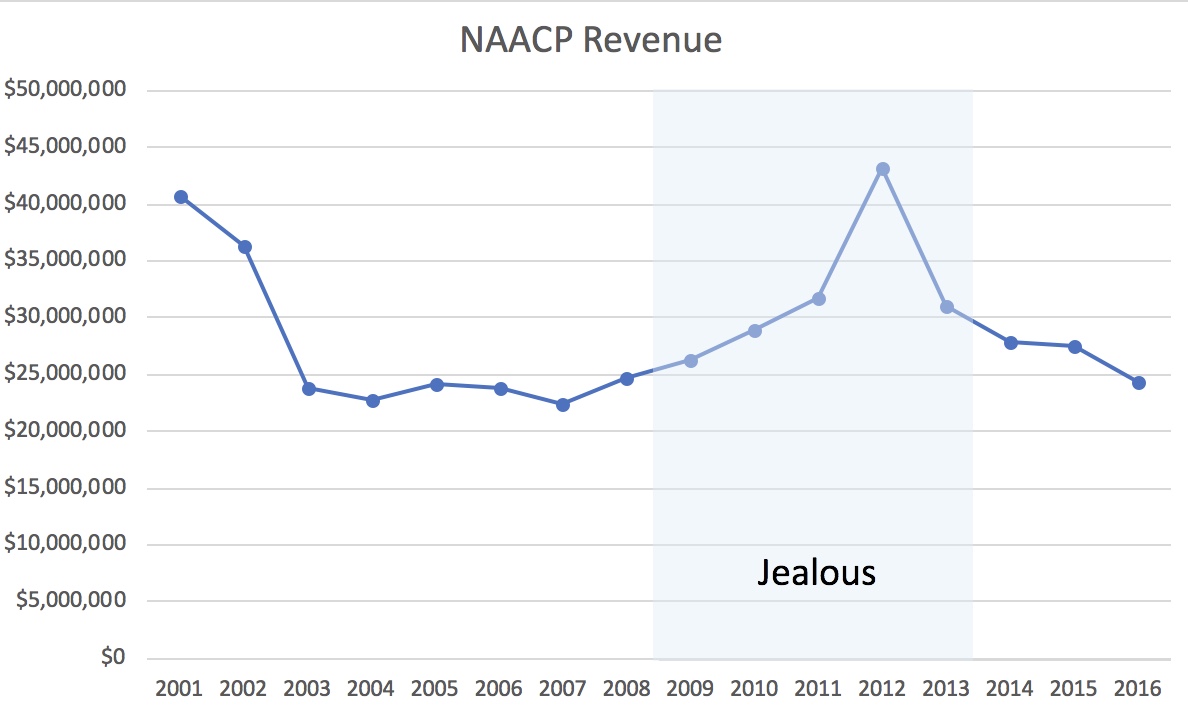
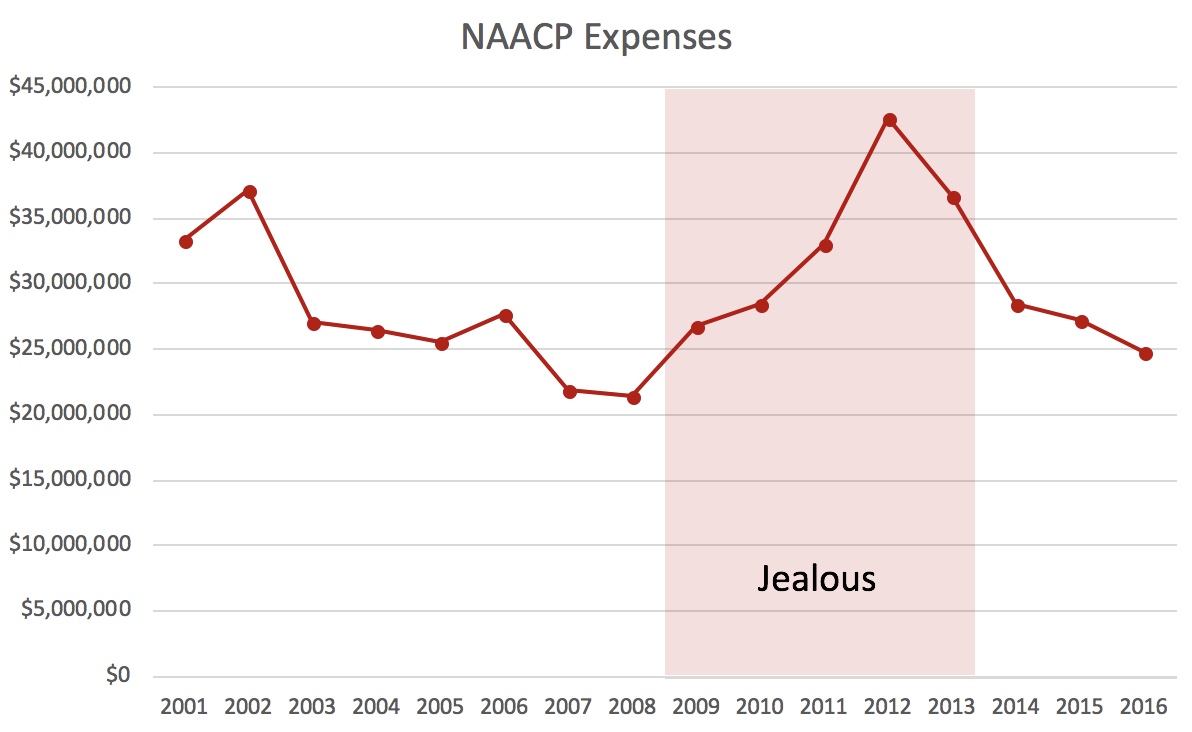
Examination of the organization’s tax returns reveals that Jealous’s leadership at the NAACP had a major impact on the organization’s finances. He increased the revenue – and expenditures – of the NAACP dramatically.

NAACP revenue rose from $24.7 million in 2008 to $43.2 million in 2012, an impressive 75% increase. However, it dropped back to $31.0 million in the last year of Jealous’s tenure before his abrupt departure after the first year of a new multiyear contract. (Jealous refused to explain the reasons for his leaving in an interview with The New Republic.) Revenue has since continued to decline, falling to $24.4 million in 2016.

Expenditures tracked revenue closely, and rose from $21.5 million in 2008 to $42.6 million in 2012 before falling back to $36.8 million in 2013. Since Jealous left the NAACP, spending has continued to fall, reaching $24.8 million in 2013.

My sense that Jealous did an amazing job at the start of expanding the organization’s revenue, and thus activities, but that it did not prove sustainable. Both revenue and expenditures dropped substantially in the last year of his leadership. Jealous did not leave the organization able to maintain even this level of revenue or expenditures, as both continued to fall.

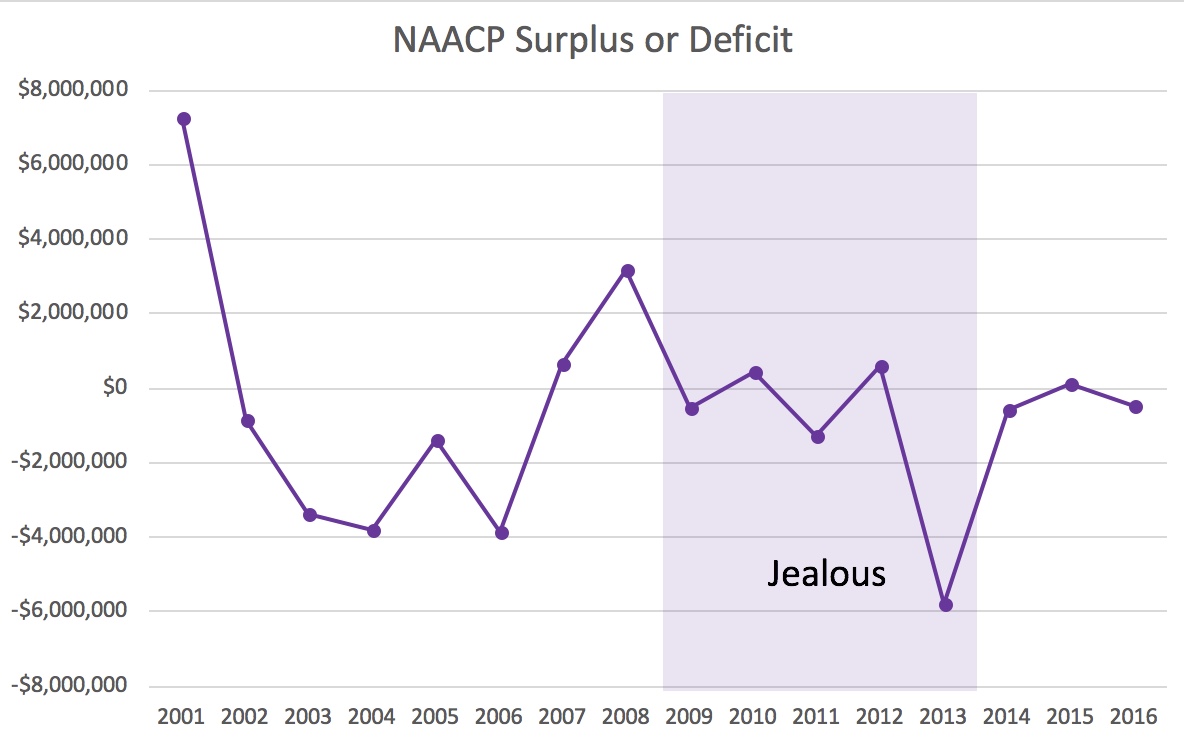
The net impact of Jealous’s financial stewardship is overall less impressive than his ability to increase the organization’s profile. In the first four years of his leadership, the NAACP’s largest surplus was $0.6 million and its largest deficit was $1.3 million. However, the deficit jumped to $5.8 million in his final year – the largest in the 16 year period examined here.

The impact on net assets is more disturbing. After increasing the organization’s assets from $12.7 million to $17.3 million, Jealous then oversaw their fall to just $8.0 million in the final year of his leadership – a drop of 37% from his arrival and 54% from the best position under his leadership.

Assets continued to fall after Jealous left, reaching a low of $3.0 million in 2015 before rising to $3.8 million in 2018. Again, this doesn’t present a picture of an organization left on very stable footing when Jealous left.

Ironically, this progressive tribune presents a great example of how the well off have continued to do well even as the incomes of ordinary people have stagnated. Jealous’s compensation rose from $285,000 in the first full year of his tenure to $375,114 in his final year, an increase of 32%.

Share

Campaign Finance Reports: Council At-Large, June 2018

By Adam Pagnucco.

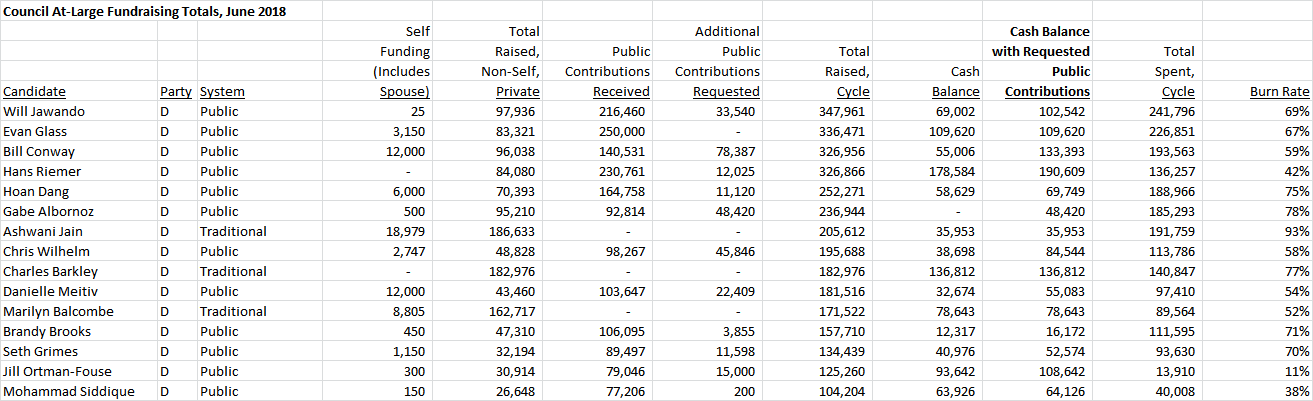
Let’s look at the June campaign finance reports for the Council At-Large candidates, the last ones available prior to the primary.  A note on methodology.  First, we calculate total raised and total spent across the entire cycle and not just over the course of one report period.  Second, we separate self-funding from funds raised from others.  Self-funding includes money from spouses.  Third, for publicly financed candidates, we include public matching fund distributions that have been requested but not deposited in raised money and in the column entitled “Cash Balance With Requested Public Contributions.”  That gives you a better idea of the true financial position of publicly financed campaigns.

Below is our fundraising summary for the Council At-Large candidates.  We are including only those who have qualified for matching funds in the public financing system or have raised at least $100,000 in traditional financing.  With a field this deep and talented, candidates who have not met either of these thresholds will struggle to compete.

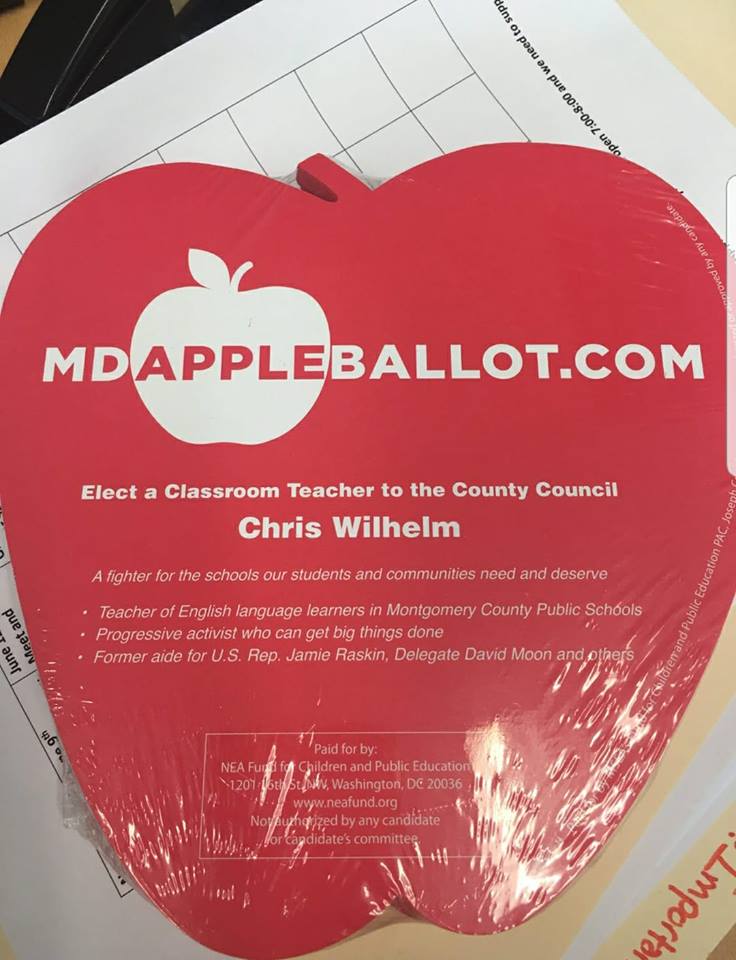
Four candidates are bunched at the top: incumbent Hans Riemer and Will Jawando, Evan Glass and Bill Conway.  Two more – Hoan Dang and Gabe Albornoz – have raised enough money to compare with past candidates who have won.  Then there is MCPS teacher Chris Wilhelm, who is working as hard as anyone and has an entire side of the Apple Ballot to himself.  That has to be worth the equivalent of an extra mailer or two.  Finally, school board member Jill Ortman-Fouse is not a money leader, having entered the race very late, but she does have a base of loyalists who could be very useful in working the polls on Election Day.  Overall, our view is that Riemer will be reelected, Jawando and Glass are in good positions and one – maybe two – of the others named above will likely also be elected.

Here’s a question for the readers: why are the female candidates not raising more money?  Danielle Meitiv (who ranks 10th on the chart above), Marilyn Balcombe (11th), Brandy Brooks (12th) and Ortman-Fouse (14th) are all good candidates running in an electorate that is 60% female.  Not only do their totals lag the above men – they also lag the amounts raised by Beth Daly (2014), Becky Wagner (2010), Duchy Trachtenberg (2006 and 2010) and of course four-term incumbent Nancy Floreen.  Public financing was supposed to equalize the influence of small contributors, including women, with corporate interests that are overwhelmingly male dominated.  And yet the nine top fundraisers are men.

Let’s remember that the best-financed candidates don’t always win.  Exhibit A is the chronically underfunded Marc Elrich, who finished first in the last two at-large races and could be the next County Executive.  The at-large race also has produced surprises in the past, including the defeats of incumbents Blair Ewing (2002), Mike Subin (2006) and Trachtenberg (2010).  As soon as your author thinks he has the at-large race figured out – BAM! – something different happens!

This is probably the best at-large field in MoCo history.  It’s sad that only four of them will win.  But so it is.  On to Election Night.

Share

Campaign Finance Reports: County Executive, June 2018

By Adam Pagnucco.

The June campaign finance reports are in and they will be the last ones available prior to the primary. Today, we’ll look at the County Executive race.  A note on methodology.  First, we calculate total raised and total spent across the entire cycle and not just over the course of one report period.  Second, we separate self-funding from funds raised from others.  Self-funding includes money from spouses.  Third, for publicly financed candidates, we include public matching fund distributions that have been requested but not deposited in raised money and in the column entitled “Cash Balance With Requested Public Contributions.”  That gives you a better idea of the true financial position of publicly financed campaigns.

Below is our fundraising summary for the County Executive candidates.  The numbers for Robin Ficker presume he has qualified for public matching funds but we have not heard definitively whether he has.

It’s official: David Blair has broken Steve Silverman’s 2006 spending record of $2 million in an Executive race.  (Sorry Steve but you knew it wouldn’t last forever!)  Blair’s $3 million in spending, mostly self-financed, exceeds the $2.1 million combined total so far reported by the other candidates.

Marc Elrich has excelled in public financing and has also had the good fortune to see the second-best financed candidate (Roger Berliner) going negative in TV and mail against the best-financed candidate (Blair).  Combine that with the attack strategy of Progressive Maryland and Elrich can use his own money to promote himself and let others do the dirty work of bringing Blair down.  It couldn’t get any better for Elrich.

Speaking of the attacks on Blair, the scale of them is becoming clear.  Berliner has spent $51,048 on mail and $391,234 on TV, all of which had negative messaging about Blair.  The Progressive Maryland Liberation Alliance PAC has so far raised $100,000, most of it in union money, to oppose Blair.  The combined amount between the two – $542,282 – is likely the most money ever spent on attacking a candidate for County Executive and the race is not over.  To our knowledge, none of the other Executive candidates has been targeted by negative TV commercials or negative mail.

The other three Democratic candidates – George Leventhal, Rose Krasnow and Bill Frick – are struggling to compete with limited resources.  Leventhal has had money problems for the entire campaign but he is working his heart out.  That plus his longevity and diverse base of supporters get him into the mix but he is still a long shot to win.

Rumors have swirled for weeks about labor polling and MCGEO President Gino Renne confirmed them to Bethesda Magazine on Friday.  Renne said that Elrich and Blair were “neck and neck” in a number of polls and said, “When you combine all the different polls, it’s a good solid snapshot of what’s going on… I would say it’s statistically insignificant [between Elrich and Blair]. It’s all about who can get their voters to the polls. If the election were today, I’d have to call it a toss-up.”

We have written about Elrich’s base before: it’s a combination of anti-development activists, progressives and people living in and near Takoma Park.  But Blair is developing a base too by consolidating those who want a different direction in county government.  Frick and Krasnow have a similar message but they don’t have the money to make it stick like Blair does.  And so this election is turning into a contest between different visions of change: a move towards greater progressivism or a move away from tax hikes and towards more economic development.

Who knows which side will win?

Share

The Wilhelm Ballot

By Adam Pagnucco.

Here is something we haven’t seen before: a mid-term year Apple Ballot with one candidate occupying one side of it and a list of others on the other side.  This Apple, still in wrapping, is customized in favor of Council At-Large candidate Chris Wilhelm.

Here is another one spotlighting District 16 House candidate Samir Paul.

The Apple we were given at the Wheaton early voting site was not like these.  It had county candidates on one side and state candidates on the other, a typical format used in the past.

Wilhelm and Paul are MCPS teachers.  We totally get why MCEA would like to elect its own members to office, although that has not always been their top priority.  For example, the union endorsed County Council District 5 incumbent Derick Berlage over MCPS teacher Marc Elrich in 1998.  In Elrich’s 2002 and 2006 races, he did appear on the Apple but we don’t recall him getting an entire side of it to himself.

The races involving Paul and Wilhelm are very different.  In District 16, the two incumbent Delegates – Ariana Kelly and Marc Korman – are endorsed by MCEA and a lock for reelection.  Paul is in a tight contest with fellow new candidate Sara Love for the open seat being vacated by Delegate Bill Frick.  He needs every edge he can get.

The Council At-Large race, on the other hand, is extremely competitive and unpredictable.  MCEA has endorsed incumbent Hans Riemer, Brandy Brooks and Will Jawando in addition to Wilhelm.  Riemer seems likely to be reelected but that’s about all that can be safely predicted in this race.  What will Riemer, Brooks and Jawando think of the Wilhelm Ballot?

Share

How to Spend More on Education and Transportation Without Raising Taxes

By Adam Pagnucco.  

It’s election season and that means it’s time for lots of promises from politicians.  And boy are they promising a lot, especially on the county’s two big issues of education and transportation.  The mailbox’s “progressive leaders” have “plans” to guarantee every child a great school, invest in transportation – especially transit – and to do all of the above without raising taxes.  Sounds great, yeah?

Time to get real, folks!

Education and transportation each have two virtues.  First, each of them generates direct economic returns.  Education spending yields a return on human capital while transportation spending yields a return on physical infrastructure.  Both are important for attracting and retaining residents and jobs.  Second, each of them is popular with voters.  For as long as anyone can remember, education and transportation have been two of the top issues in our elections – and they might possibly be THE top two.  Happily, on these two issues, good policy and good politics come together!

Paying for them is another matter.  MCPS accounts for a greater percentage of the budget than any other agency with a $2.5 billion budget in FY18.  Montgomery College received more than $300 million.  The Department of Transportation’s operating budget was $56 million.  Funding increases with meaningful impacts on these agencies need to be in the tens of millions of dollars – at least.  That kind of money far exceeds a spreadsheet rounding error.

And yet, there is a way to increase spending on MCPS, the college and transportation without massive tax hikes.  The catch is that it’s not quick or easy.

Let’s do a simple (and yes, admittedly simplistic!) exercise with the operating budget.  First, let’s identify the combined local dollar spending on MCPS, the college and the Department of Transportation (DOT).  Next, let’s segregate out intergovernmental aid, which plays an important role in the budget but is not controlled by the county government.  Then let’s segregate debt service.  Yes, over long periods of time, the county can adjust debt service.  But much of the debt service is being paid on capital projects already completed, and furthermore, a huge chunk of it goes to school construction and transportation projects.  Boosting education and transportation operating budgets by cutting their capital budgets is not the best idea in the world!  Finally, let’s subtract out local dollar education and transportation spending, intergovernmental aid and debt service from total spending and what we get is a great big category that we shall creatively name “Everything Else.”

Here’s what happens when we do that for FY11, the trough budget year of the Great Recession, and FY18, the budget that ends on June 30 of this year.
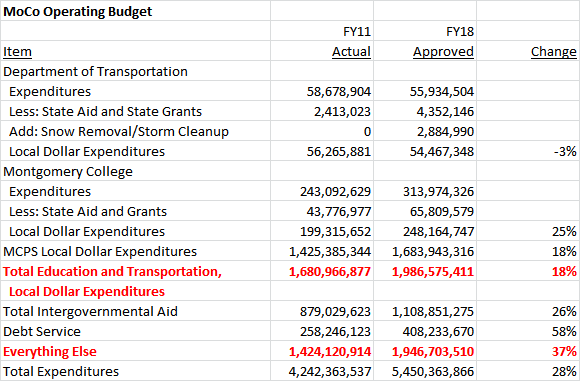
What the above data shows is that the total county budget grew by 28% over this period.  Intergovernmental aid grew by 26% and debt service rose by a whopping 58%.  (We have previously written about the county’s rapidly growing debt.)  Now let’s contrast the two remaining broad categories: the local dollars spent on MCPS, the college and DOT and everything else.  The education and transportation budgets grew by a combined 18%.  Everything else grew by 37%.

That’s right folks – spending on everything else has been growing twice as fast as local dollar spending on education and transportation operating budgets.  That’s a strange fact in a county in which education and transportation are arguably the top two political issues.

Now what would have happened if the everything else side of the budget was restrained to grow at the same rate as inflation?  The average annual growth rate of the Washington-Baltimore CPI-U since 2011 has been 1.3%, meaning that prices have grown by 9.8% over that period.  When we hold the total budget, intergovernmental aid and debt service constant and assign a growth rate of 9.8% to the everything else category, here’s what happens to local dollars available for education and transportation.  For the purposes of discussion, let’s call this Scenario 1.
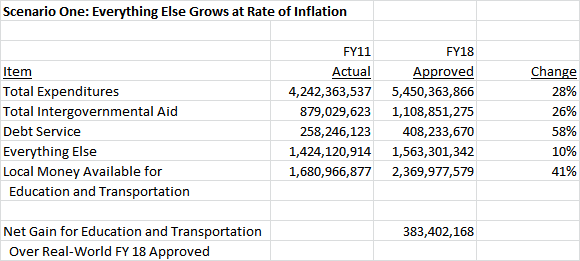
In Scenario 1, $2.4 billion is available for education and transportation because of spending restraint on everything else.  That’s $383 million more than the $2 billion that was actually available in the real world FY18 budget.

Holding a big chunk of county government to the rate of inflation for seven straight years is tough medicine and very unlikely.  So let’s create a Scenario 2 in which the everything else category is restrained to twice the rate of inflation, or 19.5% growth since FY11.
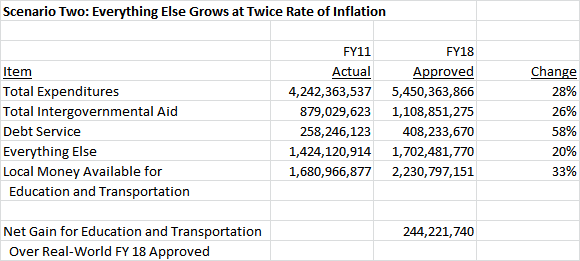
In Scenario 2, $2.2 billion is available for education and transportation, $244 million more than the real world FY18 budget.

For the sake of comparison to both of these scenarios, let’s recall that the 9 percent property tax hike was supposed to raise $140 million a year.  (It probably raised a little less than that.)  So under both scenarios, the county could have avoided the giant tax hike and still had lots of money left over for more education and transportation spending.

Yes folks, we understand the radical nature of what we are proposing – namely that liberal Democrats should deliberately and strategically restrain the growth in some forms of spending to boost growth in other spending.  This is likely to be an unpopular concept in a county that has multiple jam-packed budget hearings every year with groups of all kinds requesting money.  But here’s the benefit to concentrating on education and transportation: both forms of spending are investments that generate returns for the economy.  And when those returns boost economic growth, they generate tax revenue that bolsters the entire budget.

What is necessary to pull this off?  Simply put, this requires strategy, discipline, patience and leadership.  Without those traits, given the huge number of constituencies that want their piece of the budget, it would be impossible to focus it on education and transportation.  The natural outcome of a budget process without strategy is that everything gets funded, a tax hike follows, voters tire of it and then they pass restrictive charter amendments and vote for politicians like Larry Hogan.

So what are we going to get?  Spending on everything followed by tax hikes?  Or a budget that is strategically focused on generating economic returns from education and transportation?

Folks, that depends on your decisions in the voting booth.

Share

Maryland Politics Watch